

Building the habit of Listening.
Welcome to Building Powerful Learners Phase 2. This eight unit online programme will enable you as a teacher to expand your students’ use of learning behaviours.
The programme combines three types of action that will help you to experiment with, analyse and understand how to become more skilled in developing your students’ use of learning power.
1 Understand by using Read abouts…of which there are two types
- Essential Read …essential must read text.
- Extended Read …interesting, good to know, absorb when you can.
2 Analyse by using Find outs…tools to help you discover and analyse essential information
3 Experiment with Try outs…practical activities for you to try, check and perfect in your classroom
This unit explores the “how” of building listening.
- What are the key aspects of listening? (Essential Read about 1)
- How confident are my students now as listeners? (Find out 1)
- How could I embed building listening into my teaching? (Find out 2)
- What sort of approaches may be useful in making a start on this? (Try out 1 to 5)
- Estimate my students’ development using a detailed listening chart (Find out 3)
Structuring and using the ideas below with your students over the next month or so will enable them to extend the range of learning behaviours that they use consciously.
Essential Read about 1
Unpacking Listening
Understanding how to listen effectively is an essential skill that benefits everything from family life to business. It’s one of the most critical skills for working effectively in teams. Hearing and listening are different. Whereas hearing is a automatic and effortless process when sound waves strike the ear drum and cause vibrations in the brain, listening is about the brain giving those sounds meaning. It’s unnatural, and it requires effort. There’s all sorts of faulty listening. Sometimes we fake it or pretend to listen; sometimes we only respond to the remarks we are interested in and reject the rest. Sometimes we listen defensively and take innocent remarks as personal attacks. Or, we listen to collect information to use to attack the speaker, or we avoid particular topics, or we listen insensitively and can’t look beyond the words for other meanings, or we turn the conversation to ourselves. So, listening is indeed hard and requires effort. To be a good listener you need to be able to listen for information, listen to judge the quality of the information, and listen empathetically to build a relationship and help solve a problem. When looked at from these diverse angles growing Listening moves well beyond encouraging a student to ‘do good listening’.
A well formed Listening habit involves being ready, willing, and able to:
- Be genuinely interested in other people and what they are saying;
- Focus on the current moment, being attentive and responsive to visual cues and atmosphere;
- Notice subtle details and nuances in what is being said;
- Know when to make well-judged interventions to elucidate, probe or challenge;
- Manage distractions constructively;
- Be comfortable with silence and attend actively to what is being said.

Extended Read about 1. Understanding Listening ⬇️
The learning behaviour known as listening
Empathy and listening are core skills. We bracket them together because listening is the main medium through which empathy is generated and communicated. Students can quite readily be coached in the art of being a good listener, and can be given games and exercises that help them develop the ability to hear what someone else has said and, if necessary, play it back to them. Teachers sometimes complain that students will not listen, either to them or to each other; but the habit of listening can be cultivated in most classes inside a term. The most powerful way to do this is for the teachers to model good listening.
Extract from Building Learning Power. Guy Claxton 2002.
Re-find out 1
Focus on the listeners in your class.
The listening progression chart should give you a fairly clear view of the listening behaviours and how your students do, and do not, currently exhibit them.
- The majority of students may well display a similar set of positive behaviours (ie the majority may be in the purple or blue phase)
- You will also be conscious of some students who still lack positive behaviours (ie they are still firmly rooted in the grey/lacks phase of the progression chart)
- But some students will appear to have made general progress even in learning behaviours not spotlighted earlier.
The chart alongside shows how listening grows. Column 1 identifies the 6 phases of development, column 2 describes how the skills and behaviours may grow over time, column 3 shows the self-talk; what students may quietly say/explain to themselves at each phase of development.
A word of warning.
While you may be tempted to focus your efforts on the majority for greatest impact, you’ll need to take care not to do so at the expense of your ‘grey’ students, as these are your potential underachievers in the future.
What to look for.
In Try Outs 1 to 5, look out for teaching ideas that you think will have the greatest impact on your particular group of learners. Don’t attempt to try all of the ideas – better to do a few thoroughly than to adopt a scattergun approach.
Growing listening; a trajectory of developing behaviours, skills, attitudes and self-talk
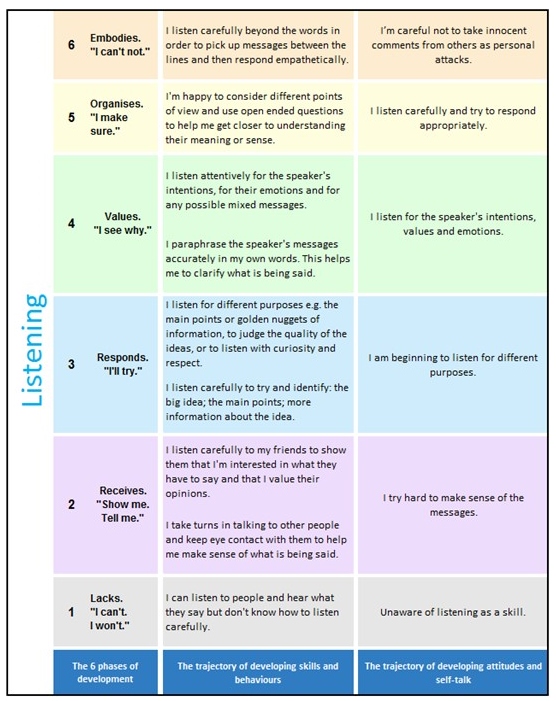
Which phase have most of your students reached now?
Download as a pdfFind out 2
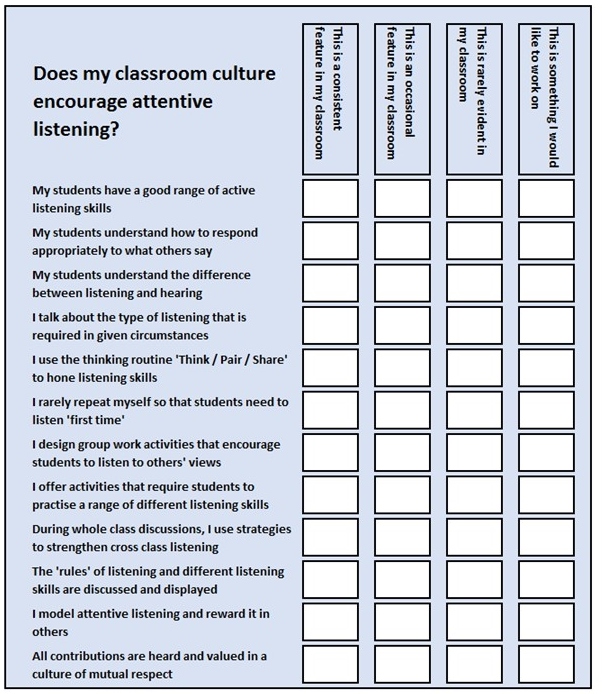
How much does my classroom culture encourage Listening?
Culture is the curriculum of the classroom, frequently hidden from the external observer, but always all evident to learners. It is the minute by minute, hour by hour, day by day way that learners come to understand their role as a learner. Culture is your enacted values in the classroom – what you do and what you do not do, what you say and do not say, what you believe and do not believe, what you value and do not value.
Here is a selection of features that might begin to shape the emotional climate of your classroom to encourage listening.
Download and print a copy.
Reflect on your current classroom culture.
It’s worth noting that the list is made up of the four action types you first met last year in the Teachers’ Palette (Unit 2);
- ways of giving students more responsibility for their learning
- the sort of language you might use to stimulate listening
- ideas for constructing lessons to build listening
- ways of celebrating listening
Ask yourself which of the features of the listening-friendly classroom are:
- already a consistent feature of your classroom?
- an occasional feature of your classroom?
- rarely evident in your classroom?
Which of these features are you interested in developing further?
At this point it might be worth having an informal chat with some of your colleagues. Is anyone already making progress with one of the features you would like to work on? Do you have any consistent features that others might learn from? Take your completed sheet to discuss at the meeting at the end of this unit.
Try out 1
A range of little culture shifts
Have a think about your current classroom culture in relation to Listening.
Begin with the ‘stop/avoid’ box – if any of these teaching behaviours are still in evidence in your classroom it would be worth thinking through how they can be eliminated, since failure to do so will undermine the changes you are hoping to achieve for your learners
Then cast your eye over the other 3 boxes. Which ideas appeal to you? Which do you think will have the greatest impact on your students?
Now seek out teaching ideas below in Try Outs 2/3/4/5 that you can use to move your classroom culture forward.
Try Out 2 focuses on ideas for moving responsibility for listening towards learners (Relating);
Try Out 3 focuses on developing a learning language for listening (Talking);
Try Out 4 focuses on how lessons/activities can be designed to activate and develop listening (Constructing);
Try Out 5 focuses on how listening can be recognised/ rewarded / praised / celebrated (Celebrating).
Try out 2
Extend students’ responsibilities in order to build listening
Understanding facial expression
Making faces
Experiment with facial expressions, asking students to show their feelings when they:
- step in a pool of mud
- eat a chocolate
- watch a dance
Discuss whether everyone reacts in the same way. Show photos of different expressions. Discuss what the people in them might be feeling and why. Paint pictures to express particular feelings and discuss the use of colour in relation to emotional content.

Teacher talk
- What can we tell from people’s expressions?
- How might this person be feeling?
- Show your happy face
- Paint a happy/disappointed/surprised/mystified expression
- What does your choice of colours in the pictures tell us?
Two more ideas for extending students' responsibilities. ⬇️
Adopt a character to help to anchor listening
‘Adopt’ a character – real, imaginary, human or animal – who/that exhibits the best features of listening. Talk about the character until your students become familiar with its attributes. Leave the character (actual /picture) on tables when you have set a group to work on using particular learning behaviour in – numeracy, reading, writing etc., as a reminder.
Teacher talk
- What is listening all about?
- Why do we need to listen to things?
- What will help us to listen carefully?
- It’s all about looking carefully
- But is it just about hearing?

Engage students in looking for listening behaviours.
Reinforce the basics of good listening
When students are learning in groups/teams, ask them to begin their contribution with “I agree with” or “I disagree with”. This technique both ensures that they are listening to each other, and build on each others’ ideas.
Teacher talk
- How do you know that someone is listening to you?
- How will you show that you are interested?
- How might you disagree with someone sensitively?
- …and let someone know that you agree with their idea?

Try out 3
Build a learning language of listening.
Teacher talk – as a learning coach
Here are 10 ideas to ensure your students do the thinking for themselves
- What does the tone of voice tell you about the person?
- Close your eyes and let the sounds wash over you.
- Can you hear what she’s really saying?
- Listen for the main messages. Can you summarise the key points of what you’ve just heard.
- How does what he’s saying make you feel?
- Wait for your turn to talk.
- How can you help XXX to say what they are thinking?
- Do you think there’s a deeper meaning in what is being said?
- How can you show empathy for the speaker in your responses?
- Do you understand the mood and beliefs of the speaker?

Two more teacher talk ideas ⬇️
Focus your listening talk….
Listening carefully.
Try the game ‘Who said sausages?’ to help students to listen carefully . . .
Warm up with a quiet activity to help them focus on the physical sensation of intent listening.
- Ask students to move round to sit in a circle.
- Ask them to close their eyes and put their hands on their laps.
- Tell them you are going to chime an Indian bell and that they should listen as carefully as they can and only open their eyes when they can no longer hear the sound.
- Ask them to be very, very quiet so that they do not disturb each other.
- Now move on to a simple listening game.
- Student remain sitting in their circle.
- They take turns to sit blindfolded in the middle.
- Point to a student in the circle who then says “sausages.”
- The blindfolded student has to guess whose voice it is.
As they become more familiar with this game, they will deliberately alter their voices and it can be a lot of fun. Remind students regularly of the skills they are using and reward good listening! Playing this game, you may enable the class to agree some good listening tips.

Teacher talk
- Listen carefully to the voice
- Can you tell who it is
- They can only say ‘sausages’ once so you will need to listen very hard
- Was that easy of tricky?
- What was happening in your ears and brain?
- What makes it easier?
Using could be language
You may have taken up this idea in Phase 1. But it’s so important that we wanted to re-enforce its usefulness again.
Could-Be’ language encourages more genuine engagement with what is being taught; how students will question and solve problems more readily if knowledge is presented as provisional. It’s about shifting the tone to more tentative, less cut and dried. The opposite is ‘Is’ language which positions the learner as knowledge consumers where their job is to try and understand and remember. ‘Could be’ language immediately invites students to be more thoughtful, critical or imaginative about what they are hearing or reading.
For more on using ‘could be’ language, see page 69-71 in The Learning Powered School
Teacher talk
Could be language includes phrase like;
- In most cases;
- may include;
- may on occasion;
- wide variety;
- could be;
- probably;
- possibly;
- most often;
- there are other ways;
- one of which….
- some people say…
Try out 4
Build listening into lesson design
It is through learning activities that learning behaviours get a workout. Their role is to enable your students to access and wrestle with information and ideas; to help them use and understand something; to ensure their effectiveness as a learner. The ‘right’ activity helps to make new concepts more concrete. The ‘right’ activity provides insights into new ideas and subject matter. The ‘right’ activities need to be carefully chosen and, critically, linked to the learning goal.
Listening for a purpose
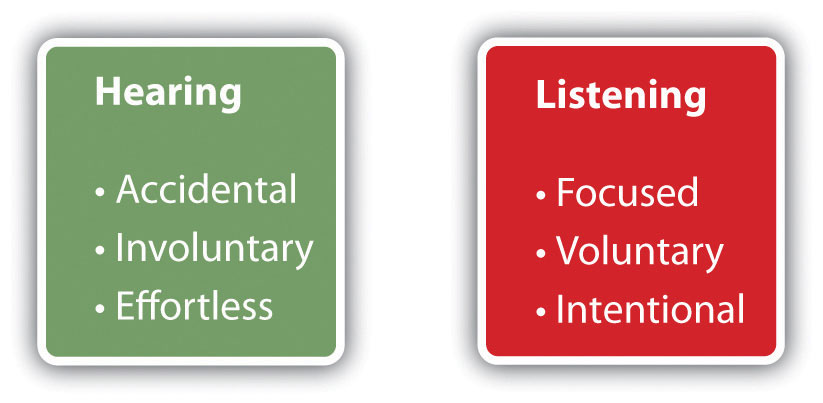
Listening for a purpose is about sharing the reason for or purpose of listening. At an early stage it’s about making the distinction between hearing and listening; saying why we are listening and what we are listening for.
With younger pupils this may just involve talking about what we do when we listen rather than just hear.
For older pupils its about being clear about the specific purpose of listening…what to listen for as part of the learning objective. For example you may give students specific questions at the start of a lesson, expect them to listen for the answers in the lesson input and require them to answer the questions later in a reflection journal.
For more sophisticated listeners.
Explain and discuss the five preferred listening styles that can be used in response to different circumstances:
- Appreciative: enjoying what is being said and how it is being said in a relaxed way
- Empathic: responding to the feelings expressed with sympathy and understanding
- Discerning: focusing on information, making notes and avoiding distractions
- Comprehensive: relating what is said to what they know already, asking questions, preparing arguments
- Evaluative: critiquing what is being said and building counter arguments
Set up ANY lesson with a specific listening purpose. For example, to discern facts; to note down new knowledge; to generate counter arguments; to critique what was said.
Use post-listening activities to evaluate students’ listening skills and their ability to transfer the use of listening strategies to other contexts.
Teacher talk
- Today we are going to see if we can spot what we do when we listen
- Listen out for the main/important ideas here
- Today I want you to listen for….
- As I go through this I want you to listen for information/facts about ….. so that you can….
Teacher talk for sophisticated learners
- There are various ways of listening. Which of these are you familiar with……..?
- Which type of listening do we tend to do in school?
- At the start of every lesson I’m going to suggest the sort of listening I want you to practice.
- When might you need to use empathetic listening?
Two more lesson design ideas ⬇️
Blend listening and predicting
- Pairs
- Ask one student to talk for 30 seconds making up anything
- The partner has to say what they think might happen next.
- Swop roles and then discuss results
.png)
Teacher talk
- Did anyone make the right prediction?
- How close were you?
- Think about what you heard. Were there any clues to help your prediction?
- What did you miss?
- What will you listen for next time?
Jigsaw listening
Form groups of students, each group tasked with listening for a different aspect of what is being said. (e.g. facts, opinions, emotions, false evidence, mixed messages etc.) After listening they agree as a group what they have heard. The groups then ‘jigsaw’ into new groupings each containing at least one member of the original groups, where they put together the different aspects that have been heard.
Teacher talk
- Form yourselves into four groups A, B, C, D.
- Group A are listen for… B for…
- It might be helpful if you note down the particular things you have been asked to listen for
- After the input each group checks out if, between the members, they have captured what they were asked to
- What did you miss? Which aspect (A,B,C,or D) proved the most difficult to capture
- Now jigsaw into new groups with an A,B,C,D member in each to put what you heard back together
- Paraphrase what you have and report back.
- What can you conclude from your discussions?

Try out 5
Build listening by celebrating its use.
Self monitoring listening in action.
Introducing a new learning behaviour every month or so is trickier than it seems.
- You might concentrate on it in say three or four lessons.
- You will bring it to the fore in your talk.
- But how do you get students to pick up all the aspects of the behaviour?
- How might you ensure they see its usefulness in lessons in general?
- How do you ensure they absorb the use of the behaviour into how they learn?
A learning mat
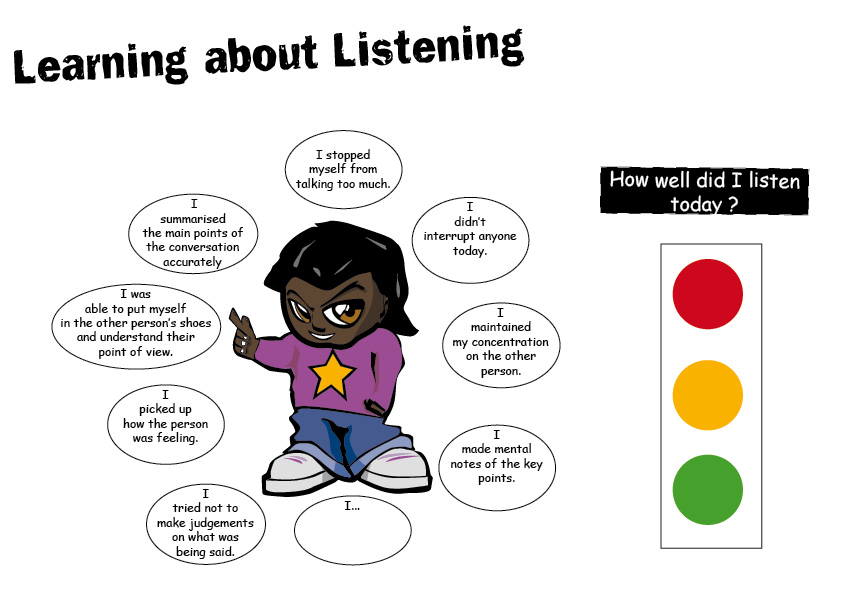
Use a learning mat for listening to ensure students monitor their own use of the behaviour.
Learning mats are usually A4 laminated sheets that show various aspects of a learning habit. Keep them on desks/tables or as part of a wall display.
Students refer to them during lessons, using them as prompts about the finer aspects of a learning habit that is being stretched. This tool helps students to be able to join in meta-cognitive talk.
Two more celebrating ideas ⬇️
Good listener prompts
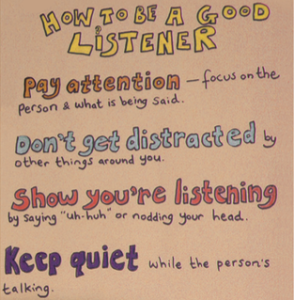
Have the students make suggestions about good listening:
- Pay attention. Focus on the person and what is being said
- Don’t get distracted by other things around you
- Show you’re listening by saying uh-huh or nodding your head
- Keep quiet while the other person’s talking
- Wait to ask a question or give comments that show others that you care about what they’re saying.
Make these into a public display and refer to them often. This is an example from a group of 9 year olds.
Managing distractions when listening
Help students to understand how to manage their distractions when listening. This of course is part of the wider Self-Regulation agenda which has been alive in schools for a while now.
Use the list below as:
- A wall display
- Adapted for a learning mat to help students monitor their focus on listening
- A focus for a discussion on listening
- A meta-cognitive listening checklist
Ways to help you focus on listening
- Put aside thoughts of what you are going to say next
- Avoid interrupting
- Know what else is on your mind and ignore it
- Face the other person so you both see and hear each other
- Ask for clarification when you don’t understand
- Focus hard on the main points
- Make brief notes of key words
Teacher talk
- Well done for not interrupting in that conversation…even though you were really wanting to say something important.
- I could see you concentrating hard on that and you picked up the main points. Great stuff.
- Have you re-thought what you were going to say? Well done for not coming in too early. I could see you rethinking your ideas.
- A good idea to make notes here to follow and remember the key points.
Find out 3
Build listening by considering it in greater depth
The chart alongside offers a deeper view of how Listening may grow.
Column one is about how we move from the convention of taking turns when listening rather than hogging a conversation, to being curious and respecting the speaker, moving on to listening actively and picking up intentions and emotions in the speaker and knowing how best to respond when people think differently, both from yourself and others, in a conversation
Column two is about self-talk; what students may be saying to themselves in growing their self-awareness about listening. We show a small flavour of self-talk thoughts that teachers can encourage students to imitate. Some relate to understanding the message while others relate to responding to the speaker. All such self-talk is important in building a listening habit.
Column three is about the ‘how’ of listening. Understanding information, being open to finding the essence of the message, the big ideas and main points; asking questions to gain more information (closed and open) and paraphrasing to check what was meant. And finally listening between the lines, looking beyond the words to find meaning.
Column four is about judging the quality of the message and deciding whether to accept or reject it. This moves from concentrating on listening, not making a judgement too early and separating the message from the speaker, ignoring information that may lead you to verbally attack the speaker. It’s important through sensitive questioning to evaluate the speaker’s credibility and check the source of the information. Conversations may then move on to examining the evidence before making a decision to accept or reject the argument/ information/idea. Finally being able to respond empathetically when rejecting an idea with your counter arguments.
The last column is about empathetic listening and helping people to sort out problems. This style of listening demands showing respect for another person’s point of view. Your role is to question in order to sort out problems, offer supportive responses, prompt the speaker to make suggestions for themselves and paraphrase their words to check understanding. It’s the hardest listening skill of all and takes a great deal of practice
Take a look at the chart and see if you can plot where the majority of your students are now.
Which aspects do they find more tricky?
How has the chart helped you to understand the development of listening more fully?
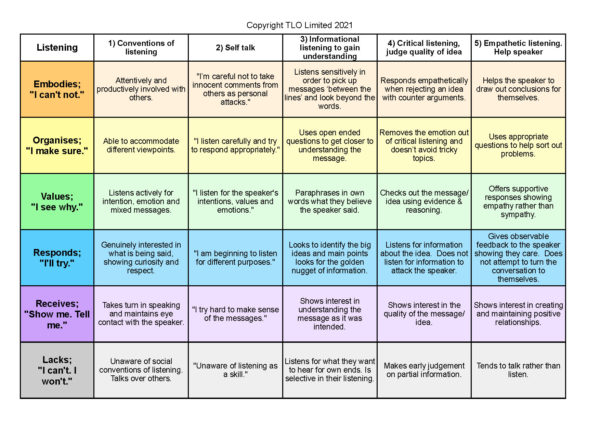
Growing listening; a trajectory of developing behaviours, skills, attitudes and self-talk
Download as a pdf
Learning together meeting (for schools that have decided that all teachers study the same unit at the same time)
Suggested meeting agenda
- Decide what you want this meeting to achieve (5 mins)
- Discuss what you have found out about students’ use of listening (15 mins)
- Re-cap and reflect on the action you have each undertaken in your classrooms (20 mins)
- Consider issues that would be beneficial if implemented across the school (10 mins)
- Review how the meeting format went (5 mins)

Learning Team Year 2 Meeting Agenda ⬇️
Item 1. Meeting Objectives. (5 mins)
Meeting objectives might include:
- discuss levels of listening displayed across the school
- share and learn from what we have each tried in our classrooms;
- feel confident about taking forward ideas from online materials into our practice;
- identify actions that would be more useful if everyone applied them in their practice;
Outcome. To have decided what the meeting should aim to achieve.

Item 2. Discussion about learning culture (15 mins)
Explore together your discoveries about your students as listeners;
- what did you find out about your students as listeners (Find out 1)?
- are students improving listening with age? Moving from grey to purple to blue etc?
- where did we each estimate our classroom to be in terms of its culture (Find out 2)?
- what did we each learn from Find out 2.
- which 3 are the weakest features?
- which 3 actions are our strongest?
- what surprised or baffled you?
- are there significant differences between year groups?
Outcome. A clearer understanding of students as listeners and the extent to which our classroom cultures are set up to support and develop listening.
Item 3. Explore action using the initial Try outs (20 mins)
Share and discuss the action you each took in making a start on strengthening listening in classroom practice.
- Which of the suggestions did you each use?
- Any concerns about or difficulties in putting the Try outs into action.
- Which seemed the most valid or successful?
- How the Try Outs affected different age groups.
- Ways of implementing these that we can all learn from and adopt.
Outcome. A clear picture of our interest in and enthusiasm for amending classroom cultures to support learning to learn. A feel for which are proving to be most effective and why. Would any of these culture shifts call for action on current school wide policies?
Item 4. Learning from practice (10 mins)
In relation to all the shades of practice you have been trying out, sharing, mulling over and observing, think about them now in two ways;
1. personally and 2. school wide.
Which ideas/practice stand out as:
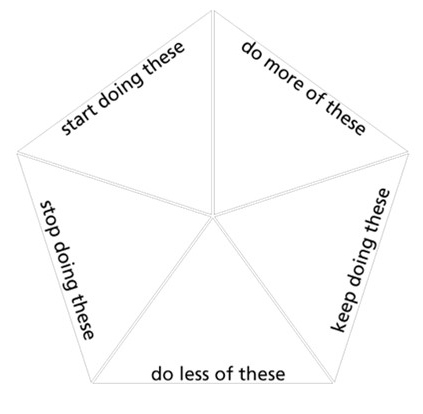
- things you want to start doing
- things you think you need to stop doing (that’s harder)
- things you want to keep doing
- things you want to do more often
- things you want to do less
Outcome.
- At this stage it’s essential to note ideas arising from this discussion using 2 pentagon diagrams;
- one for each team member personally and
- one for decisions/suggestions that are school wide.
- Ensure that your school/group wide pentagon is shared with senior leaders.
Item 5. Evaluate team session. (5 mins)
- Did we achieve our objectives?
- Are we comfortable with what we are trying to achieve so far?
- Any concerns at this point?
- Next meeting date and time.

Feedback proforma (for schools that have decided that teachers can study the units in any order)
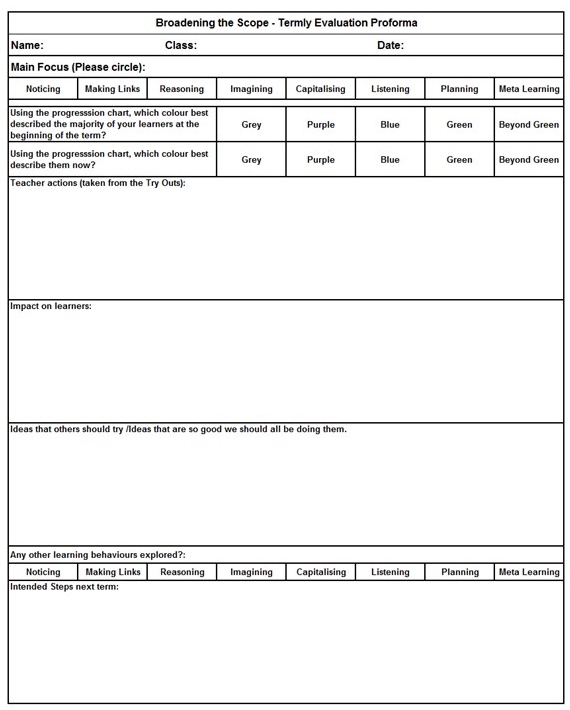
To share your experiments with others and to enable senior leaders to maintain an overview of developments, please complete this proforma termly and hand it to the Building Powerful Learners coordinator.
To give you a flavour, an example of a completed proforma is in the Noticing unit. Click below to download and print a blank version for yourself.
Download a blank proforma
Comments are closed.