

| Return to ‘the professional learning power game route map’ | Relating for Learning | Talking for Learning | Constructing Learning | Celebrating Learning |
|---|
Welcome to the Route Map into Phase 2. The Professional Learning Power Game.
You are now in the contents page of the Route Map resource.
A. The intention of this resource is to:
- help you to navigate the next stage of the ‘learning power journey’
- enable you to take stock of where you are now on your ‘learning power journey’
- reinforce the nature and purpose of building your students’ learning power
- introduce you to developing a much broader range of learning behaviours
- point you in directions to find appropriate practical ideas to take things forward
- offer tools to help you track and monitor your continuing journey.
B. The best way of using this Route Map is to..
- remind yourself why you are developing your student’s Learning Power. See sections 1.2 and 3 below.
- assess where your practice is now by looking at sections 4a and 4b below.
- find out about the range of Phase 2 unit titles. See section 5 below.
- discover the detail of how units are structured and how deep the learning behaviours charts go. See sections 6 and 7.
- learn about a unique unit in Phase 2, Reviewing our Progress, that offers tools to review and evaluate your progress in terms of classroom culture and student progress. It’s there to ensure to don’t fall off the track. See section 8 below.
- WHEN you have discovered where you are now and what you think you want to look at next MOVE INTO THE SECTIONS SHOWN IN THE GREEN STRIP ABOVE.
1. A quick reminder of…what is learning power?
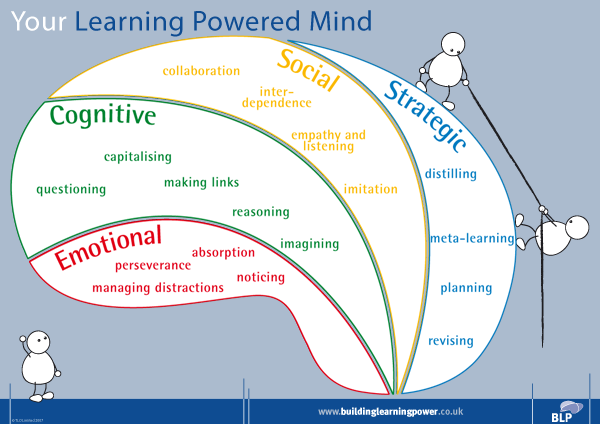
We used to think that the ability to learn was fixed at birth; some people found learning easy, others found it difficult. But we now know that learning is learnable, that the mind is improvable, that intelligence is the sum total of one’s habits of mind, and of course those habits can be changed and improved.
Research pointed out the key psychological behaviours that were judged to be of the highest value in helping people to learn and thrive in a complex world. The good thing is that these behaviours are inherent in all of us, aren’t fixed at birth, or when we leave school, and can be developed by everyone regardless of ‘ability’, social background, or age. In other words if we enabled students to become aware of and then develop and build their various learning behaviours they would naturally improve and thrive as learners.
Turning this bundle of learning behaviours into, potentially, real live learning habits is known as developing learning power, and there are no limits to extending our learning power.
A person’s Learning Power, this bundle of behaviours turned into habits, determines, even dictates, their propensity for change, influencing and underpinning their performance throughout life
The map of key learning behaviours that can be turned into learning habits.
2. Why are we building learning powered learners?
Another quick reminder of the big ideas
How you learn changes over time and responds to the qualities of the learning environment, be that in the classroom culture, in the comfort of a home or in the workplace. As environmental circumstances change, they can have either a constructive or a destructive influence on developing, or ignoring, the potential of learning power.
As understanding of the nature of learning grew building learning power formed as an approach to helping young people to help themselves become better learners. It went beyond the ideas of metacognition and self regulation by trying to build a child’s learning character…how they… approach, take part in, maintain interest in, make meaning from and reflect on…learning
It’s about creating a culture in classrooms that systematically cultivates that range of learning behaviours into learning habits; enabling students to face difficulty and uncertainty calmly, confidently, collaboratively and creatively.
This Learning Power approach refocuses schools on preparing young people better for an uncertain future; to educate not just for exam results but for lifelong learning; to thrive in the increasingly turbulent twenty-first century. Students need to have learnt how to be tenacious and resourceful, imaginative and logical, self disciplined and self-aware, collaborative and inquisitive.
Learning for the tests of life not a life of tests

3. What are the big ideas that drive our practice?
Another quick reminder.
To prosper in the learning age, we need to learn to embrace uncertainty with robust self-confidence, and approach the future with curiosity and optimism. The Building Learning Power approach offers a clear direction for this journey by;
- Recognising that effective learning depends on qualities of attention and emotional reactivity; of thought and imagination; of reflection and self-awareness; and of sociability and relationships.
- Viewing teachers as learning-power coaches who explore and extend students’ learning-to-learn behaviours.
- Infusing the development of learning habits and skills into curriculum content.
- Developing a language for learning throughout the school.
- Attending to the kind of language used to frame activities and comment on learning.
- Encouraging learning challenges that students can get their teeth into — real, interesting and hard.
- Seeing education as a preparation for a learning life, knowing that this can be pursued quietly, without a revolution, and that involves;
- getting the culture right
- making students aware of the tools they command as learners
- looking for where learning behaviours are or could be in action across the curriculum
- enabling learners to monitor and evaluate their own learning.


4. Your practice now and in the future?
You may remember this chart from the beginning of Phase 1. It shows the big ambition of that phase of the programme and distils what it’s all about.
4a. The chart for looking at what you’ve done.
- the cells in yellow capture what leaders, teachers and learners will have been doing:
- tracking the growth of learning behaviours;
- adapting classroom cultures to strengthen 4 key learning behaviours;
- adapting how the curriculum is delivered in order to build 4 key learning behaviours;
- experimenting with and expanding the number of learning behaviours consciously being used by students;
- the blue boxes capture the outcomes such changes teachers could make to classrooms; cultures and curriculum delivery.
- the green boxes capture the anticipated outcomes for people; leaders, teachers and learners.
Firstly take a look at the yellow boxes in the middle and ask yourself…did all this happen? Did we do what was recommended? Anything missed out? Anything a bit rushed or short changed?
Next take a look at the blue cells to the far right. These give an indication of the anticipated outcomes for each aspect of the first phase of the journey from;
- discovering students learning behaviours
- to shifts in classroom cultures
- to early shifts in lesson design accommodating learning behaviours
- to the beginning of you consciously using a much broader range of learning behaviours across the curriculum.
Have these things happened? Did you do what was recommended? Anything a bit rushed? Anything missed out altogether? How would you rate its success? Which were the hard bits? What would you change if you were doing it again?
Finally take a look at the green cells at the bottom. Do you think your students are improving as learners? To what extent are they using the 4 foundational learning behaviours? Are you managing to keep a track of any of these changes? What are you most pleased about? What do you think you might need/want to do next? Is there anything you think you may need help with?
Phase 1 Playing the Learning Power Game….THE BIG AMBITION

DOWNLOAD BUTTON PLEASE
4b. Charts to help you look forward
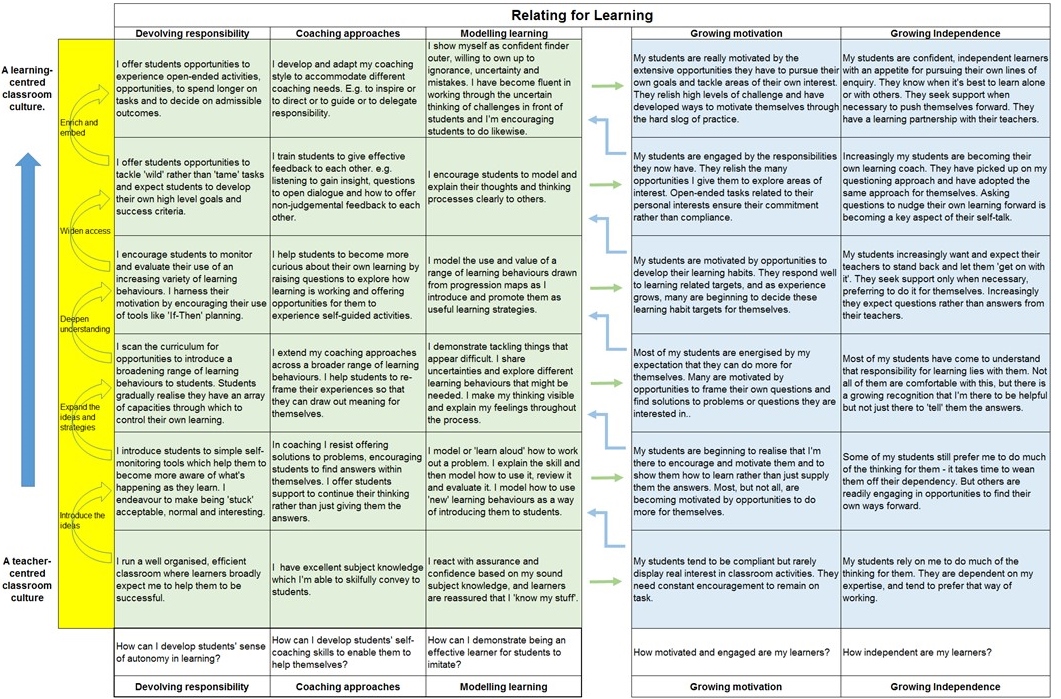
In Phase 2 we offer progression charts for teachers designed to give you a sense of your own journey as a learning power coach. In witnessing this development journey in teachers we found it was more complex than you might think and needs to keep student growth in mind!
Teacher growth is coupled to student growth
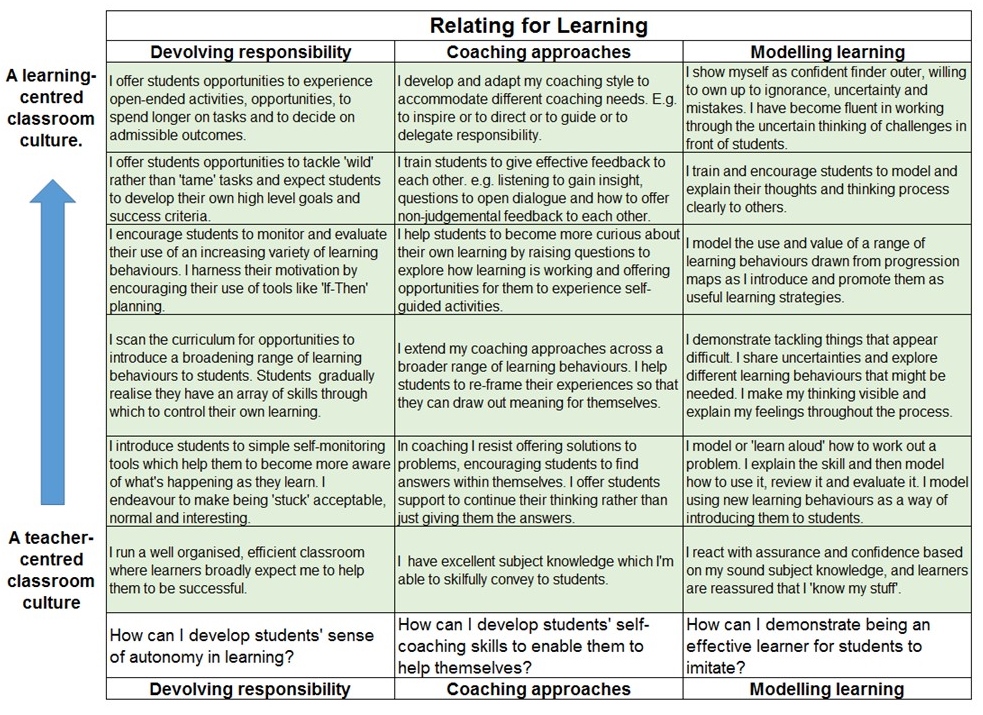
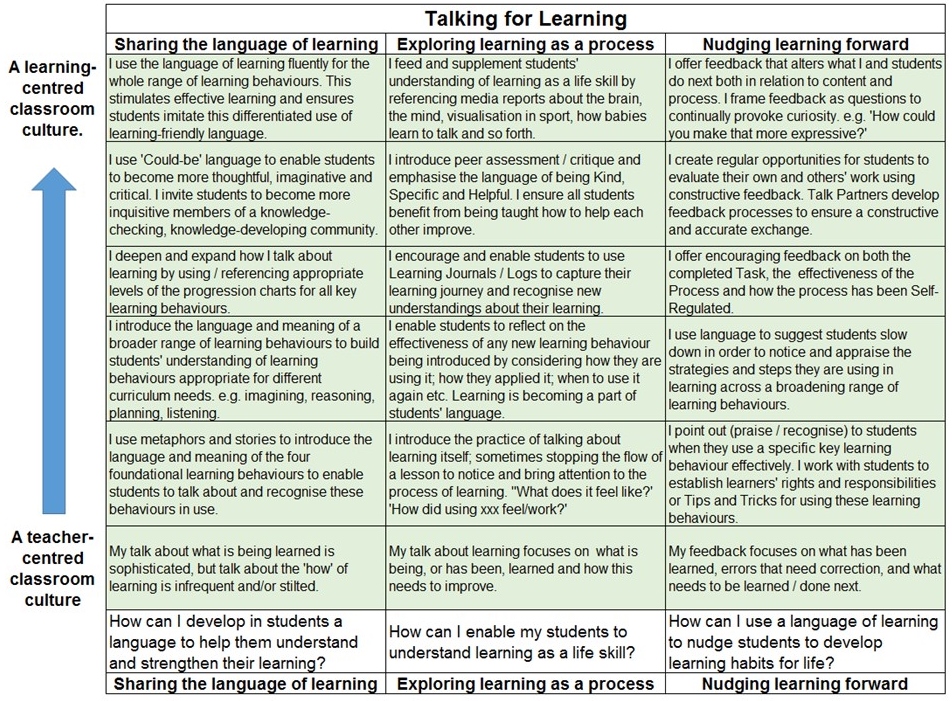
Our teacher growth chart (green) is progressive – each step builds on the preceding one, each step needs to be attended to before further ones are attempted. But in making this progression teachers really need to carefully consider where their students are as learners – they really do need to;
- start from where students are,
- rather than
- from where they themselves want to be.
This is because your practice as a teacher will be constrained by your students’ dispositions, skills and understanding of their learning. So you will also find some broad learner growth charts (shown here in blue) linked to teacher growth charts (green). We advise you to shape your practice one step ahead of your learners’ practice, then wait for your learners to ‘catch up’. Students need time to discern, understand and act on the changes you are causing them to make.
A classroom where a teacher is performing at or near the top of their growth trajectory while their learners are languishing near the bottom of their growth trajectories would be totally inappropriate and ineffective – there’s little point in changing teaching practice if it doesn’t impact on learners’ dispositions. Where learners sit on this ‘blue’ trajectory is a useful indicator of the presence and impact of the ‘green’ teacher interventions. Something is amiss if there is not a fairly close match.
All following sections of this Route Map are built around these GREEN teacher growth charts

toggle title
To what extent has my teaching style changed and what’s next?
To what extent has my learning talk developed and what’s next?
To what extent have my lesson plans developed and what’s next?

What do I now recognise, praise and celebrate and what’s next?

5. Where is there to go?
The range of Phase 2 Units.
Phase 2 ‘The Professional Learning Power Game‘ contains all the key elements needed to deepen the values, language and activities for strengthening and building students’ learning character.
Phase 2 has 13 units that can be used in any order and for a range of purposes.
Some schools will want to plan how best to use this material across the next year or so. Other schools may leave how the material is used in the hands of each individual teacher. PLEASE CHECK which of these possibilities pertains for you and your school.
4 units which deepen the four behaviours already introduced in Phase 1.
- Putting perseverance into learning
- Putting questioning into learning
- Putting collaboration into learning
- Putting revising into learning
A further 8 units which broaden the range of learning behaviours, already briefly introduced in Phase 1. Unit 4.
- Putting noticing into learning
- Putting making links into learning
- Putting imagining into learning
- Putting reasoning into learning
- Putting capitalising into learning
- Putting listening into learning
- Putting planning into learning
- Putting meta-learning into learning
And one unit that offers some tools to review and evaluate progress in terms of classroom culture and student learning behaviours. This unit can be used as often as required.
- Reviewing our Progress

6. How Phase 2 units are structured
E.G. Putting Imagining into Learning.
Each unit is designed to guide teachers through a process of building the habit in students. Sections 1–4 consider:
- Imagining and how it develops. Includes an Imagining Progression Chart. Unpick the meaning of Imagining, how it develops over time and use the Imagining chart to consider where your students are now.
- Taking Imagining into classroom culture. Includes effective classroom activities. This section offers numerous suggestions to develop a learning-friendly culture and build students’ learning skills. It includes ideas for lesson starters and quick wins; classroom activities; learning reflection tools; ideas for the appropriate learning language for each phase of progression in Imagining.
- Blending learning habits with content. Example dual focused lesson. This section suggests a series of questions and steps you might use to design imagining into lessons. Here we look closely at how to blend improving students’ Imagination with the content you have to teach. The section covers: The six principles behind any learning powered lesson; Big questions to ask about lesson design; Lesson planning in action: an exemplar Imagining-focused task.
- Team reflection and planning. Sharing the impact of classroom experiments with colleagues and plan what needs to be done next. It gives a skeleton plan for the Professional Learning Team session and includes downloadable enquiry questions and planning formats. In team sessions staff are invited to share the impact of their experiments with colleagues, discuss the online materials, and plan how they might use these to change their practice.
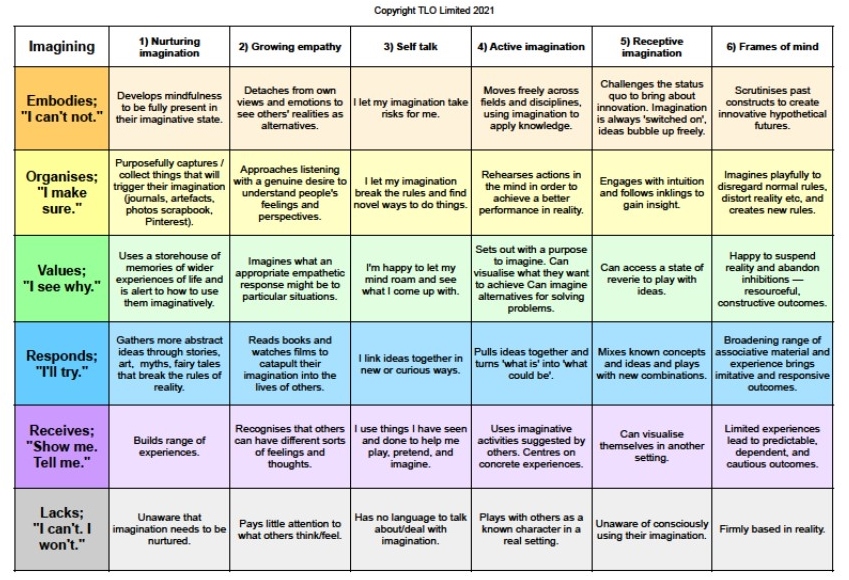
A richer view of imagining
7. Deepening learning behaviours
If you take a hard look at perseverance you’ll notice it’s about keeping going in the face of difficulties; channelling the energy of frustration productively; knowing what a slow and uncertain process learning often is. A mature learner understands that real learning requires effort and persistence, relishes opportunities to struggle with challenge, and believes that with effort they can become a more effective learner. This captures what we want all learners to become so there’s more to it than you might have thought.
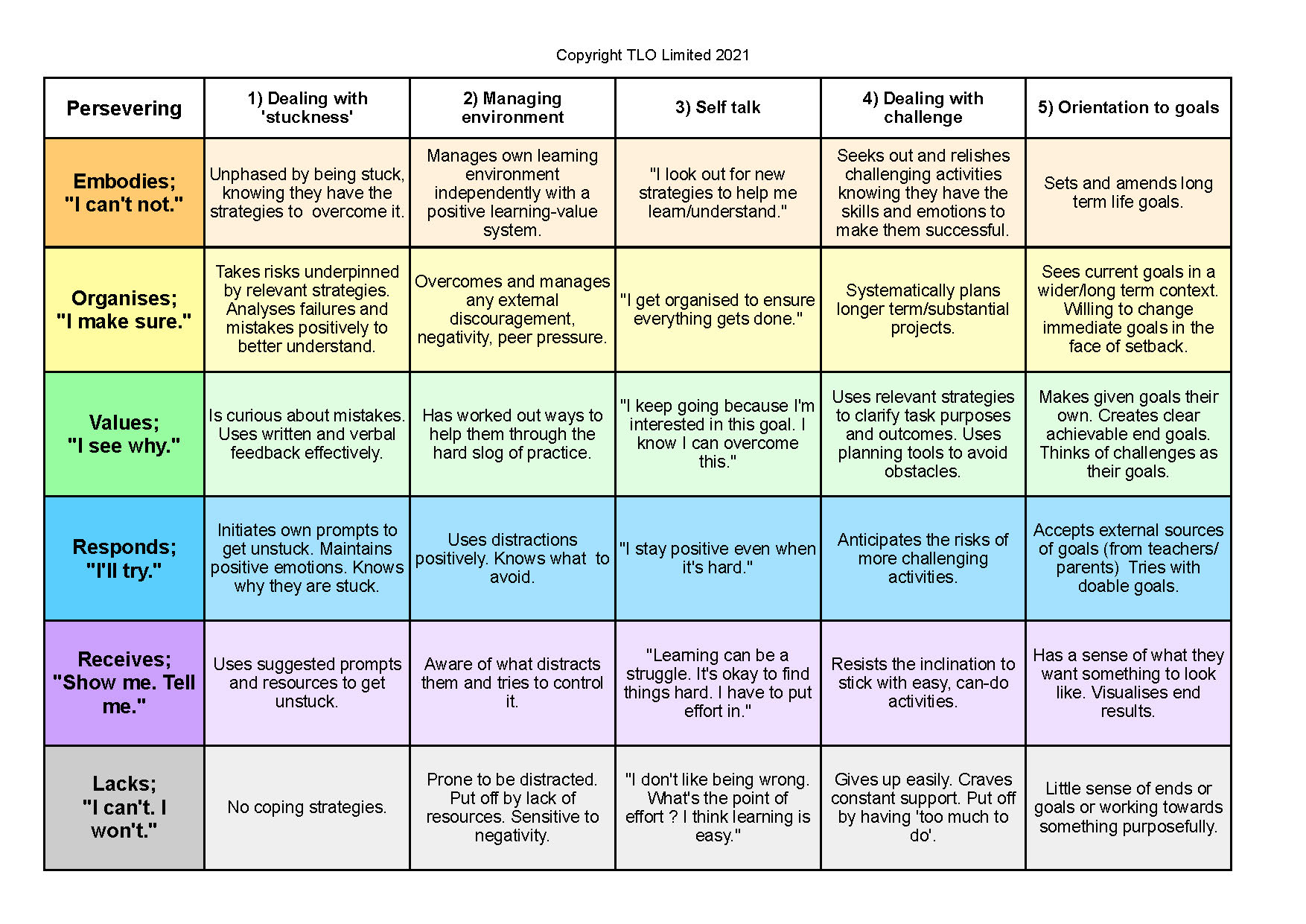
The charts in Phase 2 endeavour to pick up this deeper level of detail; take perseverance for example….
Take a look at the chart…
Perseverance is about the way we stick at things even when they are difficult. It’s one of the most useful but neglected learning behaviours. What makes us able to persevere more and more usefully? We think several things come into play here. How you are willing and able to deal with being stuck, how you are able to manage distractions and manage the learning environment, how you relate to a challenge and whether you are influenced by goals be they your own or imposed by others. All these things contribute to being able to persevere. And of course there’s your own little voice of self-awareness: what you say to yourself and how this influences your beliefs and values.
Being perseverant grows and builds when it’s nurtured and supported. Furthermore, being perseverant involves gaining control of a range of linked skills and emotions.
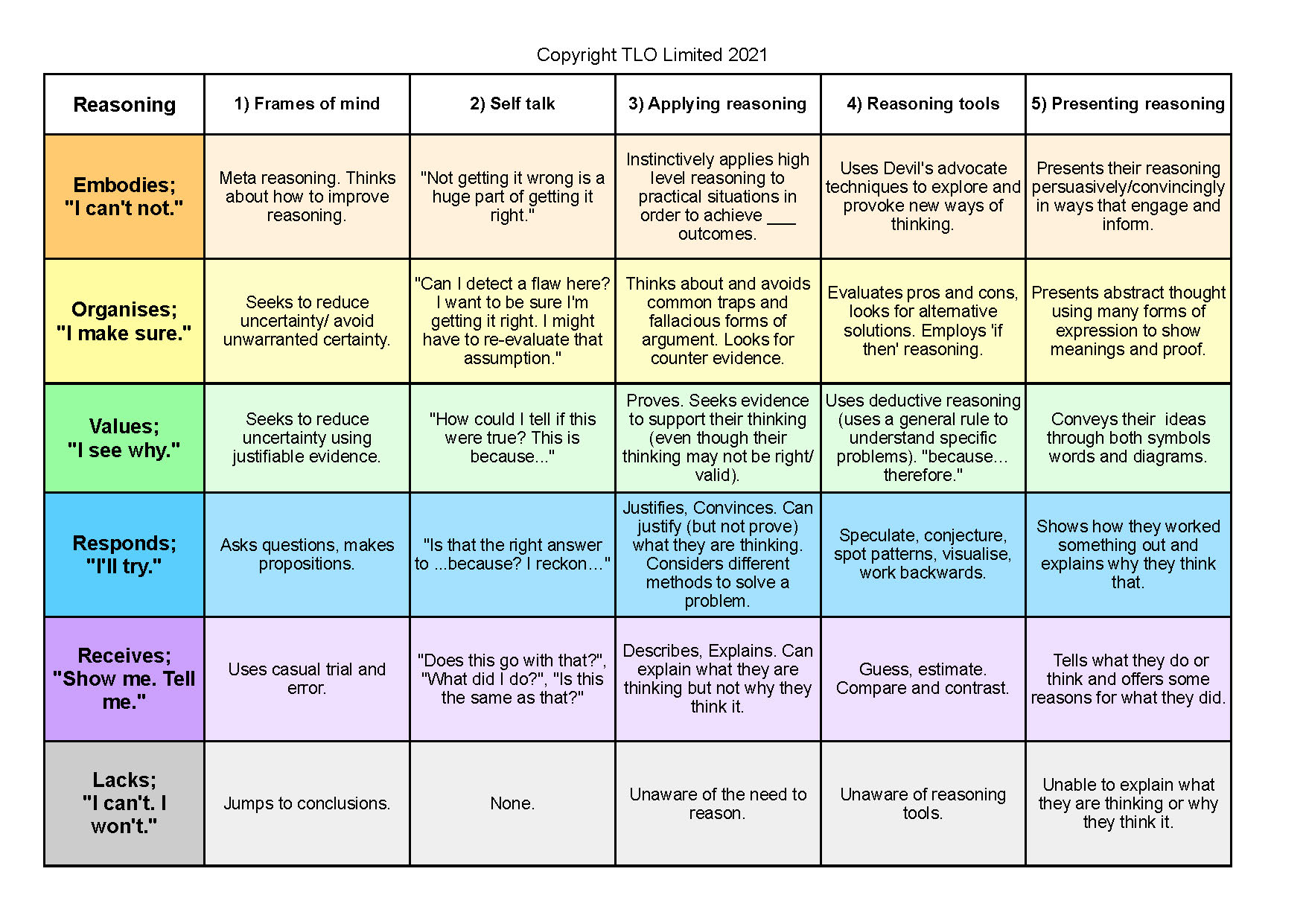
The other 11 learning behaviours in phase 2 have their own, richer progression charts. These guide teachers to better understand and coach the richer states and stages of development.
A deeper look at learning behaviours.
Here’s perseverance
And here’s Reasoning
8. Keep your progress under review
Phase 2 has a one off unit designed to enable teachers, teams or the school more widely to review their progress so far. You can use it at any suitable point in the programme.
The unit offers a rich variety of tools help to review progress in developing a learning culture in classrooms. This review provides information to guide the approach in the next phase of building students’ learning powers. Sections 1–4 help teachers to consider:
- Reflecting on their changing practice. Looking at what they have done and how their classroom has changed. This section answers the question “How far have we come?”
- Giving pupils a voice. Finding out how their students have benefited. This section answers the question “How well have our students taken to this way of learning?”
- Learning with and from colleagues. Learning from learning walks and observations. This section answers the question “What are the variations on the theme and what can we learn from these variations?”
- Team session: Learning together. Putting their heads together and thinking “What next?” These team session answers the questions “How are we doing, how are our students doing and where do we need to go next?”

title
subtitle
lhs text
rhs image
title
subtitle
lhs text
rhs image
title
subtitle
lhs text
rhs image
Comments are closed.