

An overview of this phase 3 unit: Building Coherence – Curriculum and Lesson Design
This unit is designed to be undertaken by a small team of teachers with a view to building a strategy for introducing a whole school approach to tracking the growth of learning power for all students.
The unit should take around 6 months to complete if you follow these suggested timings:
Section 1 explores the rationale for tracking learning power;Sections 2 and 3 are reminders of the tracking ideas introduced in phase 1 and the learning behaviours introduced in phase 2 respectively;[Expect these 3 sections to take a month to complete.]Sections 4 and 5 is where the unit really gets underway;In section 4 you are invited to dip your toes in the water and explore your own learning profile and tentatively create profiles for a couple of your own students;Section 5 challenges you to create learning profiles for all of the students in your class;[Expect sections 4 and 5 to take at least one month, maybe 2.]Section 6 is the first team meeting. It is designed for team members to share their students’ learning profiles. Schedule this once all team members have completed section 5 – this will likely be sometime in month 4;Section 7 supports your preparatory thinking in advance of the final team meeting in section 8. Aim to complete these sections in months 5 and 6. Be prepared to allocate some time after the section 8 meeting to finalise your team recommendations in writing.
1. Why it is important to track students’ learning growth
Tracking tools sometimes have a bad press. Too often assessments are summative rather than formative, too often used to label, too infrequently used developmentally. Some are little more than an administrative burden that have minimal effect on classroom practice.
The motivation to track students’ learning growth is not rooted in a desire to identify ‘Grey phase Perseverers’ or ‘Green phase Collaborators’ – rather it is about capturing individual students’ learning strengths and relative weaknesses so that:
teachers can tailor their interventions to target and support the growth of learning behaviours;students can become aware of their own learning behaviours so that in time they can take control of their own learning growth.
It is part of a whole school approach to bringing learning out of the shadows, to helping teachers and students to value how they learn at least as much as what they learn.
In addition, it offers schools an alternative metric for success, a coherent approach to monitoring the impact of learning related initiatives and, most importantly, the rich information necessary to support all students to become ever more effective learners.

2. How you tracked growth in Phase 1
In Building Powerful Learners Phase 1, Unit 3 . . .
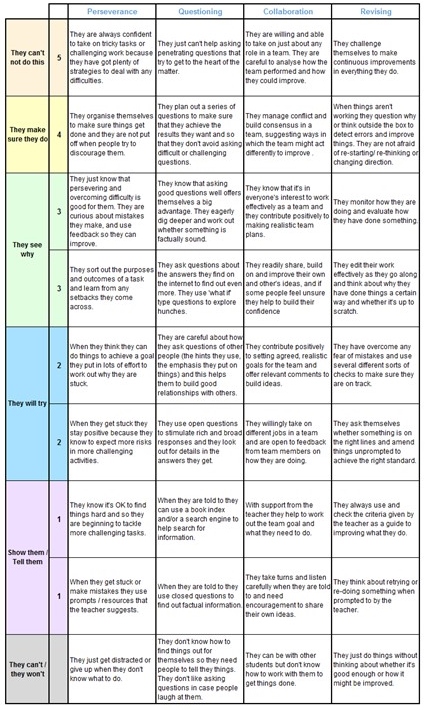
You met the progression charts for the four key learning behaviours (Perseverance, Questioning, Collaboration, Revising), and were invited to ask yourself:
What sort of learning characteristics do my learners have?What sort of learning characteristics do my more successful learners have?Which characteristics or behaviours do my struggling learners have?Which learning behaviour contributes to the success of most of my learners?Which learning behaviour is used less than any of the others?How do the answers to these, and similar questions, apply to my teaching and the curriculum?
You considered your own growth in relation to these 4 behaviour trajectories and subsequently created Learning Profiles for four students in your class. If you still have those learning profiles it would be a good idea to retrieve them as a reminder. Alternatively you can just revisit the relevant parts of Unit 3 here:
Now in this Phase 3 unit we explain how to mirror that process, but this time:
in relation to 12 learning behaviours;and in relation to all learners in your class;and eventually to all learners in your school.
3. Adding a further 8 learning behaviours.
The purpose of this first team meeting is to give team members the chance to: The prospect and potential of Here we outline the leadership considerations that will be necessary for the successful implementation. Considerations include: Shared Values; Skills; Staff; Systems; Structure; Style; and Strategy. It’s worth taking your time to reflect on all seven aspects – it is only when you’ve addressed all seven will you have laid the foundations of success. This final team meeting is designed to agree recommendations around how the school should introduce If the team does not already contain a senior leader, we suggest that at least one should be invited so that they can hear your suggestions, probe your reasoning, and understand the implications of moving to a whole school approach. lhs pic lhs pic lhs pic lhs pic lhs pic lhs pic lhs pic lhs pic lhs pic lhs picTo help schools make the collection of learning data more manageable we have selected 12 of the original 17 characteristics for you to take a closer look at over time. The 12 we have selected are the original 4 (Perseverance, Questioning, Collaboration, Revising) plus the 8 further learning characteristics (Noticing, Making Links, Reasoning, Imagining, Capitalising, Listening, Planning and Meta Learning) that were introduced in phase 2.This section offers glimpses of these fascinating learning characteristics and how they grow under the influence of a learning friendly environment. Understanding more about them will increase your confidence to collect valid data about how these characteristics are growing in your students.Read more about these 12 learning behaviours and how they grow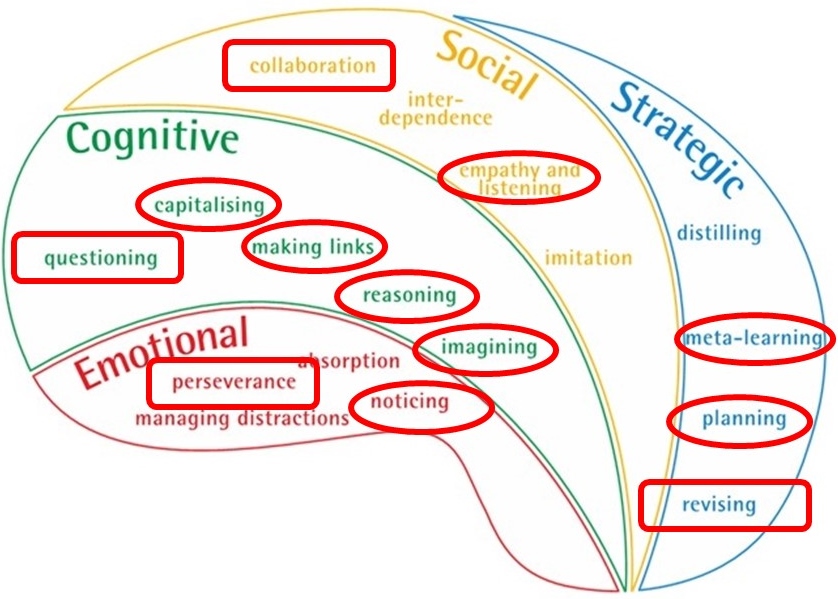
4. Up close and personal with your own learning behavioursThis section gives you opportunities to…discover and understand what ‘good learners’ tend to be like in terms of the 12 learning behaviourslook at yourself through a learning behaviour lenstentatively consider the learning behaviours of a couple of studentsremind yourself of how the 12 learning behaviours progressPerhaps the best way of really getting to grips with all of these 12 learning behaviours is to take a personal look at yourself as a learner and the learning behaviours you tend to use. What might your learning profile look like; where are your strengths, what are the behaviours you find tricky; which would you like to improve?Having got the idea we then invite you to look at just a couple of your students; a low and a high attaining student. This should give you a glimpse of how easy or tricky it is to generate a learning profile for an individual student.Create your own learning profile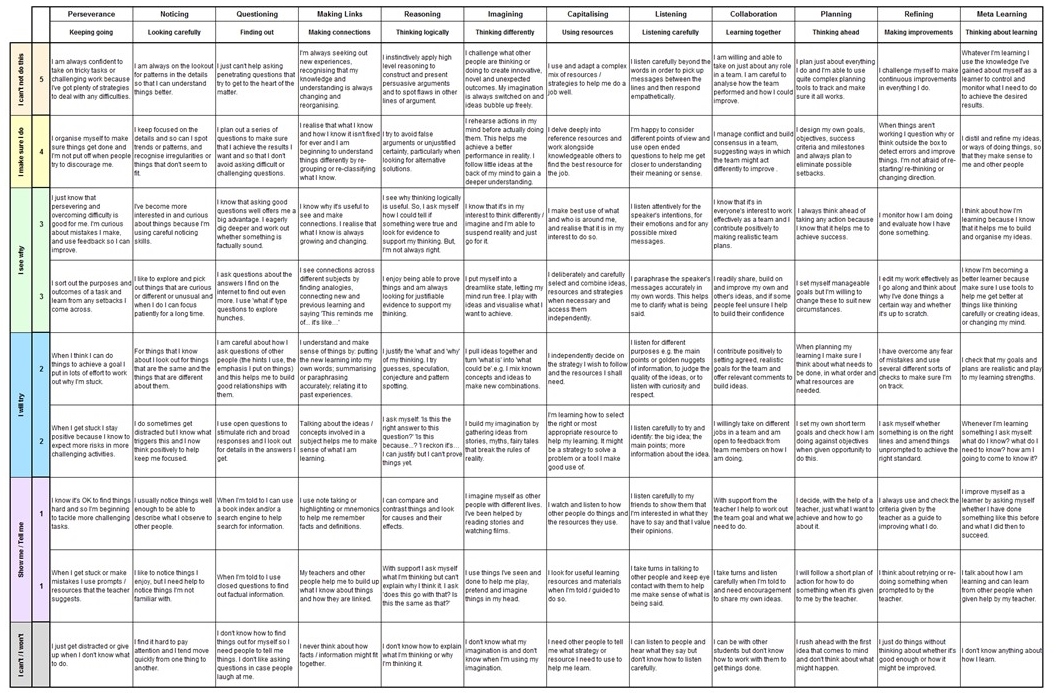
5. Creating learning profiles for your own classThe learning profiles you began to explore in section 4 have the power to reveal interesting and vital information about students’ learning.This is the point at which you do the ‘heavy lifting’ and create profiles for each of the students in your class. Take your time over this – it is the vital preparation for the upcoming team meeting when you will compare and contrast your own class profiles with others.The first team meeting should be scheduled around 2/3 months into your engagement in Building Coherence, and you should aim to complete this section in advance of that meeting.
6. Team Meeting #1
Comparing and contrasting our learners’ profilesshare their experiences of creating student learning profiles;explore similarities and differences;begin to frame some possible hypotheses about what the profiles reveal;consider whether the completed profiles offer any evidence that learning behaviours are progressing as students move through the school;pave the way for the next team activity – beginning to think about how student learning profiles might be integrated into whole school practices.
7. Considering the issues around whole school implementation
developing learning profiles as a whole school strategy will inevitably raise all manner of important questions. There will be strategic, leadership and management questions that deserve consideration before leaders can make a reasoned decision about the implementation.
8. Team Meeting #2
Framing our proposed strategy for whole school implementation
student learning profiles across the school, and to foreshadow some of the potential consequences of so doing.Title
Title
Title
Title
Title
Title
Title
Title
toggle title ⬇️
Title
toggle title ⬇️
Title
Comments are closed.