

This resource is designed to help you:
- make the most of the up-coming staff training about building your students’ learning power
- come to the training having done a bit of preparatory thinking
- feel prepared to become engaged in and enjoy our first online training session
- be confident to take on the post session tasks that you need to try out before session 2 (see 3 below)
- find out more about the programme you will be taking part in over the coming 12 months (see 5 below)
1a.Pre-session preparation: the basic research.
The slide below summarises the blend of research that has contributed to the development of dispositional learning.
Shaped by research
Several strands of research have strongly influenced the development of Building Learning Power.
Professor Mihalyi Csikszentmihalyi’s concept of flow, a state of focused attention in which one is wholly engaged in learning has been important in developing aspects of BLP.
Lauren Resnick has been a pioneer in advocating the central importance of habits of mind as the core component of what it is to be intelligent.
Professor Martin Seligman’s concept of ‘learned helplessness’ has done much to shape understanding of what it is to be resilient and resourceful in learning.
Art Costa’s work on ‘habits of mind’ (HoM) is the closest cousin to BLP, offering advice to teachers about structuring their teaching around a list of 16 ‘habits of mind.

1b. Pre-session preparation: a film to watch.
This short introductory video will help you to tune-in to the what, why and how of building powerful learners.
Although this video was made some years ago its messages remain true. Headteachers, teachers and students talk about the impact of changing the classroom culture to give students a more genuine role in the learning process. Take a few minutes to absorb the messages, it will help you tune into the training session.
1c.Pre-session preparation: a quiz to try
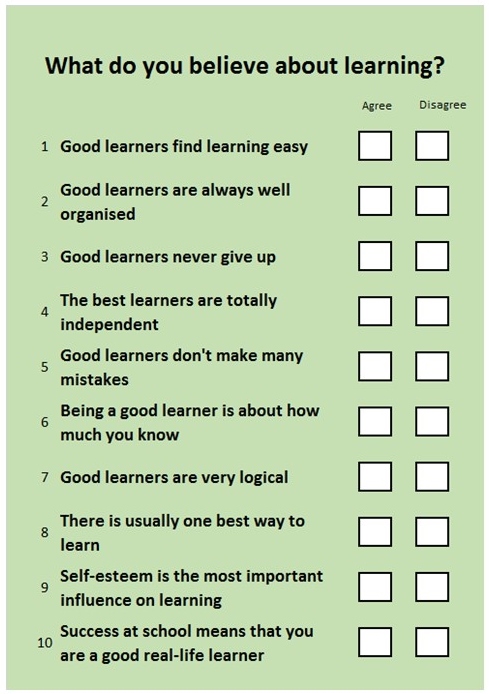
Questionnaire
The best place to start working on learning power is with yourself ,so this brief questionnaire is about what you believe about good learners. Mull over the statements and indicate whether you broadly agree or disagree with them.
Things to think about;
- Think about how you teach in relation to each statement.
- To what extent does your teaching style embody what you say about good learning?
- Do you (sometimes) act as if you believed something different from what you say you believe?( This can be a bit uncomfortable!)
1d. Pre-session preparation: a booklet to print
The at-a-distance training session is anything but just a lecture. It’s interactive in nature calling on you, as a participant, to engage in activities and discussions. The resource book captures the story of the session. It contains many of the presentation slides as well as important diagrams and interactive activities. It will act as a memory jogger into the future.
Resource book
Please download and print a copy of the Resource Book you will need for online session 1.
Download Resource BookBring the Resource Book with you to the session with your name on it…we have found people don’t like to lose their copy when they have carefully recorded information in it.
Session 1 Resource Book
2. How the session is organised
We hope you will find the session an interesting variety of interactive activities, quiet thinking time and interesting presentations. You will be invited to take part using all your relevant learning behaviours to help you come to grips with new idea on the familiar theme of teaching and learning.
Session objectives
Our first session is designed to achieve the following objectives;
- become aware of key learning behaviours
- use learning behaviours effectively
- become aware of why learning behaviours are useful
- gain an understanding of how behaviours grow
Session Timetable
- x.00 Introduction and objectives
- x.05 What do good learners do? Activity
- x.25 The supple learning mind. Input
- x.40 What do we do when we learn? Activity
- x.05 Post session task 1 (complete for session 2)
- x.10 Post session task 2 (complete for session 2)
- x.20 Evaluation of session
- Cheerio till session 2
3 Managing in session group tasks
During this first session there are 2 group activities.
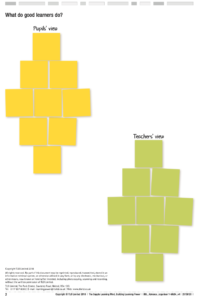
The first involves you considering what your students think good learners do, and how this may differ from their own views of learning. (20 Mins including discussion)
The second involves you looking at comic book pictures, considering clues and and putting them into an order to make a credible storyline. This task is about you applying your own learning habits to reason and imagine a solution. (25 mins including sharing solutions and the patterns of habits used)
For each of these tasks please assign a member of the group to distil the findings and report back on behalf of the group.
Gathering group feedback
Activity 1 At the end of the activity please discuss and feedback on;
- the sort of ideas your pupils have about what good learners do?
- which 3 ideas are most prominent?
- what might that imply?
- why might children have these ideas?
- what might cause/influence these beliefs?
- as teachers, how are your beliefs about learning different?
- what’s the standout difference?
- why do pupils’ views differ from yours?
- what else surprises the group?
- how might teachers’ change things?
Activity 2 At the end of the activity please discuss and feedback on;
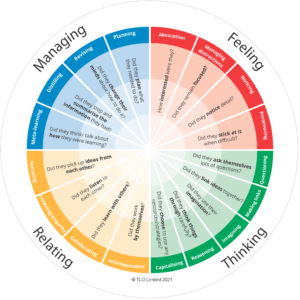
- How the group observers have ‘coloured in’ the wheel showing learning behaviours they thought had been used
- Compare this pattern with the one shown by the tutor
- Which learning behaviour did you use most?
- Which weren’t used at all?
- Did people spot themselves using all the main ones?
- Which ones do you think you missed?
- Key question...if you were only able to allocate 2 behaviours to this activity which 2 would they be?
This rich discussion will serve to show the importance of understanding, using and developing learning behaviours.
5.Post session tasks
(To be done after session 1 and before session 2.)
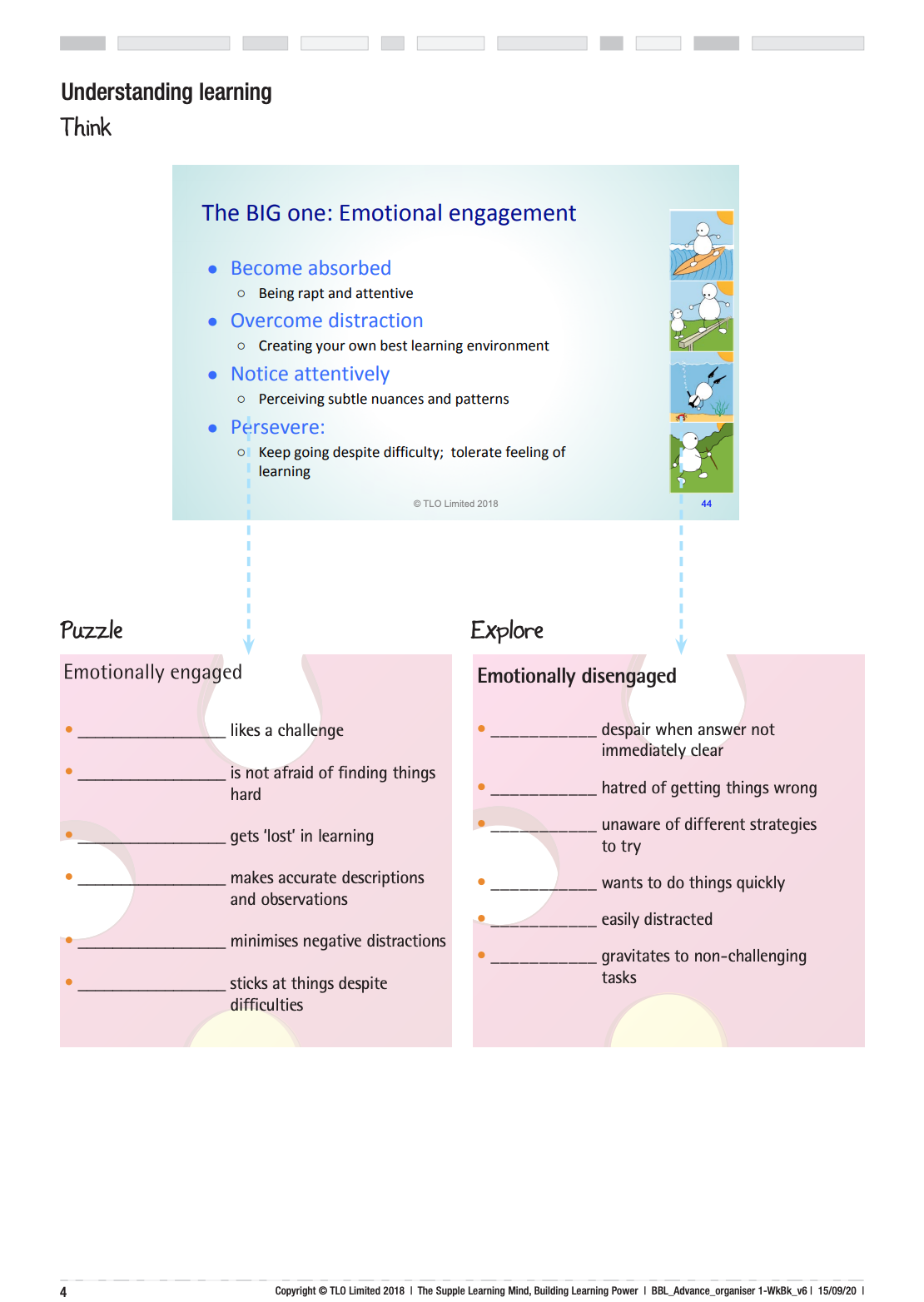
The very best way to secure your learning after session 1 is to relate the ideas to your own students. By doing so you’ll begin to connect practically with what learning power is all about.
Post session task 1
Getting to know your students as learners
- Use pages 10-13 in your Resource Book
- Think about pupils you know well and fill names into the sheets. This will just help you to attach a real student’s behaviour to an abstract learning behaviour. It will make the behaviours come alive for you.
- Copy these sheets and complete them again as you come to know your pupils better over the first few weeks of term. Keep an eye open for any changes in their behaviours.
Post session task 2
Becoming aware of how your curriculum supports learning power
- Use page 14 in the Resource Book.
- When planning your next few lessons use this wheel to remind you of facets of the foundational four learning behaviours. Look carefully at the words in each segment. They are descriptions of the aspects of the four behaviours.
- Then, with lesson plans in hand, ask yourself ‘Where am I expecting/supporting students to’:
- act/behave like this?
- Do I just expect this behaviour without mentioning it?
- Am I specifically planning its use into how learning is happening
- Does the behaviour need supporting
- Which of these behaviours do I seem to be expect or support frequently?
- Which behaviours seem to be getting little or no use?
- Why might this be?
- Where do I need to place greater effort
- Over time you will begin the design your curriculum such that you students will have ample opportunities to develop all the facets of important learning, character-building, behaviours.
Task 1
Task 2
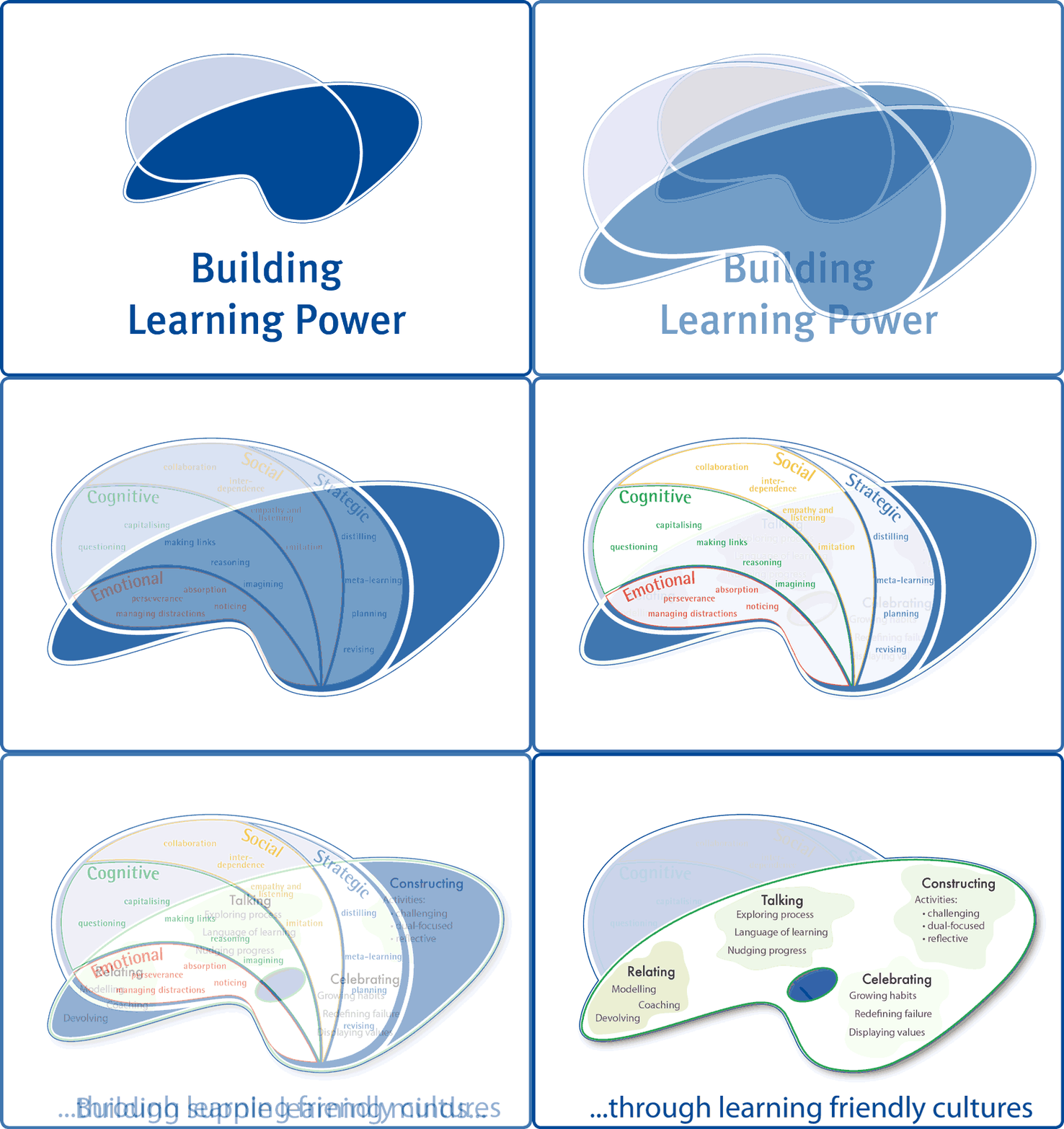
6. An overview of the course that you will work your way through over the coming months – ‘Playing the Learning Power game‘.
The blended learning course contains all the key elements you will need to introduce the values and activities of building your students’ learning power.
The course has 7 sections:
- What do we mean by learning power?
- Classroom relationships
- Talking about learning power
- Designing learning powered lessons
- Celebrating learning power
- How are our classrooms and our learners developing?
- Where next?
Read More detail about 'Playing the Learning Power game' course
How the course is designed
Sections 1–6…
have exactly the same structure in order to ease familiarity with the material and guard against getting lost. Each section deals with a key aspect of understanding learning power and has:
- an introduction to what it is about … take particular note of the key points
- part 1 aims to give you an idea of the sort of practice you are aiming for
- part 2 highlights the main ideas of the section’s content
- part 3 offers a few practical ideas to start things off
- part 4 broaches the idea of redesigning your practice and invites you to make a plan
The content of the course
Section 1 What do we mean by learning power?
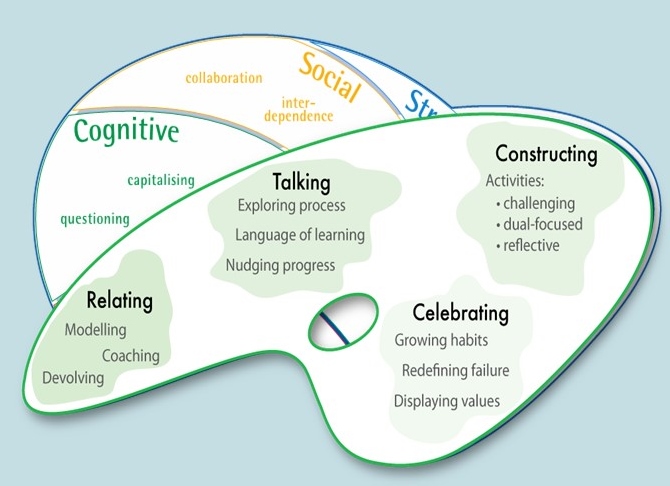
The underlying ideas, research and models
Here you will find:
- the two interlinking models of building better learners
- examples of how the models work in practice;
- the four learning behaviours to make a start on
- the essential aspects of classroom practice
- links with educational research
- encouragement to try things out with your learners
- suggestions for how amendments to your teaching will help students to be better learners
Section 2 Classroom relationships
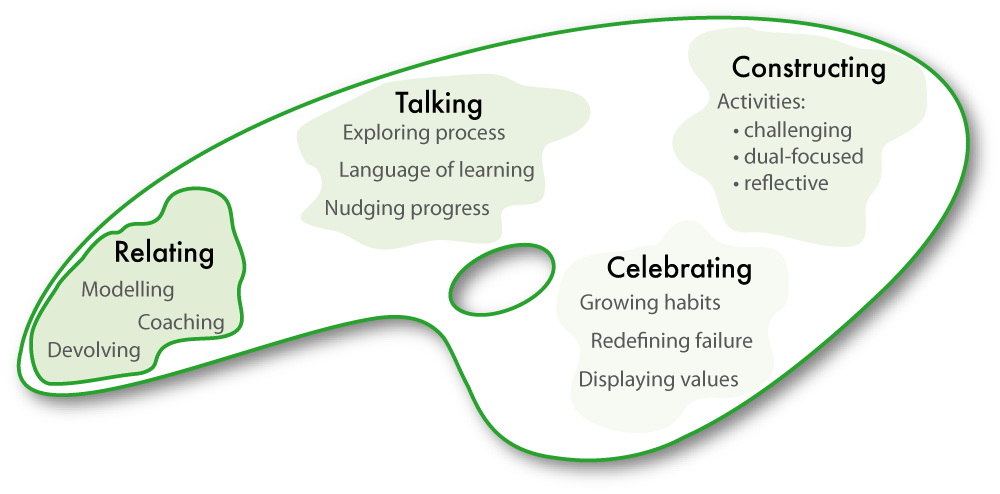
Important shifts in classroom roles
Here you will find:
- examples of the sort of responsibilities you might devolve to learners
- examples of different ways to be as a teacher
- modelling the process of learning
- acting as a coach; asking not telling
- enabling greater learner responsibility
- encouragement to try things out with your learners
- suggestions of ways to plan to expand devolving responsibility to students
Section 3 Talking about learning power
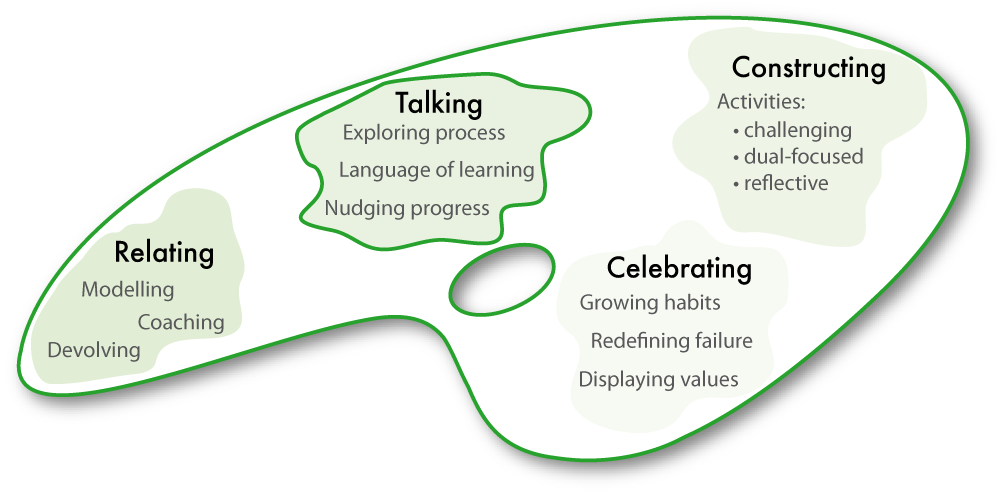 How and when to talk ‘learnish’.
Here you will find:
- examples of how learners can talk about learning
- examples of different ways to talk about learning
- nudging the process
- offering feedback
- encouraging reflective self-talk
- encouragement to try things out with your learners
- suggestions of ways to plan to expand your learning language
Section 4 Designing learning powered lessons
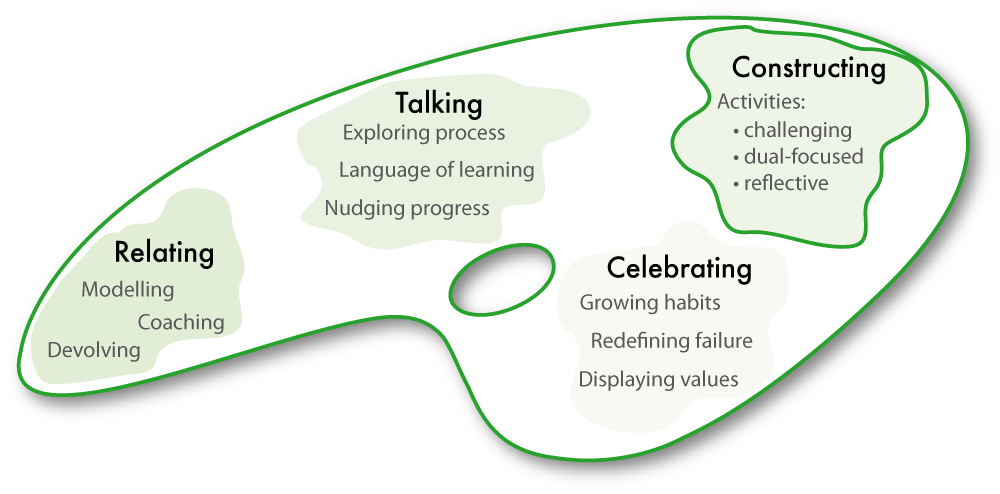 How to put dual-focused lessons together
Here you will find:
- explanations of the three fundamentals of dual focused lessons
- linking content and process
- rich and challenging activities
- building in reflection
- a format to assist designing dual-focused lessons
- an example maths lesson using the lesson design format
- activities to help start this journey
- examples from teachers in classrooms
Section 5 Celebrating learning power
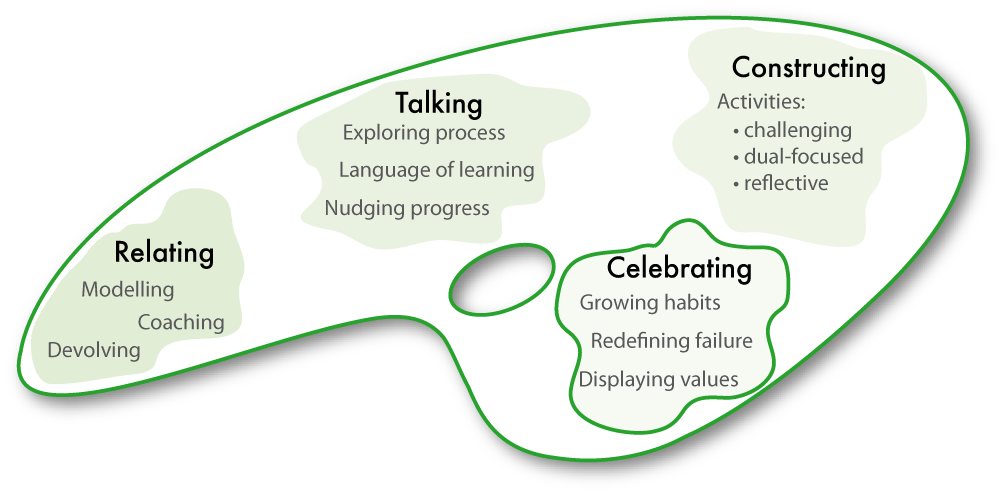 What’s seen as important in learning friendly classrooms
Here you will find:
- examples of how learners can celebrate their learning
- examples of different ways to celebrate learning
- in the growth of learning behaviours
- in re-defining failure
- in displays in the classroom
- encouragement to try things out with your learners
- suggestions of ways to plan to expand what you celebrate about learning
Section 6 How are our classrooms and learners developing?
Section 6a. How is my classroom culture developing?
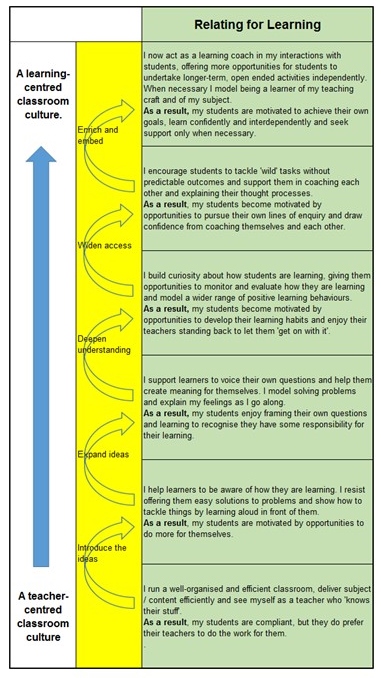 What to look for and record about your classroom culture
Here participants will find:
- Charts showing what the phases of teachers’ growth look like in relation to;
- relating
- talking
- constructing
- celebrating
- with links to the anticipated outcomes for learners
- ideas for developing further developing your classroom culture
- in order to create increasingly learning-friendly classrooms
Section 6b. How are my learners developing?
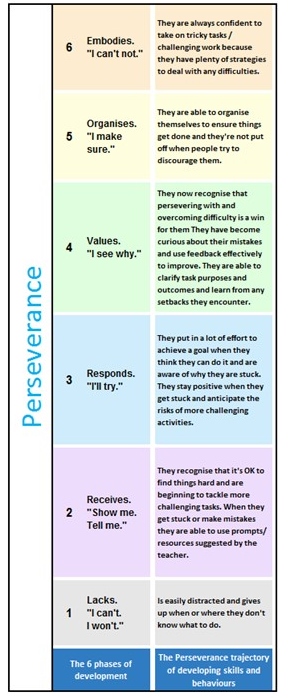 What to look for and record about better learning
Here participants will find:
- explanations of three aspects of progression – frequency, scope and skilfulness in use
- Charts showing what the phases of growth look like in relation to;
- perseverance
- questioning
- collaboration
- revising
- examples of things to try out with your learners
- ways of tracking the growth of learning dispositions over time
- suggestions of ways to plan to expand what you might track about learning
Section 7 Where now: where next?
Here you will find:


an opportunity to briefly reflect on what has been achieved across the school by taking on the blended learning programme ‘Playing the Learning Power Game’;
- descriptions of a broader set of modules that make up the next phase of the programme.
- brief explanations of why and how the next phase enables students to become better learners
Comments are closed.