

Classroom Culture
Culture is the curriculum of the classroom, frequently hidden from the external observer, but always all too evident to learners. It is the minute by minute, hour by hour, day by day way that learners come to understand their role as a learner. Culture is the enacted values of the teacher, not the espoused ones – it is the shadow that the teacher casts in the classroom in terms of what they do do and what they do not do, what they say and do not say, what they believe and do not believe, what they value and do not value.
There are four units dealing with shifting to a learning friendly classroom culture:
Helping your learners to . . . take responsibility for their own learning
Helping your learners to . . . develop a language of learning [This unit]
Helping your learners to . . . learn about learning
Helping your learners to . . . celebrate and value their learning behaviours
Find out what this unit is about
‘Helping your learners to . . .develop a language of learning.
Open Me
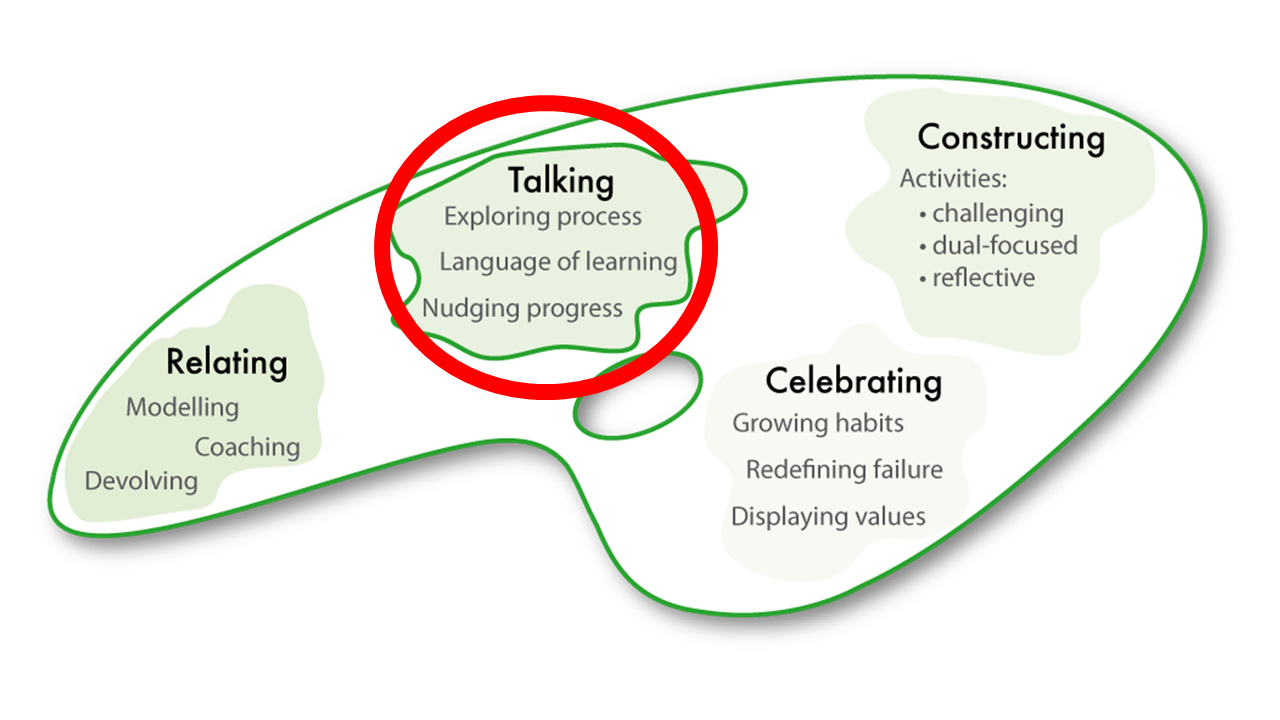
This unit focuses on – talking about the ‘how’ of learning.
The format of the module will be familiar to you if you have done other modules in this suite:
- Section 1 explores what we mean by ‘talking about the ‘how’ of learning’, details the three aspects of it, and offers some further background reading in the ‘Read More’ sections;
- Section 2 offers some quick wins to practise;
- Section 3 offers you a short cut to making your plan of action, with advice on things to stop doing, things that are worth starting quickly and things you could take your time over doing.
Background information
This short section summarises the two key models of Building Better Learners, the supple learning mind and the teachers’ palette.
It outlines the basic values, ideas and research that inform all the practical ‘how to’ ideas for use in classrooms. It’s an essential read if you are new to these units but skip it if you are familiar with its content.
Open Me
What do the 2 frameworks of Learning Power look like?
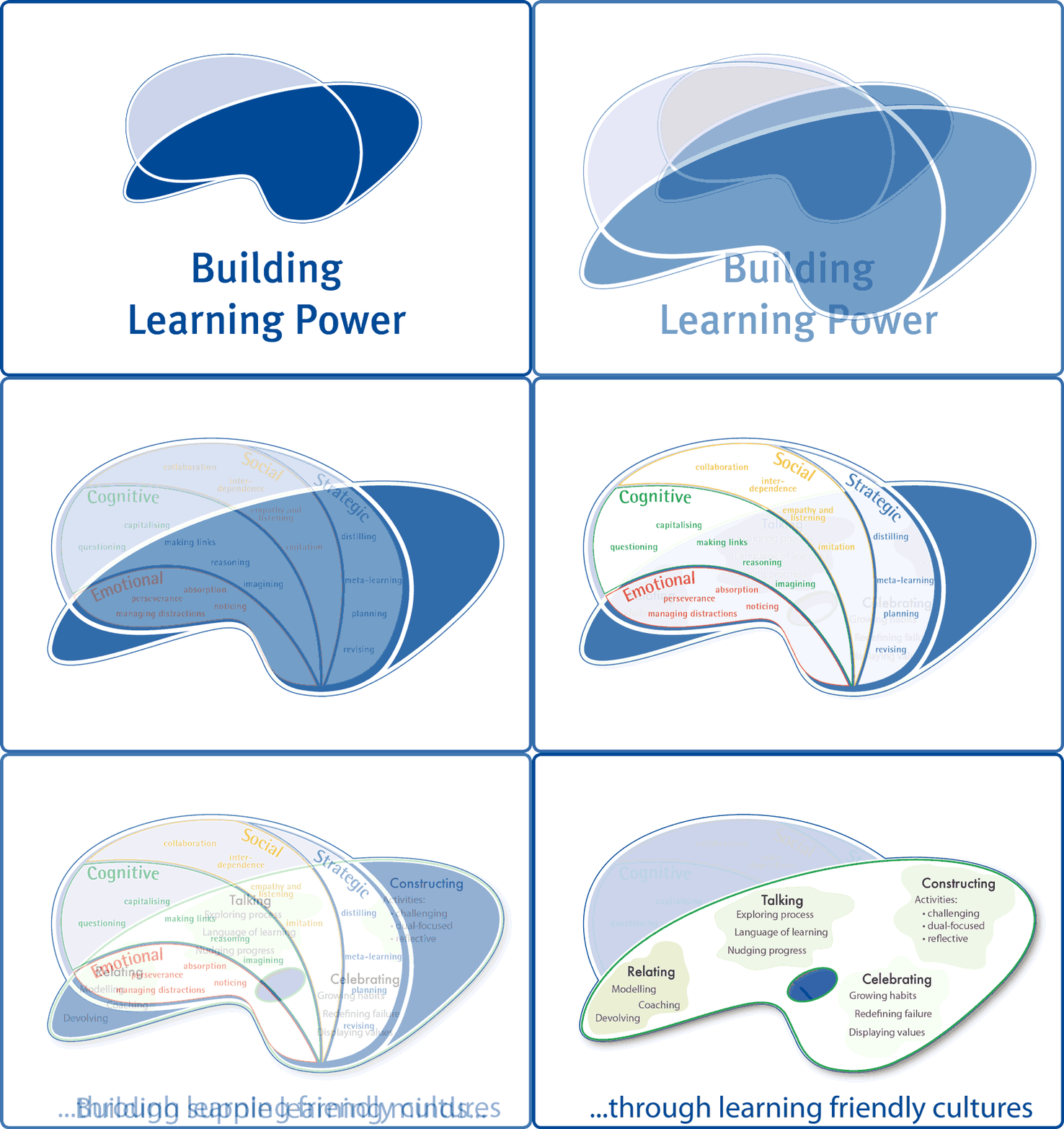
Building Learning Power puts at the heart of education the development of psychological characteristics that are judged to be of the highest value in young people growing up in a turbulent and increasingly complex world. There are two main parts to the approach:
A: a model of a learner and learning, in terms of a set of characteristics that work together to make a person a highly capable learner; we use ‘learning power’ to describe the effect. [the supple learning mind]
B: a view of the kind of pedagogy that will nurture and strengthen the learning characteristics in young people. [the teachers’ palette]
These are bound together by the fundamental idea that ‘learning is a learnable craft’, and by explicit, detailed discussion of how learning works, supported by a rich repertoire of words and action.
What constitutes a supple learning mind?
![BLP_Brain_Generic_no-Rs-[Converted]](https://www.buildinglearningpower.com/wp-content/uploads/2016/12/BLP_Brain_Generic_no-Rs-Converted-300x216.png)
![BLP_Brain_Generic_no-Rs-[Converted]](data:image/svg+xml,%3Csvg%20xmlns=%22http://www.w3.org/2000/svg%22%20viewBox=%220%200%20300%20216%22%3E%3C/svg%3E)
![BLP_Brain_Generic_no-Rs-[Converted]](https://www.buildinglearningpower.com/wp-content/uploads/2016/12/BLP_Brain_Generic_no-Rs-Converted.png)
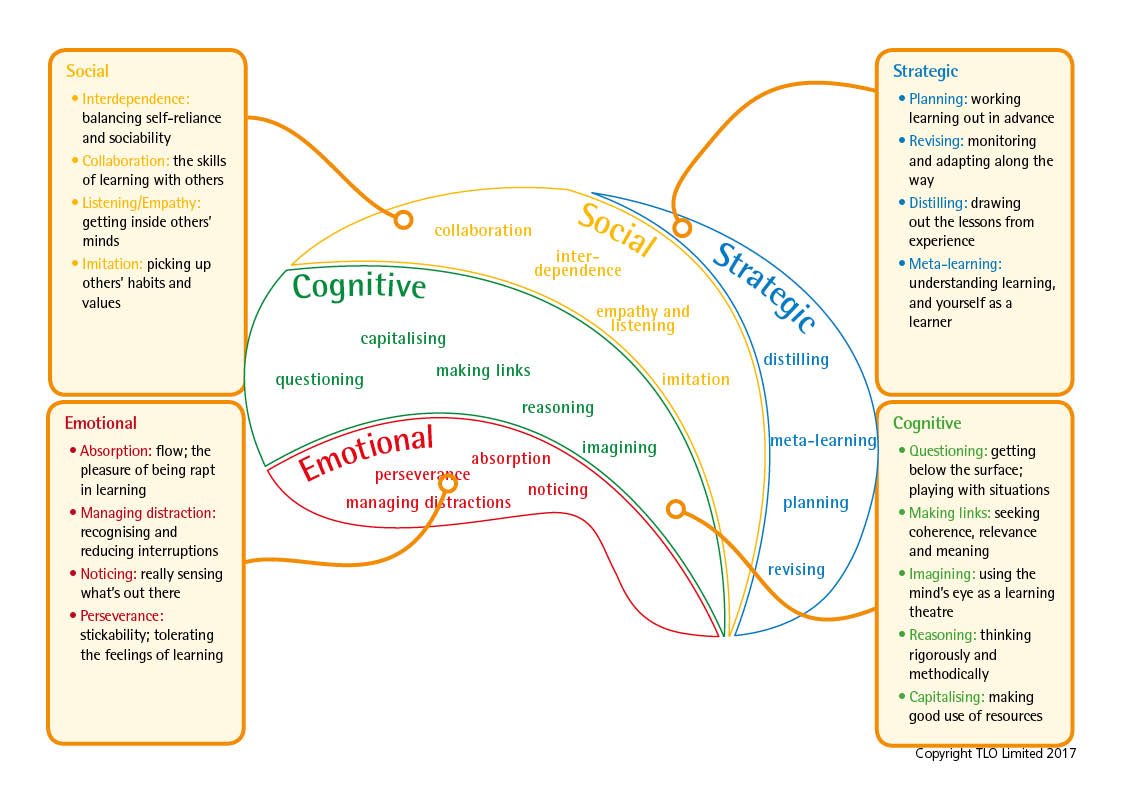
The Supple Learning Mind framework, originally conceived and researched by Professor Guy Claxton, reveals learning as a complex process that isn’t just about thinking and having a good memory; it includes how we feel, how we think, how we learn with and from others and how we manage the process of learning. It gives the beginnings of a learning language that helps teachers think about how learning behaviours enable students to grow as learners and tackle the curriculum more profitably.
Each domain of learning…social, cognitive, social and strategic… clusters together the high value learning behaviours that best make that domain work well. For example the social domain is made up of interdependence, collaboration, listening and empathy and imitation.
What does the teachers’ palette consist of?

The Teachers’ Palette provides an overview of aspects of a learning friendly culture that combine to create the seedbed for building powerful learners. It includes the types of teacher action that create the conditions necessary for such learning to become habituated – how they relate to students, the language they use, the types of tasks they design, and the things that they truly value.
The teachers’ palette distils the key teacher behaviours associated with a learning friendly-culture within which the 4 purposes of Successful Futures can flourish.

The central argument is that effective learning requires a unique blend of the learning behaviours identified in the Supple Learning Mind, learning behaviours that can flourish only in learning-friendly classrooms as outlined in the teachers’ palette.
Questions you might ask yourself
Something to think about
Does your curriculum and its expected delivery . . . .
- already go beyond the transmission of a centrally defined set of knowledge, skills and understandings and intentionally build the learning behaviours outlined in the supple learning mind?
- enable students to take responsibility for their own learning?
Comments are closed.