
Unit 5. Building the habit of questioning.
Welcome to Building Powerful Learners. This eight unit online programme will enable you as a teacher to:
- explore how learners might become not just better learners but effective lifelong learners;
- engage your learners consciously with the ideas and processes of their own learning.
The programme combines three types of action that will help you to experiment with, analyse and understand how to become skilled in developing your students’ learning power.
1 Understand by using Read abouts…of which there are two types
- Essential Read …essential must read text.
- Extended Read …interesting, good to know, absorb when you can.
2 Analyse by using Find outs…tools to help you discover and analyse essential information
3 Experiment with Try outs…practical activities for you to try, check and perfect in your classroom
Unit 5 explores the “how” of building questioning.
- What are the key aspects of questioning? (Essential Read about 1)
- How confident are my students now as questioners? (Find out 1)
- How could I embed building questioning into my teaching? (Find out 2)
- What sort of approaches may be useful in making a start on this? (Try out 1 to 5)
- Find out more about Visible Thinking Routines. (Find out 3)
Structuring and using the ideas below with your students over the next month or so is your fifth step in becoming a skilled learning power practitioner.

Essential Read about 1
Unpacking Questioning
Understanding and making use of a widening range of questions to satisfy our need to know what or why or how etc. is an important life skill which is arguably more important today than ever before. In negotiating an increasingly complex world our tendency to question needs to be further sharpened and enhanced.
A well formed Questioning habit involves being ready, willing, and able to:
- Want to find things out;
- Actually go about finding things out;
- Have the strategies for searching for answers;
- Make sure answers are valid;
- Be brave about asking difficult questions;
- Have strategies for coping with getting under the surface of things;
- Learn to be comfortable with ambiguity and uncertainty;
- Not be afraid of the ‘don’t know’ state of mind.
Being willing and able to ask appropriate, searching questions is as much about how we deal with this emotionally as it is about having the practical strategies to do it. Being able to question, seek a range of possibilities and be sufficiently open minded to actively consider alternatives is a critical aspect of becoming a resourceful learner.

Essential Read about 1. Introducing Questioning ⬇️
The learning behaviour known as questioning
Questioning: asking questions of yourself and others; being curious and playful with ideas; delving beneath the surface of things.
Questioning means both the ability to ask good questions and the disposition to do so (which is sometimes called curiosity). Good learners like questions, and are not afraid of the ‘don’t know’ state of mind out of which questions emerge.
Good learners like to wonder about things. For them, it often really is a wonder-ful world. The phrases ‘How come?’ and ‘What if?’ are never far from their lips.
They value getting below the surface of things, and are less likely to accept uncritically what they are told. They like to come to their own conclusions. They are more willing to reveal their questions and uncertainties if they think it will help them learn.
Questioning can be as much non-verbal as it is verbal. Playing around with materials or ideas just to see what happens is a powerful way of asking questions. It is what artists and inventors spend a lot of their time doing. The inclination to ask questions flourishes when you are around people who are also asking questions, and who encourage and appreciate your questions too.
So effective questioners are motivated and not afraid to ask questions about the past, the present and to explore the future. They have an extensive range of question types and techniques at their disposal, which they use with discernment and sensitivity to occasion. A well-formed questioning habit involves being ready, willing and able to:
- not take things at face value;
- be less likely to accept answers uncritically;
- ask questions of oneself as well as of others;
- get under the surface of things;
- be comfortable with uncertainty and ambiguity;
- not be afraid of the ‘don’t know’ state of mind;
- be playful, yet systematic and analytical;
- be socially aware of the impact that questions may have on others;
- challenge others’ thinking;
- understand and use different types of question for different purposes;
- recognise that revealing their own uncertainties helps them learn.
Try outs 1-5 offer a range of things that you can do to build and strengthen your students’ questioning skills.

Re-find out 1
Focus on the questioners in your class.
Just to get you tuned in – have a quick look back to what you discovered in Unit 3 about Questioners in your class.
Through the lens of the Questioning progression chart you should have a fairly clear view of the questioning behaviours that your students do, and do not, currently exhibit.
- The majority of students may well display a similar set of positive behaviours (ie the majority may be in the purple or blue phase)
- You will also be conscious of some students who still lack positive behaviours (ie they are still firmly rooted in the grey/lacks phase of the progression chart)
- But some students will appear to have made more progress than the majority.
A word of warning.
While you may be tempted to focus your efforts on the majority for greatest impact, you’ll need to take care not to do so at the expense of your ‘grey’ students, as these are your potential underachievers in the future.
What to look for.
In Try Outs 1 to 5, look out for teaching ideas that you think will have the greatest impact on your particular group of learners. Don’t attempt to try all of the ideas – better to do a few thoroughly than to adopt a scattergun approach.
Growing questioning; a trajectory of developing behaviours, skills, attitudes and self-talk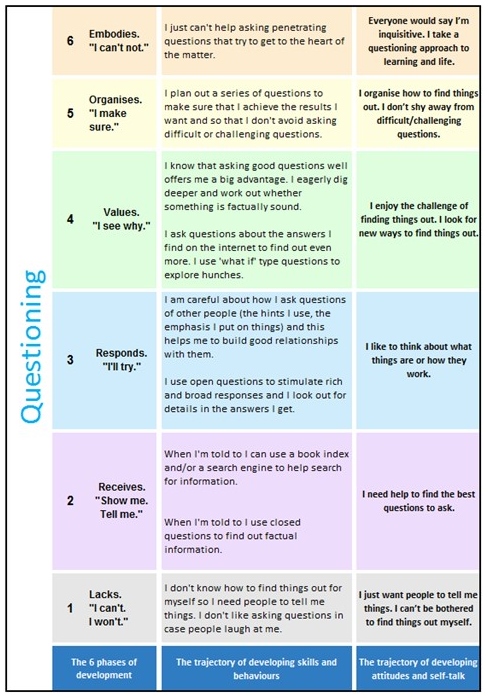

Which phase have most of your students reached now?
Download as a pdfFind out 2
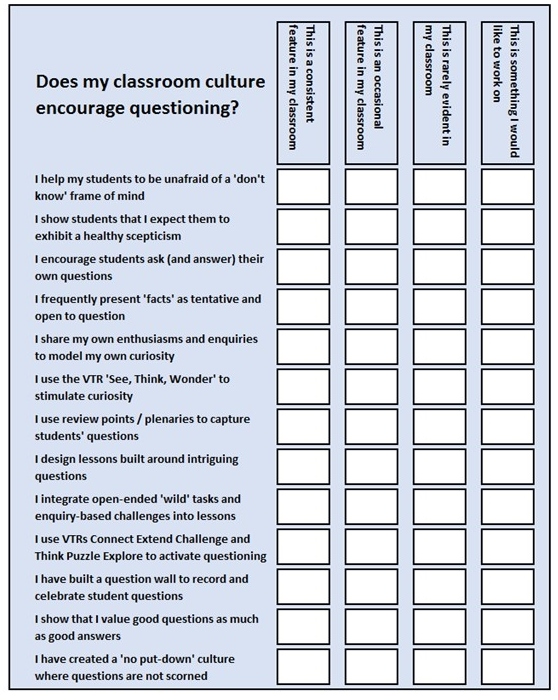
How much does my classroom culture encourage Questioning?
Culture is the curriculum of the classroom, frequently hidden from the external observer, but always all too evident to learners. It is the minute by minute, hour by hour, day by day way that learners come to understand their role as a learner. Culture is the enacted values of the teacher, not the espoused ones – it is the shadow that the teacher casts in the classroom in terms of what they do do and what they do not do, what they say and do not say, what they believe and do not believe, what they value and do not value.
Here is a selection of features that might begin to shape the emotional climate of your classroom to encourage questioning.
Download and print a copy.
Reflect on your current classroom culture.
It’s worth noting that the list is made up of the four action types you first met in the Teachers’ Palette (Unit 2);
- ways of giving students more responsibility for their learning
- the sort of language you might use to stimulate questioning
- ideas for constructing lessons to build questioning
- ways of celebrating questioning
Ask yourself which of the features of the questioning-friendly classroom are:
- already a consistent feature of your classroom?
- an occasional feature of your classroom?
- rarely evident in your classroom?
Which of these features are you interested in developing further?
At this point it might be worth having an informal chat with some of your colleagues. Is anyone already making progress with one of the features you would like to work on? Do you have any consistent features that others might learn from? Take your completed sheet to discuss at the meeting at the end of this unit,
Try out 1
A range of little culture shifts
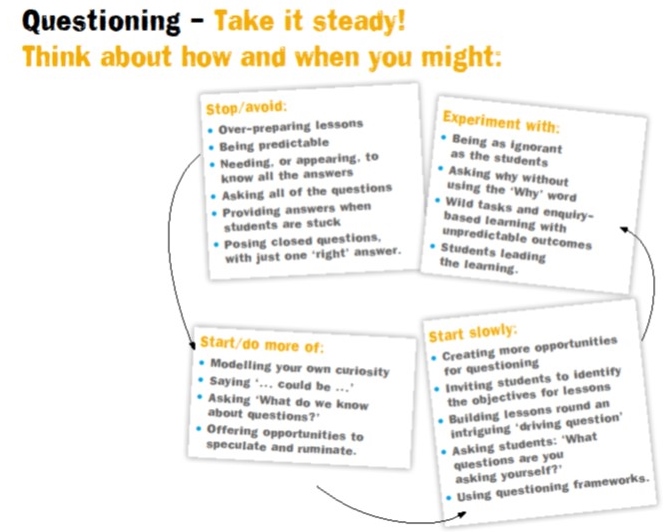
Have a think about your current classroom culture in relation to Questioning.
Begin with the ‘stop/avoid’ box – if any of these teaching behaviours are still in evidence in your classroom it would be worth thinking through how they can be eliminated, since failure to do so will undermine the changes you are hoping to achieve for your learners
Then cast your eye over the other 3 boxes. Which ideas appeal to you? Which do you think will have the greatest impact on your students?
Now seek out teaching ideas below in Try Outs 2/3/4/5 that you can use to move your classroom culture forward.
Try Out 2 focuses on ideas for moving responsibility for questioning towards learners (Relating);
Try Out 3 focuses on developing a learning language for questioning (Talking);
Try Out 4 focuses on how lessons/activities can be designed to activate and develop questioning (Constructing);
Try Out 5 focuses on how questioning can be recognised/ rewarded / praised / celebrated (Celebrating).
Try out 2
Extend students’ responsibilities in order to build questioning
Build in Wait Time
Let students think it through for themselves
What we should do. Research suggests that the optimum time that teachers should wait after asking a closed question relating to factual recall is approximately 3 seconds. For an open question that requires a more elaborate response students should be given around 10 seconds of thinking time.
What we actually do Research into the actual wait time that teachers give students before accepting an answer is closer, on average, to 1 second, irrespective of whether the question is closed or open.
In other words, students aren’t being given sufficient time to think things through for themselves. Q&A sessions become an exchange between teachers and the intellectually fleet of foot and/or impulsive students. Students who want or need time to think it over and come up with their considered answer are denied the opportunity to do so.
A tough question: How long do you routinely give your students to think through an answer before they give it? Are you one of the 3 second / 10 second teachers, or have you lapsed into pursuing pace at the expense of giving time for thought? Most teachers won’t know the answer, but it might be worth finding out!
A challenge – ask a close colleague to monitor the time that you tend to give students to respond to your questions. If you find that you are in the 3 second / 10 second group – great! But if you find that you are giving too little time for student responses, you might consider how changing your practice might improve your students’ responses.

Two more ideas for extending students' responsibilities. ⬇️
Internet Search.
Establish a topic which the students could research on the Internet. Ask them to use search engines to find out what they need to know, without being precise about what the outcome should be. Find out which key words have been most successful in helping them to access useful information.
In pairs, use these key words to construct good questions. Try typing those questions into a search engine to see if they produce different or more focused information.
Discuss the different ways that questions might need to be structured in different contexts and for different audiences.

Build a three-level questioning habit
‘ReQuest’ is a structured process for deepening questions. For example, start with an image or a painting such as The Arnolfini Wedding by Jan van Eyck:
On-the-line questions: ask questions about the picture for which the answers can be seen just by looking closely at the picture: ‘How many candles are there?’ ‘What kind of room is it?’ ‘What is on the wall behind the people?’
Between-the-lines questions: questions whose answers can be inferred by looking at the picture: E.g. ‘What is the relationship between the two people?’ ‘How long ago was the picture painted?’ ‘What time of day is it?’
Beyond-the-line questions: questions whose answers need to be elicited by making interpretive links from the picture: E.g. ‘What did the artist think of his subjects?’ Is the number of candles significant?’ How does perspective work in the painting?’

Try out 3
Build questioning with a learning language
Teacher talk – as a learning coach
Here is a range of things you could say to nudge curiosity. When you use this kind of language you are talking as a learning coach, encouraging students to think for themselves.
10 ideas to ensure your students do the thinking for themselves
- That’s an interesting/insightful question.
- What questions did we ask last time?
- You might find it useful to try and predict what you think will happen.
- Could you speculate about the possible results and solutions.
- What sort of questions might help you get a bit further with this problem?
- Do you believe that? Might there be more to it?
- A closed question might focus your search.
- How can you get to the bottom of this?
- A hypothetical question might help to stimulate your ideas.
- How can you phrase that so that you don’t upset people?

Two more teacher talk ideas ⬇️
Talk about what happens when you ask questions?
Encourage students to become intrigued:
- What do we mean when we say . . . Let’s ask a question?
- What are questions for?
- Asking questions helps us to find out things.
- You can ask questions in your head. It doesn’t need to be out loud.
- If you never ask, you never find out!
- What would you like to find out about….?
- That’s a great/useful question …
- Can you think of any more questions?
Managing class questioning
How many of us elicit an answer from a student, polish it slightly, put the emphasis in the correct place, and then paraphrase what the student originally said back to the class? In such ways teachers unintentionally create the conditions for inattentive or selective listening.
The main problem appears to be that teacher/student exchanges often resemble a game of table tennis – ping, pong, ping pong – all student responses going back to the teacher before another question is directed to another student. It would be better if class discussions resembled a game of basketball or volleyball, where the discussion bounces around the classroom and the teacher’s role becomes one of redirecting student answers to other students.
Achieving this means saying things like:
- Do you agree (or disagree) with that?
- Can you add anything to what xxx said?
- Who can build on that?
- Are you convinced by what xxx said?
- Can you explain what xxxx meant?
- Can you find a flaw in that argument?
- Can you defend that view?
- How would you challenge that viewpoint?
- Could you summarise what xxx just said?
- Do you think (s)he is right/wrong?
No repetition, just passing one answer on to another student for comment. And because the teacher does not repeat the original answer, students have to listen to their peers’ answers be prepared to involve themselves in the discussion.

Try out 4
Build questioning into lesson design
It is through learning activities that learning behaviours get a workout. Their role is to enable your students to access and wrestle with information and ideas; to help them use and understand something; to ensure their effectiveness as a learner. The ‘right’ activity helps to make new concepts more concrete. The ‘right’ activity provides insights into new ideas and subject matter. The ‘right’ activities need to be carefully chosen and, critically, linked to the learning goal.
The Question Formulation Technique
This intriguing technique has been developed by the Right Question Institute over several years. The technique puts students into the driving seat of asking their own questions. It helps students to learn how to produce their own questions, improve them, and think how best to use them. During this process students practice divergent and convergent thinking and metacognition (thinking about thinking). When students know how to ask their own questions, they take greater ownership of their learning, have deeper comprehension and make new connections and discoveries on their own.
The teacher begins the technique with a sharp enough hook to start the students’ questioning process. In brief the process goes like this;
- Stage 1: Produce Your Own Questions
- Stage 2: Improve Your Questions
- Stage 3: Prioritise Your Questions
For yourself this activity can be used for two purposes.
- to introduce your students to the idea of questioning being a useful learning behaviour.
- to inform yourself of your students’ current questioning skills.
Present students, in groups of 4/5, with an image in the centre of a large piece of paper. Invite them to ask as many questions as they can about the image, following the rules below. [The image, or artefact, could relate to an existing or upcoming project, or as a stimulus for creative writing, or any part of your curriculum – anything that will intrigue and generate lots of questions.]
Stage 1: Produce your Questions
Four essential rules for producing your own questions:
- Ask as many questions as you can;
- Do not stop to discuss, judge or answer the questions;
- Write down every question exactly as it is stated;
- Change any statement into a question.
Stage 2: Improve Your Questions
Categorise the questions as closed – or open-ended:
- Working together, categorise your questions as either closed (C) or open (O);
- Agree if any of your open questions would be better if they were closed, and if any of your closed questions would be better if they were open;
- Change any of the questions from one type to another in light of the above discussion.
A reminder. A closed question is one that can only be answered with a limited set of options. Yes/No or single word answers. Open questions are questions that encourage detailed answers and cannot be answered with a simple “yes” or “no”.
Stage 3: Prioritise the Questions
- Choose your three most important questions:
- Why did you choose these three as the most important?
Ask students to prioritise their questions for the job in hand [project or creative writing]. Prioritisation will differ according to the lesson plan in mind.
This causes students to compare their questions and assess which will be most helpful. They also begin to sequence the questions; which would need to be answered first before others could be even considered. Looking at the sequential nature of the questions – e.g. for a story – that offers a possible storyline.
By this point, having observed your students, you will have a clear idea of which questioning skills are alive and well or are not secure.
Reflection Point: How can I design lessons and activities that will enable my students to ask questions in a wider range of contexts?
Learn more about this technique.
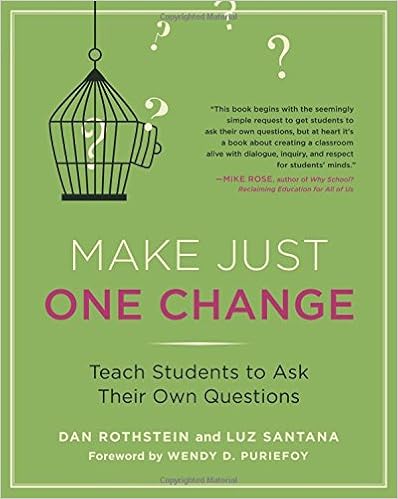
The book Make Just One Change: Teach students to ask their own questions, is a very readable comprehensive discussion and analysis of how to use the Question Formulation Technique.
Two more lesson design ideas ⬇️
Developing the art of asking questions
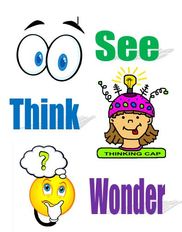
See Think Wonder
A visible thinking routine that encourages students to;
- notice attentively and make careful observations (See)
- make thoughtful interpretations
- reflect on what they are noticing
- make links to what they already know
- distil the important bits (Think)
- ask a question about what has been noticed (Wonder).
It helps stimulate curiosity and sets the stage for inquiry.
Use this routine when you want students to think carefully about why something looks the way it does or is the way it is.
Use at the beginning of a new unit to motivate student interest or try it with an object that connects to a topic during the unit of study.
Consider using it with an interesting object near the end of a unit to encourage students to further apply their new knowledge and ideas.
The routine works best when a student responds by using the three stems together at the same time, i.e., “I see…, I think…, I wonder …. “ However, you may find that students begin by using one stem at a time, and that you need to scaffold each response with a follow up question for the next stem.
Variations on See Think Wonder:
- Read, Think, Wonder;
- Hear, Think, Wonder;
- Or introduce emotions by using See, Feel, Think, Wonder.
Question dice
Shaping the learning around learners’ questions.
Create (or buy) two dice. One has What/Where/Who/Which/Why/How. The other has Is/Was/Could/Would/Should/Might.
Towards the end of a lesson/module, generate question stems comprising a question word and a verb by rolling the 2 dice. Ask students to create a question about the topic in hand using the question stem as a starting point.
- Which xxxx could….?
- Why was…….?
- What might……?
“Is” will generate answers about the present, “Was/Did” about the past, “Can/Could” requires students to explore possibilities, “Would” requires students to consider what is probable, “Will/Should” requires students to predict/hypothesise, “Might” requires students to imagine/speculate.
Use the learners’ questions to frame the next lesson.

Try out 5
Build questioning by celebrating it.
Have students work out a hierarchy for their learning goals for classroom display
Invite students to categorise the following statements into 3 groups for a classroom display
- basic questioning skills
- developing questioning skills
- higher level questioning skills
- I ask closed questions to gather factual information.
- I can tell the difference between open and closed questions.
- I ask questions when I want to find something out.
- I am good at finding information on the internet.
- I ask open questions to encourage others to tell me what they think.
- I think about how I am asking questions to make sure I don’t upset anyone.
- I am not afraid of asking questions in class.
- I ask ‘what if . . . ‘ type questions to explore possibilities
- I ask myself if the answer is true and if it tells me what I need to know.
- I can use a book index to help me find information.
Could you change each of these statements into an If / Then target, which can then become the basis of the Learning Goals display?
NB. You first met If/Then targets in Unit 2 Try out 1. Take a look back to find out/remind you of how.

Two more Celebrating learning ideas ⬇️
Make questioning a subject
Question walls…exploring question types
At the start of a topic call for and display questions which students think might be answered during a topic. Go on to:
- Discuss what sort of questions these are — open, closed, speculative, divergent, clarifying, essential, subsidiary;
- how they might lead to different types of information/reactions/strategies to gather information;
- Draw up and display lists of generic questions to use whenever students undertake certain types of task, e.g. scientific investigation;
- Refer to and extend these question groups regularly.
Create, with students, a set of questions they might ask when they are stuck. These could include; What did I do last time when . . . . ? What do I already know about this? What should I do first? And next? I am finding this tricky because . . . . Who might know? Where can I look?

Monitoring questioning in action
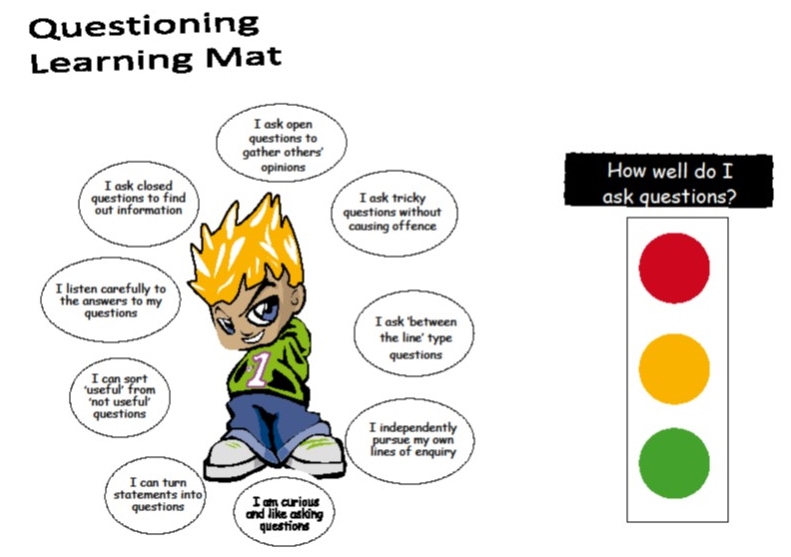
A learning mat
Use a learning mat for questioning to ensure students monitor their own use of questioning.
Learning mats are usually A4 laminated sheets that show various aspects of a learning habit. Keep them on desks/tables or as part of a wall display.
Students refer to them during lessons, using them as prompts about the finer aspects of a learning habit that is being stretched.
Find out 3
Introducing Visible Thinking Routines
You met the Visible Thinking Routine ‘See Think Wonder’ in Try Out 4. You can find out more about Visible Thinking Routines here, further examples of which you will find as you move through this programme.
Visible Thinking Routines are simple routines that apply across a wide range of subjects and contexts, and which require students to think or behave in a variety of different ways. When you use them regularly they become woven into the fabric of the classroom culture and progressively hard-wired into the thinking practices of your students. They become part of the learning culture.
More on Visible Thinking Routines ⬇️
To be effective these routines need to;
- direct, guide, support, encourage thinking
- be short, memorable with few steps
- be used over and over again
- be useful in a variety of contexts
- facilitate connections, generate ideas, use knowledge
Visible Thinking Routines (VTRs) have been developed at Harvard University. These are another excellent way of bringing to the fore the mental muscles that students are using in class. Making Thinking Visible, a book by Ron Ritchhart, Mark Church and Karin Morrison, describes a wide range of VTRs, and how to make use of them, in considerable detail.
In the thinking routine ‘See–Think–Wonder’, students are asked to pay careful attention to a demonstration, a video clip, or an image, and then to ‘do an STW with your learning partner’. Very quickly they learn that this means: share with your partner the details that you saw, the thoughts that those impressions suggested to you, and the further questions that these trains of thought made you wonder about.
Another very simple routine that you may already use is ‘Think–Pair–Share’ which invites students first to spend a few seconds marshalling their own thoughts on a question they have been asked, then to discuss the issue with a partner, and finally to be ready to report back the fruits of that discussion to the whole class. We explore this in the next unit, unit 6.
A third routine, which prompts students to reflect on how their thinking has changed is ‘I used to think . . . but Now I think . . ‘ is introduced in Unit 7.
There is a wealth of information on the Visible Thinking website should you wish to explore further.
Remember these routines are not simply ways of delivering an action packed lesson but serious ways of training students to think.
Visit the VTR websiteLearning together. Meeting 5
Unit 5 Suggested meeting agenda
- Decide what you want this meeting to achieve (5 mins)
- Discuss what you have found out about students use of questioning (15 mins)
- Re-cap and reflect on the action you have each undertaken in your classrooms (20 mins)
- Consider issues that would be beneficial if implemented across the school (10 mins)
- Review how the meeting format went (5 mins)

Learning Team Meeting 5 Agenda ⬇️
Item 1. Meeting Objectives. (5 mins)
Meeting objectives might include:
- discuss levels of questioning displayed across the school
- share and learn from what we have each tried in our classrooms;
- feel confident about taking forward ideas from online materials into our practice;
- identify actions that would be more useful if everyone applied them in their practice;
Outcome. To have decided what the meeting should aim to achieve.

Item 2. Discussion about learning culture (15 mins)
Explore together your discoveries about your students as questioners;
- what did you find out about your students as questioners (Find out 1)
- are students improving as questioners with age? Moving from grey to purple to blue etc?
- where did we each estimate our classroom to be in terms of its culture Find out 2?
- what did we each learn from Find out 2.
- which 3 are the weakest features
- which 3 actions are our strongest
- what surprised or baffled you
- are there significant differences between year groups
Outcome. A clearer understanding of students as questioners and the extent to which our classroom cultures are set up to support and develop questioning.
Item 3. Explore action using the initial Try outs (20 mins)
Share and discuss the action you each took in making a start on strengthening curiosity in classroom practice.
- Which of the suggestions did you each use?
- Any concerns about or difficulties in putting the Try outs into action.
- Which seemed the most valid or successful.
- How the Try Outs affected different age groups.
- Ways of implementing these that we can all learn from and adopt.
Outcome. A clear picture of our interest in and enthusiasm for amending classroom cultures to support learning to learn. A feel for which are proving to be most effective and why. Would any of these culture shifts call for action on current school wide policies? i.e. Question Walls.
Item 4. Learning from practice (10 mins)
In relation to all the shades of practice you have been trying out, sharing, mulling over and observing, think about them now in two ways;
1. personally and 2. school wide.
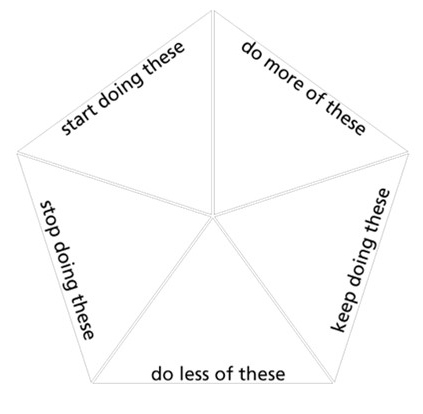
Which ideas/practice stand out as:
- things you want to start doing
- things you think you need to stop doing (that’s harder)
- things you want to keep doing
- things you want to do more often
- things you want to do less
Outcome.
- At this stage it’s essential to note ideas arising from this discussion using 2 pentagon diagrams;
- one for each team member personally and
- one for decisions/suggestions that are school wide.
- Ensure that your school/group wide pentagon is shared with senior leaders.
Item 5. Evaluate team session. (5 mins)
- Did we achieve our objectives?
- Are we comfortable with what we are trying to achieve so far?
- Any concerns at this point?
- Next meeting date and time.

Comments are closed.