
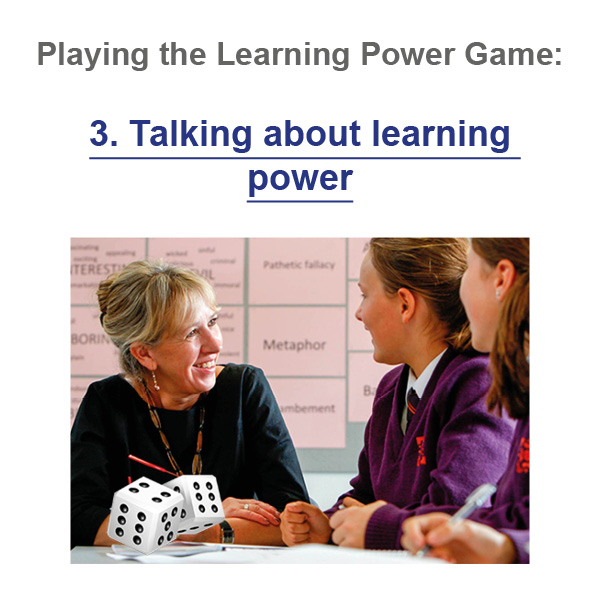
Learning Power invokes a language for understanding and discussing the learning process. Having this language enables you as a teacher to plan lessons that deliberately stretch learning behaviours one or two at a time and talk about learning in a way that enhances it. The way you express yourself in the classroom creates a powerful linguistic environment that teaches young people the best of what we know about learning. The language of learning helps students to discuss, understand, and become conscious of using and improving their learning behaviours.
In this unit you will find:
- examples of how learners can talk about learning
- examples of ways to talk about learning by:
- nudging the process
- encouraging reflective self-talk
- offering feedback
- encouragement to try things out with your learners
- suggestions of ways to plan to expand your learning language
Key points of developing Learning Power language
- The process of learning becomes the object of conversation.
- This helps students to become conscious of using their learning behaviours.
- Extending the learning language helps learners talk about, understand and improve how they learn.
- Encouraging learners to notice, talk about and assess how their learning is going helps them become meta-learners.( meta-cognitive and self-regulating)
Multiple functions of learning language
Having a language that captures the richness of learning helps teachers and students to uncover learning as a visible process that can improve. The learning language offers you, as a teacher, and your students a way of talking about what learners actually do, and this in itself enables them to expand their capacity and appetite for learning.
The language of learning has many uses. It helps;

The Supple Learning Mind ingredients
- you to think about how you might talk in a way that helps to cultivate each of the learning behaviours.
- students to notice and recognise learning behaviours they were unaware of.
- students to gain a better personalised understanding of content by consciously engaging the behaviours.
- to name learning behaviours explicitly so that students (and their parents) know what it is you are noticing and valuing.
- to know which learning habits and attitudes are being exercised by the way subjects are being presented, taught and assessed.
- you to become aware of which learning behaviours you routinely require students to use in lessons — and then to think more carefully about whether there might be others you could profitably call on instead.
- you to design activities that stretch and strengthen learning behaviours so that they become student’s learning habits. You begin to think;
- How is learning happening?
- What habits of mind am I cultivating in students by the way we I’m designing and delivering the curriculum/this lesson?
- Which learning behaviours need to be used more often so that they become habits?
It’s not only the words themselves that are powerful but the variety of functions they have in making learning behaviours visible, learnable and habitual. The learning behaviours themselves become even more useful when brought to life through everyday phrases that promote, encourage and strengthen them.
Comments are closed.