Celebrating and valuing learning is about making learning the object of attention. The values of learning bubble up and show themselves in what you attend to, what you recognise, what you praise, what you display and celebrate. In learning friendly classrooms failure, mistakes, being stuck and effort are re-framed so that learners come to view these old adversaries as valuable, interesting and essential. Furthermore, in the learning friendly classroom the development and growth of learning behaviours themselves is given attention, praise and recognition.
In this unit you will find:
examples of how learners can celebrate their learning
examples of different ways to celebrate learning
in the growth of learning behaviours
in re-defining failure
in displays in the classroom
encouragement to try things out with your learners
suggestions of ways to plan to expand what you celebrate about learning
Key points in celebrating Learning Power growth
The process of learning is the object of attention
The underlying values of learning become visible through what is enabled, recognised, praised, displayed.
Failure is re-defined and mistakes, effort and being stuck are recognised as valuable
Good questions are recognised as important as good answers.
Metacognitive behaviours are given their essential place in the learning process
Growth in learning behaviours is provided for, looked for and celebrated
Aspect 1: Growing Learning habits – finding ways to notice, track, record and celebrate learning behaviour growth. It implies that teachers and learners have a good understanding of themselves as learners and of what ‘getting better’ at learning looks and feels like. In the same way that attainment is routinely tracked, recorded and celebrated, so is learning itself.
Ask yourself:
Are students in our school becoming increasingly skilful as learners during their time with us?
What evidence do we have for this?
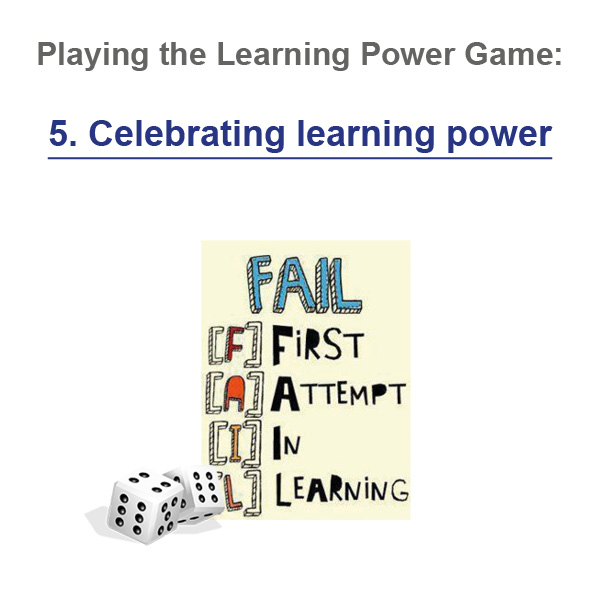
Aspect 2: Re-defining failure – turning the lens around: mistakes become learning opportunities; difficulty is when learning happens; struggle is to be expected; asking questions shows curiosity, not a lack of intelligence; effort not just talent is what leads to success. It is about ensuring that hard won gains over the difficult are preferable to effortless success over the easy. Ask yourself:
How do I treat ‘stuck’, ‘mistakes’ and praise in my classroom?
How much have we re-defined failure?
Aspect 3: Displaying values – the process of learning (as opposed to the finished outcomes of learning) are on display. Annotated work in progress, first attempts, revisions, failed lines of enquiry, leading, of course, to the finished article. What we choose to display tells students a lot about what we truly believe: displaying/praising only the finished article suggests that whatever we might say, we are more interested in the outcome than the process. In such ways are the underlying values of the classroom revealed to learners. Ask yourself:
What does the display in my classroom reveal about my priorities and my commitment to keeping the process of learning in the foreground?

Comments are closed.