
Why do you want to build better learners?
We illustrate our strategic line of argument . . .
But what would yours be? We invite you to build your own.
If we cannot articulate why building better learners is important, why would anyone buy into this vision for learning?
An exploration about why it makes sense to build our students to be better learners
Why do we need to bother to pursue building better learners?
Here is our strategic line of argument. But what is yours? Why do you believe that building better learners is a core purpose of schooling?
The future…and learning
‘Students throughout the world need now to reach higher levels of achievement, not only to find fulfilling work but also to empower themselves to thrive in an increasingly complex world’
– Dylan Wiliam
- Employment requires being able to enhance and transfer knowledge and to operate collaboratively
- The capacity to learn and adapt needs to be lifelong because change is a permanent state.

Schools…and learning
The job of schools is to prepare all youngsters for their future lives. However, there’s a disconnect between education systems and the increasingly complex needs of the 21st Century. Students need the exam results AND a set of generic skills and attitudes to deal with complexity; learning dispositions such as curiosity, inquisitiveness, experimentation, reflectiveness and sociability.
Learning to learn…better
- Vast amounts of information is available and learners, young and old, need to know how to find and select relevant information, to process it, connect it, to understand it and use it.
- Learning is increasingly taking place in different settings and with different relationships.
- Learning is a way of life.
Schools’ approaches…to improving learning
Schools approach getting Good Results in one of two ways:
The traditional, transmission model
Good Results PLUS learners who are passive, dependent and anxious about failure.
OR
The learning-centred model
Good Results PLUS learners who are inquisitive, imaginative, and independent and have other such characteristics that will stand them in good stead for a complex world.
Building Better Learners is about the PLUS of the learning-centred model; how to deliver it, build it, sustain it and track it such that students are prepared as lifelong learners: able to deal with the new and complex with confident uncertainty.
Doing this involves teachers getting more precise and forensic about learning behaviours and attitudes, and shifting school cultures to becoming more learning friendly.
Given that we know how, why would we not?
Changes in learners
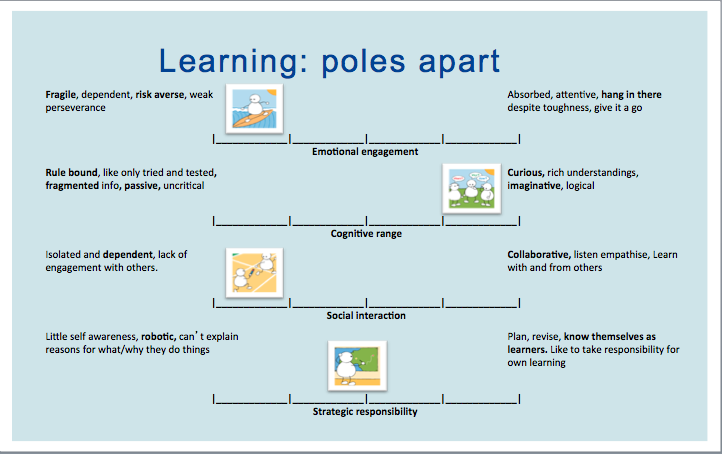
In learning-friendly cultures students gradually grow their learning attitudes and behaviour.
Perseverance, self-control, attentiveness, resilience to adversity, openness to experience, empathy, tolerance to diverse options. A wealth of high-value learning habits.
Where would you like your learners to be on these trajectories – towards the left, or the right? Where are they now?

And in case you are wondering why such habits matter, recent research has shown:
- Achievement tests predict only a small fraction of the variance in later life success
- Achievement tests don’t adequately capture such qualities
- Learning habits have strong effects on educational attainment but have additional effects on important life outcomes beyond their effects on schooling

- How would you make the case for making building better learners a key purpose of your school?
- Is your line of argument engaging and compelling?
- Who might you need to convince?
- How and when will you engage with these various stakeholder groups?
Comments are closed.