
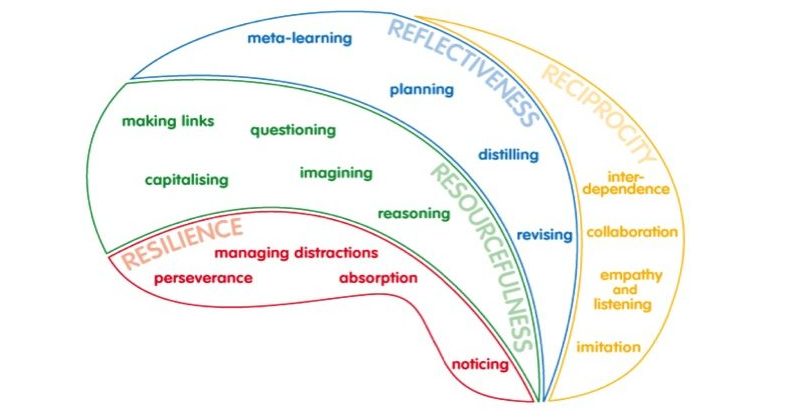
The first key model of Building Learning Power – the Supple Learning Mind.
Find out about the 4 dimensions of learning powered minds :
- The features of a Supple Learning Mind;
- How the vocabulary of learning enriches understanding of learning;
- The extent to which they get regular exposure in your classroom(s).
and gain an overview of the essence of effective learning behaviours.
If you are reading this as a senior leader… reflect on how the issues raised work across the school.
If you are reading this as a classroom practitioner… reflect on how the issues raised affect your own learners.
The Supple Learning Mind framework of high value learning behaviours.
A rich framework for learning
![BLP_Brain_Generic_no-Rs-[Converted]](https://www.buildinglearningpower.com/wp-content/uploads/2016/12/BLP_Brain_Generic_no-Rs-Converted.png)
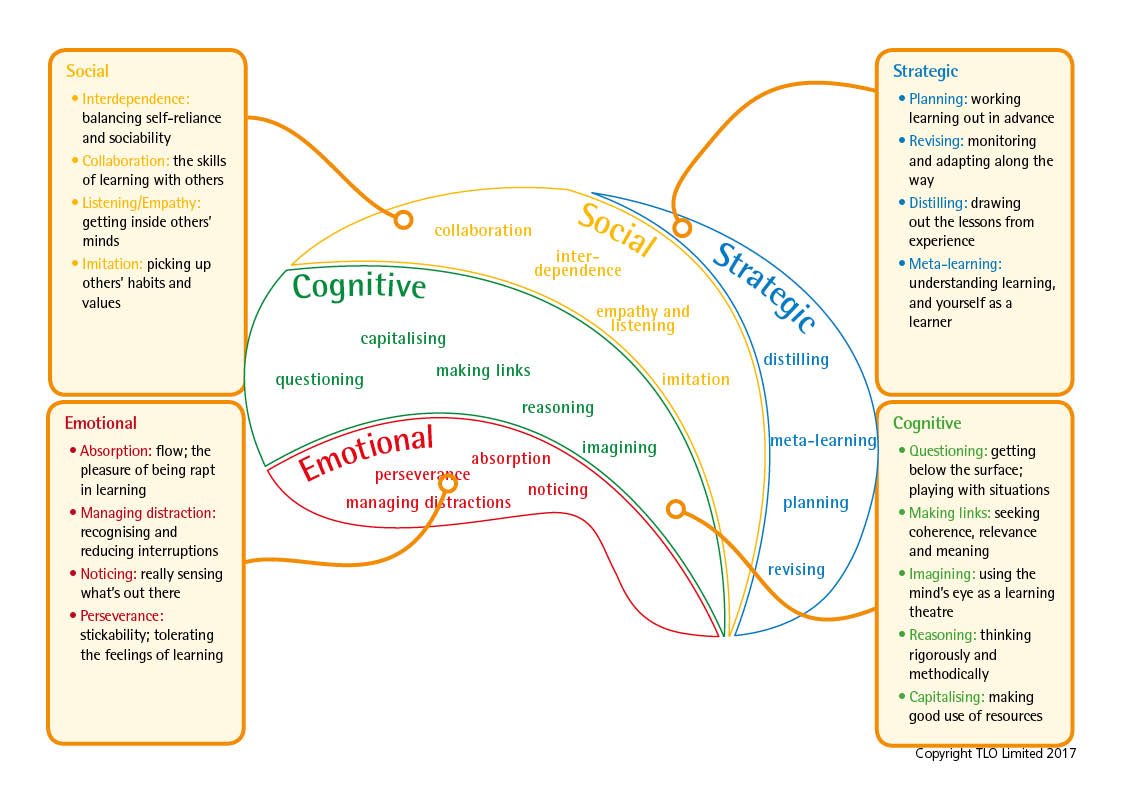
The Supple Learning Mind framework was originally conceived and researched by Professor Guy Claxton. It captures the key psychological characteristics that are judged to be of the highest value in helping students to learn and thrive in a complex world. The framework embraces each of the domains of learning and these are shown in its four parts:
- The Emotional domain of learning (sometimes described as Resilience)
- The Cognitive domain of learning (sometimes described as Resourcefulness)
- The Social domain of learning (sometimes described as Reciprocity)
- The Strategic domain of learning (sometimes described as Reflectiveness)
This learning framework shows that learning isn’t just about having a good memory; it includes how we feel, how we think, how we learn with others and how we manage the process of learning. It shows that learning is a complex process. Furthermore it provides a language that helps teachers to think about how they cultivate each of the learning behaviours and helps students to gain a better personalised understanding of how they learn content.
Each domain clusters together the high value learning behaviours that best make that domain work well. For example the social domain is made up of the learning behaviours of interdependence, collaboration, listening and empathy and imitation.

- What’s your initial reaction to the learning framework?
- Which learning behaviours chime with you?
- Are there others you would add?
- Which of the four domains makes most sense to you?
- Which domain is, arguably, the most important?
The vocabulary of the Supple Mind creates a language of learning
Having a language that captures the richness of learning can be used to understand and discuss the learning process, helping teachers and students to uncover learning as a visible process that can improve.
The learning language offers teachers and students alike a rich vocabulary for thinking and talking about what learners actually do, and this in itself enables them to expand their capacity and appetite for learning.
The language has many uses. It helps:
- teachers to think about how they might talk in a way that helps to cultivate each of the learning behaviours.
- students to notice and recognise learning behaviours they were unaware of.
- students to gain a better personalised understanding of content by consciously engaging the behaviours.
- to know which learning habits and attitudes are being exercised by the way subjects are being presented, taught and assessed.
- to understand concepts such as ‘reasoning’, ‘collaborating’, or ‘managing distractions’, and to have worked on getting better at using them purposefully and routinely.
- to name such things explicitly so that students (and their parents) know what it is teachers are noticing and valuing.
- teachers to become aware of which learning behaviours they routinely require students to use in lessons — and then to think more carefully about whether there might be others they might profitably call on instead.
- teachers to design activities that stretch and strengthen learning behaviours so that they become student’s learning habits. Teachers begin to think, ‘How is learning happening; What habits of mind am I cultivating in students by the way we I’m designing and delivering the curriculum’; Which learning behaviours need to be used more often so that they become habits?
So as we can see it’s not just the words themselves that are powerful but the variety of functions they have in making learning behaviours visible, learnable and habitual. The learning behaviours themselves become even more useful when brought to life through everyday phrases that promote, encourage and strengthen them.
- Which of these functions of the learning language sound useful to you?
- How could you make use of this learning vocabulary?
- Have a quick look at lesson plans for last week and try to think which learning behaviours the activities required students to use (maybe without you realising it).
- If you started to use this learning framework which learning behaviour would you tackle first?
Translating the Supple Mind into classroom practice
So, how does all this translate into the classroom? Basically, as a teacher, you are going to talk about the behaviours, stretch them through activities, model them, and show that you value them when you see them in use.
Have a think about some of the learning behaviours and work out;
- how often you try to help students develop such behaviours in the way that you teach at present;
- how many of your students display these behaviours in the classroom (even without knowing it).
Emotional Engagement
- what do I do now to help students develop these behaviours?
- how many of my students display these behaviours now (even without knowing it)?
- Relish a challenge
- Not afraid of finding things hard
- Identify significant detail
- Stick at things despite difficulties
- Minimise negative distractions
- Work for extended periods to solve a problem
Cognitive Range
- what do I do now to help students develop these behaviours?
- how many of my students display these behaviours now (even without knowing it)?
- Become curious about possibilities
- Ask questions to get to the bottom of things
- See how things fit together
- Are logical and systematic
- Use imagination to good effect
- Make use of a wide range of learning resources and strategies
Social Involvement
- what do I do now to help students develop these behaviours?
- how many of my students display these behaviours now (even without knowing it)?
- Work well with others
- Maintain own ideas in a group
- Listen to what others say, showing understanding
- Put themselves in others’ shoes
- Absorb and use the way other people do things
- Know when to learn alone or with others
Strategic Responsibility
- what do I do now to help students develop these behaviours?
- how many of my students display these behaviours now (even without knowing it)?
- Sort out what needs to be done
- Think ahead of taking action
- Take stock to make sure things are on track
- Change tack if necessary
- Pull out key points from experience
- Talk about how they learn

About your teaching, ask yourself:
- Which behaviours do you regularly attend to?
- Which do you rarely attend to?
- Which psychological domain receives most attention in your classroom? (emotional, cognitive, social, strategic)
- What does this reveal about your teaching?
About your learners, ask yourself:
- Which of these behaviours are already well-developed?
- Which are least well-developed?
- To what extent are learners aware of using these behaviours?
- Is there a link between what you do and how students are as learners?
- What is this making you wonder?
Comments are closed.