
A model for growing learning habits
Find out about how learning powered minds grow :
- Three aspects of ‘Getting Better’
- Frequency
- Scope
- Skill
- The structure of a progression chart
- Consider your own learners in relation to the Perseverance chart.
and gain an overview of the importance of progression in learning behaviours.
If you are reading this as a senior leader… reflect on how the issues raised work across the school.
If you are reading this as a classroom practitioner… reflect on how the issues raised affect your own learners.
The Big Picture: Getting better at learning – what does it mean?
Supporting students to get better at learning requires teachers to assist them to spontaneously make more, wider, and increasingly sophisticated use of the learning behaviours. Ultimately students need to be able to make these behaviours their own; intuitively see the point of them; call them to mind for themselves when needed, and become ever more skilful in their use.
There are three key facets to the growth of learning behaviours – firstly the frequency/how often the behaviour is being used; secondly the range/scope of contexts in which it is used; and thirdly the skilfulness with which it is employed.
Getting better = using it more frequently
 The first dimension of progression, and easiest to activate, is frequency/how often. The distinction between skill and habit is important – skills are what you can do, whereas habits are what you do do. A skill that is only rarely employed, or only employed when adult-directed, is at best embryonic. Initially the aim is to activate the skill more frequently through direct intervention with a view to reducing the level of intervention as the skill becomes stronger through more frequent use. The target is to develop the skill into a habit that the student employs frequently, without support, as and when the need arises.
So the message here is to spot students using a learning behaviour and point this out.
Getting better = using it in different contexts
 The second dimension of progression relates to the range of contexts within which the skill is deployed. The child who is tenacious and thoughtful on the play station can equally be defeatist and impulsive in the classroom – they have the skills, but fail to recognise that the perseverance that leads to success on the play station is precisely the same outlook that is needed for success in the literacy lesson. Initially the skill is used only in familiar circumstances, but the aim is to help students to recognise and exploit opportunities to utilise their leaning behaviours in new and uncharted territory.
Again the message is to look out for and comment on students using the habit, however tenuously, in different subjects or in the playground.
Getting better = becoming more skilled in its use
 The third dimension, and by far the most subtle, is that of skilfulness. While we may start by encouraging students to ask more questions, more often and in different subjects, we rapidly turn our attention to the quality of the questions that are being asked. It is not too difficult to describe the attributes of a high level, sophisticated questioner who is skilled at asking incisive, generative questions, but it is very difficult to map out and sequence the steps between the natural curiosity of a three year-old and the sophisticated skill-set of the consummate question-asker/enquirer. This is the challenge, and why skilfulness is the most complex of the three dimensions. However, once mapped, the impact on how you mentor, set targets, enable self and peer assessment, design tasks, and plan the curriculum etc. is immense.
Helping students become more skilled in their learning behaviours is the role of a teacher in learning-friendly classrooms.
Looking at progression through just one learning behaviour – Perseverance.
A perseverant learner understands that effective learning requires effort and persistence, they relish opportunities to struggle with challenge, they put in effort based on a range of strategies that keep them going, they manage their environment to maintain their effectiveness. If you think about that sentence you will recognise that there are a lot of different skills tied up in that single word ‘perseverance’.
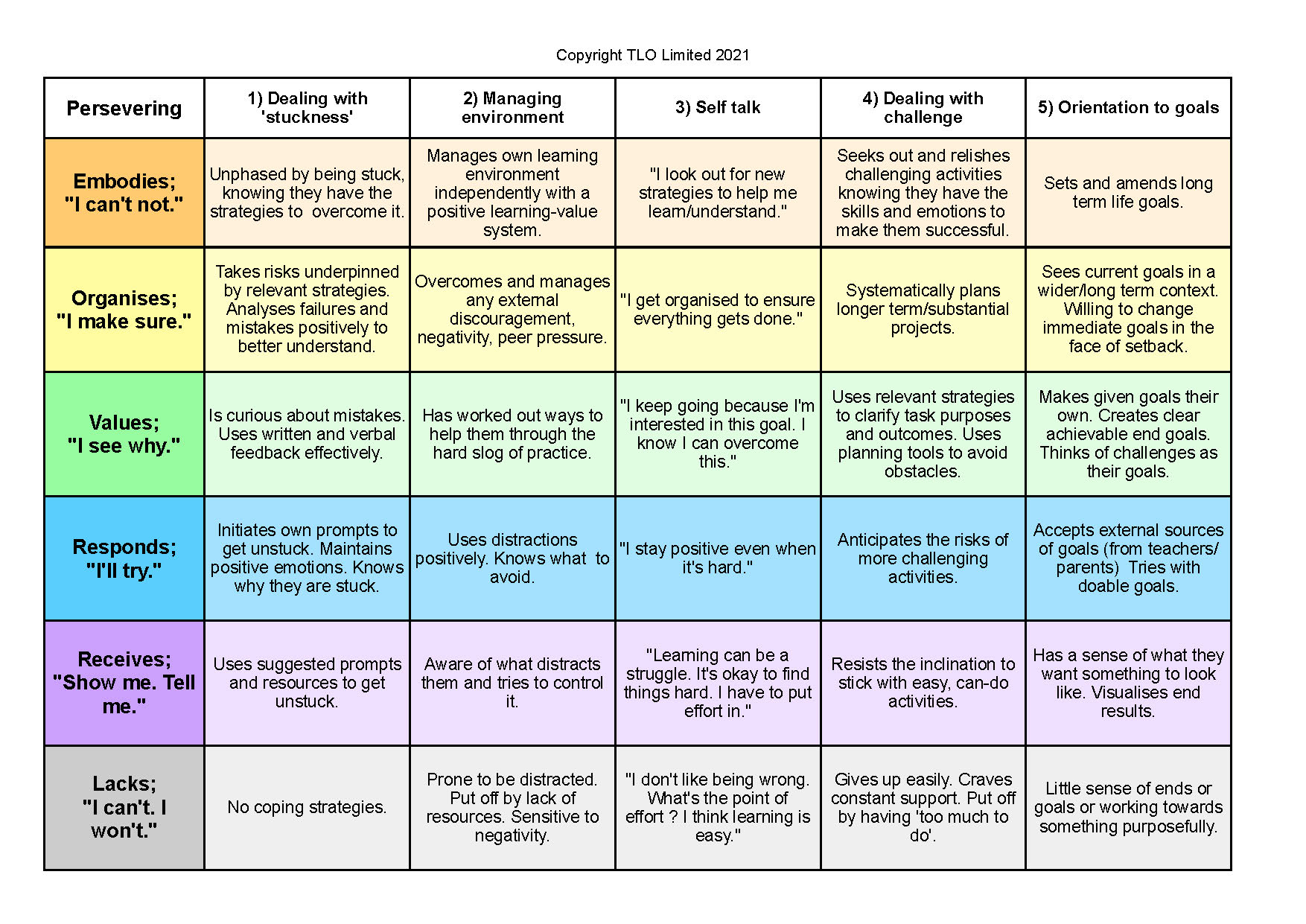
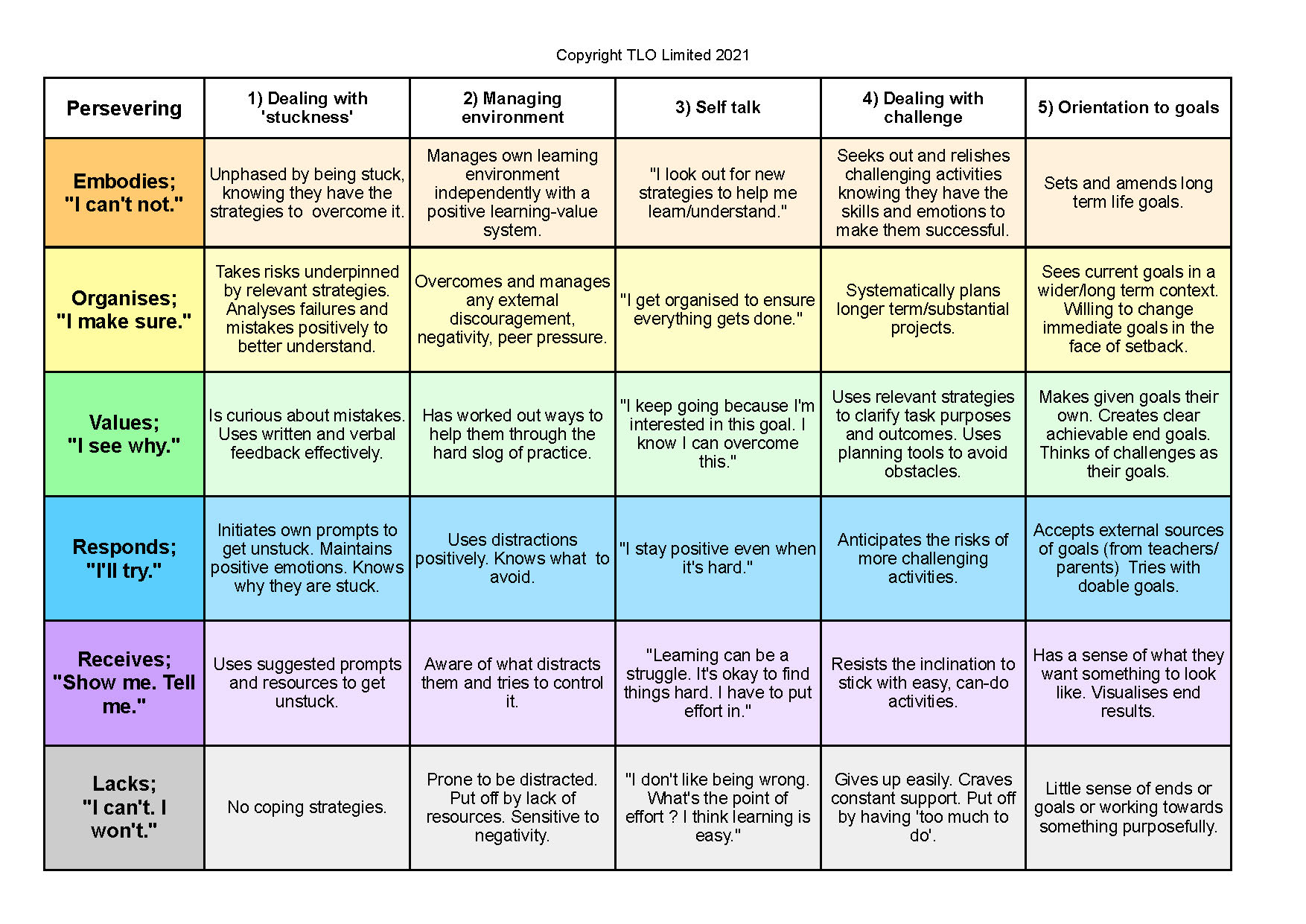
These threads that combine to make up a perseverant learner appear to be:
- what you do when you get stuck or find things tricky;
- how you manage distractions and things that interfere with learning;
- what you believe about yourself as a learner;
- how you feel about challenge and difficulty;
- how motivated you are to achieve the task in hand.
These threads define the columns of our progression grid.
Having sorted out the skill columns we now need to think about what the progression steps might be that move you from ‘can’t’ to ‘can’ to ‘will do’ to ‘always do’?
Our progression steps are based on Bloom’s taxonomy of the affective domain:
- Phase ‘Receives’ (purple) is about doing something because you are told or expected to;
- Phase ‘Responds’ (blue) is about gaining interest and doing things more willingly;
- Phase ‘Values’ (green) is a key phase since the student now sees the value of behaving in this way. It’s a win for them; to behave like this is in their interest. It’s in this phase that the behaviour becomes more secure;
- Phase ‘Organises’ (yellow) is the phase in which the student capitalises on this ‘in their interest’ behaviour and organises themselves to use it positively;
- Phase ‘Embodies’ (orange), is the phase in which the student has made this behaviour their own. It has become part of their character; they can’t not do it and they have become highly skilled in doing it.
These phases define the rows of our progression grid.
Putting it all together. Our Perseverance progression grid looks like this:
Consider your learners with regard to progression in perseverance:
- Think about your most tenacious of learners – which skills and beliefs are already secure in them?
- Think about your ready giver-uppers – where are they on this chart?
- Outliers aside, where are the majority of your youngest learners?
- Outliers aside, where are the majority of your oldest learners?
Wider thinking
- Do students become increasingly perseverant as they move through your school?
- Can you speculate on why this happens?
- Which teacher behaviours might be causing this, for better or worse?
- How might you use the chart to help your students to become more perseverant?
And more generally:
- How does this chart/map affect your understanding of perseverance?
Progression maps, like this one, lie at the heart of Building Better Learners – they help teachers to move from wishful thinking about improving learning to an observable trajectory of effective learning skills and habits.
Comments are closed.