
Classroom cultures that build better learners.
Find out about:
- 3 types of classroom culture – teacher, learner, and learning-centred;
- The shifts necessary to move from teacher-centred to learner-centred;
- The shifts in teacher behaviours that create a learning-centred classroom culture;
- The outcomes for learners.
It reads ok but doesn’t work hard to sustain interest. Its a bit on the long side, short on the hows and no pics. Where’s the key question?
“Aside from that, Mrs Lincoln, did you enjoy the play?”
About classroom culture

Culture – all those little habits, routines and practices that implicitly convey ‘what we believe and value around here’. Classrooms are the places where, hour by hour, students experience the values and practices that are embodied in the school, rather than just the ones that are espoused.
Culture is about the micro-climate: what teachers do and say; what they notice and commend, or don’t; what kind of role model of learning they offer; how they design and present activities to build learning behaviours. Some classroom cultures are just more learning friendly than others.
Types of learning culture
Research by Chris Watkins back in 2004 suggested three types of classroom learning cultures, some more learning friendly than others.
- Teacher centred; overriding emphasis on what the teacher is doing or saying.
- Learning = being taught.
- Students are passengers
- Students have an impoverished view of their learning ability.
- Learner centred; students take a more active role in deciding what to do.
- The learning is making meaning.
- Students are crew
- Students collaborate and discuss learning
- Learning centred; students learn about learning itself.
- Students use a language of learning.
- Become conscious of the learning process and the learning habits they command.
- Students are pilots of their learning
Learning shift

Watkins argues that the shift from teacher-centred to learner-centred culture needs to be tackled before it is possible to move to a learning-centred culture. The shift from teacher-centred to learner-centred involves creating a classroom where:
- learners are increasingly active participators rather than passive observers;
- responsibility is increasingly shared rather than residing with the teacher;
- dialogue about learning and collaboration with peers increases as teacher monologue decreases.
Hence there are often two strategic shifts to make in the journey from Teacher centred to Learning-centred cultures. Teacher centred cultures may well achieve good results but only Learning-centred cultures achieve good results PLUS curious, creative, self-regulating, independent learners.
Putting flesh on these bones:
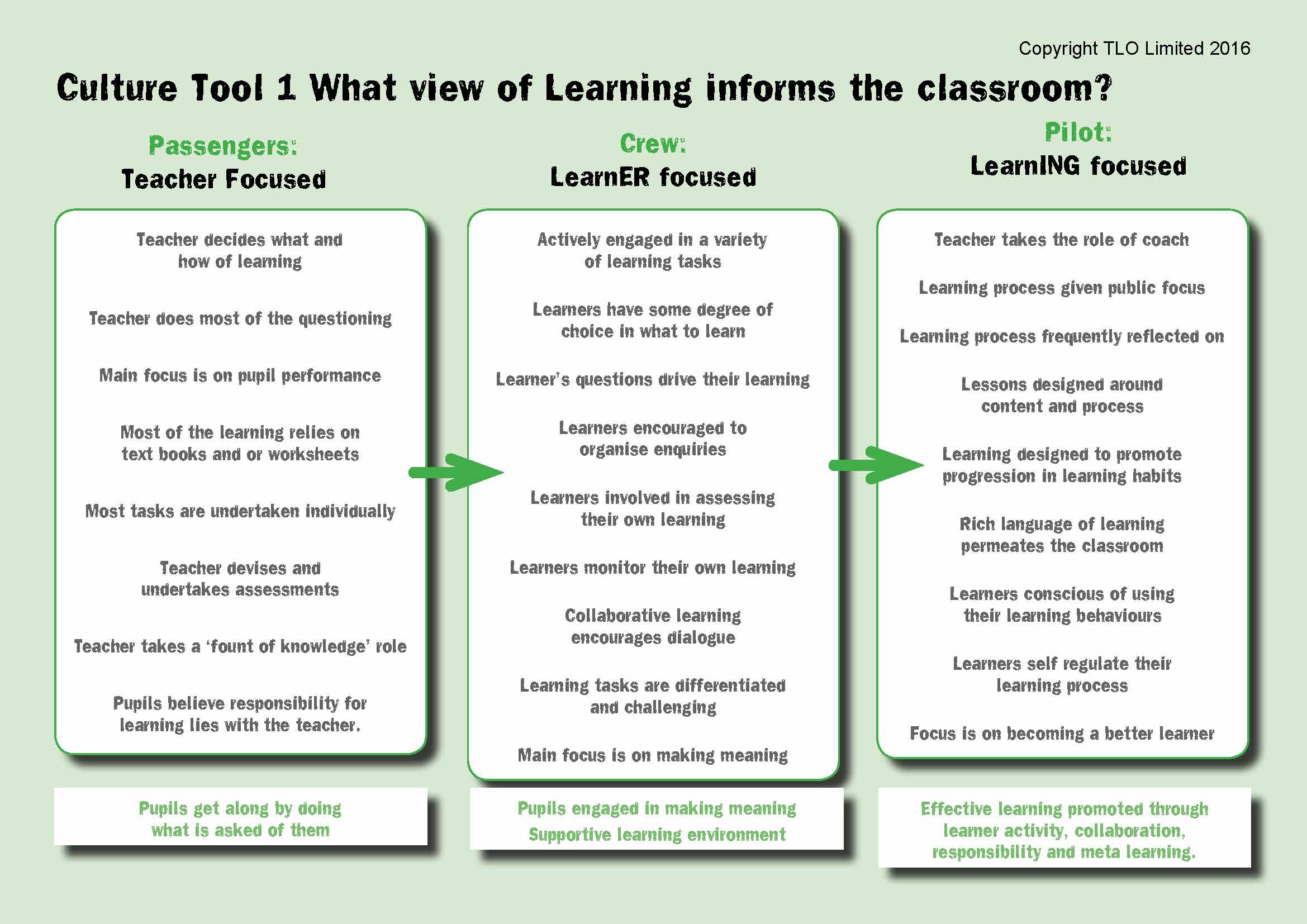
The Culture Tool gives more detail about each of the classroom cultures.
Take a look at the resource and think about your school’s learning culture against the indicators in each panel.
- Reflect on the culture of each classroom
- Highlight all aspects of culture that are a regular feature in each classroom
- What are the similarities and differences between phases, year groups, individual classes?

- Which panels have most statements highlighted?
- Does this alter from subject to subject, phase to phase?
- What does this imply?
- Which statements in the middle panel would you most want to work on?
- If much of the middle panel is already secure, which statements in the right hand panel need to be worked on first?
- It’s worth remembering that the more teacher-centred the school the longer the journey to a learning-friendly culture.
The journey towards a learning-centred culture . . .
Once there is sufficient secure practice in panel 2 of the model above, the school can turn its attention to creating a learning-centred culture, the one to the right of the diagram.
In broad terms the teachers’ role becomes one of surfacing the learning; making it public; making it visible to the learner; making students aware of their learning behaviours, thoughts and feelings. In so doing the strategic emphasis of the classroom shifts;
- from performance ⟹ learning.
- from content ⟹ process.
- from teaching ⟹ coaching
And in order to make these strategic shifts there are four inter-related aspects of teacher behaviour to work on:
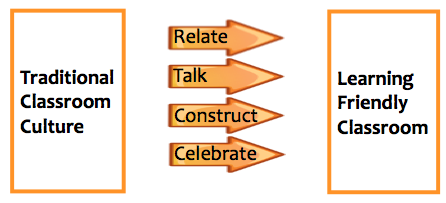
The 4 Shifts in classroom culture – Relating, Talking, Constructing and Celebrating:
1. Relating for learning is about:
- Learning becoming a shared responsibility
- Students being given more responsibility for their own learning
- The teacher becoming the learning coach; enabling students to find their own ways to improve
- Collaborative activity that helps students to see each other as resources for learning
- Students being given choices about what and how to learn
- Students talking more, adults talking less
- Teachers modelling being a learner
- Processes promoting, enabling and supporting the best of what we know about learning.

2. Talking for learning is about:
- Learning, rather than performance, becoming the object of conversation
- The gradual introduction of a learning language helping students to become conscious of using their learning behaviours
- Using and extending the language; adding breadth and depth to how teachers and learners talk about, understand and improve learning.
- Students being encouraged to notice things about how they are learning, talking about the learning process and becoming a meta-learner.
The language of learning revolves around a set of high value psychological characteristics to develop a supple learning mind. These include emotional, cognitive, social and strategic characteristics. These characteristics are unpacked in Section 2.

3. Constructing learning is about:
- Learning, rather than performance, being made the object of learning.
- Reflecting on learning and reviewing learning being built into the learning model used in the classroom
- Learning activities being designed to stretch and challenge – by having a dual focus to explore content and stretch students’ ability to use their learning behaviours.
- Teachers making conscious choices about which habits/learning behaviours to introduce and stretch and how best to couple these with content so that lessons become more interesting and challenging.
- A third dimension being added to teaching: 1. Subject matter, 2. Assessment 3. The learning behaviours being used in order to learn.

4. Celebrating learning is about:
- Learning, rather than performance, being made the object of attention
- The underlying values about learning becoming visible through what is recognised, praised, displayed. For example:-
- Being stuck being recognised as an interesting – not shameful – place to be.
- Mistakes being recognised as invaluable in learning.
- Effort being unpacked to show how it is channelled.
- Good questions being as important as good answers.
- Using learning behaviours more often and more skilfully being nudged and recognised
- So the growth of learning habits is being attended to closely.

Putting these 4 shifts together . . .
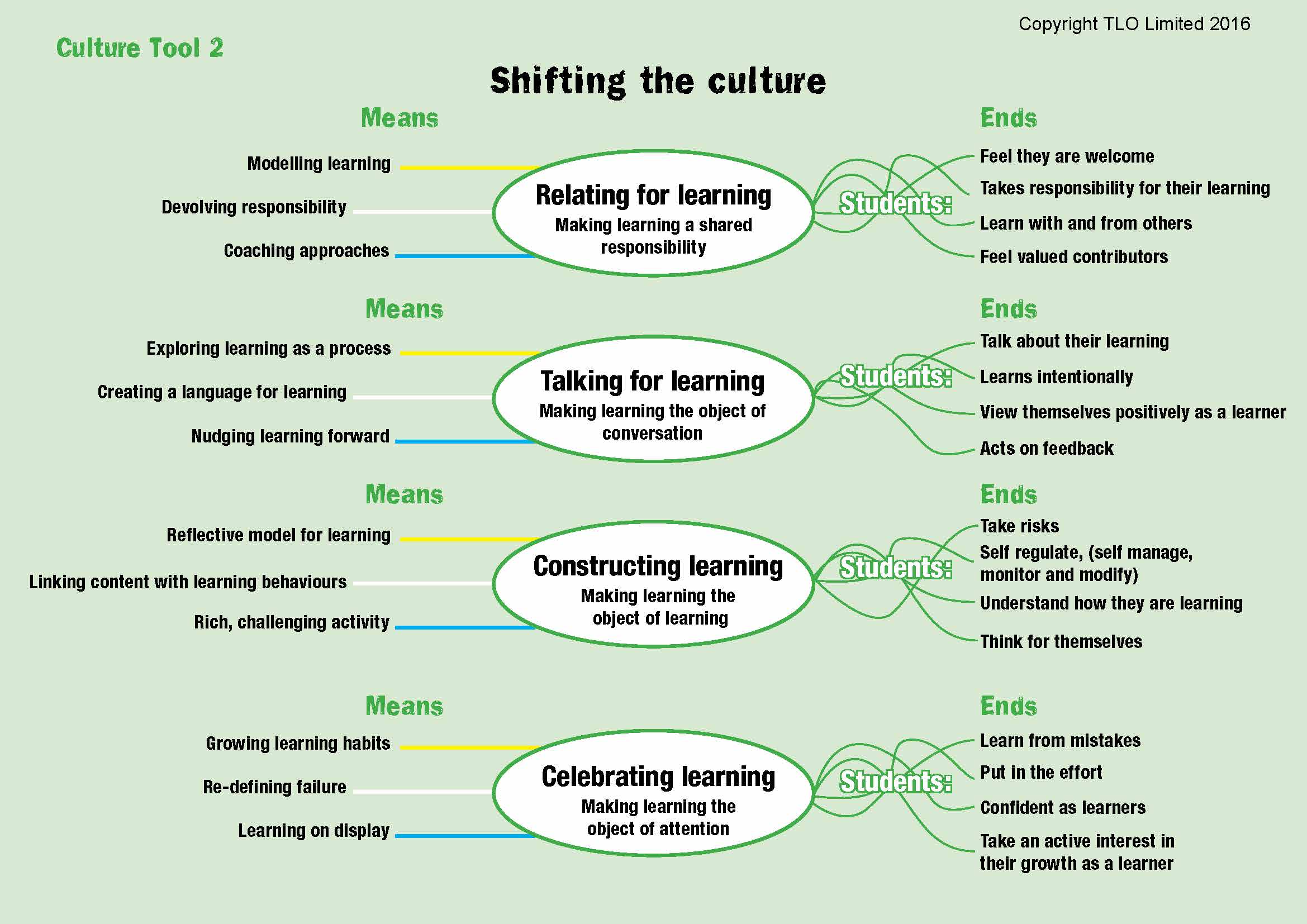
The model above shows the 4 shifts necessary to create the learning-centred classroom, on the the left-hand side the 12 ‘Means’ of creating this culture, and on the right-hand side the ‘Ends’, the outcomes for learners.
Cast your eye over the model:
- Which outcomes / ‘Ends’ would you want for your learners?
- To what extent are they already like this?
- How do you know?
- Which of the ‘Means’ do you regularly see in classrooms?
- Which would you like to see more of?
- What insights about classroom culture have you gained from this Bitesize summary?
Comments are closed.