
This unit :
Building Better Learners is about creating a culture in classrooms – and the school more widely – that systematically cultivates habits and attitudes that enable young people to develop supple learning minds.
In this section we look briefly at how teachers begin to shift the construction of learning in order to stretch students’ use of learning behaviours.
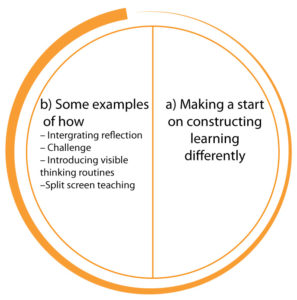
How does the construction of learning in the classroom change?
a) Making a start on constructing learning differently
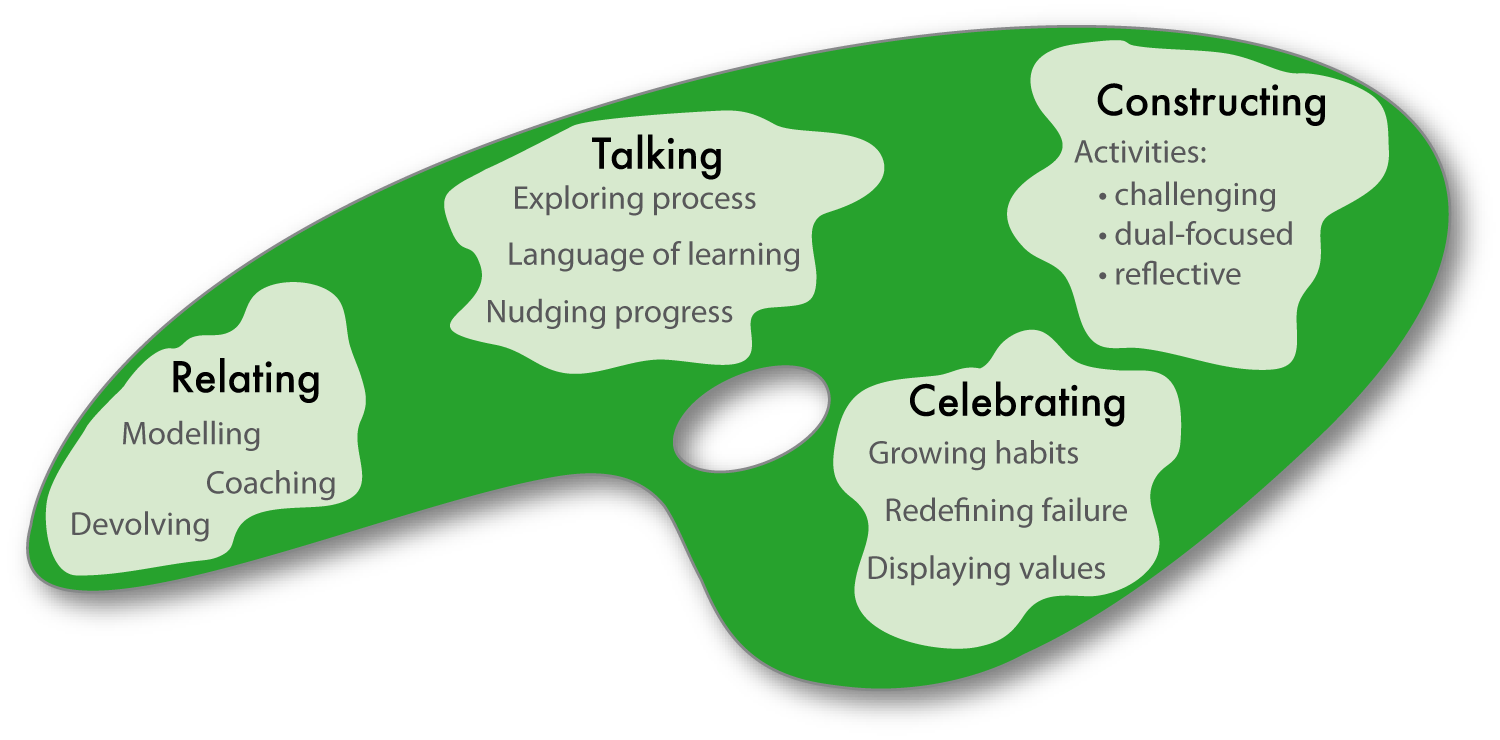
As we saw in section 3.1, Constructing learning firstly involves integrating reflection and review into the way learning is organised; where activities are designed to stretch and challenge not just in outcome terms but in the very nature of ‘doing’ the task (dual focus of content and process). students’ emotional engagement is a pre-requisite when learning is organised in these ways, and the value of learning is in pushing yourself so that your capacities are stretched and strengthened. The early stages of making a shift in this aspect of the learning friendly classroom might simply include;
- plan lessons to explicitly include reflection and review purposefully
- making challenge fun and available in forms other than activities
- introducing a couple of Visible Thinking Routines
- beginning to dabble with split screen learning
The classroom becomes a place where young people learn that to struggle with a problem is ultimately satisfying and brings its own rewards.
Learning organised to promote struggle

b) Some examples of how
1) Infuse reflection and review into lessons
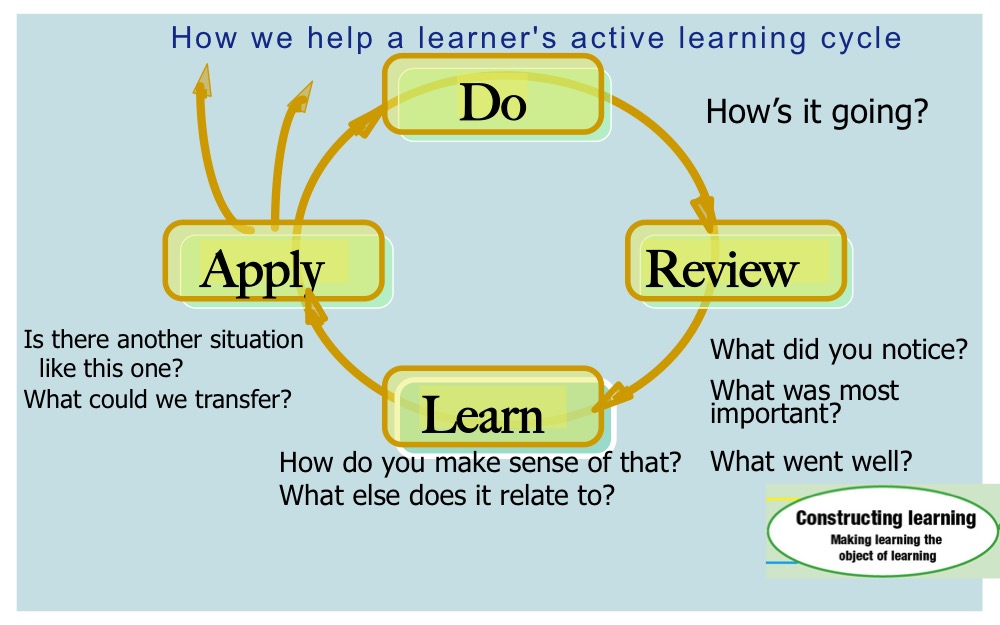
Reflection has become widely seen as part and parcel of good learning. Strategic approaches such as ‘Plan Do and Review’ have been with us for many years. More recently ‘Assessment for Learning’ has emphasised the role of reflection in improving learning and achievement. Students are now much more familiar with such techniques.
As Mike Hughes observes in ‘Closing the Gap‘
“Trying to learn without reviewing is like trying to fill the bath without putting the plug in”
And yet, reflection is still used by many schools for summative evaluation of a piece of work, rather than being woven formatively throughout the learning and production process.
Being able to reflect, review and refine your ideas is one of the key learning characteristics. Students need to be taught;
- not to wait till they’ve finished before reviewing what they are doing;
- to keep making small checks and revisions all the time as they go along …am I on the right track? Is there something I’m missing?.
- to check what they have done at the end…is this as good as I can make it?
- at the end, to think about whether there’s a better way to do it?
Reflection and review as non-negotiables
2) Making challenge available and fun
There’s a big link between emotional engagement and challenge
Learning is always an emotional business and learning how to manage this is best done ‘on the job’ in the course of learning rather than as a separate stand-alone activity. Emotional engagement is a prerequisite of powerful learning, it’s what gets you interested enough to be willing to put in the effort to get better and see the value of pushing yourself. So lessons aren’t just designed to make use of different kinds of learning behaviours but to give those behaviours a good work-out. Activities are designed to:
- be challenging, where being stuck and confused are regular and fruitful experiences.
- give students the opportunity to ‘learn what to do when they don’t know what to do’ – to work on wild tasks, rather than tame ones, where there’s plenty of scope to get lost and perplexed.
“The presence of challenging learning intentions has multiple consequences. Students can be induced to invest greater effort, and invest more of their total capacity than under low demand conditions.”
(John Hattie, Visible Learning)
Or, as a teacher said to us recently:
“I became a better teacher the day I stopped thinking ‘have I made it easy enough for them to understand it?’ and started thinking ‘have I made it hard enough to stretch them?'”
Try these ideas to support challenge
- Make positive connections between making mistakes and challenge
- Model how to think about and work through challenges
- Create a challenge wall; put up questions, extension tasks, riddles, problems. A go-to place for another challenge when other learning is finished
- Display work that shows students have improved mistakes etc.
- Stimulate using ‘Stingray’ questions…What if...(something they thought they knew from a different angle – What if gravity was twice as strong ?)
- Use the ‘learning pit’ to talk through what to do to overcome/surmount a challenge.
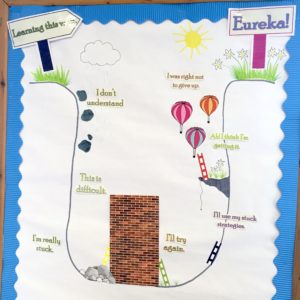
The Learning Pit
You need to be emotionally engaged to take on challenge.
3) Introducing Visible Thinking Routines for Reflection
What are Visible Thinking Routines?
VTRs are, as they say, simple routines that apply across a wide range of subjects and contexts, and which require students to think in a variety of different ways, that are used so regularly by teachers that they become woven into the fabric of the classroom culture and progressively hard-wired into the thinking practices of students.These are ways in which different ways of thinking can become routine in classrooms. They become part of the learning culture.
To be effective such routines need to be;
- Direct, guide, support, encourage thinking
- Short, memorable, few steps
- Used over and over again
- Useful in a variety of contexts
- Facilitate connections, generating ideas, using knowledge
Find out more: Google ‘Visible thinking routines’
Connect Extend Challenge is a visible thinking routine for connecting new ideas to prior learning and encourages reflection.
It goes like this;
CONNECT: How are the ideas and information presented CONNECTED to what you already knew?
EXTEND: What new ideas did you get that EXTENDED or pushed your thinking in new directions?
CHALLENGE: What is still CHALLENGING or confusing for you to get your mind around? What questions, wonderings or puzzles do you now have?
The routine helps students make connections between new ideas and prior knowledge. It also encourages them to take stock of ongoing questions, puzzles and difficulties as they reflect on what they are learning.
Make thinking visible
4) Split screen teaching

Whether we realise it or not, all lessons have a dual purpose:
- The content dimension, with material to be mastered
- The ‘learning’ dimension, with some learning skills and habits being exercised.
In conventional lessons where students focus exclusively on mastering content while the learning dimension is not acknowledged; students may learn ‘stuff’, but they remain unaware of how they are learning it. Such lessons make the content very public, while the associated learning behaviours remain a closely kept secret. So students learn habits of compliance or dependence.
In developing learning power, teachers are making conscious choices about which habits to introduce and stretch and how best to couple these with content so that lessons become more interesting and challenging. Through such overt coupling of content and specific types of process, students come to know, understand and take control of their learning behaviours – they knowingly use and develop the whole range of learning behaviours.
To make a start on this, try considering your plans for the coming week or month in relation to the following questions;
Where, in these plans, can you find opportunities to:
1. Build their emotional engagement
- In your series of lessons, where do you expect students to become stuck?
- What prompts would help them overcome their stuckness?
- Are there any opportunities to encourage noticing behaviours?
2. Stretch their cognitive range
- What proportion of your lessons are spent on encouraging students to question?
- Where might you encourage more student questioning or playing with ideas?
- To what extent are the activities predigested – where most of the work has been done for them?
- How much do the activities generate students’ own initiative, questioning, research and information processing?
- Could you make more activities ‘wild’ rather than ‘tame’?
- What proportion of your series of lessons calls for disciplined, logical thinking and reasoning?
- Could some of the activities be amended to foster imagination, visualisation, intuition?
3. Foster their interpersonal involvement – social
- What proportion of your series of lessons requires students to collaborate in order to complete a task?
- Could you fit more collaborative activity into your lessons?
4. Extend their strategic responsibility (Reflectiveness)
- What proportion of your series of lessons involves students in monitoring and revising their own work?
- Could you include more along these lines?
Infusing learning into lessons
PRIMARY
Building Better Learners is about creating a culture in classrooms – and the school more widely – that systematically cultivates habits and attitudes that enable young people to develop supple learning minds.
In this section we look briefly at how teachers begin to shift the construction of learning in order to stretch pupils’ use of learning behaviours.
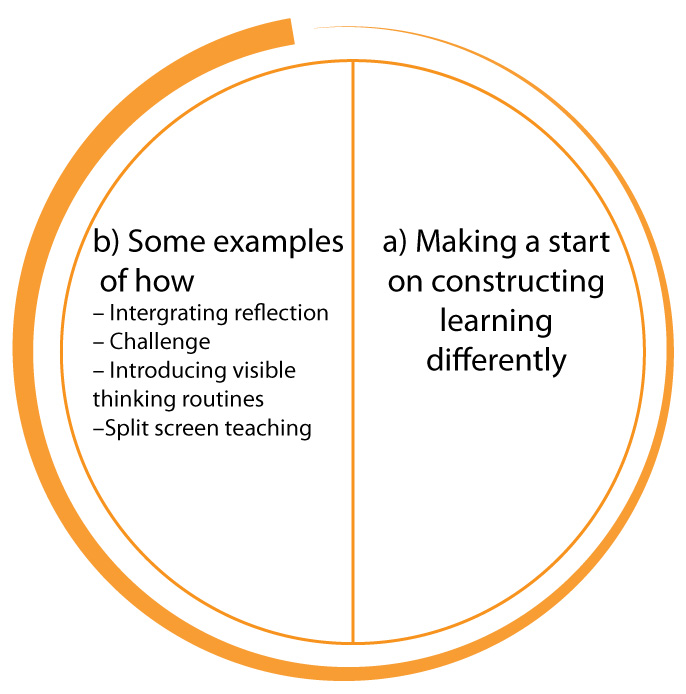
How does the construction of learning in the classroom change?
a) Making a start on constructing learning differently
As we saw in section 3.1, Constructing learning firstly involves integrating reflection and review into the way learning is organised; where activities are designed to stretch and challenge not just in outcome terms but in the very nature of ‘doing’ the task (dual focus of content and process). Pupils’ emotional engagement is a pre-requisite when learning is organised in these ways, and the value of learning is in pushing yourself so that your capacities are stretched and strengthened. The early stages of making a shift in this aspect of the learning friendly classroom might simply include;
- plan lessons to explicitly include reflection and review purposefully
- making challenge fun and available in forms other than activities
- introducing a couple of Visible Thinking Routines
- beginning to dabble with split screen learning
The classroom becomes a place where young people learn that to struggle with a problem is ultimately satisfying and brings its own rewards.
Learning organised to promote struggle
b) Some examples of how
1) Infuse reflection and review into lessons
Reflection has become widely seen as part and parcel of good learning. Strategic approaches such as ‘Plan Do and Review’ have been with us for many years and form the basis of a good deal of learning in Early Years. More recently ‘Assessment for Learning’ has emphasised the role of reflection in improving learning and achievement. Pupils are now much more familiar with such techniques.
As Mike Hughes observes in ‘Closing the Gap‘
“Trying to learn without reviewing is like trying to fill the bath without putting the plug in”
And yet, reflection is still used by many schools for summative evaluation of a piece of work, rather than being woven formatively throughout the learning and production process.
Being able to reflect, review and refine your ideas is one of the key learning characteristics. Pupils need to be taught;
- not to wait till they’ve finished before reviewing what they are doing;
- to keep making small checks and revisions all the time as they go along …am I on the right track? Is there something I’m missing?.
- to check what they have done at the end…is this as good as I can make it?
- at the end, to think about whether there’s a better way to do it?
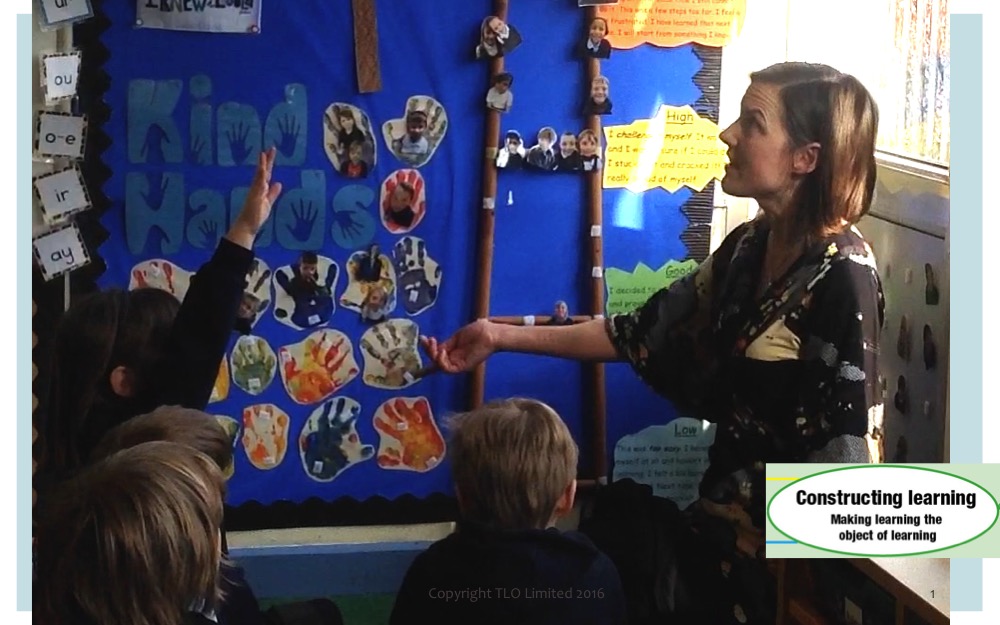
At this school in Bristol, Becky draws the children together at the end of a lesson and to review together what they have been doing. The emphasis is on whether they have stretched themselves and how that felt. The ladder shows different stages of stretch and children put their faces on the step they have been trying.
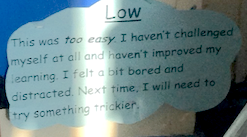
Here’s a description of the lowest stretch
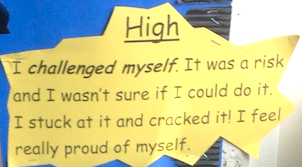
Here’s a description of a higher stretch
In this key stage one class in a small school in Cumbria the teacher Claire draws the children together to discuss what they have been doing. The puppet (Orla) is the bad learner in the class (there are no others) and the children explain to Orla what they have been doing. They produce a correct record of what they have done in a special book for Orla after their discussion (see book at end of video)
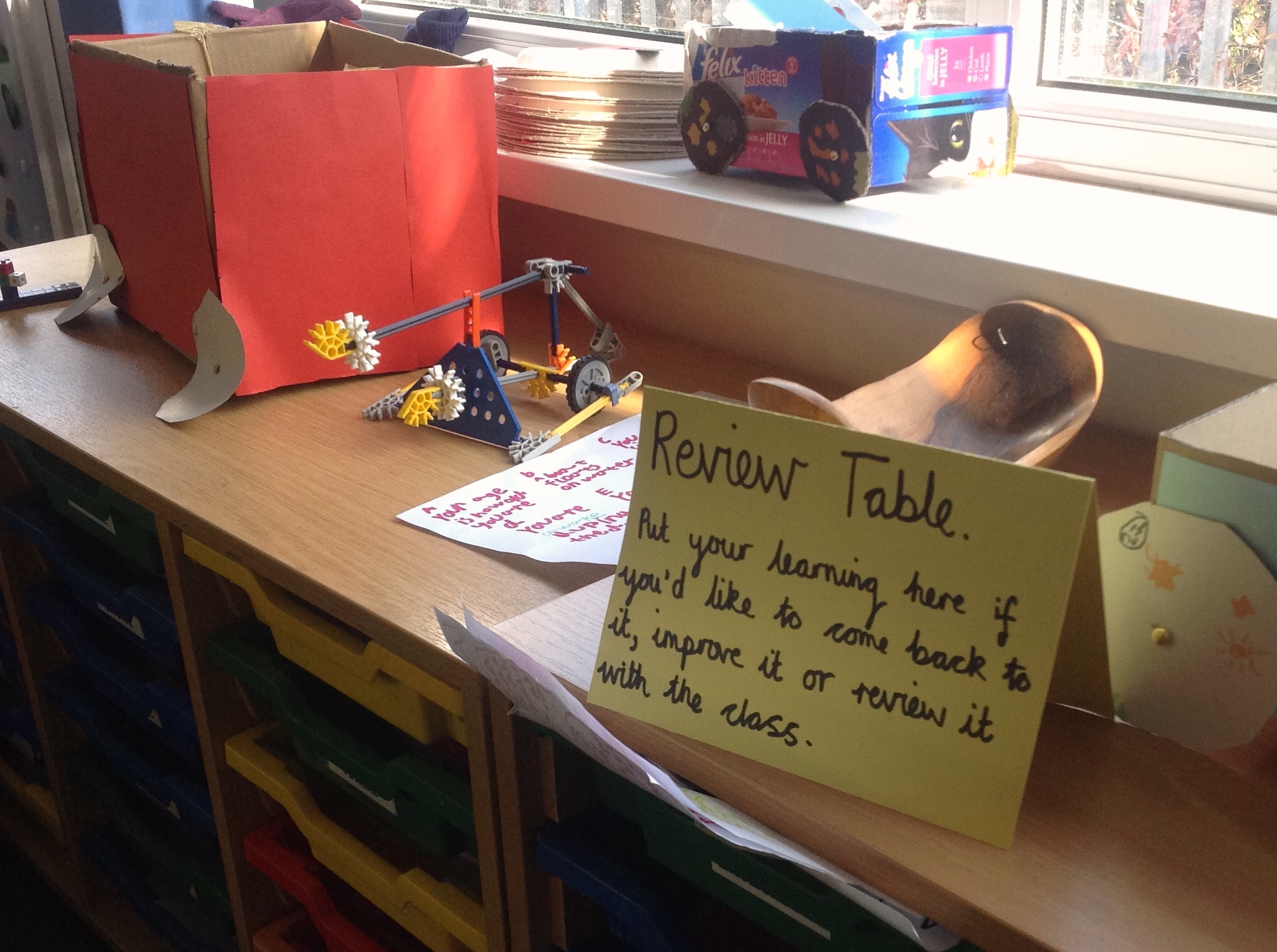
Here’s just a little reminder that you can come back to reconsider, re-edit, review your learning a while later.
Reflection and review as non-negotiables
2) Making challenge available and fun
There’s a big link between emotional engagement and challenge
Learning is always an emotional business and learning how to manage this is best done ‘on the job’ in the course of learning rather than as a separate stand-alone activity. Emotional engagement is a prerequisite of powerful learning, it’s what gets you interested enough to be willing to put in the effort to get better and see the value of pushing yourself. So lessons aren’t just designed to make use of different kinds of learning behaviours but to give those behaviours a good work-out. Activities are designed to:
- be challenging, where being stuck and confused are regular and fruitful experiences.
- give students the opportunity to ‘learn what to do when they don’t know what to do’ – to work on wild tasks, rather than tame ones, where there’s plenty of scope to get lost and perplexed.
“The presence of challenging learning intentions has multiple consequences. Students can be induced to invest greater effort, and invest more of their total capacity than under low demand conditions.”
(John Hattie, Visible Learning)
Or, as a teacher said to us recently:
“I became a better teacher the day I stopped thinking ‘have I made it easy enough for them to understand it?’ and started thinking ‘have I made it hard enough to stretch them?'”
Try these ideas to support challenge
- Make positive connections between making mistakes and challenge
- Model how to think about and work through challenges
- Create a challenge wall; put up questions, extension tasks, riddles, problems. A go-to place for another challenge when other learning is finished
- Display work that shows pupils have improved mistakes etc.
- Stimulate using ‘Stingray’ questions…What if...(something they thought they knew from a different angle – What if gravity was twice as strong ?)
- Use the ‘learning pit’ to talk through what to do to overcome/surmount a challenge.
The Learning Pit
You need to be emotionally engaged to take on challenge.
3) Introducing Visible Thinking Routines for Reflection
What are Visible Thinking Routines?
VTRs are, as they say, simple routines that apply across a wide range of subjects and contexts, and which require students to think in a variety of different ways, that are used so regularly by teachers that they become woven into the fabric of the classroom culture and progressively hard-wired into the thinking practices of students.These are ways in which different ways of thinking can become routine in classrooms. They become part of the learning culture.
To be effective such routines need to be;
- Direct, guide, support, encourage thinking
- Short, memorable, few steps
- Used over and over again
- Useful in a variety of contexts
- Facilitate connections, generating ideas, using knowledge
Find out more: Google ‘Visible thinking routines’
Connect Extend Challenge is a visible thinking routine for connecting new ideas to prior learning and encourages reflection.
It goes like this;
CONNECT: How are the ideas and information presented CONNECTED to what you already knew?
EXTEND: What new ideas did you get that EXTENDED or pushed your thinking in new directions?
CHALLENGE: What is still CHALLENGING or confusing for you to get your mind around? What questions, wonderings or puzzles do you now have?
The routine helps students make connections between new ideas and prior knowledge. It also encourages them to take stock of ongoing questions, puzzles and difficulties as they reflect on what they are learning.
Make thinking visible
4) Split screen teaching
Whether we realise it or not, all lessons have a dual purpose:
- The content dimension, with material to be mastered
- The ‘learning’ dimension, with some learning skills and habits being exercised.
In conventional lessons where pupils focus exclusively on mastering content while the learning dimension is not acknowledged; pupils may learn ‘stuff’, but they remain unaware of how they are learning it. Such lessons make the content very public, while the associated learning behaviours remain a closely kept secret. So pupils learn habits of compliance or dependence.
In developing learning power, teachers are making conscious choices about which habits to introduce and stretch and how best to couple these with content so that lessons become more interesting and challenging. Through such overt coupling of content and specific types of process, students come to know, understand and take control of their learning behaviours – they knowingly use and develop the whole range of learning behaviours.
To make a start on this, try considering your plans for the coming week or month in relation to the following questions;
Where, in these plans, can you find opportunities to:
1. Build their emotional engagement
- In your series of lessons, where do you expect pupils to become stuck?
- What prompts would help them overcome their stuckness?
- Are there any opportunities to encourage noticing behaviours?
2. Stretch their cognitive range
- What proportion of your lessons are spent on encouraging pupils to question?
- Where might you encourage more pupil questioning or playing with ideas?
- To what extent are the activities pre-digested – where most of the work has been done for them?
- How much do the activities generate students’ own initiative, questioning, research and information processing?
- Could you make more activities ‘wild’ rather than ‘tame’?
- What proportion of your series of lessons calls for disciplined, logical thinking and reasoning?
- Could some of the activities be amended to foster imagination, visualisation, intuition?
3. Foster their interpersonal involvement – social
- What proportion of your series of lessons requires pupils to collaborate in order to complete a task?
- Could you fit more collaborative activity into your lessons?
4. Extend their strategic responsibility (Reflectiveness)
- What proportion of your series of lessons involves pupils in monitoring and revising their own work?
- Could you include more along these lines?
Infusing learning into lessons
Comments are closed.