
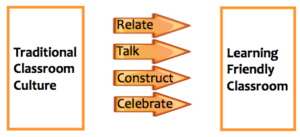
Building powerful learners involves shifting classroom cultures from teacher-focused to learning-friendly.
Find out about the 4 aspects of classroom culture:
- The relationships in the classroom;
- What is talked about;
- How lessons are designed;
- What is celebrated.
and gain an overview what these look like in teacher-focused classroom and learning-friendly classrooms.
If you are reading this as a senior leader… reflect on classroom cultures across the school.
If you are reading this as a classroom practitioner… reflect on your own classroom culture.
A Transforming Culture
Making learning power work involves transforming the culture of the classroom. A common language for learning is adopted; staff shift responsibility for learning to students and model learning by sharing their own difficulties, frustrations and triumphs; students come to understand themselves as growing learners and consciously improve their learning habits; teachers assume the role of learning-power coach, offering students interesting, real and challenging activities to enable them to create their own knowledge and stretch their learning habits. Underpinning this is the obvious reality that students will only change their behaviours once their teachers have changed theirs’.
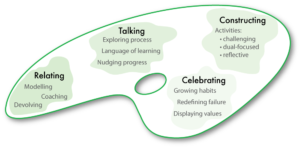
The culture of the classroom is determined by how teachers are, the relationships that exist between the teacher and the learners, the ways in which the teacher talks and what the teacher talks about, the extent to which teaching is designed to ensure both content acquisition and the development of learning behaviours, and the often subliminal messages about what the teacher really thinks is important.
These 4 aspects of culture – Relating, Talking, Constructing and Celebrating – form the basis of The Teachers’ Palette, one of the two key models in Building Learning Power.
Which of these descriptions of teacher-focused and learning-friendly cultures better describes your classroom(s)?
Relating for Learning
Consider these two descriptions, the former of a classroom where relationships for learning are teacher-centred, and the latter of a classroom where responsibility is shared.
Relating in a teacher-focused classroom
The classroom is heavily teacher-led and responsibility for learning lies almost exclusively with the teacher. Teachers teach efficiently and students make good content progress. Students have little influence on the direction of their own learning. They go to school to be taught things by an expert. The underlying culture is ‘teacher knows best’.
Relating in a learning-friendly classroom
Responsibility is genuinely shared, teachers and learners learn together, with and from each other. Teachers are skilful coaches who value discovery over instruction in the belief that students can discover much for themselves. Students exercise choice and pursue their own lines of enquiry. The line between teacher and learner is increasingly blurred.
Talking for Learning
Consider these two descriptions, the former of a classroom where talk is almost exclusively about content, and the latter of a classroom where talk is about how students are learning.
Talk in a teacher-focused classroom
Talk is mostly about content and ‘working hard’, teachers are inclined to discuss ‘the right way of doing things’ to get things right. Supportive comments and feedback focus on subject knowledge. Discussion about learning, when it happens, is often ill-focused and relates, for example, to ‘doing your best’ or ‘working in a group’.
Talk in a learning-friendly classroom
A rich and differentiated language of learning permeates classroom discourse, teachers and students together explore and reflect on the process of learning and how it can be improved. Both exhibit fluency and deep understanding. Teacher comments are differentiated and supportive and nudge students to focus on the what and on the how of learning, and how they are linked.
Constructing Learning
Consider these two descriptions, the former of a classroom that focuses on understanding the content, and the latter of a classroom that focuses equally on developing content understanding and growing learning behaviours.
Lesson design in a teacher-focused classroom
Attainment and examination success are the key drivers, teachers design lessons to ensure effective content acquisition. Activities are designed to address the content to be learned. Reflection is confined to reflection on what content has been learned, and is frequently done by teachers for learners.
Lesson design in a learning-friendly classroom
Teaching is constructed with learning in mind, teachers skilfully orchestrate lessons to ensure progression in content and the acquisition of effective learning habits. Activity is characterised by a range of rich, challenging, open ended tasks or problems. Reflection focuses on what was learned and how it was learned and how well it was learned and how it might be applied elsewhere.
Celebrating Learning
Consider these two descriptions, the former of a classroom that prizes knowledge acquisition, and the latter of a classroom that demonstrates a commitment to building better learners.
Celebration in a teacher-focused classroom
Classroom culture focuses on ‘knowing stuff’, teachers act to improve content learning without focusing on the process of learning. Improvements in students’ learning behaviours come about by chance and without direct teacher intervention. Teaching is frequently risk-averse, and display focuses almost totally on content. Rewards tend to be given for high attainment or progress rather than for effective learning behaviours.
Celebration in a learning-friendly classroom
Classroom culture prizes students’ growth as learners as highly as their curriculum attainment, and teachers take action to help individual students to grow as learners. They ensure that learning is sufficiently challenging to induce errors from which learning about content and learning about learning can be achieved. Creative, interactive display enables students to understand how learning behaviours support and enhance content acquisition.

- Which of the four aspects of culture is most learning-friendly in your classroom/school?
- What more needs to be done?
- Which of the four aspects is least learning friendly? What could you do differently?
- If you were to look back on this in six month’s time, which aspect would you most like to have progressed?
- What will you do to ensure that this happens?
Comments are closed.