

Do we need a separate version for Wales that references the welsh agenda re learning school? See pdf from welsh govt sent on 2/3/19
“Does the school, as an organisation, create the conditions necessary for learning power to flourish?”
Find out about:
- How the four domains of learning – the emotional, cognitive, social and strategic – apply to a school as an organisation;
- The extent to which your school is a learning organisation.
Adopting a focus on learning in school involves supporting teachers to develop their practice to support students to build their learning behaviours. But changes may also be needed at an organisational level to create a climate within which such changes in teachers and students can flourish.
This unit outlines a range of organisational indicators that support the development of Building Better Learners and invites you to analyse where your school is now against these indicators.
Does the school, as an organisation, create the conditions in which learning power can flourish?
Creating a trickle down culture
As a school you have decided that you want to develop your students as emotionally intelligent learners who are cognitively skilled, socially adept and strategically aware. However, this is unlikely to happen unless teachers themselves adopt these qualities, modelling and surfacing the behaviours they wish to instil in their students.
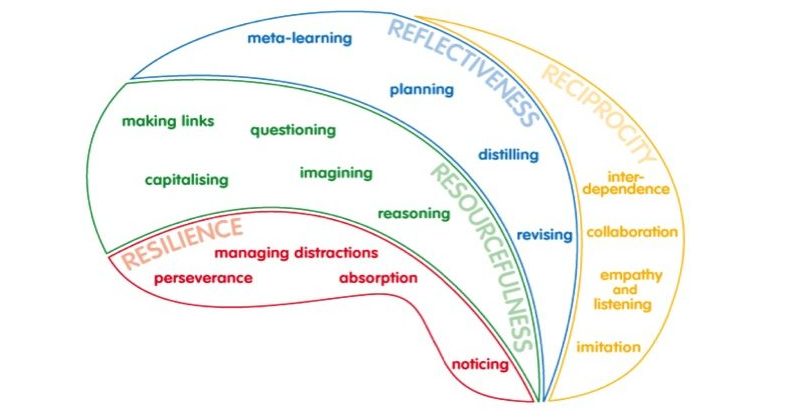
The Supple Learning Mind for learners, teachers and schools
Similarly, teachers will find it difficult to do this unless, the school, as an organisation, does itself display these qualities. Thus in adopting a focus on learning the school needs to act in ways that:
- ensures its own improvement as an organisation;
- ensures its teachers grow as confident, interdependent, risk taking professionals, who in turn..
- guide students to become self-regulating learners. It’s a cascade effect.
As John Hattie says in Visible Learning for Teachers:
“The remarkable feature of the evidence is that the greatest effects on student learning occur when teachers become learners of their own teaching, and when students become their own teachers”
The school as a learning organisation
Translating the learning framework to an organisation
A school that is emotionally engaged, cognitively skilled, socially involved and strategically responsible exhibits a range of positive learning behaviours, much like the ones we are seeking to develop in learners:
The school that is Emotionally Engaged:
- Takes risks in pursuit of its long-term goals;
- Is tenacious;
- Is resilient and optimistic in the face of difficulty;
- Maintains focus on what it sees as important;
- Experiments and learns from its mistakes.
The school that is cognitively skilled:
- Is interested in and questions how things might be different;
- Senses how things are inter-connected;
- Is efficient and methodical;
- Creates its own understandings for itself;
- Makes enterprising, opportunistic use of what is available.
The school that is socially involved:
- Is inclusive;
- Is led by a team that consults and coaches;
- Values all contributions and contributors;
- Is outward looking and networked with other schools / professionals;
- Learns and functions as a team.
The school that is strategically aware:
- Has a vision and plan of action to achieve it;
- Initiates;
- Monitors, evaluates and and adapts;
- Focuses on the important rather than the urgent, and knows the difference;
- Understands how it learns.
How well does this describe your school? What might you need to do differently?
A school that learns
Where is our school on its own learning journey?
Consider these descriptions of a school’s learning culture. Which better describes your school as a learning organisation?
The emotionally engaged school
Consider these two descriptions, the former of a school with low levels of emotional engagement, and the latter of the highly emotionally engaged learning organisation.
The school is inclined to start out on things, but lacks the will to see them through to a conclusion. Sometimes things fail due to lack of attention to detail and/or poor organisation / administration. Outside influences have a disproportionate impact on the school’s own agenda, making it more reactive than proactive.
The school is tenacious in pursuing its own agendas to a successful conclusion. Leadership, management and administration combine to deliver effective change by attending to both the big picture and the necessary detail. Leaders filter outside pressures to ensure that the school retains focus on its core purposes.
The cognitively skilled school
Consider these two descriptions, the former of a school with low levels of cognitive skill, and the latter of the highly cognitively skilled learning organisation.
The school is more inclined to ask ‘why’ than ‘why not’. It lacks the curiosity to ask searching questions about how it might improve, and sometimes repeats previous errors. Development lacks imagination and creativity, and sticking to the tried and tested is preferred to innovative solutions. A lack of clear, methodical and logical thinking means that the school is prone to make decisions based more on instinct than on evidence. It finds it hard to make best use of the resources and ideas available to it.
Intensely curious, the school is forever thinking ‘what if?’ and ‘why not?’. Innovative yet methodical, creative and yet securely grounded in its recent history, willing and able to exploit the creative ideas and strategies that emerge. Enterprising in developing creative solutions to seemingly intractable problems, skilled in making too little go further than other schools, able to make limited resources achieve maximum impact.
The socially adept school
Consider these two descriptions, the former of a school with low levels of social engagement, and the latter of the highly socially adept learning organisation.
The school feels isolated and is inclined to assume that everyone / everything is against it. Is inward looking and feels that it has to ‘go it alone’. Is unaware of existing exemplary practice and so unable to replicate it. Hears what is being said, but is not alert to the underlying messages. Empathy is in short supply. Takes a top-down approach to managing employees, fearful that without this they will not do as required /expected.
The school is outward looking and connected to a number of networks from which it learns and with whom it shares best practice. It values other schools as sources of support and insight and not as potential rivals. It is alert to what is and is not being said. Treats employees with empathy and understanding, secure in the belief that together everyone will achieve more. Leaders work collaboratively with classroom practitioners, aware that their aspirations can only be realised through the efforts of those working most frequently with learners.
The strategically responsible school
Consider these two descriptions, the former of a school with low levels of strategic insight, and the latter of the highly strategic learning organisation.
The school has detailed plans, but these are based on a poorly defined vision or a vision that is not well-shared and understood. Conversely, the vision is secure, yet the plans are ill-defined and lack precision. Monitoring is undertaken, but the results sometimes fail to feed back into planning processes. Evaluation is not always undertaken. The school is prone to focus on the urgent at the expense of the important. It ‘does initiatives’. External verification / accreditation is considered more important than self-evaluation. Lack of clarity over what it is trying to achieve leaves it at the mercy of events, forever trying to bend with the prevailing wind rather than pursue its own agendas.
The vision is secure and agreed by all stakeholders. Plans are systematic and sufficiently detailed, yet open to amendment as circumstances change. Monitoring and Evaluation process are consistent and feed back into action plans. Flexibility in pursuit of goals is evident. The school is able to maintain a focus on what it agrees to be important, while dealing with the urgent as and when necessary. The school innovates, rather than ‘does initiatives’. Self-evaluation is more rigorous and yields greater insight than external assessment. The school understands itself as a learning organisation.
Schools Poles Apart

- What are your first instincts ?
- How far to the right is your school on each of the four aspects ?
- Which might be most in need of attention ?
Comments are closed.