

The why and how of tracking learning progress.
Find out about how progress in learning could be tracked:
- The nature of progression in learning behaviour
- Ways of tracking progress
- Using the outcomes of tracking.
and gain an overview of the importance of progression in learning behaviours.
If you are reading this as a senior leader… reflect on how the issues raised could work across the school.
If you are reading this as a classroom practitioner… reflect on how the issues raised might work in your own learners.
A quick overview of progression
If a parent were to ask whether their child was more perseverant than when they arrived in the school, what would you be able to say? How would you respond beyond, hopefully, yes, or a bland statement about ‘sticking at things for longer’? How would you know? What evidence might you use and where would this come from?
A school that is interested in growing student learning behaviours will want to know the effectiveness of its strategies and the extent to which its students are growing as learners. This is not rooted in a need to label students as ‘level 3 at turn taking’ or ‘A* at conflict resolution’, but rather out of a desire to understand the small, incremental steps that will take a child from ‘can’t share’ to ‘great team worker’, so that subtle intervention can support and even speed the child’s growth as a ‘collaborator’. The same is true, obviously, for all of the other learning behaviours of a Supple Learning Mind.
There are three key facets to the progression of learning behaviours – firstly the frequency/strength with which the behaviour is used, secondly the range of contexts in which it is deployed, and thirdly the skilfulness with which it is employed.
The skilfulness of the habit:
While we may start by encouraging students to ask questions, for example, more frequently or in a wider range of contexts, once this confidence is achieved we rapidly turn our attention to the quality of the questions that are being asked. It is not too difficult to describe the attributes of a high level, sophisticated questioner who is skilled at asking incisive, generative questions, but it is very difficult to map out and sequence the steps between the natural curiosity of a three year-old and the sophisticated skill-set of the consummate question-asker/enquirer. This is the challenge, and why skilfulness is the most complex of the three dimensions. However, once mapped, the impact on mentoring, target-setting, self and peer assessment, assessment, recording, reporting, task design, and curriculum planning etc is immense.
Why track progress?
There are several reasons why schools find it useful to start documenting progression in students, far beyond being able to reassure a parent about progress. They find that it:
- motivates and encourages students to put in the effort to continue improving their learning behaviours;
- gives students feedback on their learning behaviour progress so that they can decide which learning; behaviours they are going to target in the next period;
- encourages teachers to realise that their efforts to improve learning behaviours are being effective;
- gives teachers information about individual students or classes that will enable them, the teachers, to discuss and guide learning development more precisely and helpfully;
- validates the progress made by students in terms of conventional attainment measures.
All of these purposes are legitimate and useful but they suggest different kinds of information gathered over different timescales. In devising a policy for tracking the development of learning power, schools create a multifaceted portfolio of indicators rather than a single metric.
What types of evidence might we consider?
Getting students ‘doing it’ is one thing, but getting them doing it more frequently, more skilfully, in a wider range of contexts, is why you are involved. What types of evidence can teachers collect in order to make these kinds of judgements? We think of these in three broad categories: what students think of themselves as learners; what teachers observe of students as learners; what other people perceive of students as learners.
What students think about themselves as learners
 Given the opportunity, students are often happy to reflect on, talk about or write about themselves as learners. Learners’ own self-reports offer a rich and legitimate source of evidence through, for example:
- extracts from students’ learning logs;
- digital records of personal best moments taken by students themselves;
- student responses to self-report questionnaires;
- evidence from self and peer assessments;
- testimony recorded in their school planner.
What teachers observe of students as learners
 Taking on the role of a learning coach offers teachers more time to observe students developing their learning habits. As they mark students’ work they will also be noticing and commentating on their use of various learning behaviours. They may be rewarding /praising the determined use of learning behaviour or undertaking observations of students as they grapple with a new challenge.
Such evidence might include:
- students’ products or performances;
- photographic records of ‘personal best’ moments;
- dynamic assessment—observations and records made of students in the process of learning. When and how they ask for help. The kinds of questions they ask. The sort of self talk they venture out loud;
- a record of to whom, when and why rewards/praise were given;
- recognition comments that echo the progression chart statements.(e.g. the chart below)
What other people perceive of students as learners
Evidence of using their learning behaviours more widely can be drawn not only from other teachers but from people who see the students outside school. It might include:
- unsolicited comments from parents;
- digital records from home or school clubs or out-of-school activities;
- testimony from employers regarding a student’s attitude to work during work experience;
- testimony from piano teachers, sports coaches, youth club leaders, and the like.
You may have noticed that ‘students’ achievement levels’ do not feature as a source of evidence for their developing learning power. This is not because we don’t think it is important, but because it does not necessarily correlate with learning power. Students’ achievement might have improved because the school has got better at spoon-feeding, for example. Nevertheless, research tells us that greater confidence and skill at learning results in better performance.
Naturally, as you gain a clearer record of your students’ growth as learners (as opposed to knowers), you have a rich evidence base from which to report more extensively to parents about both their attainment levels and how they are developing as a learner.
Tracking deeper skills
Consider our Progression Chart for perseverance, which offers a way to understand and plot the complex journey from the ready giver-upper to the highly tenacious in pursuit of goals.
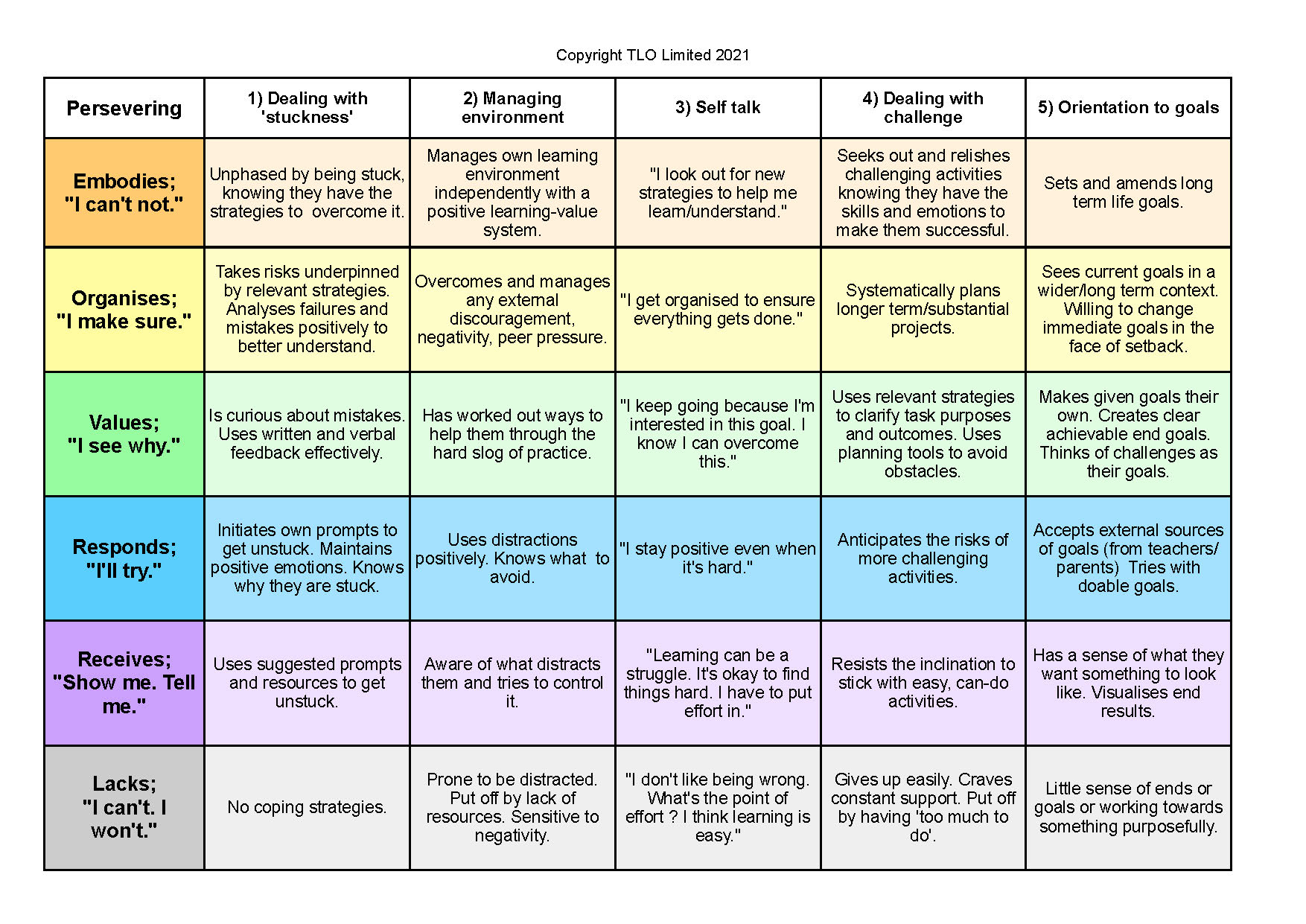
Currently such charts are written for teachers; the language too sophisticated to be useful for students and the statements often too broad to be individually tracked. However, these statements could used/adapted for use in student reports.Or, why not try breaking the statements down even further into a couple of ‘can do’ statements.
But, take a broad look at your school’s learners through the lens of this map of perseverance:
- Outliers aside, where are the majority of your youngest learners?
- Outliers aside, where are the majority of your oldest learners?
- Do your students become increasingly perseverant as they pass through your school?
- Can you speculate on why this happens?
- Would plotting this progression be useful?
- to teachers
- to students
- to parents
- Do you think it would be realistic to have most of your oldest students reaching at least the Value/Green phase?
- How might you use the chart to help you sort out the evidence you need to collect to show such progression robustly?

- what are the advantages of tracking learning behaviours in this way?
- any disadvantages?
- how could you use the outcomes to inform:
- teaching?
- learning?
- mentoring?
- target setting?
- curriculum planning?
- reporting to parents?
Comments are closed.