

This unit is a companion to the eight phase 2 Building Powerful Learners units.
It offers further insights into progression in the 4 key learning behaviours that were introduced in phase 1 of the programme.
Progression in the 4 foundation learning behaviours
The story so far . . .
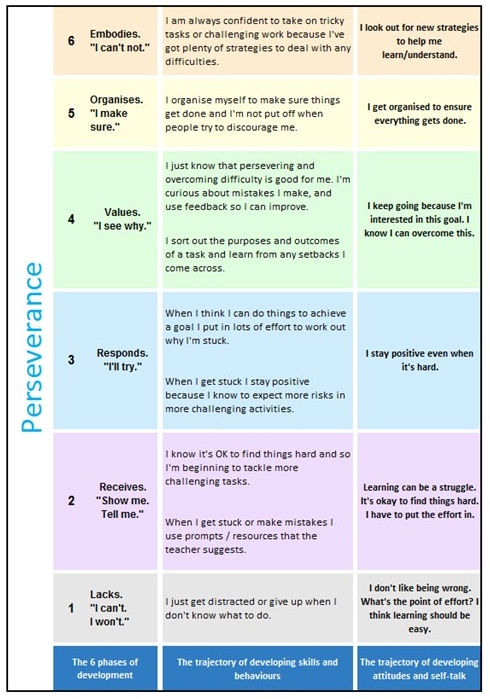
In Phase 1 of the Building Powerful Learners programme, we offered relatively simple, single column progression trajectories for the 4 foundation learning behaviours (like the one for Perseverance opposite). This was intentional, easing teachers into understanding progression without overwhelming them with too much detail.
To support your developing understanding of the foundation learning behaviours and how they grow, we now offer the full progression charts for Perseverance, Questioning, Collaboration, and Revising. Explore these full progression charts in the toggle boxes below.
Spend some time exploring these full progression charts – you will gain further insights into these key learning behaviours and how they develop over time. Also – take the opportunity to look at your own students through the lens of these full progression charts, identifying areas of strength and relative weakness.
Find out more about progression in Perseverance ⬇️
Overview of the full Perseverance progression chart
Perseverance is about the way we stick at things even when they are difficult. It’s one of the most useful but neglected learning behaviours. What makes us able to persevere more and more usefully? We think several things come into play here. How you are willing and able to deal with being stuck, how you are able to manage distractions and manage the learning environment, how you relate to a challenge and whether you are influenced by goals whether they be your own or imposed by others. All these things contribute to being able to persevere. And lastly there’s your own little voice of self-awareness: what you say to yourself and how this influences your beliefs and values.
Take a closer look at what each column of the chart is about.
Column one is about way how we react when we get stuck; the strategies we have for overcoming it; being brave about not knowing something; how we cope with making mistakes; how we benefit from feedback about mistakes or being stuck; how we come to love mistakes, become curious about them and learn from them. There’s a long and winding road buried in the statements in this column and the role of the teacher is to ensure students make a significant start on this journey.
Column two is about how we manage our learning environment; the extent to which we can manage our own learning climate, ignore or manage distractions, regain focus if lost. Since much of students’ learning takes place in a classroom, they need to be able to manage and take advantage of that environment. They learn to understand just what distracts them from learning and why distractions can be both a help and a hindrance. How they need to learn to overcome the hard slog of practice and use their environment to help. How the learning environment can include all sorts of negativity from others and how they might overcome these disruptive emotions. The learning environment itself has many facets that can trip up and stall learning.
Column three is about what we say to ourselves as we learn. The statements capture what someone in each phase of the grid might be thinking. Students may use some of these phrases when talking with you, or in writing from time to time, but mostly self-talk goes on inside their heads. We have shown a small flavour of self-talk thoughts that teachers can encourage students to imitate. Some relate to how emotionally brave they are, others to the strategies they have at their disposal. All such self-talk is important in building a persevering habit.
The deeper perseverance chart.
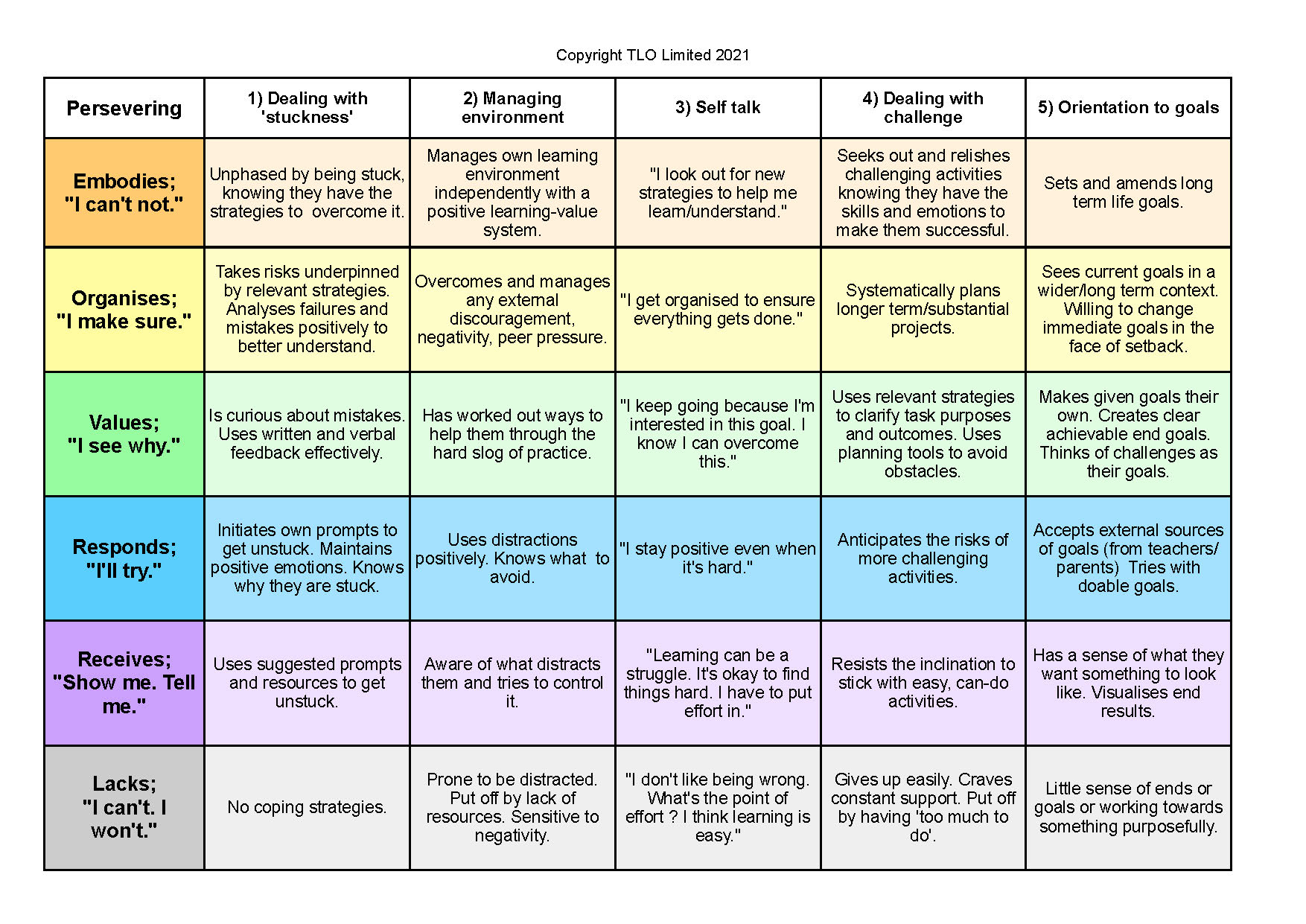
Growing perseverance; a trajectory of developing behaviours, skills, attitudes and self-talk
Download as a pdf
Column four is about how we relate to challenge: are we more excited by the prospect of triumphing over challenge, or more afraid of failing when faced with difficulty? Challenge needs to be included here with Perseverance because there is little need to persevere with easy, familiar activities. Students need to be challenged even for us to discover how or whether or not they persevere at all. So the growth of ways to cope with challenge helps to cement Perseverance too. Here they learn to enjoy a challenge and recognise the satisfaction of triumphing over difficulty. The phases include practical ideas like recognising risks, sorting out what the challenge is fundamentally about, and using tools to plan and avoid obstacles.
The last column is about how we relate to goals, since having goals can have an impact on our perseverance. Let’s face it, if you haven’t got a goal, or at least an interest in something, you are not likely to stick at it and channel your emotion positively to get it done. In the beginning students have little sense of goals or purpose but this can be turned into being able to imagine what something might look like. Later students can be helped to understand what a ‘do-able’ goal is and how to turn goals set by the teacher into a goal that they want to achieve – to make it their goal. A wanted goal is something you put effort into. Later phases in this development include being able to put your goals into a wider context, to realise that being able to do X or Y isn’t just about the here and now but has wider implications for life. This will certainly come into play when choosing options, for example. Do students go for something they like, enjoy and find easy or do they choose some options on the basis of their relevance to their future career? It’s a hard and grown up sort of decision to make. This orientation to goals all turns on how we design our own goals, blend these with the goals of others, and then pursue them with tenacity and independence.
What do you think?
- How does this extended progression chart connect with what you have already learned about Perseverance?
- How does this chart extend your thinking?
- What challenges and questions does this raise for you?
Make a note of…

- Which column(s) your students are most secure in.
- Which column(s) are most in need of further development.
Find out more about progression in Questioning ⬇️
Overview of the full Questioning progression chart
We tend to think of questioning as a common everyday skill that we all use and indeed it is. But questioning is rooted in curiosity and is therefore a big driver of learning. But as with any learning behaviour it can wither and atrophy if left unattended. If children are made to feel stupid for asking questions, or told that questioning is cheeky, or that questioning is time wasting they are more than likely to give it up…it has little value to them. So this grid draws together all the aspects of learning that might contribute to questioning becoming a vital, well-honed skill for navigating life. It deals with the details of questioning skill but also touches on search skills and indeed how we ask questions of others such that it’s accepted and generously answered.
Take a closer look at what each column of the chart is about.
Column one is about how we actually attend to being curious; what is it that piques our curiosity and how we keep it going. In the early phases this might involve looking carefully for the issues or details that our questions raise, using this information to go deeper, becoming fully involved/absorbed in a quest to uncover possibilities or answers. The more we ask, the more we find out, and the more curious we become to find out yet more. In the later phases we might become more picky about the information we are uncovering/seeking, making sure it is valid for our purposes. We become fascinated by both the big picture as well as the small details of an enquiry and seeking new experiences and information becomes a way of life.
Column two is about we go about being curious, finding things out, seeking information requires the ability to search effectively. This may start with asking questions of others or using a book index and library skills or reading a map. But these days searching rapidly embraces the internet and a whole new range of focused questioning skills come into play. Finding information may have become rapid and simple but discerning relevant, reliable and robust information calls for yet more new skills. How we seek, question and capitalise on a variety of resources, from books, to the internet, to physical tools is a vital aspect of any ‘finding out’ quest.
Column three is about what we say to ourselves as we learn. The statements capture what someone in each phase of the grid might be thinking. Students may use some of these phrases when talking with you, or in writing from time to time, but mostly self-talk goes on inside their heads. We have shown a small flavour of self-talk thoughts that teachers can encourage students to imitate. How might we talk to ourselves in shaping our questioning behaviour? How does this talk move from the ‘need for help’, to enjoying the challenge of finding out, to taking a questioning approach to everything we do.
The deeper questioning chart.
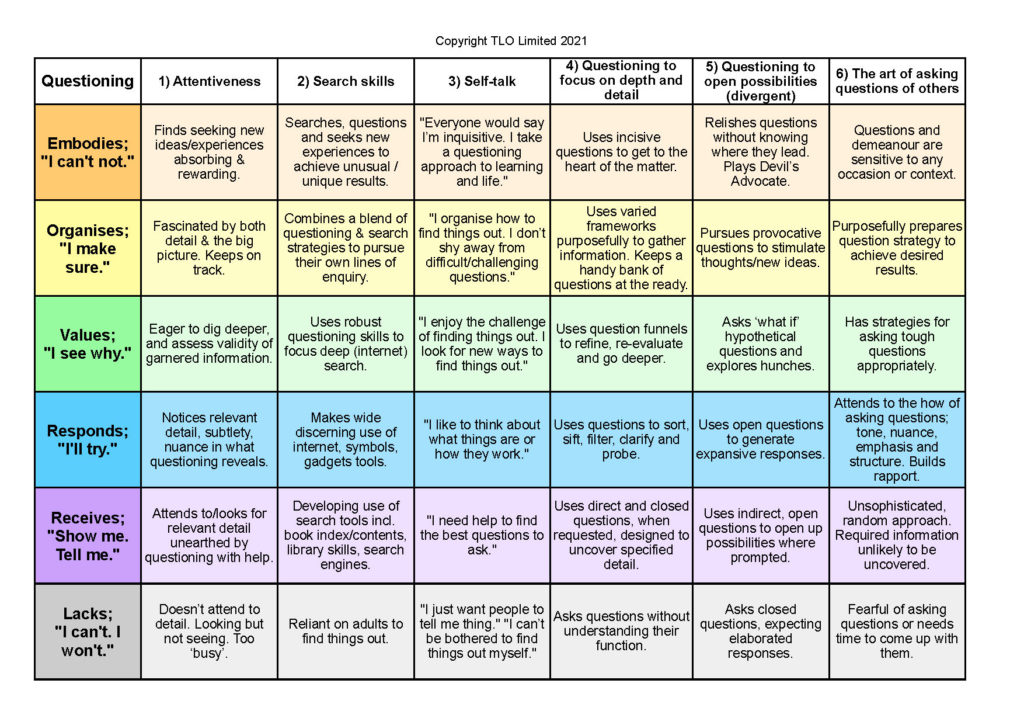
Growing questioning; a trajectory of developing behaviours, skills, attitudes and self-talk
Download as a pdf
Column four is about the types of questions, and in this case the type of questions that are designed to seek more detail and depth. Here the questioning is more focused moving from simply knowing about closed questions and using them to find things out; to developing questions that will sift and filter information; to being about to use question frameworks purposefully; to being able to construct incisive and generative questions to probe the essence of something. In brief, how adept are we at posing questions that will uncover specific details and converge on and get to the heart of the matter.
Column five is about a different sort of questioning; that of opening possibilities (divergent). Here our questioning approach gets braver as we move from opening possibilities when prompted, probing for more expansive information, to asking ‘what if’ questions. This expansive questioning leads to exploring possibilities, thinking about things differently, stimulating new ideas, daring to be different, exploring hunches, being creative. It’s a line of questioning that leads us into the unknown.
The last column is about the aspect of asking questions of others. Questioning others, even through the lens of being curious, is a skilful business. It’s easy to upset people without realising it. It might be by using the wrong tone, or putting the emphasis in the wrong place. Building rapport with people is a really important aspect of being able to ask questions, especially when, for one reason or another, the questions have to be tough. In the later phases of developing this skill we learn how to prepare a set of questions that will make an argument/case, or uncover a problem, or develop a story (much as you may do in preparing a set of questions for guiding a lesson). Eventually we become skilled enough to know just what sort of question to ask, in the right way, in the appropriate setting. Thus we have become sensitive to the potential impact of posing questions as much as to the quality of the question itself.
What do you think?
- How does this extended progression chart connect with what you have already learned about Questioning?
- How does this chart extend your thinking?
- What challenges and questions does this raise for you?
Make a note of…
- Which column(s) your students are most secure in.
- Which column(s) are most in need of further development.
Find out more about progression in Collaboration ⬇️
Overview of the full Collaboration progression chart
Collaboration involves knowing how to learn with others, as part of a team, in situations where no one person knows all parts of the puzzle. This complicated yet essential learning habit develops in several different ways. First of all it hinges on social interaction; how well we get on together, whether we are patient with others and respect their views. Then how we are able to bounce off others to build ideas; making the most of several brains rather than one. Next, how we learn to be part of a team and to perform different roles when needed. Fourthly, how we talk to ourselves about learning with others, where our real understanding of the process is revealed. Fifthly, how we contribute to the process of actually getting things done. Not just being there but doing something helpful. And lastly how we contribute to improving team performance by evaluating not just outcomes but the process of getting there.
Take a closer look at what each column of the chart is about.
Column one is about how we interact socially in learning and working with others. The way in which we learn the social conventions of behaving in a group; taking turns to speak and contribute, listening to understand others; being patient with others and not hogging the limelight; stepping outside our own concerns and building the confidence of others and respecting their views; being able to manage and overcome the inevitable controversy as teams work creatively together; and thus being able to become a valuable sociable member of any team.
Column two is about how just being good mates in a team doesn’t lead to success. Teams have to understand how to build ideas together; to draw on the ideas of others, to be able to graciously set aside ideas that wouldn’t work, to spark off others to ensure new and better ideas get an airing. And somehow, in all this ‘togetherness’ people are able to retain their independent judgement and avoid being drawn into group think. Teams share and build ideas together; growing and improving possible solutions in order to reach their goals.
Column three is about how working as a team is rather different to working in a team. It’s all about ‘teamness’ or ‘togetherness’. In order to work as a team people need to understand team roles, to find out what role they are particularly good at, to take on a range of roles when needed and eventually be willing to play any role in a team to ensure the goal is reached. Being able to work as a team is influenced by how our self-perception and confidence grow, how we learn to trust, and how we recognise the need for each other.
The deeper collaboration chart.
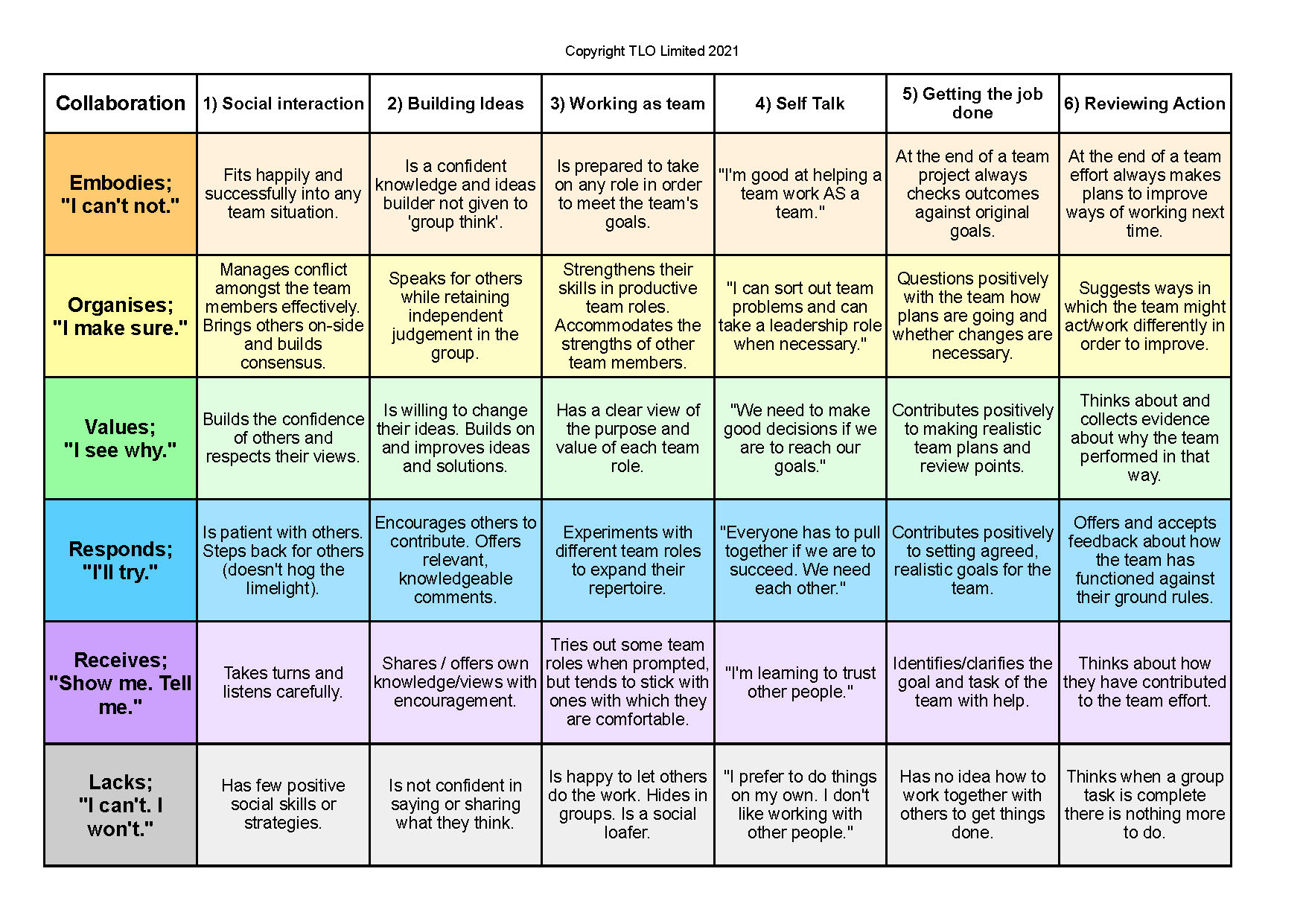
Growing collaboration; a trajectory of developing behaviours, skills, attitudes and self-talk
Download as a pdf
Column four is about what we say to ourselves as we learn. The statements capture what someone in each phase of the grid might be thinking. Students may use some of these phrases when talking with you, or in writing from time to time, but mostly self-talk goes on inside their heads. We have shown a small flavour of self-talk thoughts that teachers can encourage students to imitate. Some relate to standards, others to self-monitoring, or flexibility. All such self-talk is important in building a collaborating habit.
Column five is about how teams achieve their goals by using the well-known learning process of Plan Do Review. Good teams have people who know that the first job is to be clear about what the task is really about. They are skilled in considering/creating/agreeing realistic goals to be achieved and which everyone has bought in to. Then the team has to plan how they will achieve the goal, how they will monitor their progress and methodology and how they will make sure the job is well done.
The last column is about how teams learn how to improve. It’s the aspect of teamwork that is frequently left out altogether or given short shrift. But it’s the aspect of teamwork that helps teams build themselves into better teams. It includes evaluating how they performed as individuals in contributing to the work of the team and how/whether the team process worked to achieve the team goal. Importantly such reflection leads to serious re-planning of their ways of working. It’s meta learning at a team level. Good teams will be looking for what has become known as marginal gains, those little things we can do better/improve that will impact on the overall performance.
What do you think?
- How does this extended progression chart connect with what you have already learned about Collaboration?
- How does this chart extend your thinking?
- What challenges and questions does this raise for you?
Make a note of…
- Which column(s) your students are most secure in.
- Which column(s) are most in need of further development.
Find out more about progression in Revising ⬇️
Overview of the full Revising progression chart
Revising is about the way we work on something to improve it. Whether it be icing a cake, solving a tricky maths problem or creating a well-crafted essay, all require effort, retries and determination to satisfy ourselves that the result pleases us. How we tackle such a job isn’t just a case of monitoring as we go along or reviewing the result: it will be influenced by other qualities. Our attitude to change, whether we have a sense of quality and what sort of validation we need. The grid intertwines these important contributors to our growth in the habit of Revising.
The learning guru Royce Sadler put it like this: “Students need to be able to judge the quality of what they are producing and be able to regulate what they are doing during the doing itself”.
Take a closer look at what each column of the chart is about.
Column one is about how we relate to the change process. For many of us, doing things differently is scary and only for the bold and confident. But if we want students to enjoy achieving their best learning outcomes, we need to scaffold that process by building confidence – helping students move beyond their comfort zone and becoming more flexible as a learner. In the early phases students adapt what they are doing because they are being told and/or supported to do so. But this support pays off at the ‘value’ phase (green) when students feel positive about their efforts and realise learning is all about rethinking and adjusting and redoing, rather than getting it right first time. By the ‘organises’ phase (yellow), students are ready, willing, and able to move beyond making relatively small changes to making wholesale changes or starting again on a different tack.
Column two is about how we relate to standards of excellence, quality, and correctness. The next contributory factor in revising what we are doing has to do with how we view quality; whether we have a sense of standards; our view of what’s good, bad or indifferent. In the early phases students accept what they are told about by teachers; what something needs to look like, be like, feel like. Schools are full of them – objectives, criteria, steps to success, outcomes – and constantly trying to achieve them can be dispiriting. But with support and encouragement students are able to begin to think for themselves what makes something good and determine their own standards.
Column three is about what we say to ourselves as we learn. The statements capture what someone in each phase of the grid would be thinking. Students may use some of these phrases when talking with you, or in writing from time to time, but mostly self-talk goes on inside their heads. We have shown a small flavour of self-talk thoughts that teachers can encourage students to imitate. Some relate to standards, others to self-monitoring, or flexibility. All such self-talk is important in building a revising habit.
The deeper revising chart.
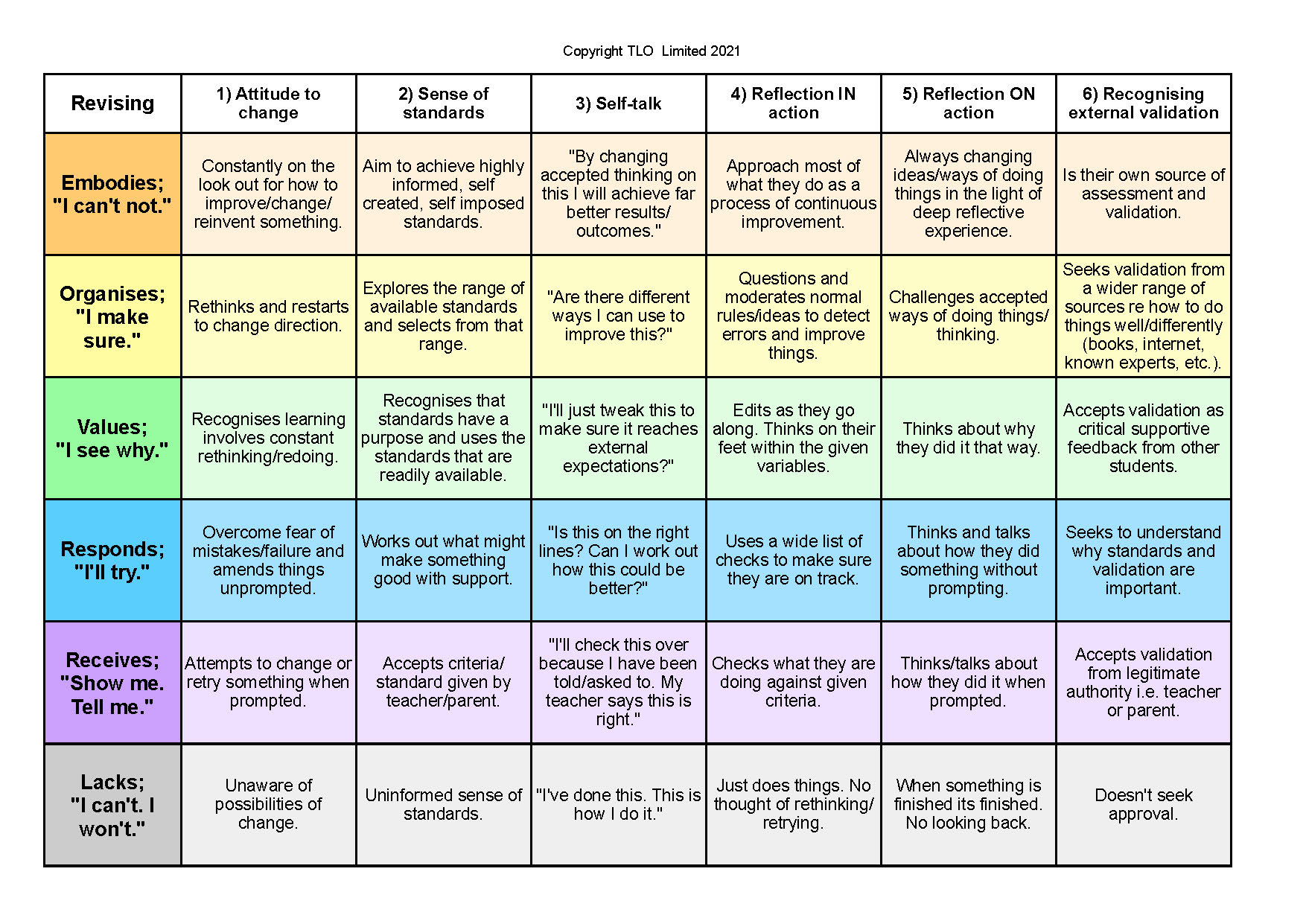
 Growing revising; a trajectory of developing behaviours, skills, attitudes and self-talk
Download as a pdf
Column four is about checking how things are going, about reflection in action. This column is about how we monitor what’s happening as we go along; keeping a weather eye on how things are going. Students need help to do this well. They need to know what they are looking for, what they are tracking. Should they look for good things or bad, for feelings, for whether they understand…? It’s a minefield. The early phases shown here relate to monitoring what you are doing against known criteria, and checking the process of doing something itself. Students need these props in the early phases. It’s only in the ‘valuing’ (green) phase that they become skilled at editing as they go along, having had practice with checklists and criteria in earlier phases. Look particularly at the difference between ‘value’ and ‘organised’. In the ‘value’ phase the amends, revisions, and re-tries are being done with the original aim/goal/objective in mind. In the ‘organised’ phase students are prepared to ditch the original plan, ask hard questions, change the rules and change direction. It’s a big and important shift in becoming an independent learner.
Column five is about the inclination to reflect on what we have achieved, about reflection on action. This is the essence of learning from experience although sadly it is not a common inclination. The key here is not simply reflecting on what happened and whether we could have improved, but whether we take heed of such lessons and behave differently next time. This is not a natural skill and will need careful structuring and nurturing. Notice that the early phases are about what happened and are heavily scaffolded. By green students are asking why they did it that way, and by yellow they are challenging those familiar ways of working and rethinking the how in order to achieve better outcomes. It’s a breakout moment.
The last column is about how we relate to external validation. The last constituent of revising has to do with how we need and use external validation – the need for a legitimate authority source to confirm that what we are doing is right. When we are chasing facts we need to be sure they are correct. When we are using standards we need to be sure they are sound. In the early phases this authority normally comes from parents and teachers. As students move through the phases there is a move to seeking out experts, dictionaries and original sources. (The internet invariably plays a role here but while it might be a great place to start it’s a terrible place to finish! It needs to be used with discernment.) Sources of legitimate authority play into how we revise and improve our learning.
What do you think?
- How does this extended progression chart connect with what you have already learned about Revising?
- How does this chart extend your thinking?
- What challenges and questions does this raise for you?
Make a note of…
- Which column(s) your students are most secure in.
- Which column(s) are most in need of further development.
Comments are closed.