
Creating a Learning Powered School is a suite of courses designed to assist primary schools to build their students’ learning character and so help them become effective lifelong learners.
Read on to find out about the what, the why and the how of this suite of on-line courses.
1. Learning power and why we need to build it
How you learn changes over time and responds to the qualities of the learning environment, either in the classroom culture, the home or in the workplace. As environmental circumstances change, they can have either a constructive or a destructive influence on developing, or ignoring, the potential of learning power.
As understanding of the nature of learning grew, building learning power formed as an approach to helping young people to help themselves become better learners. It went beyond the ideas of metacognition and self regulation by trying to build a child’s learning character…how they… approach, take part in, maintain interest in, make meaning from and reflect on…learning
It’s about creating a culture in classrooms that systematically cultivates a researched range of learning behaviours into learning habits; enabling students to face difficulty and uncertainty calmly, confidently, collaboratively and creatively.
Building student’s learning powers refocuses schools on preparing young people better for an uncertain future; to educate not just for exam results but for lifelong learning; to thrive in the increasingly turbulent twenty-first century. Students need to have learnt how to be tenacious and resourceful, imaginative and logical, self disciplined and self-aware, collaborative and inquisitive.
The joy and wonder of learning

2. The vision, heritage and shape of the programme
Vision
Creating a Learning Powered School is a suite of courses for primary schools that want to ensure their students knowingly become better learners. The aim is to help schools prepare their students for a lifetime of learning, by:
- growing their independence as learners;
- ensuring they understand how they learn, and how they can get better at learning;
- empowering them to lead a productive lifetime of learning.
Heritage
The suite of courses combines a rich research heritage from Carole Dweck, Mihalyi Csikszentmihalyi, Art Costa, Sir Ken Robinson, Dylan Wiliam, Chris Watkins, John Hattie, David Perkins, Ron Ritchhart and Guy Claxton, and includes;
- The formative work of finding out about your students’ learning behaviours
- The practical work of shifting classroom cultures to better accommodate learning behaviours
- The fine grained work of purposefully blending the use of learning behaviours into lesson design
- The blending work of gradually adding more of the original researched learning behaviours into the mix.
Shape and flexibility.
This suite of courses has two very different phases;
Phase 1 Building Powerful Learners. This introductory on-line course introduces the ‘what’ of the learning mind, the features of classroom learning cultures and the growth of learning behaviours. It explores practical ideas for developing the four key learning behaviours; perseverance, questioning, collaboration and revising. It’s about establishing the approach across the school. See section 4 below for more detail.
Phase 2 Expanding and deepening practice. You might look on this phase as a differentiated expansive library. It offers a range of on-line courses and specialised resources which schools can mix and match to meet a wide variety of their specific needs across the school. See section 5 below for more detail.


3. A blended learning approach
Developing teachers’ working practices is known to be hard and delicate work which needs support to ensure the ideas take root in classrooms. Our suggestions for staff development practice are heavily influenced by the work of Dylan Wiliam and EEF’s Effective Professional Development guidance report.
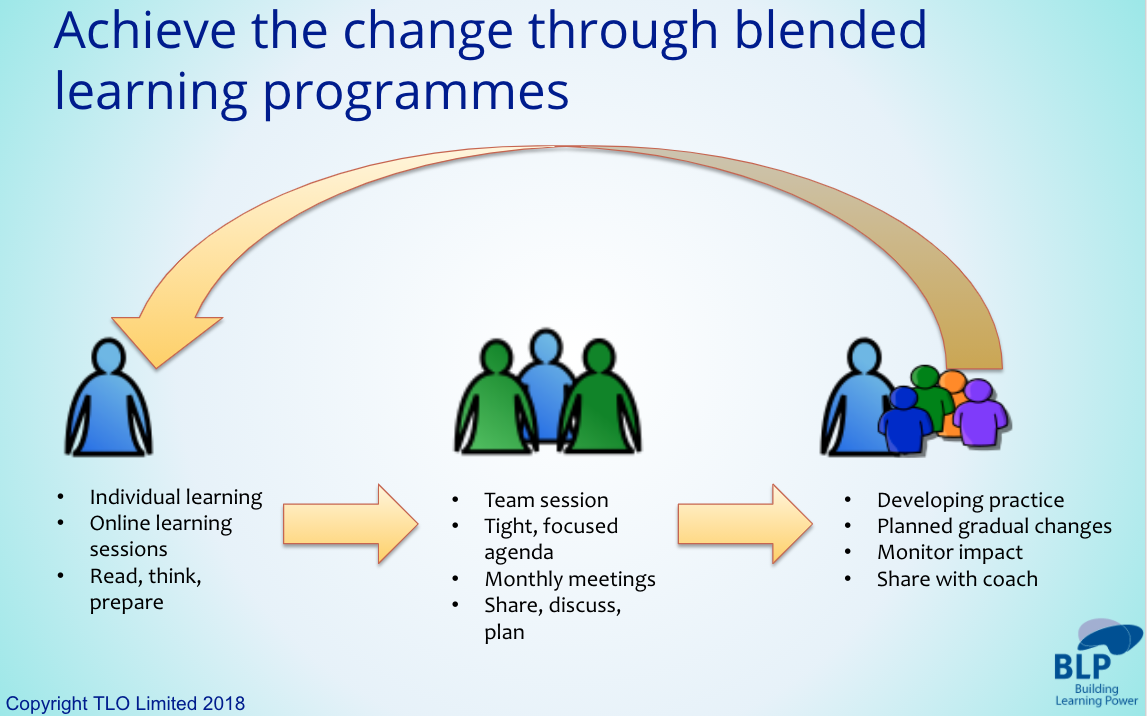
The suite of courses offer a careful blend of:
- online learning units or resources that… are available at any time, faithfully present researched content, are broken into manageable chunks and encourage the use of prior knowledge;
- learning team sessions that……are placed throughout the programme, provide a carefully structured agenda to ensure effective meetings, offer social support, act as a forum for affirming and reinforcing progress;
- trying things out in classrooms where…teachers develop plans and monitor their actions because “learning by doing” is integral to the development of expertise.
This trio of learning opportunities work together to help teachers replace long-standing habituated practices with more effective ones.
Why is changing practice hard? ⬇️
Changing practice is hard and takes both time and deliberate practice.
Although this suite of courses aims to develop learners’ learning behaviours, it firstly requires teachers to adapt their teaching behaviours! Changing practice is hard and takes both time and deliberate practice. It’s not just about knowing new stuff, it is about doing what you do differently and involves teachers changing:
- what they know – their knowledge;
- what they believe – their feelings or attitudes;
- what they can do – their teaching skills;
- what they actually do – putting it all into practice.
Changing how you teach is a delicate, complex process……...that’s why it’s hard! And the hardest thing isn’t getting new ideas into teachers’ heads . . .It’s getting the old ones out…….that’s why it takes time and effort.
It takes time and practice to undo old habits and become graceful at new ones.
All the evidence shows that teachers change their practice when they work together and support each other in trying out new teaching strategies, within a culture of classroom based action research. It is about teachers being empowered to explore together to find out what works with their students, in this context, at this time. As a consequence, the school learns its way forward, together.
The shape and content of the whole suite of courses takes account of this delicate professional change process.

4. Phase 1 of this suite of courses
Phase 1 is about making a confident start. Building Powerful Learners is made up of 8 on-line units. Each unit may take a couple of hours to read and digest and offer a range of activities to try out in classrooms over about a month. It works best when all staff undertake the same units . This phase covers the essentials of developing powerful learners and draws on the Professional Learning Teams model.
On-line Units;
- The big picture of learning — reveals the “what” of learning itself.
- The big picture of classroom culture — examines the “how” of a learning culture.
- The big picture of progression in learning — explores what getting better at learning looks like.
- Building the habit of Persevering — encourages building the “how” of perseverance.
- Building the habit of Questioning — encourages developing the “how” of questioning.
- Building the habit of Collaborating— encourages expanding the “how” of collaboration.
- Building the habit of Revising — encourages accommodating the “how” of building revising.
- Looking Back, and Moving Forward —reflects on changing practice and explores the possibilities of what next.
Press the button to find out more about the content for phase 1, Unit by Unit
Go to the overview section
5. Phases 2 and 3 of this suite of courses
Phase 2 Expanding and deepening practice is designed to support schools that wish to take things further and deepen the start made in Phase 1. This phase offers a selection of two different packages that can be used and re-used by all staff and/or groups of staff over several years. We leave it to schools to decide how best to make use of them.
Package A. Building the Scope – This is simply about expanding the range of learning behaviours being brought into play in classrooms. The familiar format of the Phase 1 units is copied here for a further eight learning behaviours.
- You can access these units in any order:
- Noticing, Making links, Reasoning, Imagining, Capitalising, Planning, Meta learning, Empathy & Listening.
Package B. Building Depth – This package is about deepening and securing teachers’ understanding of a learning -friendly classroom culture. Essentially it puts more meat on the bones of the teacher’s palette model introduced in Phase 1.
- You can access four substantial units that further develop:
- Devolving responsibility for learning to students
- Talking to deepen students’ understanding learning
- Constructing lessons with learning in mind
- Celebrating the growth of student learning behaviours.
Phase 3 is about consolidating the gains made at phase 2. It is about building a coherent whole-school approach to Building Powerful Learners and should not be started until phase 2 is well underway. Unlike the previous 2 phases, this is designed as a small team-based research and development project that aims to shape and harmonise whole school practice.
Building Coherence – This package is about developing two whole-school-wide strategies; one to collect information about how students’ characters are developing and one to enhance the integration of learning behaviours into curriculum design.
- Creating Students’ Learning Profiles
- Enables schools to uncover, collect and analyse information about each of their students’ learning characters, and to use the outcomes to better understand how to support individual students to grow their learning power.
- Creating Curriculum and Lesson Plans
- Explores more deeply how to integrate the use of learning behaviours into individual lessons and into the design of the whole curriculum.
6. Leadership questions for schools
The prospect and potential of taking on the initial Phase 1 Building Powerful Learners programme will inevitably raise all manner of important questions. There will be strategic, leadership and management questions that deserve consideration before school leaders can make a reasoned decision about whether or how to implement Building Powerful Learners.
Here we outline the leadership considerations that will be necessary for the successful implementation of any or all of the programmes. Considerations include: Shared Values; Skills; Staff; Systems; Structure; Style; and Strategy.
It’s worth taking your time to reflect on all seven aspects – it is only when you’ve addressed all seven will you have laid the foundations of success.
1. Shared Values
How does Phase 1 Building Powerful Learners fit with our school’s ethos?
- Do the course’s aims fit with the school’s vision and values?
- Do these ideas fit well with our vision of the purposes of education?
- If our vision / mission statement does match, is our vision lived in the day to day life of the school, or is it more aspirational and indicative of a direction of travel?
- If our vision is at odds with Building Powerful Learners, do we need to open up a conversation about the core purposes of education before embarking on this route?
If, at this stage, you feel that Phase 1 Building Powerful Learners may well be the way forward for your school, you’ll find the following six questions essential as the school moves towards implementation.
2. Skills
What sort of skills/competencies would the programme enhance:
- in our students?
- in our teachers?
3. Staff
How could we accommodate the Blended Learning staff development approach suggested?
- What’s the best way to organise this staff development model across the school?
- How will we achieve high levels of engagement with the programme?
4. Systems
How do we prevent it becoming a workload issue?
- What sort of time and effort will staff need to make?
- What changes to the school’s operations will need to be accommodated?
- How will we prevent Building Powerful Learners becoming a workload issue for teachers, support staff, the programme lead, and senior leaders?
5. Structure
Who will lead it and what accountability may be needed?
- Who will lead this change strategy and what accountability may be needed in the system?
- How will the programme leader keep senior leaders informed of developments?
6. Style
How are we going to support the programme?
- How will leaders create the conditions where teachers are encouraged to take risks, to try things out, to fail in safety?
- How will leaders demonstrate an ongoing interest in the enquiries that teachers are undertaking?
7. Strategy
How do we expect Building Powerful Learners to work? How will we create and agree a plan to pull all this together?
- Will this be a top-down ‘initiative’, or will we involve all staff in the forward planning?
- How will we keep the strategy ‘tight but loose’? – tight enough to create momentum and maintain sustained interest, yet sufficiently loose to flex and accommodate emerging needs as necessary.





Comments are closed.