
 0.1a – Introduction
These materials will help you to:
- Appreciate the full extent of the Every Child Matters (ECM) agenda in a holistic way
- Diagnose your practice in the light of the holistic ECM framework
- Integrate ECM into your long- and short-term plans
- Inform and improve Sections 3, 4 and 5 of your SEF.
Our approach has been to link the five major ECM outcomes with a range of known good practice and national strategies to form a holistic framework for school development. This guards against ECM being seen as a bolt-on, or as something to be largely contained within Section 4 of the SEF.
The tools will help you to ensure that your improvement / development plan(s) address the ECM agenda, while avoiding the repetitions that will arise from structuring such plans under the five ECM outcome headings.
These diagnostic tools will also help you to make more evaluative, rather than descriptive, statements in Sections 3, 4 and 5 of your SEF.

 0.1b – The Contents of this CD-ROM
ECM Overview:
Find out what ECM really means for schools and how the tools can help you.
Using the Tools:
Find out what the three diagnostic tools consist of and how to make best use of them.
Using the results:
Explore how you can make sense of your data, and use the results of your diagnosis to inform your school improvement plan and your SEF.
Further assistance:
Some suggestions about how TLO can help you maximise the benefits of using these tools.
Learner Outcomes – Tool 1:
A tool to help you consider possible ECM outcomes for learners.
A flexible Word document to guide your thinking.
Find the Gaps – Tool 2:
A tool to help you diagnose the school’s provision against the five outcome areas of ECM.
A flexible Word document to guide your thinking.
The Long View – Tool 3:
An audit tool to diagnose provision in depth and plan a way forward.
A flexible Word document to guide your thinking.
1.1 – ECM Overview – Coming together
Changing services for children and young people
Every Child Matters aims to support every child to
- Be healthy
- Stay safe
- Enjoy and achieve
- Make a positive contribution
- Achieve economic well-being
These outcomes are believed to be the key to well-being in childhood and later life.
In order to make these outcomes real, the organisations involved in providing services for children and families are coming together in new ways, to share information and work together to give more integrated, accessible and personalised services built around the needs of the child. This means that children and their parents or carers will have a greater involvement and say in how the services work.
—
 1.2 – ECM Overview – Change in schools
What does this mean for schools?
Schools have always been concerned with the whole child and therefore already pay regard to the ECM outcomes. However, you are now faced with a much wider framework through which to look at the school and plan for its future. Furthermore, the common inspection framework across children’s services will look for the school’s impact on and provision for the ECM programme.
How will schools be different?
Although the major ECM outcomes have always been your concern, the ECM programme will mean changes for schools in both WHAT you provide and HOW you provide it.
Most of the WHATs and HOWs of ECM provision have come at you in the form of separately labelled strategies and initiatives; some of these have been around for longer than ECM, while others have been created within it.
Programmes, initiatives and buzz-words that have been brought within ECM include Extended Schools (including wrap-around care), workforce remodelling, Healthy Schools Standard, Primary and Secondary Learning Strategies, personalised learning (including assessment for learning), and student voice.
The central role of schools remains that of raising educational standards. However, schools are no longer expected to do this largely alone, but rather in collaboration with other services to remove barriers to learning. This culture of collaboration is being encouraged not only between services but within the school, where children and parents / carers are not just being present, or taking part in, but having an influence on decisions and actions. Learners become co-creators of their educational experience, through being empowered to engage with and become responsible for the how and what of their own learning and well-being.
 1.3 – ECM Overview – The materials
How these materials can help you
The materials are designed to help you see how the essence of various strategies fits within the ECM agenda, and to keep control of your school’s cycle of self evaluation and planning in the context of ECM.
Firstly, in Tool 1 we have tried to describe how a learner might be as a result of being involved in a school influenced by the integrated ECM agenda. We have expanded and humanised the ECM outcomes and the ‘Aims’ that lie under them.
The tool invites you to consider the learner outcomes in relation to your learners, how you would track their achievements, what such outcomes would mean in practice for your school, and whether the school could best achieve this alone or in collaboration with other schools and services.
Secondly, in Tool 2 we have listed a wide range of statements of good practice, under the five ECM outcome areas. These statements have been influenced but not dictated by a range of the current strategies, programmes and initiatives, and written to reflect participation and empowerment of learners, and collaboration with other services. We have organised the statements into broad categories that a school might use in thinking about itself – ethos, environment, curriculum, curriculum delivery, enriched and extended curriculum, partnerships with others, and how a school monitors its provision and outcomes.
This tool should give you a sense of the scope of ECM and of how different strategies fit within it. You can use it to quickly review where you are now and see where there may be gaps in your provision relative to the ECM framework.
Thirdly, Tool 3 has the five sets of good-practice statements reconfigured into a single list, with space for you to record more detailed information about your practice, and to note actions that you may want to consider in your planning. The tool is designed to allow you to sort and rearrange the list in ways that suit your own interests.
All the tools are provided as tables in Word files, so that you can edit and manipulate them to suit your purposes. You may wish to tailor some of our statements to reflect your practice more specifically; you may wish to delete some that are not relevant (e.g. there are several that relate to 14-19 concerns, which will not interest primary schools); you may wish to add your own, in the same general spirit.

2.1 – Using the tools – Overview of the tools
There are three diagnostic tools.
You can use them together or separately.
Learner Outcomes – Tool 1
This contains some suggested learner outcomes for each area of ECM. You can use this to:
- Understand the impact that ECM should have on your learners
- Use the outcomes as standards against which to evaluate the impact of your provision. (This will help you to produce a much stronger, evaluative SEF)
- Think about what you do now to enable learners to achieve such outcomes, and where you might collaborate with other services or schools.
Find the Gaps – Tool 2
This is a checklist of good practice drawn from a range of national strategies and divided into the five ECM outcome areas. You can use this to:
- Gain an overview of ECM in action
- Understand how practice relates to outcome areas
- Complete a quick review of your provision practice.
The Long View – Tool 3
This is an audit tool for a deeper analysis of your current practice. You can use it to:
- Analyse your whole school practice
- Record the extent of your development in each area
- Note your ideas for action
- Sort your action statements for use in your planning – this will help you to produce a Plan against the five outcome areas (as some LAs are now proposing).
—-
 2.2 – Tool 1 – Learner Outcomes
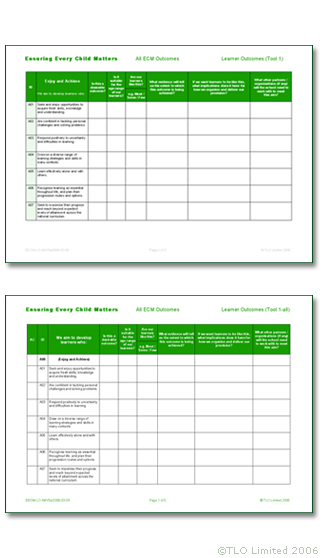
[A Word document table showing what ECM means in terms of outcomes for learners. For each of the 5 ECM areas we have developed a set of statements that describe how a learner might appear when viewed through the ECM framework.Against each statement the tool provides a number of mostly open-ended questions with spaces for your responses. In the light of these, you may want to adapt our learner outcomes or add some of your own.
Think of this as a thinking tool rather than as something where you must fill in every box.
Using Tool 1
You could use this in several ways, for example:
Look at the learner outcome statements to get a feel for what ECM is really about (the holistic model).
Share the learner outcome statements with staff and governors and decide whether they are appropriate for your school and how you might improve or adapt them.
Develop a set of indicators (things that will tell you whether the outcomes are being achieved) for each group of learner outcome statements. Collect data against the indicators. Use this data to produce a stronger evaluative SEF (see section “Using the results” – “Informing your SEF”).
Consider the implications of these outcomes for the school’s provision and practice, and whether the school could best achieve this alone or in collaboration with others.
Note that two versions of Tool 1 are provided, one with filename containing LearnerOutcomesS and the other LearnerOutcomesT. The ‘S’ and ‘T’ can be thought of as standing for ‘separate’ and ‘together’. The first contains five tables, each with the learner outcome statements for just one of the ECM outcome areas; the second has the same statements, but all in one big table.
One important difference between them is that the ‘T’ version has an analysis column which you can use to code and sort the statements, so that they do not have to be isolated under their ECM headings. See the description of Tool 3 for more about analysis columns.
—-
 2.3 – Tool 2 – Find the Gaps
A Word document table using the 5 ECM outcome areas and showing suggested learner outcomes (see Tool 1), and statements of good practice that will contribute to the achievement of the outcomes.
The statements for each area of practice are shown together across the five ECM outcome areas. This enables you to see how good practice links together across the five areas.
What Tool 2 consists of
The good practice statements are drawn from or implied by a range of national strategies. They are classified under the following categories:
School Ethos
This covers the underlying values that will pervade the school.
School Environment
This includes aspects of the school environment implied by ECM.
Curriculum Content
This covers content you may need to check or include as a result of ECM.
Curriculum Delivery
This covers a wide range of curriculum delivery practice which is implied or made overt through ECM (including related strategies).
Extended Curriculum
This covers extra-curricular and enrichment activities that are implied or explicit in national strategies.
Partners – Parents and Carers
Partner Organisations and Services
These cover the types and nature of partnerships that the school will be developing in order to fulfil ECM.
Monitoring and Evaluation
This covers a range of things that the school might check and monitor in order to show progress in ECM outcomes and improvements in provision. A range of school policies and success criteria are included here, which the school may need to monitor.
Using Tool 2
We recommend that you print out the table on A3 paper to get an efficient overview (or onto A4 and use your photocopier to magnify it!). It is not as daunting as it may look at first sight. It is designed to help you find your gaps quickly. You could use this in several ways, for example:
Simply scan the statements to get a feel for ECM and how practice relates to the five outcome areas.
Complete a desk-top review to check which practice statements the school is covering and which might need attention.
You might use highlighters to identify:
- Those areas you feel secure about
- Those that need further work
- Those that are not yet in place
Invite appropriate members of staff to complete a review of practice using this tool. Compare results and then consider whether Tool 3 might be useful to help you look more deeply into specific areas of practice.
 2.4.1 – Using Tool 3
Using Tool 3
You can use this tool in several ways. Here are three suggestions to spark your own ideas:
Leadership team review
Invite members of the senior leadership team to work through all the statements, or a selection of them.
Compare results, and rationalise into one document.
Agree how best to sort the action statements to help your planning.
Involve middle leaders
Divide the document into meaningful sections and invite relevant members of staff to respond to statements in that section (e.g. SENCO, curriculum managers, assessment coordinator, Key Stage coordinators, etc.).
Compare results, rationalise into one document and integrate into current plans.
Involve everyone
Select areas of the document linked to curriculum delivery, or monitoring, or extended curriculum, etc.
Invite all, or selected, members of staff to respond to the statements.
Arrange for team meetings to discuss individual findings, agree a team response, and rationalise into a team-based document to inform team planning.
Later, team leaders could meet to discuss each team’s findings, agree collaborative actions, and rationalise into one document to inform whole-school planning.
Using the analysis columns, AC1 and AC2
NB: If you don’t understand this next piece, don’t panic — you don’t have to use the feature!
The table contains two columns intended to be used for analysis codes. These allow you to classify your action statements, using any scheme you like for grouping the statements together, with short codes to indicate the grouping: at the simplest, perhaps ‘y’ or blank to indicate a yes / no selection.
Once you have entered codes in a column, you can use Word’s feature for sorting data in a table, according to the codes. You can request a sort on up to three columns – the Cat and ID columns that are already filled in may well be of use in creating meaningful arrangements of the statements. We leave you to decide the details of how and when to use this possibility, but offer some suggestions in the section ‘Using the results’.
 2.4 – Tool 3 – The Long View
A Word document table that rearranges all the good practice statements from Tool 2 into one holistic list.
The list is initially organised by the categories used in Tool 2 – School ethos, School environment, Curriculum content, Curriculum delivery, Extended curriculum, Partnerships (two categories), and Monitoring and evaluation.
Space is provided for you to note the extent of the school’s development, and action you might want to take, against each statement.
How the Tool is made up
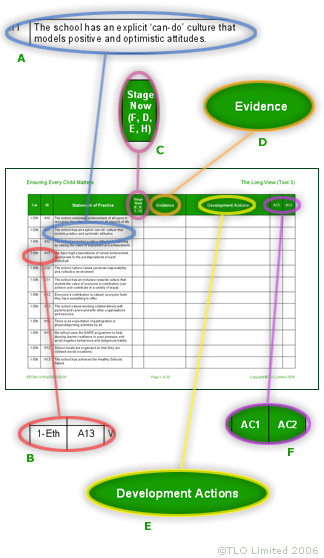
Statement Bank (see A in the figure)
- The tool centres on a bank of all the good practice statements in tool 2, here combined into a single list (rather than five), in order to avoid duplication and give a holistic feel.
- The statements help you to consider your current practice and give pointers to possible future practice.
- The list is not exhaustive but rather gives a flavour of good ECM practice.
- Add to the statements where you feel things are missing.
Category and Identifier codes (B)
Each statement is labelled by:
- an identifier (ID column) linked to one of the ECM areas and as used in Tool 2
- a short code representing the category (Cat column): e.g. 1-Eth for ethos, 4-D for curriculum delivery.
The initial letter of each ID value allows it to be related to one of the ECM outcome areas.
Stage Now (C)
Use this column to rate the development stage your current practice has reached. The suggested codes are:
F = Focusing
We need to or are just starting to get to grips with this. It has substantial planning/resource implications.
D = Developing
An area we are currently developing/experimenting with. Very mixed across the school. Has further resource implications. Has coaching and sharing implications.
E = Establishing
Area quite well developed, being established across the school but not yet a natural part of what we do. Has minor resource implications.
H = EnHancing
This area is a natural part of what we do. High measure of consistency of practice across the school. Continuing to improve. Few or no resource implications.
Evidence (D)
Use this column to make a note about the evidence that supports your rating code (this is not a SEF in disguise, so don’t think you have to justify the evidence source).
Development Action (E)
Use this column to note the action you might take, in response to your development rating.
Analysis-code columns (F)
You can insert your own codes here, allowing you to re-order your action list for inclusion into your improvement plans (see “Using the Tools” – “Using Tool 3”, “Using the analysis columns…”).
sub_2-4.jpg
—-
 3.1 – Using the Results – Menu
In this section we look at two ways in which you might use the results of your diagnosis:
- Planning your way forward, both long-term and short-term.
- Informing and improving Sections 3, 4 and 5 of your SEF.
You may well think of more uses for the diagnostic results.
sub_3-1.jpg
3.2.1 – Planning A Way Forward – General Guidance
Your ‘to do’ list from the diagnosis is categorised into:
- School ethos (‘Cat’ code = 1-Eth)
- School environment (Cat = 2-Env)
- Curriculum content (Cat = 3-CC)
- Curriculum delivery (Cat = 4-D)
- Extended curriculum (Cat = 5-EC)
- Partners – parents and carers (Cat = 6-PC)
- Partner oganisations and services (Cat = 7-OP)
- Monitoring and evaluation (Cat = 8-M)
You will need to put the ‘to do’ action statements through your own ‘planning sieves or filters’ so that you can incorporate them into your plans.
sub_3-2-1.jpg
 3.2.2 – Planning A Way Forward – Long & Short-Term
Planning – long-term, strategic
Look for patterns and relationships. Look through your ‘to do’ action statements and:
Firstly, Select individual actions or clusters of actions that naturally fit into one or more of your current long-term strategies. Use the analysis-code columns to select these actions.
Secondly, Select actions or clusters of actions that you identified as being at the Focusing stage. This suggests that long-term action is needed. Consider their urgency and importance and whether any amount to a new strategy. If so, develop a strategy by grouping the actions into year 1, 2 or 3 of the strategy; identify resource implications, e.g. CPD, workforce remodelling, IT needs, etc.
Thirdly, Select actions that you have secured or designated funding for; e.g. personalised learning:
- Use this as a clustering heading
- Identify all the ‘to do’ actions that cluster under this heading
- Make sure you have a coherent set of actions
- Use an analysis-code column to select these items, and sort them together
- Turn them into a time-lined plan.
Planning – short-term, operational
Look for short-term gains in the ‘to do’ action statements.
Think operationally – when, what, how, who
Scan for:
Urgent and important actions. those actions or clusters of actions that need to be dealt with swiftly (within the next year). Break these down into ‘must do’ next term / ‘can wait’ for term two or three. Turn into project plans, using your usual planning formats, thinking about outcomes, success criteria, when, how and who.
sub_3-2-2.jpg
 3.2 – Using the Results – Planning a way forward
You have two starting points:
Identified Actions and Current Plans
What we suggest you do now is:
- integrate ECM actions into your normal planning formats.
What we suggest you avoid is:
- having a separate ECM plan;
- changing the structure of your plans to follow the ECM areas: this will lead to a disjointed plan with many overlaps.
(The coding system in Tool 3’s ID column indicates which ECM outcome area each statement could be linked to; so if you really must put your planning into five artificially separated areas, sorting the table rows on the ID column will help you to do that.)
Your ‘to do’ list from the diagnosis is categorised into:
- School ethos (‘Cat’ code = 1-Eth)
- School environment (Cat = 2-Env)
- Curriculum content (Cat = 3-CC)
- Curriculum delivery (Cat = 4-D)
- Extended curriculum (Cat = 5-EC)
- Partners – parents and carers (Cat = 6-PC)
- Partner oganisations and services (Cat = 7-OP)
- Monitoring and evaluation (Cat = 8-M)
You will need to put the ‘to do’ action statements through your own ‘planning sieves or filters’ so that you can incorporate them into your plans.
sub_3-2.jpg
 3.3.1 – Informing your SEF – Section 3
SEF Section 3: Achievement and Standards
Firstly, state your strategic learner outcomes.
Those below are as suggested in Tool 1; you may have others.
We aim to develop learners who
- Seek and enjoy opportunities to acquire fresh skills, knowledge and understanding.
- Are confident in tackling personal challenges and solving problems.
- Respond positively to uncertainty and difficulties in learning.
- Draw on a diverse range of learning strategies and skills in many contexts.
- Learn effectively alone and with others.
- Recognise learning as essential throughout life, and plan their progression routes and options.
- Seek to maximise their progress and reach beyond expected levels of attainment across the national curriculum.
Secondly, state the evidence that shows the extent to which the outcomes are being achieved. For example:
- analysis of data on progress and achievement against targets
- surveys of learner perceptions of their learning habits
- surveys of parent / carer perceptions of their children’s learning habits
- analysis of other indicators that you monitor relating to the above outcomes
You will find other suggestions for monitoring data under the monitoring section of Tool 2.
Thirdly, state the action you intend to take to improve the outcomes. Use your ‘to do’ actions linked to Enjoy and Achieve statements, together with other actions linked to specific aspects of the curriculum.
sub_3-3-1.jpg
3.3.2 – Informing your SEF – Section 4
SEF Section 4:
Personal development and well-being of learners
4a) To what extent do learners adopt healthy lifestyles?
Firstly, state your strategic learner outcomes;
for example (from Tool 1, again):
We aim to develop learners who
- Display high levels of self-esteem and personal worth.
- Make choices consistent with a healthy life-style.
- Exercise emotional intelligence in dealing with self and others.
- Maintain self-belief in challenging circumstances.
- Are capable of nurturing productive and loving relationships.
- Address the spiritual dimension of their lives.
Secondly, state the evidence that shows the extent to which the outcomes are being achieved. This could include surveys of learner or parent / carer perceptions related to the above outcomes; analyses of indicators such as lunch preferences; participation in sports activities; attitudes to drugs; and so on, and what this tells you about the extent to which this aspect is being met or achieved. You will find other suggestions for monitoring data in the Monitoring section in Tool 2.
Thirdly, state the action you intend to take to improve the outcomes. Use your ‘to do’ actions linked to the Be Healthy category. State whether you intend to take the action alone or with other partners.
4b) To what extent do learners feel safe and adopt safe practices?
Firstly, state your strategic learner outcomes. For example,
We aim to develop learners who
- Understand the importance and purpose of moral codes, rules and laws.
- Relate to others in ways that build trust and understanding.
- Recognise dangerous situations and have strategies to avoid or cope with them.
- Know where to turn for help in school, their local community and wider society.
- Know the value of taking calculated risks.
- Possess the skills of conflict resolution.
Secondly, state the evidence you collect to show how well the outcomes are being achieved. This will include data on bullying, anti-social behaviour, etc.; and surveys of learner perceptions related to the outcomes and what this tells you about the extent to which this aspect is being met or achieved.
Thirdly, state the action you intend to take to improve the outcomes. Use your ‘to do’ actions from the Stay Safe category. State whether you intend to take these actions alone or with other partners or services.
4c) How much do learners enjoy their education?
- Take account of Learners’ attitudes, behaviour and attendance
- Learners’ spiritual, moral, social, emotional and cultural development
This section might include something along these lines.
- Analysis of attendance levels, truancy rates and exclusions with comparisons with previous year and trends.
- Analysis of detention rates – % of students detained.
- Evidence from student surveys and formal conversations about their enjoyment of their education.
- Evidence of charitable activities involving students.
- State what these tell you about the extent to which this aspect is being met or achieved.
Include the action you intend to take as a consequence of the evidence.
4d) How well do learners make a positive contribution to the community?
Firstly, state your strategic learner outcomes. For example,
We aim to develop learners who
- Believe they have a voice in determining outcomes for themselves and others.
- Take responsibility for their own actions.
- Form their own opinions and state them with confidence.
- Respond to the attitudes and opinions of others with empathy and tolerance.
- Engage enthusiastically in a range of activities and opportunities.
- Are able and willing to honour commitments to others, groups, teams and their community.
- Contribute constructively to the experience of other people.
- Exercise their rights as individuals in a socially acceptable way.
Secondly, state the evidence the you collect to show how well the outcomes are being achieved. Use a range of indicators, e.g. from those suggested in the Monitoring section of Tool 2. Include indicators linked to transition, School Council and other ways in which students make a contribution to the school, community projects, etc. State what this evidence tells you about the extent to which this aspect is being met or achieved.
Thirdly, state the action that you intend to take to improve the outcomes. Use your ‘to do’ actions from the Making a Positive Contribution category. State whether you will take these actions alone as a school or in collaboration with other partners or services.
4e) How well do learners prepare for their future economic well-being?
Firstly, state your strategic learner outcomes. For example,
We aim to develop learners who
- Adopt an enterprising frame of mind, are proactive, self-directing and goal oriented.
- Recognise that they will need to be lifelong learners to deal with a changing world of work.
- Can make informed choices about their learning pathways and progression towards marketable qualifications, based on an understanding of their strengths, aptitudes and weaknesses.
- Expect to invest in learning to improve their material circumstances.
- Are able to defer gratification in pursuit of their learning goals.
- Are willing and able to source and act upon professional advice in pursuit of life goals.
Secondly, state and discuss the evidence you collect to show how well the outcomes are being met.
Thirdly, state the action that you intend to take to improve the outcomes. State whether the action is internal to the school or is to be developed with other partners.
On the basis of your evaluation, what are your key priorities for development?
This is where the essence of your strategic development plan resides!
sub_3-3-2.jpg
—
3.3.3 – Informing your SEF – Section 5
SEF Section 5: The Quality of provision
5a) How good is the quality of teaching and learning?
Firstly, state what you are helping learners to become.
For example,
– independent and interdependent in learning
– collaborative
– etc.
You could use the same outcomes as expressed in Section 3.
Secondly, state how you monitor the quality of provision, including surveys of student and parent / carer perceptions, classroom observations, etc. State what this evidence tells you about the extent to which this aspect is being met or achieved.
Thirdly, state what you intend to do to improve, extend, and develop the quality of provision.
5b) How well do the curriculum and other activities meet the range of needs and interests of learners?
Firstly, state what the curriculum and other activities aim to provide.
Secondly, describe evidence of monitoring and state what this tells you about the extent to which student needs are being met.
Thirdly, state what actions you intend to take as a result.
5c) How well are learners guided and supported?
Firstly, state what your guidance and support programmes are designed to achieve. For example,
To support and respond to all individuals in order to ensure that everyone maximises their potential and overcomes difficulties.
Secondly, show how you monitor these programmes and what the evidence is telling you about the extent to which this aspect is being met or achieved.
Thirdly, state what actions you intend to take as a result of analysing the evidence.
5d) Where relevant, what is the quality of provision in the foundation stage or sixth form?
Firstly, state the outcomes you aim to achieve.
Secondly, show how you monitor the quality of provision and state what the evidence tells you about the extent to which this aspect is being met or achieved.
Thirdly, state what you intend to do as a result.
5e) On the basis of your evaluation, what are your key priorities for development?
This is where you identify the key features of your strategic improvement/development plan.
sub_3-3-3.jpg
—
3.3 – Using the Results – Informing your SEF
General guidance
- Meeting ECM outcomes for every child means a long-term course of action.
- Your SEF needs to reflect this longer-term approach.
- Each section of your SEF should be outcomes-driven.
- Using these tools enables you to identify the development of provision required to meet the outcomes and is a legitimate source of evidence of careful diagnostic evaluation.
- Incorporating the above issues will naturally lead to the production of a strategic, evaluative SEF which shows your clear strategic intent as a school.
The subsections suggest how you might use Tool 3 to inform sections of your SEF. We realise that many of you have found that the SEF proposes some artificial boundaries, leading to repetition across some of the sections, particularly Section 3 and Section 4c. The challenge still remains, as achievement, progress and progression, and the enjoyment of learning are inseparable.
sub_3-3.jpg
—
 4.1 – Further Assistance
Having used these diagnostic tools, you may find that there are areas of development that your school needs to look at more closely. Perhaps you are already aware of gaps in the ways you deliver a secure entitlement for all young people. Without doubt, you will want to enhance your leadership role within the local community and the ways in which you harness the energies of all the children’s services.
In building a cohesive response to Every Child Matters that ensures that all young people are equipped to take greater responsibility for themselves by the time they leave your school, you may need to look further at some of the following:
- Your vision for lifelong learning and achievement throughout the school
- Securing a strategic plan that ensures improved outcomes and provision for all
- Defining policies that will assure consistent services for young people
- Understanding what is meant by personalising learning and how this can impact on your school
- Developing the leadership potential of all young people in your organisation
- Enhancing the part played by parents in their children’s learning
- Responding coherently to workforce remodelling
- Building partnerships with external agencies
TLO Limited may be able to help you realise your aspirations in the following ways:
Training
- Strategic planning for school leaders and governors
- A common language for learning through Building Learning Power
- Developing the coaching capacity of all staff
- Training in new leadership roles for school leaders, teachers and associate staff
Consultancy Support
- Working through the Every Child Matters agenda for change
- Evaluating the quality of leadership and learning across the school
- Developing the school’s capacity to self-evaluate
- Managing change constructively
Publications
Visit www.tloshop.co.uk or www.tloltd.co.uk for access to details of TLO’s highly regarded publications for schools, including:
Building Learning Power by Guy Claxton
Building Learning Power in Action by Sarah Gornall, Maryl Chambers and Guy Claxton
Pathways to Coaching by Graham Powell, Maryl Chambers and Gillian Baxter
Managing Support Staff Performance by Gillian Baxter and Maryl Chambers
Contact Details
a: TLO Limited, Henleaze House, Harbury Road, Bristol, BS9 4PN
t: 0117 989 8204
f: 0117 907 7897
e: office@tloltd.co.uk
w: www.tloltd.co.uk
w: www.buildinglearningpower.co.uk
w: www.tloshop.co.uk for on-line purchase of publications
sub_4-1.jpg
5.1 – Tool 1 – Learner Outcomes

Tool 1 (A) Download
Tool 1 (ALL )Download
EECM_LearnerOutcomesT_V0a TOOL 1 WORD DOC VERSION
Tool 1 comes in two versions: one with filename containing LearnerOutcomesS and the other LearnerOutcomesT. The ‘S’ and ‘T’ can be thought of as standing for ‘separate’ and ‘together’. The first file contains five tables, each with the learner outcome statements for just one of the ECM outcome areas; the second file has the same statements, but all in one big table.
To access either version, click on the relevant button in the Download Menu (top right of screen). When the file is open in Word, save a copy to your computer.
Both versions are also provided as PDF files for convenient printing. Again, click on the relevant link in the Download Menu to open the file in Acrobat Reader.
sub_5-1.jpg
—-
6.1 – Tool 2 – Find the Gaps

Tool 2 Download
EECM_FindTheGaps_V0a WORD DOC VERSION TOOL 2
To access Tool 2, click on the button in the Download Menu (top right of screen). When the file is open in Word, save a copy to your computer.
Tool 2 is also provided as PDF files for convenient printing: one at the full A3 paper size, and one reduced to A4. Again, click on the PDF button in the Download Menu to open the file in Acrobat Reader.
sub_6-1.jpg
—-
7.1 – Tool 3 – The Long View


Tool 3 Download
EECM_LongView_V0a Word doc TOOL 3
To access Tool 3, click on the button in the Download Menu (top right of screen). When the file is open in Word, save a copy to your computer.
As with the other tools, Tool 3 is also provided as a PDF file. Click on the PDF button in the Download Menu to open the file in Acrobat Reader.
sub_7-1.jpg
Comments are closed.