
xxxxxx = ing xxxx=word
Growing your child’s learning character
The purpose of this series of resources is to help you to build and strengthen your child’s learning character. Learning character is about those attitudes, inclinations, values and skills that, when used with increasing competence and confidence across many learning opportunities, become learning habits; they are characteristics of successful lifelong learners.
These resources are not trying to turn you into your child’s teacher nor lay the groundwork for home schooling……
A quick look at learning itself
Learning is an interesting process that goes on in people’s brains. We used to think that ‘intelligence’ was fixed at birth so there seemed little point in trying to cultivate it. But now research has shown that learning is learnable and we are realising that there are some energies or powers that can be used to shape how we learn. Learning how to learn involves more than skills, it involves peoples’ attitudes, their dispositions, values, interests and beliefs as well. So, this approach is about helping children to help themselves to be disposed to persist, or to be inclined to question and be curious, to be able to collaborate harmoniously and learn well with other people, to be open to new ideas, or to manage their learning effectively.
The good thing is that these dispositions, inherent in all of us, are not fixed at birth. They can be developed by all of us regardless of ‘ability’, social background or age. They have a significant impact on how you learn and your progress through life. Extending our learning power has no limits.

The hidden aspect of learning
What if some of the girls you knew tended to believe that ‘Maths isn’t for girls’ or some other children you knew thought that ‘If you can’t solve it in a minute, you can’t solve it at all’ or even that ‘Bright people never have to try’. All these erroneous ideas cause children to be disposed to give up easily, or to feel stupid, or to disengage. You might think of ‘dispositions’ as indicators of the degree to which one is disposed to make use of a skill or knowledge.

xxxxxx
LOOK IN FOUNDATION PACK
‘Wonder is the beginning of wisdom.’ So stated Socrates, considered by some to be ‘the father of questioning’. Even through nearly 2,500 years of human development and societal ‘progression’, those words still hold true. In growing the habit of questioning, it is important to acknowledge that questioning itself is rooted in curiosity, that great driver of engagement, of seeking, of asking, and asking again.
‘Good learners like to wonder about things. For them, it often really is a wonder-ful world. The phrases ‘How come?’ and ‘What if?’ are never far from their lips.
They value getting below the surface of things, and are less likely to accept uncritically what they are told. They like to come to their own conclusions. They are more willing to reveal their questions and uncertainties if they think it will help them learn.
When you use this learning habit, you …
from HYLT
- are not afraid of not knowing
- are curious about things and people
- like to get below the surface of things and come up with your own conclusions
- often wonder why
- play with ideas, asking “How come?” and “What if?”
Your supple learning mind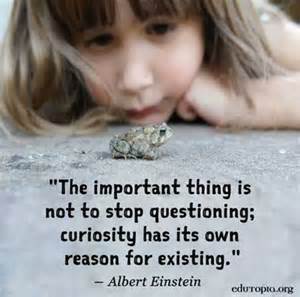

The explanations and activities, in this online unit aim to help you, as a parent, to make a start on:
- introducing your child to one of the key learning behaviours;
- using the language of learning effectively with your child;
- trying some activities into your family life;
- developing your child’s confidence and skill to grow their own xxxxxx habits.
The notes below will be amended when we have finished shaping the whole module
NEEDS TO BE INSERTED FROM QUESTIONING
Comments are closed.