

What you’ve got here is a resource to:
- help you navigate and make sense of the online module Helping your Learners to Imagine;
- assist you in considering how you might translate the ideas into your classroom practice;
- support you in preparing for a Learning Team meeting where I will join you via zoom.
You’ll find the module Helping your Learners to Imagine alongside this resource in My Courses.
Ideas in this module may take you into new ways of thinking about learning. You’ll find notes below to help you map ideas together and use them in your classroom practice.
1. Just a reminder about the blend of learning approaches
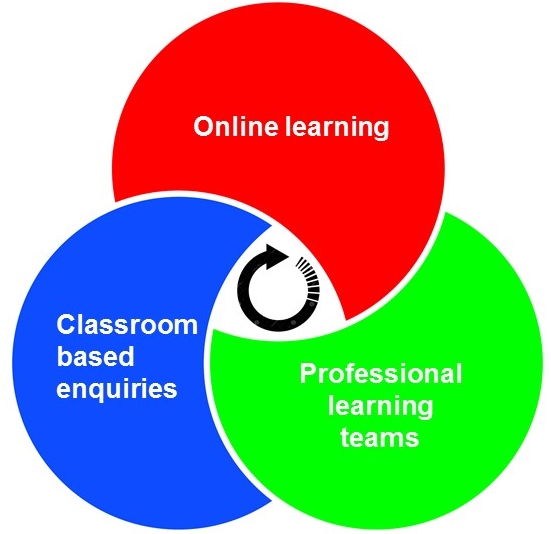
For the school to take on wholeheartedly the new ideas that minute-to-minute and day-by-day will build better learners requires far more than just a quick exposure to its principles and methods. Development of this magnitude asks a lot of you as teachers, often involving amending / changing / growing / adapting your teaching habits. So this blended learning programme offers a rhythm of different learning elements that help you to become researchers of your own practice.
The programme the school is about to embark on is a careful blend of:
- online learning sessions….that faithfully disseminate the researched content for building better learners;
- professional learning team sessions …… that provide sustained, meaningful assistance; learning with and from colleagues;
- trying things out for yourselves in classrooms……because “learning by doing” is integral to the development of expertise and expertise cannot be developed quickly. It can only be developed if you have ample opportunity for practice, reflection, and adjustment.
This trio of learning opportunities gives you time, practice and support to undo old habits and become graceful at new ones.
The monthly blended learning cycle
2. Making sense of the content: Helping your learners to imagine
We encourage you to:
- Take it slowly and try to avoid any inclination to just skim through the whole resource;
- Spend about 15 mins on each of the 5 steps below; sufficient time to read, think and note down your learning.
Start with section 1.
- Read – ‘What is imagining?’
- Go over it again because there may well be some features of this behaviour that you haven’t met before.
- Take time to think about the learning behaviours in a class you know well and fill in the names of the learners.
- Ask yourself:
- Which of my learners appear to do all / most of these things already?
- Which of my learners don’t appear to exhibit any of these positive learning behaviours?
- What am I discovering?

Note your musings ready for discussion at the Professional Learning Team meeting.
Then skip to section 3.
- Carefully read ‘Understand how imagination grows’, this is likely to be new to you.
- Take time to find out how the phases of growth work (see toggle box in that section).
- Focus on the class you know well and think about where your pupils might fit on this trajectory.
- Think through the questions shown below the trajectory but don’t assume higher achievers will automatically be further up the trajectory than lower achievers.
- Ask yourself the hard question – could my learners make progress up this trajectory over the next year?
- If yes, look out for helpful ideas to make it happen as you work through the content.
- If no, look out for ideas that could make learners more secure at their current stage.

Note your musings ready for discussion at the Professional Learning Team meeting.
Now turn back to section 2.
- Get a sense of what is meant by classroom culture and look at the diagram showing some aspects of culture that enables imagining to flourish.
- Think about your own classroom culture:
- which of these aspects are a regular feature in your own classroom?
- which might you consider introducing into your classroom?
- which sound interesting but you’re not sure what some of the phrases might look like in practice?
You’ve now looked at the nature of the learning behaviour (imagining), considered how it might grow, and looked at features of the classroom culture that supports it.

Note your musings ready for discussion at the Professional Learning Team meeting.
Now turn to section 4 to explore some teaching ideas that could be used to build these behaviours in your own classroom.
- Read through section 4 – Ideas to Practise
- look at both the primary and secondary columns because many of the ideas can be amended to fit different ages.
- Which of these ideas might fit your needs or simply appeal to you?
- Which do you already use?
- Which might work well in your own classroom?

Note your musings ready for discussion at the Professional Learning Team meeting.
Section 5 Develop your talk
You’ll find about 10 statements here that you could use to nudge imagining. Using this language can be a big shift for many teachers because what you’re doing here is talking in a way that will nudge the use of imagining. In other words you’re using intentional and precise learning language.
Ask yourself:
- How much do you currently talk about the process of learning, as opposed to the outcomes of learning?
- Have you ever considered, in advance, how you might talk about the process of learning, or do you tend to just trust yourself to say the right thing at the right time?
- Might you need to make a conscious decision to prepare in advance the language that you use?
- Which of the suggested phrases / comments would best resonate with your students and fit with any of the teaching ideas you might try from section 4?

Note your musings ready for discussion at the Professional Learning Team meeting.
3. Putting the bits together: making connections
In preparation for the meeting you’ll find it useful to gather up all your musings from working your way through the module…your sense of what imagining means; your feel for the imaginers in your class; your estimate of where most pupils are on the imagination journey; your selection of things you might need to do differently to help pupils use their imagination more; your three favourite picks of the activities you might try; your choice of imagination friendly language to go with the activities; your hopes of how your pupils might change…what could they become?
Making it all make sense for you
From your big collection of features about imagination ask yourself;
- which subject area would be a safe place to start?
- could the ideas I’m toying with be useful in another subject?
- which subject would I be cautious about using imagining in?
- what aspect of imagining would I want pupils to reflect on after using it (see learning mat).
- would it be possible to design a lesson or project using all the features shown on the learning mat?

4. A learning team meeting: what to expect.
Professional Learning Teams provide a forum for supporting you in converting the information and ideas in the online learning sessions into “lived” practices within classrooms.
They are safe forums in which to;
- kick around ideas from the online content,
- unpack it’s meaning when it’s unclear,
- consider what’s do-able and appropriate for your students
- make plans for what and how you might incorporate the ideas into your practice
- share and unpack what you have tried in the classroom
- relate your triumphs and tribulations
- reflect on what you hope you might do differently
Such learning communities provide a time and place where you’ll hear real-life classroom stories from colleagues. These stories provide local reassurances that the ideas work, that they can be tweaked, that pupils in our school benefit from them. It’s the support you need to take such risks.

5. How the team meeting will work
The culture of a learning team is sometimes described as ‘Supportive Accountability’ where everyone should be supportive and feel supported. The accountability bit has to do with making the team feel serious and legitimate rather than casual, here today, gone tomorrow. To make it work people need to feel accountable to themselves, to each other and to the school.
A tight agenda to scaffold and focus change
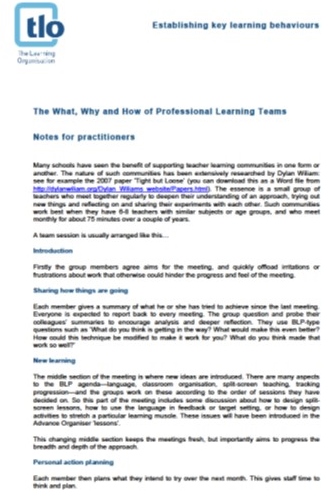
Session agendas follow these stages
- Agreeing objectives and agenda (5mins)
- Sharing learning enquiries (20mins)
- Re-capping the on-line materials (15mins)
- Deciding what’s to be done (15mins)
- Personal Action Planning (20mins)
- Evaluating the meeting process (5mins)
The flow of the meeting moves from ‘settling down'(1) to ‘how have you been doing?'(2) to ‘what did we learn online that we can use?'(3&4) to ‘ what am I planning to do next?'(5) to ‘how did our meeting go?'(6). It’s a logical flow that scaffolds the work of the team.
In the first meeting agenda item 2 is replaced with discussing the role and function of the team, how it will operate and drawing up its ground rules. Here’s a short paper about this.
6. What to bring to the meeting
Rather than simply deciding to introduce something new into the classroom because it sounds interesting we strongly recommend you focus your developments by making use of enquiry questions and plans.
Enquiry questions and plans
Please download yourself a copy of the Enquiry question and the Enquiry plan and bring them to the meeting.
Enquiry questions
Why start with a question? Because this is an enquiry, you want to find out if something will change (student behaviour) if you change something specific.
If I do XXXX will it improve/develop/enhance YYYY?
Enquiry plans
The learning enquiry plan creates a record of what will be done and as such is an important document. It represents a promise to do it and this promise keeps the plan as a priority in your mind.
The plan should also record what you will watch out for over the next few weeks. What you’ll monitor how you change your practice and what you’ll monitor about changes in your pupils. When you note such changes it motivates you to carry on since the change is almost always positive.
I’m looking forward to seeing you all at our first learning team meeting.
text across top
Title
lhs text

Comments are closed.