
Unit 1. The big picture of learning
Welcome to Building Powerful Learners. This eight unit online programme will enable you as a teacher to:
- explore how learners might become not just better learners but effective lifelong learners;
- engage your learners consciously with the ideas and processes of their own learning.
The programme combines three types of action that will help you to experiment with, analyse and understand how to become skilled in developing your students’ learning power.
1 Understand by using Read abouts…of which there are two types;
- Essential Read …essential must read text.
- Extended Read …interesting, good to know, absorb when you can.
2 Analyse by using Find outs…tools to help you discover and analyse essential information
3 Experiment with Try outs…practical activities for you to try, check and perfect in your classroom
This Unit 1 explores the “what” of learning itself.
- What are the key groups of learning behaviours? (see Read about 1)
- What am I like as a learner? (see Find out 1)
- What are my students like as learners? (see Find out 2)
- What might I do to introduce students to their learning behaviours? (see Try outs 1 to 5)
- What could use I check how my experiments are going? (see Find out 3)
Structuring and using the ideas below with your students over the next month is your first step in becoming a skilled learning power practitioner.

Essential Read about 1
Introducing the framework of high value learning behaviours
The idea of learning power has been described as the raw ‘building blocks’ of learning; not abilities, not styles, but the actual components of learning itself; the raw energy of learning. Through a systematic programme of research over several years, and with the co-operation of thousands of research participants, researchers at Bristol University turned this ‘learning power’ inside-out until finally it was broken down into the four domains of learning and seventeen identifiable learning capacities; key psychological characteristics that were and are judged to be of the highest value in helping students to learn and thrive in a complex world. These learning capacities are inherent in us all, not fixed at birth, or when we leave school: they can be developed by everyone regardless of ‘ability’, social background, or age. There are no limits to extending our learning power.
The headlines of these ideas are shown in the supple learning mind diagram opposite.
Learn more in the Read about below.
Essential Read about..The supple learning mind framework. ⬇️
The Supple Learning Mind framework of high value learning behaviours
A rich framework for learning
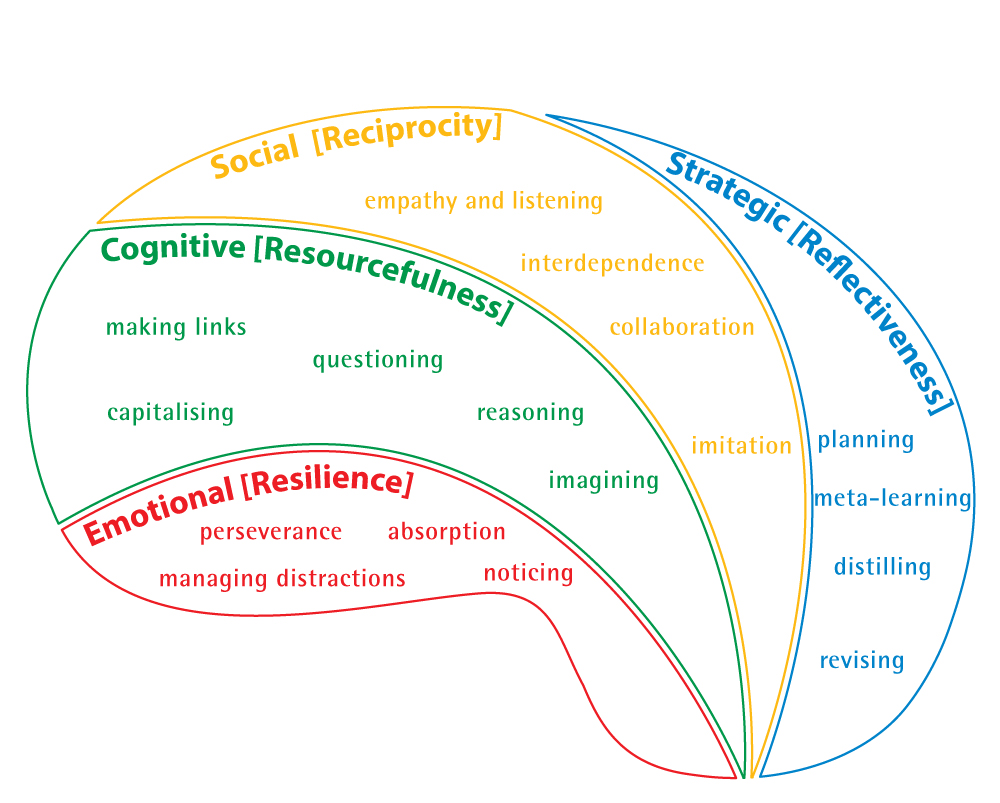
The Supple Learning Mind framework uses each of the domains of learning and these are shown in its four parts:
- The Emotional domain of learning (where we need to be disposed to being resilient)
- The Cognitive domain of learning (where we need to be disposed to being resourceful)
- The Social domain of learning (where we need to be disposed to being reciprocal)
- The Strategic domain of learning (where we need to be disposed to being reflective)
This learning framework shows that learning isn’t just about having a good memory; it includes how we feel, how we think, how we learn with others and how we manage the process of learning. It shows that effective learning is a complex process with a dispositional overlay i.e. all the positive or negative ways someone views learning. Furthermore it provides a language that helps teachers to think about how they cultivate each of the learning behaviours and help students to gain a better personalised understanding of what they have to do to learn content.
Each domain clusters together the high value learning behaviours that best make that domain work well and each of these have a dispositional aspect. For example the social domain is made up of the learning behaviours of being ready, willing and able to be interdependent, to collaborate, to listen and empathise and to imitate. Similarly the strategic domain is made up of being ready, willing and able to plan, distill, reflect on and to be meta-cognitive.
Essential Read about 2
Why all this matters
Schools today need to be educating not just for exam results but for lifelong learning. To thrive in the twenty-first century, it is not enough to leave school with a clutch of examination certificates. Students need to have learnt how to be tenacious and resourceful, imaginative and logical, self-disciplined and self-aware, collaborative and inquisitive. ‘Students throughout the world need now to reach higher levels of achievement, not only to find fulfilling work but also to empower themselves to thrive in an increasingly complex world’ The core purpose of education is to prepare young people for life after school; to get them ready, as Art Costa, an American educator with similar views, says, ‘not just for a life of tests, but for the tests of life’. This means helping them build up the mental, emotional, and social resources to enjoy challenge and cope well with uncertainty and complexity. If you strip away political dogma, the evidence is overwhelming that this aim is not currently being achieved for very many students. Of course, this has to be done in a way that also develops literacy and numeracy, and gets young people the best test results possible. Fundamentally this is what Building Powerful Learners is all about.
– Dylan Wiliam
Find out 1
Look at yourself as a learner.
Which learning behaviours are you using?
Challenge: There are nine little pigs in a field. By drawing two squares, can you give each pig its own pen? 5 minutes to complete.
Analyse your approach: Take a few minutes to consider the learning behaviours that you brought to bear on this problem, even though you probably did so unconsciously . . . .
Did you….
- Become absorbed in the problem?
- Pay attention to detail?
- Manage any distractions?
- Keep going, even if you found it tricky?
- Ask yourself questions (maybe in your head)?
- Think about other similar problems you might have seen?
- Use your imagination?
- Think about the problem methodically?
- Use any particular resources or strategies?
- Decide in advance how you might go about solving the challenge?
- Have to change your approach because your first idea was not working?
- Think about what you learned from doing this short activity?
- Reflect on how you were learning while doing the activity
These questions reflect the essence of the learning behaviours, minus the social behaviour group, identified in the Supple Learning Mind Framework.
Find out 2
Look at your students as learners
The purpose of this tool is to encourage you to get to know your students as learners. It aims to raise your awareness of if or even how well your students use valuable groups of learning behaviours. It’s a seemingly simple activity but it can prove quite taxing and you’ll need to know your class fairly well. Try to think of your students as learners rather than just performers.
About the design of the tool.
- The tool’s four sections correspond to:
- the emotional aspect of learning (feelings) pink;
- the cognitive aspects (thinking) yellow;
- the social aspects (working together) green;
- the strategic aspects (managing) blue.
- Note that ALL the statements are positive. They describe GOOD learning behaviours
Using the tool
- Think about students in your class and note down the name of the first student that comes to mind for each statement. But don’t use the same child for all the statements.
- Think about what evidence you might have to support your judgement.
- Now turn each statement into a negative.
- Again, note down the names of students that come to mind for that negative statement.
Analysing results
- Which aspect of learning was the most difficult to fill in? i.e. emotional, cognitive, social, strategic?
- Was it easier to place students in the positive or negative statements?
- Is there a gender imbalance in the students you have named?
- Are the named students mostly high or low attainers, or do they represent a range of attainment?
- What have you discovered about your students as learners?
- Anything new? Surprising? Concerning?
- Broadly, which aspect of learning (emotional, cognitive, social, strategic) feels the strongest or weakest in your class?
- Issues raised here will help steer your thoughts about the current strengths and weaknesses of your students as learners.
Extended Read about
The importance of dispositions and the essentials of the approach
Underlying this approach is a recognition that learning how to learn involves more than skills, it involves students’ attitudes, values, interests and beliefs as well. It’s about helping students to help themselves to be disposed to persist, to question and be curious, to collaborate harmoniously and to be open to new ideas. It may be that some of the girls in your classes believe that ‘Maths isn’t for girls’ or that some students think that ‘If you can’t solve it in a minute, you can’t solve it at all’ or that ‘Bright people never have to try’. All these erroneous ideas cause students to be disposed to give up easily, to feel stupid, to feel disengaged. You can think of ‘dispositions’ as indicators of the degree to which one is disposed to make use of a skill or knowledge. The good thing is that these dispositions, inherent in all of us, are not fixed at birth. They can be developed by all of us regardless of ‘ability’, social background or age. Extending our learning power has no limits. 
Extended Read about. A brief history of learning to learn. To read at leisure. ⬇️
From learning more, to learning better, to becoming better learners: a brief history of development.
Learning more: an interest in raising achievement
- Outcome of schooling (e.g. KS2 SATs results)
- ‘Good teaching’ was about content and acquisition
- ‘Good teachers’ could put across information, develop literacy and numeracy, etc.
When schools’ prospectuses first started talking a lot about ‘improving the quality of students’ learning’ what they really meant was ‘raising attainment’. ‘Learning’ was only used to refer to the outcome of schooling, learning as performance rather than learning as a process. There was no recognition of ‘learning’ as an interesting process going on in children’s brains.
Learning better: developing study skills
- Hints and tips on retaining and recalling for tests
- Practising techniques
- ‘Good teaching’ was still content focused, plus delivering study skills based on practical things that students could do to improve the organisation of their knowledge, their memories, or the effectiveness of their revision. The concern with ‘improving learning’ was linked to exams with numerous hints and tips on how best to retain and recall what had been learned.
Learning better: styles and self-esteem
- Characteristic ways of learning (e.g. multiple intelligences)
- ‘Good teaching’ included reducing stress levels and helping students raise their attainment levels
- Concern shifts to the ‘how’ of teaching
The concern with the emotional aspects of learning led to a tsunami of approaches but lacked an overall framework. Mind maps to help organise and retrieve knowledge; bottled water to lubricate students’ brain cells to ensure they didn’t ‘dry up’; learning styles of overall learning strengths (auditory, visual, kinaesthetic) which people were encouraged to play to; background classical music; the centrality of bolstering students’ self-esteem. L2L manuals became fashionable but the focus was on how the teacher could ‘teach’ better, rather than on how students could be helped to become better learners.
Becoming better learners: involving students in their learning
- Concerned with how students can be helped to help themselves (e.g. think creatively)
- Teachers themselves involved in becoming better learners
- Developmental and cumulative — encouraging the ‘ready and willing’, not just the ‘able’
Why the shift in focus? A glance at the research
When we all believed that ‘intelligence’ was fixed at birth there seemed little point in trying to cultivate it. Now we know just how learnable learning is we are realising that there’s a place for developing how we learn. Research at Bristol University uncovered seven dimensions or energies or powers that can be used to shape how we learn. This was the beginning of shaping a good route map of how children’s learning power grows: a route map to do with the growth of our resilience in learning, our learning relationships, our thinking skills and how we manage our learning. The route map causes questions such as:
- What does resilience mean to a four-year-old, or ten-year-old, and how can it be appropriately stretched?
- What kinds of thinking skills will help students become better learners
Questions such as this explain why this ‘learning power’ approach is often referred to as ‘building’ learning power.
The secret of learning power: disposition to make use of skill
Underlying this approach is a recognition that learning how to learn involves more than skills. How, and how well, children learn can’t be reduced to a matter of ‘skill’; it involves their attitudes, values, interests and beliefs as well. For example…
Kamini believes that ‘Maths isn’t for girls’ so she is not predisposed to try hard tasks. Neither is Fred, but for a different reason: he believes that ‘If you can’t solve it in a minute, you can’t solve it at all’. Evie thinks that ‘Bright people never have to try’, so she feels stupid when she can’t do something easily, and gives up too.
Think of ‘dispositions’ as indicators of the degree to which one is disposed to make use of that skill or knowledge. Rather than nouns, ‘dispositions’ are adverbs — those little signifiers of ‘time, manner and place’ that modify the verbs they accompany. To be disposed to persist, for example, is simply
- to show persistence across a broad rather than a narrow range of occasions;
- to tend to persist in the face of more severe obstacles or frustrations; and
- to have a rich repertoire of ways of supporting and encouraging one’s own persistence.
To be disposed to ask questions is to
- tend to ask questions in English as well as in maths
- to ask questions despite a degree of discouragement or fear.
When one is ‘disposed’ to self-evaluation you
- stand back from time to time and ask yourself how it is going
- self-evaluation has become routine, second nature, and across the board.
This shift in terminology reflects the influence of a particular strand of research that has emphasised the difference between skills and dispositions. David Perkins of Harvard University and others have shown that people often appear less capable than they are, not because they don’t possess the skill they need, but because they don’t realise that now is the right moment to call that skill to mind and make use of it. They lack what Perkins calls ‘sensitivity to occasion’. Skills and techniques aren’t enough. Students must not only possess the requisite capabilities; they must be ready, willing and able to use them when the time is right.
We need to move from thinking about learning as a set of techniques and skills that can be ‘trained’, to a set of dispositions, interests and values that need to be ‘cultivated’.
The first generation of Learning to learn – Learning More
The second generation of Learning to learn – Learning Better
The third generation of Learning to learn – Becoming Better Learners
Try out 1
What do your students think good learners do?
Explore with your class what is it that good learners do.
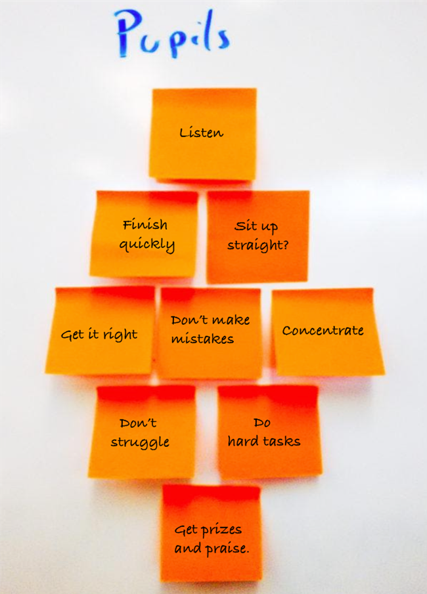
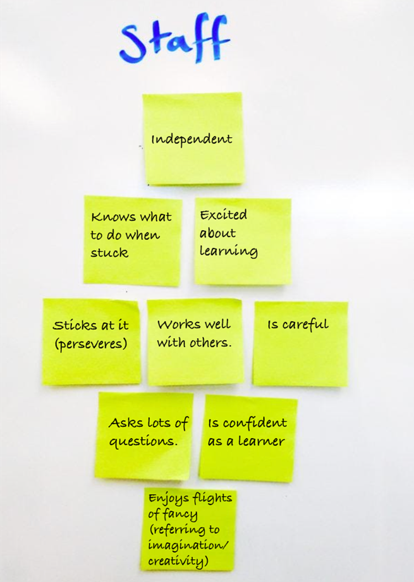
‘What do good learners do?’ has been an interesting question for teachers and students over many years. The worry is that we’ve always had surprisingly different answers from teachers on the one hand and students on the other. Worrying because the messages teachers convey to students seem to be very different to their real beliefs.
The pictures alongside record a sample of responses we’ve seen over the years.
- from students who think good learners…finish quickly, get it right, get prizes and praise.
- from teachers who think good learners…work well with others, ask lots of questions, are independent.
Take time to ask your own students what they think good learners do.
- Organise students into groups of 4 or 5
- Give each group and yourself nine Post-its
- Ask students to think about what they think good learners do and write each idea onto one Post-it.
- Explain that you will do the same
- When groups have nine ideas they should arrange them into a diamond 9 pattern with the one they think most important at the top.
Consider the results together.
What’s the difference between 2 diamond nines? Like it or not, as a teacher you are in the habit forming business. Students ideas will be formed from teacher actions and responses.
- Take feedback on their ideas
- Pose questions about how the two diamonds differ
- Explore why students have these ideas and
- Why are they different from yours
- Broaden students ideas about learning
Try it again in 6 months
As a way of testing out how things are going try repeating this exercise in say 6 months or the end of the year.
- What would you like or expect your answers to be?
- What would you like or expect your students’ answers to be?
- Which three of your students’ current answers would you like to change most?
Try out 2
To support emotional aspects of learning
Make students aware of perseverance
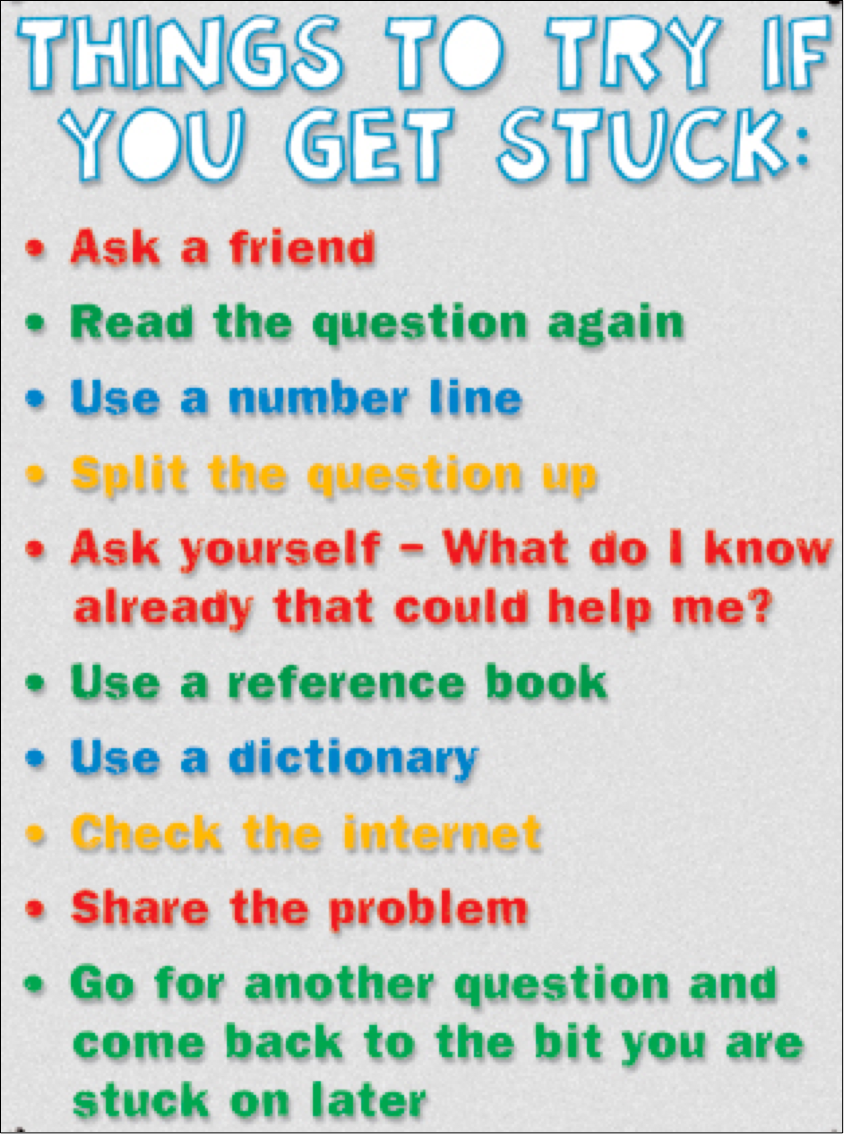
Develop ‘stuck prompts’ together.
- Work with students to find useful questions to ask themselves and helpful strategies to use when they get stuck.
- Ensure that there are plenty of options that come higher on the list than “Ask the teacher”.
- Create stuck prompts as reminders around the classroom.
- Or a special Stuck Table with plenty of resources.
- Or Stuck Walls with multiple displays of Stuck Posters.
- Or a Stuck-of-the-week’ display.
All these are, in effect, low-risk, low-investment levers for creating a shift in students’ sense of what is valued, what is normal, and what is the point of their learning — and thus in the quality of their engagement. It’s about making being stuck acceptable, normal and interesting.
Try out 3
To support cognitive aspects of learning
Make students aware of questioning
Engage with a ‘mystery’ object in a bag
Invite students to ask questions to find out what the mystery object is.
- Vary the complexity according to the age and experience of the class. Use clues to narrow down the possibilities for younger children e.g. it’s something you’d find in the garden. Young children will tend to want to ‘guess’. They will need encouragement to ask questions before offering solutions.
- Ask talk partners to come up with two ‘I wonder’ questions e.g.” I wonder what it’s made of?”
- Set a limit, say 10/15/20 questions allowing the children to guess before showing the object.
- Key is to focus on the questions, to acknowledge and reward good questions.
- At the end compile a list of some of the useful/unusual/interesting questions that were asked.
What you are doing here is encouraging students to find things out for themselves and to be interested in the answer as much as the question. You are raising their awareness of the role and power of questioning giving them help to ask a ‘good’ question (i.e. a generative question, one that will get them somewhere)

Try out 4
To support the social aspects of learning
Make students aware of collaboration
Work out Rights and Responsibilities
Work in pairs or small groups to suggest a charter of matching rights and responsibilities or ground rules for collaboration. If everyone has a right to have their voice heard, everyone also has a responsibility to listen attentively to others. If everyone has a right to take part, everyone also has a responsibility to include others. If everyone has a right to experience different group roles, everyone has a responsibility to be flexible in the roles they play.
What you are trying to do here is make students aware of social conventions and advantages of working/learning with others. Such rights and responsibilities are necessary in any class in any age group since they declare ‘how we want to be around here’. It’s a good idea to include the social skills needed, sharing ideas, working out what needs doing, playing their part and even thinking about how they have contributed to the team.
Try out 5
To support the strategic aspects of learning.
Make students aware of the process of learning
Work vs Learning
Teachers have traditionally talked much more about ‘work’ than they have about ‘learning’. One study carried out in London schools compared the frequency of use of these two words, and found that ‘work’ was used 98% of the time, and ‘learning’ only 2%.
Research has found that when classroom activity is called learning or ‘play’ groups find the activity more pleasurable than when it’s referred to as ‘work’. Students also become much more locked on to it, their minds wander much less, they are more imaginative, and they learn more from the activity.
Now there is nothing wrong with the word ‘work’ but it doesn’t invite you to get interested in the activity itself. You will be pleasantly surprised at the effect on your students if you talk less about ‘work’ and more about the process of learning itself.
It’s the start of a journey whereby learning is seen as a journey with an internal dialogue needing delicate encouragement. In Visible Learning, John Hattie says: “The more students are thinking about how they can make their own learning more and more effective, the better they do.”
From:
WorkUsing the word work to describe classroom activity.
For example “Get on with your work” or “Have you finished your work” or “Where is your homework?”
To:
LearningUsing the word learning to describe classroom activity.
For example “How is your learning coming along?” or “Is this piece of learning finished” or Home Learning
Find out 3
How are your students learning?
Over the last few weeks you have been working to broaden your students’ awareness of learning and what good learners do. This is no easy task but even at this early stage it’s worth finding out more about how they are learning and wondering about possible stumbling blocks.
Over the next few weeks use the Find out 3 wheel every now and again to get a feel for the sort of learning behaviours students are being given a chance to use and whether they are indeed taking that opportunity naturally.
About the design of the tool
- The wheel is divided into the four aspects of learning:
- emotional or feeling behaviours of learning… (red)
- cognitive or thinking behaviours of learning…(green)
- social or relating behaviours of learning… (yellow)
- strategic or managing behaviours of learning… (blue)
- Each statement ‘wedge’ has four ‘levels’ of engagement/activity shown by the gradually deepening tones of colour.
Using the tool
- Copy and date several copies and use a new copy for each observation over the next few weeks.
- Make observations across the major aspects of your curriculum
- Maths. English, Science. Humanities. PE.
- Observe for several minutes and;
- Colour in the ‘strength’ of the learning behaviours are being used.
- NB. Some or all of the behaviours may not be being used at all.
Analysing results
- Which single learning behaviour appears to be being used most often across all your observations?
- Which behaviour appears to have fewest opportunities for use?
- Which of the 4 ‘colours’ Emotions, Thinking, Relating, Managing appear more often? across these observations?
Two big questions
- Is the way the curriculum is structured/defined providing enough opportunities for students to use this broad range of learning behaviours? i.e. do the tasks/activities actually require, or unknowingly ensure, that students use the behaviours? Are they bound to use them?
- Are the students sufficiently aware of themselves as learners to be able to take advantage of such opportunities?
In other words is it the curriculum delivery that needs freeing up or are the opportunities there but the students are unaware of the ‘how’ of learning?

Learning together. Meeting 1
Guidelines to enable you to:
- Agree a meeting structure and ground rules for this and any following Learning Together meetings;
- Discuss your responses to your reading of Unit 1;
- Discuss your findings and reactions from working with suggestions in Unit 1;
- Plan further action.
Although time is short in schools, coming together after individually working through each Unit will serve to deepen individual experiences and secure a robust whole school approach.
Learning Team Meeting 1 Agenda ⬇️
Unit 1 Suggested meeting agenda
- Agree how you want to work together; meeting ground rules, objectives (15 mins only for 1st meeting)
- Discuss what you have found out about learning, (10 mins)
- Re-cap and reflect on the action you have each undertaken in classrooms (20 mins)
- Note and record issues and changes in your practice going forward (10 mins)
- Review how the meeting format went and identify issues for strategic leaders. (5 mins)
The guidelines below are fairly informal. If however you want to run more structured learning team meetings the paper below offers a full explanation of how traditional learning teams work.
What-Why-How-of-PLT.pdf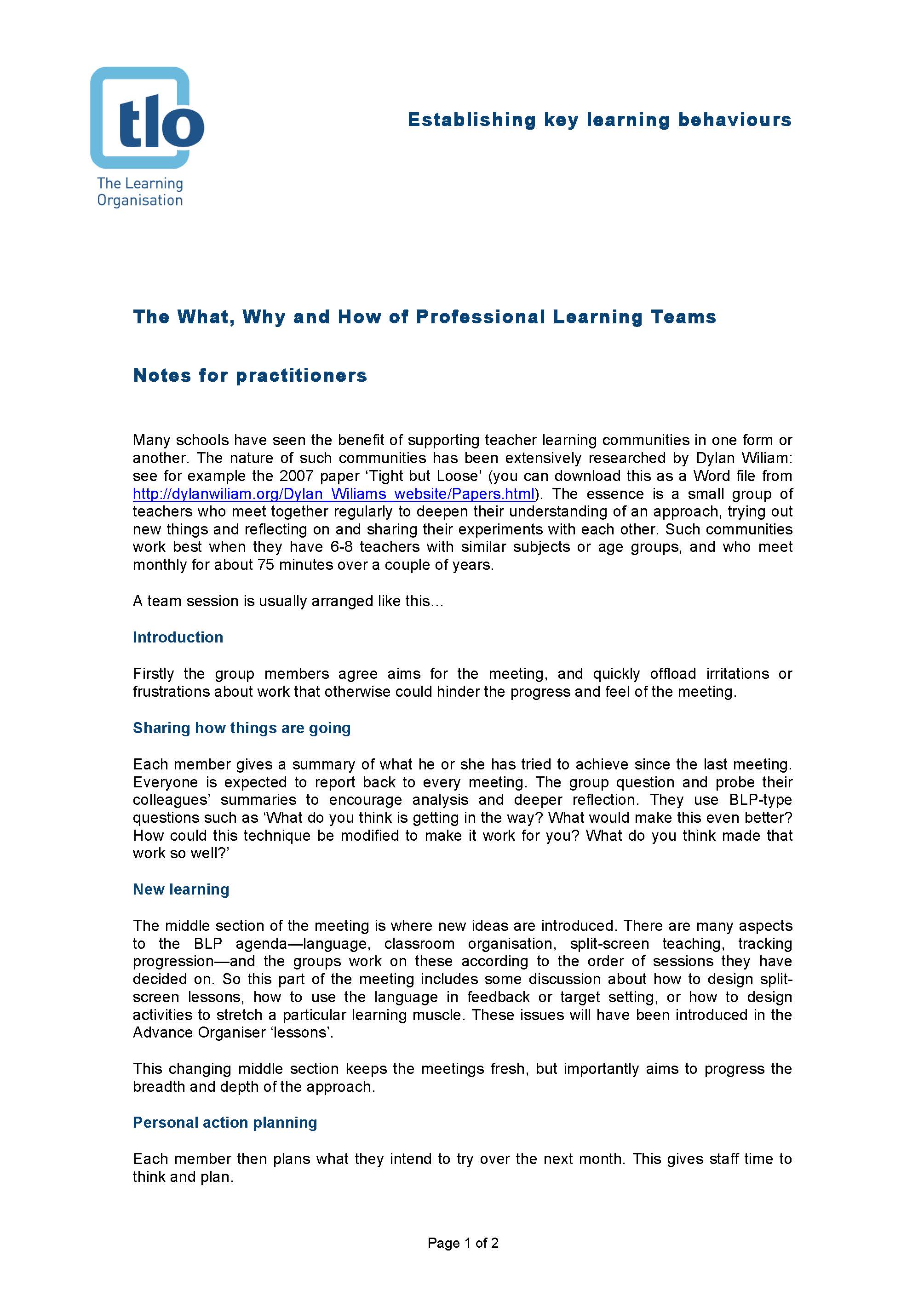
Item 1. Ground rules and objectives. (15 mins)
Explore how you want to operate as a learning team.
Meeting objectives might include:
- share and learn from what we have each tried in our classrooms;
- feel confident about taking forward ideas from online materials into our practice;
- identify actions that would be more useful if everyone applied them in their practice;
- plan further personal developments in classroom practice.
Outcome. To have decided what such meetings should aim to achieve henceforth.
Item 2. Discussion about learning (10 mins)
Explore together your reaction to the Supple Learning Mind model and discoveries about yourself and your students as learners
- what were your first impressions?
- what do you still need to get your head around?
- what did you find out about yourself as a learner? (Find out 1)
- what did you come to realise about your students as learners? (Find out 2)
- what did your students come up with in the diamond 9 exercise? (Try out 1)
- what surprised or baffled you?
- are there significant differences between year groups?
Outcome. A clearer understanding of the thinking behind Learning Power and its potential for improving your students’ learning.
Item 3. Explore action in the initial Try outs (20 mins)
Share and discuss the action you each took in making a start on developing learning power
- which of the suggestions did you each use
- any concerns about or difficulties in putting the Try outs into action
- the impact of these actions
- which seemed the most valid or successful
- how the Try outs affected different age groups
- results of Find out 3 by each teacher
- implications of the results…Curriculum focus? Learning to learn focus? One or both?
Outcome.
A clear recognition of what people have tried out in classrooms and the understanding coming from it. A note of which ideas all teachers should try and a sense of how the school’s journey needs to be balanced between a deepening of students’ role in the curriculum and a focus on strengthening a wide range of learning behaviours.
NB. If senior managers do not attend staff meetings such as these they should be informed of important suggested outcomes relating to Find out 3.
Item 4. Learning from practice (10 mins)
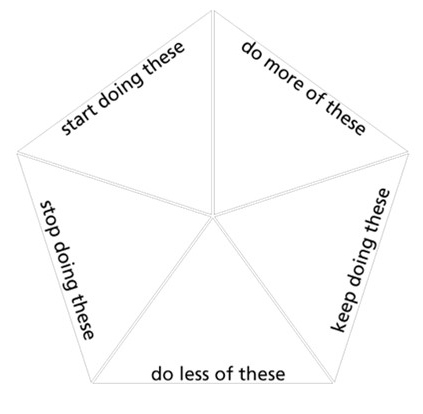
In relation to all the shades of practice you have been sharing and mulling over, which stand out stand out as:
- things you want to start doing
- things you think you need to stop doing (that’s harder)
- things you want to keep doing
- things you want to do more often
- things you want to do less
At this stage it’s valuable to note ideas arising from this discussion.
Outcome.
It’s useful for every teacher to keep a copy of this document as a reminder and proof of your learning.
Item 5. Evaluate team session. (5 mins)
- Did we achieve our objectives?
- Are we comfortable with what we are trying to achieve?
- Any concerns at this point?
- Next meeting date and time.
Outcome
Remember to report any outcomes from section 3 with a strategic nature to senior managers.
Comments are closed.