
This section gives you all sorts of help on deciding which learning behaviours to tackle and shows you where to find them. It may be wise to approach a senior leader to discuss your starting point in the context of the school’s previous work on learning power. When you reach this point you will have been invited to join one of the school’s Professional Learning Teams.
Features of the catalogue
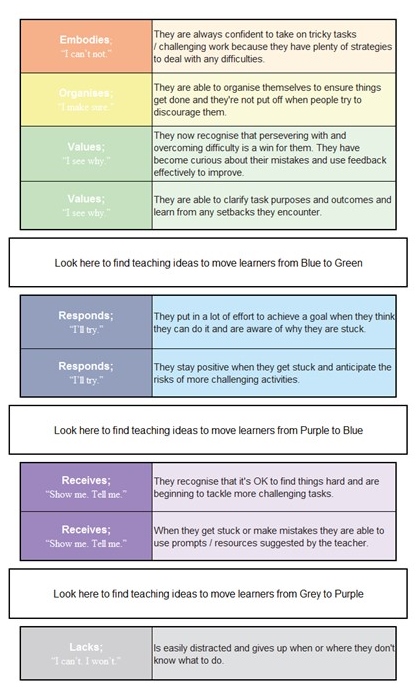
- the 12 learning behaviour progression tables;
- each interlinked with specific teaching ideas to enable that progression;
- and shorthand diagrams that summarise how this all plays out in classroom cultures.
The Catalogue – Progression phases interlinked with teaching ideas . . .
1. Decide where to make a start . .
Take a look at the data you have recorded about your students. (see section 3.1 or 3.2) Become curious about what your data is telling you and remember not all learning behaviours are equally important. Some are more critical for success in some subjects than others, while others are critical for success across the curriculum.
Find the behaviours to make a start on
- You could start by looking at those behaviours that apply more generally and are linked to students’ attention…perseverance, noticing, listening, refining. These alone may account for sluggish performance.
- Look particularly at questioning. More curious students are motivated to explore and engage, whereas a student lacking curiosity usually has little enthusiasm for learning.
- Remember too, that it’s well-researched that well-developed meta-cognitive skills tend to raise students’ attainment. So maybe think hard about including meta learning too.
- Select three or four behaviours that seem most appropriate to work on first for your group. If the school is undertaking the Phase 1 course Playing the Learning Power game they will be focusing on only 4 behaviours…perseverance, questioning, collaboration and revising/refining for the majority of the course.
Let learning profiles influence your choice of approaches or activities

2. Check out your classroom culture
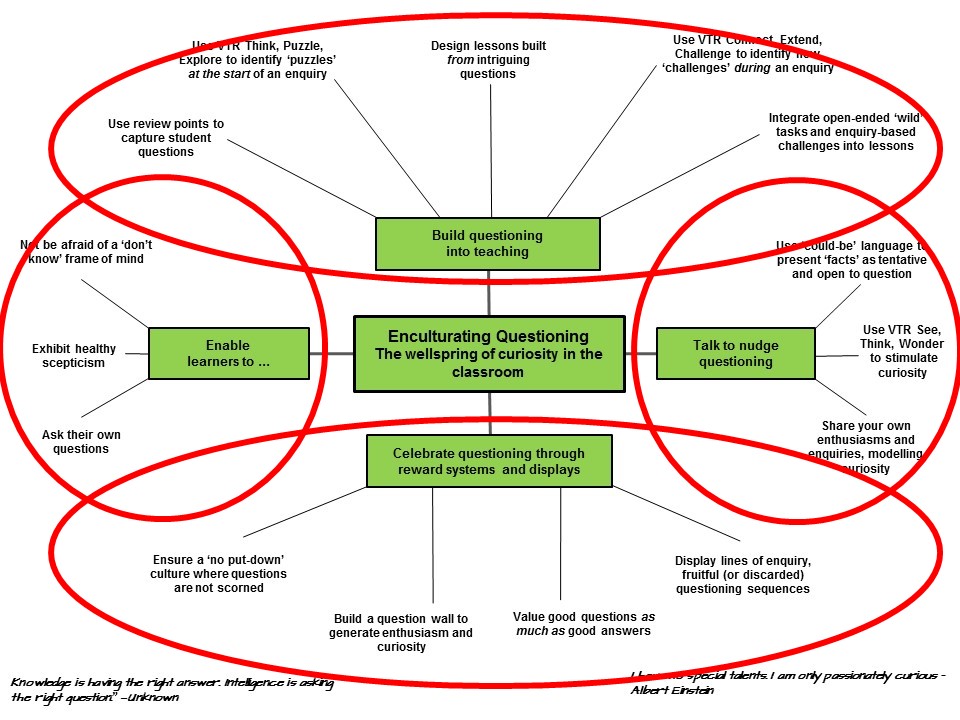
Having already explored classroom culture in section 4, we now consider the aspects of classroom culture that need to be present for the particular learning behaviour to flourish. The culture diagrams you will find in each section address 4 aspects of classroom culture:
- At 9 o’clock – the dispositions, habits and behaviours you are aiming to enable your learners to develop;
- At 3 o’clock – how you might talk about the learning behaviours;
- At 12 o’clock – how you might organise learning to exercise the behaviours;
- And at 6 o’clock – how you might organise your classroom to celebrate the behaviours.
Give time to evaluate your own classroom culture against these 4 aspects, because minor adjustments to classroom culture will make it easier for the teaching ideas that follow to achieve the outcomes you desire for your learners.
The classroom culture to foster learners’ curiosity (for example)
3. Decide which levels to start on
- The next thing to consider is how well are the students disposed to the learning behaviours you have selected.
- What stage of ‘mindedness’, about this behaviour, have these students attained? Are they:
- unaware and or fearful of the behaviour? (grey);
- needing masses of help or reassurance? (purple);
- becoming willing to work on/ tackle this? (blue);
- ‘sold’ on this behaviour because they realise it’s good for them? (green)
- Remember, your role will be to ‘work between the lines’. So, if your students are:
- still in the grey zone… you need to look at material shown between grey and purple;
- in the purple phase…you need to look for ideas between purple and blue;
- in the blue zone…you need to look for ideas between blue and green.
- green and above you need one of our more sophisticated products!
- PS. It’s usually a good idea to start at the bottom and work up. You’ll often find activities that you can adapt or tweak a bit for different phases of growth or different ages of student.
- Remember too, that in these early stages, you’ll be bringing these behaviours out of the shadows in several ways:
- making students aware of the behaviour;
- talking about it (what, how, why, when, if);
- giving them opportunities to practise it, both in lessons and elsewhere;
- celebrating its use;
- reflecting on it to improve it.
- You will find a variety of teacher activities ‘between the lines’ in all twelve behaviour progression tables so enabling you to work on many of these fronts.
Working between the lines
Comments are closed.