
11. Refining – Making improvements
A well formed Refining habit involves being ready, willing, and able to: self-monitor how things are going, keeping an eye on the goal; expect the unexpected, having a readiness to re-shape, re-order, re-form plans to take account of new circumstances; remain alive to new, unforeseen opportunities and ideas; look at what you are doing with a critical eye; strive to be the best you can be; make sure things are on track and make improvements along the way. So students need to learn how to deal with change, emotionally and practically. With an inflexible frame of mind they are unlikely to recognise the need to change their ideas or the way they do something. They also need to know what ‘good’ looks like; how to keep an eye on how things are going and the willingness to evaluate how things went against external standards. Growing revising moves well beyond encouraging a student to ‘have another go’. 
How well does your classroom climate encourage Refining? ⬇️
Does my classroom climate encourage Revising?
Here is a selection of features that might begin to shape the emotional climate of your classroom to encourage revising.
The diagram has 4 sections:
- Top – strategies you could build into the way you teach to stimulate revising;
- Right – indications of the sort of language you might use to stimulate revising;
- Bottom – ways in which you might celebrate / praise students’ use of revising;
- Left – things that you need to enable students to do.
Apply your own attentive noticing skills and consider whether you already use any of these features and which you fancy trying.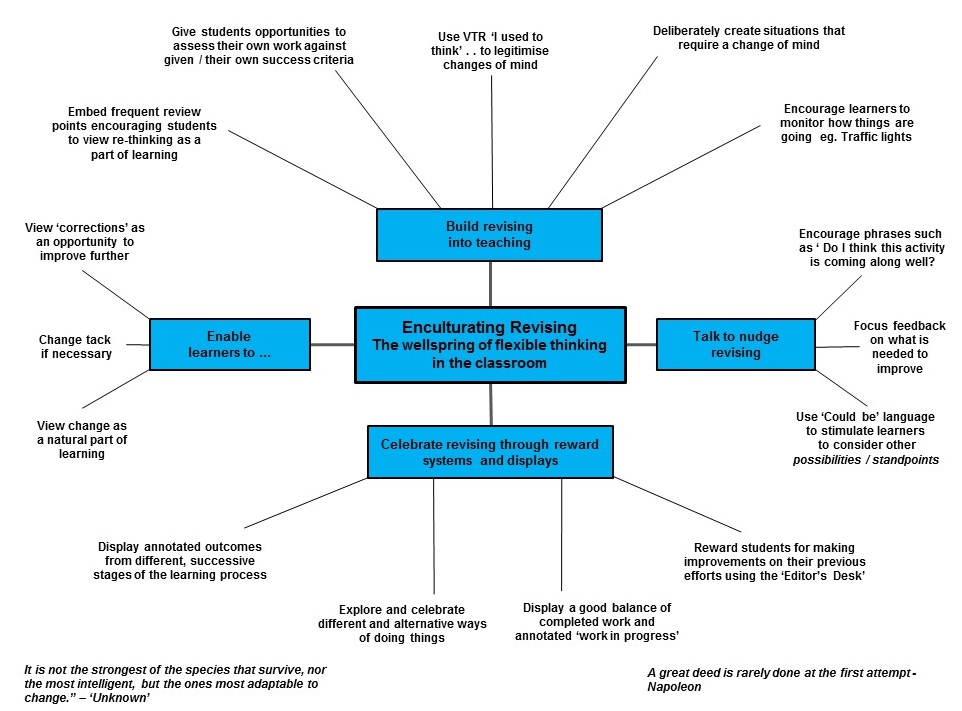
Bridging the gaps – teaching ideas to cultivate Revising
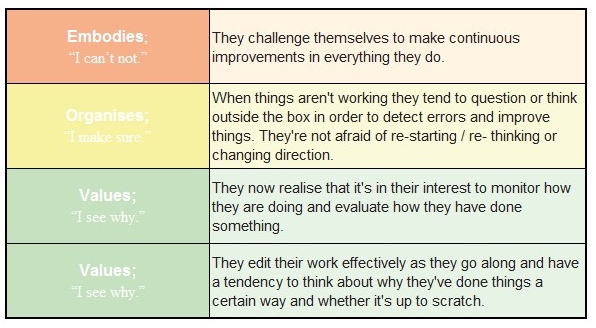
Teaching ideas to move learners from Blue to Green ⬇️
What you are trying to help your students to achieve
In the Values (green) phase, students understand the importance of keeping a close eye on progress in order to achieve high-quality outcomes that meet their goals. They see the point in making changes in the light of the original goal or external standard or internal feedback. They understand the need to learn from previous experiences and realise that learning is all about changing understandings; not just knowing stuff. In so doing they widen the scope of external validation.
Your role as a teacher in this phase is to:
Devolve responsibility for refining… by expecting students to create their own monitoring checklists
Talk about refining…by exploring the positive relationship between making changes and achieving outcomes
Give students opportunities to practise refining…by building in plenty of time for peer assessment activities
Celebrate refining… by reflecting on, praising or displaying its use
1. Devolve responsibility for refining
Engage students in purposeful refining (and noticing)
Ron Berger’s Ethic of Excellence
Build a culture of critique
Plan formal critique sessions, where students may show a piece of work, explaining their ideas and what they were trying to achieve. Students are then encouraged to critique the work, but using the rules that it must be:
- Kind
- Specific
- Helpful
Students should be encouraged to phrase their critique as questions e.g. ‘Have you thought about…..?’ As a result of this feedback from their peers, students improve their work over time. This is demonstrated brilliantly, by this short video.
Just watch, be amazed and try similar approaches with students.
2. Talk for refining
Growing reflection in action
To make minor changes to tweak
- You could always say to yourself..’Does this meet the criteria?’
- Could you / do you need to make some small improvements?
- We never/rarely get it right first time.
- You could say to yourself…’I did this well/right/better because I made XX changes
To edit as they go along
- Are you checking whether this is OK?
- So, by checking all the steps/sections you have achieved a great outcome
- Can you think of other ways you might do it?
- Check your success criteria and that you are still on track
- Does this need fine-tuning?
- You need to think on your feet.
3. Give students opportunities to practise refining
Visible Thinking Routine
I used to think . . . . . Now I think.
This routine helps students to reflect on how and why their thinking/understanding is changing.
Remind students of the topic you have been working on. Ask them to respond to each of the sentence stems: I used to think…, Now, I think…
Alternatively ask students to write down their views at the beginning of a topic. Invite them to revisit & update their answer during and at the end in light of what has been learned.
Or, at the beginning of a lesson ask students to write down what they understand by a particular term that will be explored in the coming lesson (e.g. Phrase (English); Proof (Maths); Power (Science) etc). At the end of the lesson, ask them to write down what they now understand by the term.
Read more on the VTR website

An activity that enhances content understanding by using Revising
Per-verse
Use this activity to demonstrate how opinions and hypotheses change and are revised as more information becomes available. Underline the importance of speculative thinking that is unlikely to be right first time.
Groups of three or four. One stanza of a poem to each group. DO NOT REVEAL THE POEM’s TITLE! Explain: The group has to make assumptions about what they are reading based on the limited information they have.
Ask groups to:
- Distil what they know so far, and
- List the questions to which they need answers.
Next, exchange stanzas with another group
- Does the new information answer any questions?
- Are there new questions to find out about?
- How do the verses fit together — which comes first?
Repeat the process about four times. Run a formative plenary: What do we know so far? Now issue all groups with the complete but cut up poem and ask students to work towards a sequence that makes sense.
Extend understanding of revising by exploring;
- How did opinions change as more information became available?
- Were group members willing and able to revise their views?
- How flexible was people’s thinking?
- What is the wider importance of keeping an open mind?
We have found Mushrooms by Sylvia Plath a useful poem to start with. Download it in cut up form here
Download

4. Celebrate refining
Get a handle on excellence
The Rating Wheel describes an expert ‘Reviser’. Use the wheel as a reflection tool for students to consider which skills they know about, which they have used and which might need improvement.
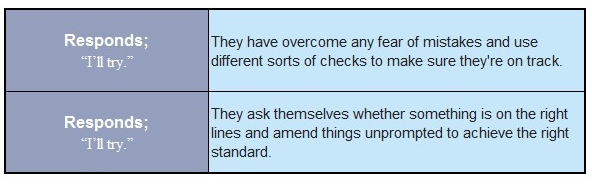
Teaching ideas to move learners from Purple to Blue ⬇️
What you are trying to help your students to achieve
In the Responds (blue) phase students have overcome a fear of mistakes and are more able and willing to monitor what they are doing. They begin to develop the idea of ‘good’ themselves and to understand why given standards are important. They respond positively to supportive feedback and talk reflectively about how they could improve with encouragement.
Your role as a teacher in this phase is to:
Devolve responsibility for refining… by offering feedback that requires a thoughtful response
Talk about refining…by exploring the nature and purpose of standards
Give students opportunities to practise refining…by encouraging students to make regular progress checks and to consider alternative methods/strategies
Celebrate refining… by reflecting on, praising or displaying its use
1. Devolve responsibility refining
Give revising a special place
The Editor’s Desk
Create an area of the classroom which is dedicated to and celebrates the skills of reviewing and improving.
Set aside a table in the classroom, and equip it as if it were an office – writing equipment, computer, office chair etc.
This is called the ‘Editor’s Desk’, which is set aside for a student to use when they are in editing, drafting, redrafting, correcting or improving mode.

2. Talk for refining
Extend the language of Revising
Collect words that describe what a good reviser does. How else might we talk about Revising?
Relate Revising to well-known sayings
What do we mean when we say …
Change tack
Think on your feet
Fine tuning
Back to the drawing board
Keep an open mind

3. Give students opportunities to practise refining
What do you see here?
Ready students’ minds for adjusting their point of view, changing their mind or revising their ideas.
The technique, illustrated here through the picture of a dog leaping over First World War trenches, can be applied to any image where there is some kind of unexpected juxtaposition of conflicting aspects within the same picture.
The purpose is to draw students into speculating about various parts of the image before revealing the full image. This will necessarily require them to revise and build on their first impressions. The underlying message is that new information often forces us to change our original understandings.

4. Celebrate refining
What stuck with you today?
Make reflection on what they have done part of the daily or lesson routine. This display from Miriam Lord primary school in Bradford shows a range of discussion cards which the teacher uses with specific groups of students during or at the end of a day.
The questions include:
- Today I have learned….
- Today I have tried to…
- My biggest success today has been….
- What will your tell your family when they ask ‘What did you do at school today’?
- The most important thing I have learned today.
- Has something inspired you today?
Each, in different ways, encourages students to think about how their thinking / understanding has changed, how they have revised their view of things.

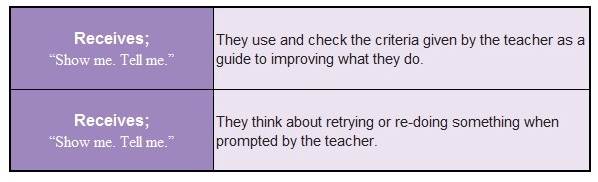
Teaching ideas to move learners from Grey to Purple ⬇️
What you are trying to help your students to achieve
In the Receives (purple) phase, students begin to make checks on how they are doing against given criteria when prompted. They can talk about what they did and sometimes how. They rely on their teachers or parents to validate what they do/have done.
Your role as a teacher in this phase is to:
Devolve responsibility for refining… by introducing the idea of refining/revising
Talk about refining…by introducing the process of talking about what they have done
Give students opportunities to practise refining…by allowing plenty of time
Celebrate refining… by reflecting on, praising or displaying its use
1. Devolve responsibility for refining
Explore what it means to revise.
Invite the students to move around a big open space then stop and make the shape you call out.
When they have all made their shape, ask them to look around at each other and then have another go at making the same shape differently.
- Do this several times.
- Talk about thinking again and changing one’s first idea of how to do something.
- Over time get the children to start asking themselves whether they want/need to improve their first go at making the shape -so gaining a sense of an internal ‘good enough’ measure.

2. Talk for refining
Talk about and have students create success criteria
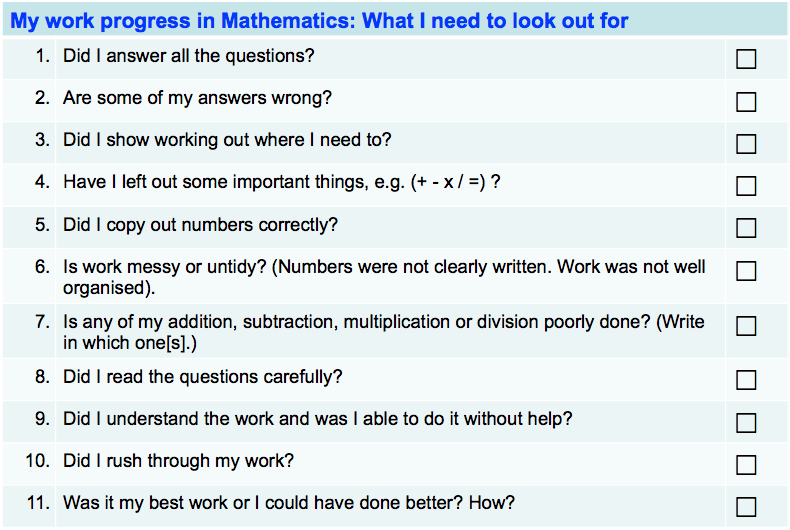
Make it clear to students what you are looking for in a piece of learning and give them opportunities to check their ‘work ‘against the criteria, either individually or in pairs. Ensure the criteria are linked to the original learning intention. Knowing what is expected encourages students to stay on focus and to revise their work to meet the criteria. Invite students to create success criteria themselves in order to encourage ownership.
Include
- what students should know
- how much, and how, they should include opinions, judgements and their own thinking
- what skills they should be able to demonstrate
- how to link the outcome to the original learning intention.
3. Give students opportunities to practise refining
Cooking is a very real way for students to understand the need to check progress and make changes if necessary.
- Decide on the recipe to use
- Decide what you could change that would make students realise the need to check and change things.
- For example
- make the oven temperature too hot
- measure the wrong amount of flour or water etc.
- It may seem a bit wasteful to deliberately burn/spoil the first batch but that only needs to happen with the first batch and then each succeeding group can be doing the checking.

4. Celebrating refining
Give revising a high profile
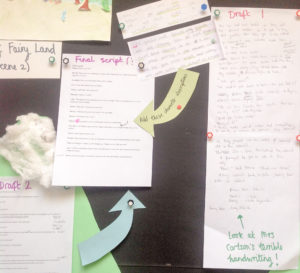
Display work in progress
- Collect and display work at different stages of development. Use arrows and notes to highlight the changes and their impact.
- Renew and refer to these frequently to encourage students to review and amend their work.
- Show that learning isn’t about perfection at the first attempt!

Comments are closed.