
5. Reasoning – Thinking logically
A well formed Reasoning habit involves being ready, willing, and able to: resist jumping to conclusions; seek justifiable evidence to shape sound, well-honed arguments; scrutinise your assumptions; seek evidence and counter evidence, look for false steps and carefully draw conclusions; remain suspicious, doubting and self-doubting in order to avoid unwarranted certainty; convey your logical thinking clearly, through dialogue, symbols, analogies, prose and pictures. So, at a less abstract level, students need to learn the inclination to resist impulsive responses; to respond logically and thoughtfully; to apply logic by explaining, justifying and, ultimately, proving what they think; to utilise a range of reasoning tools; and to develop strategies for presenting their reasoning to others persuasively. 
How well does your classroom climate encourage Reasoning? ⬇️
Does my classroom climate encourage Reasoning?
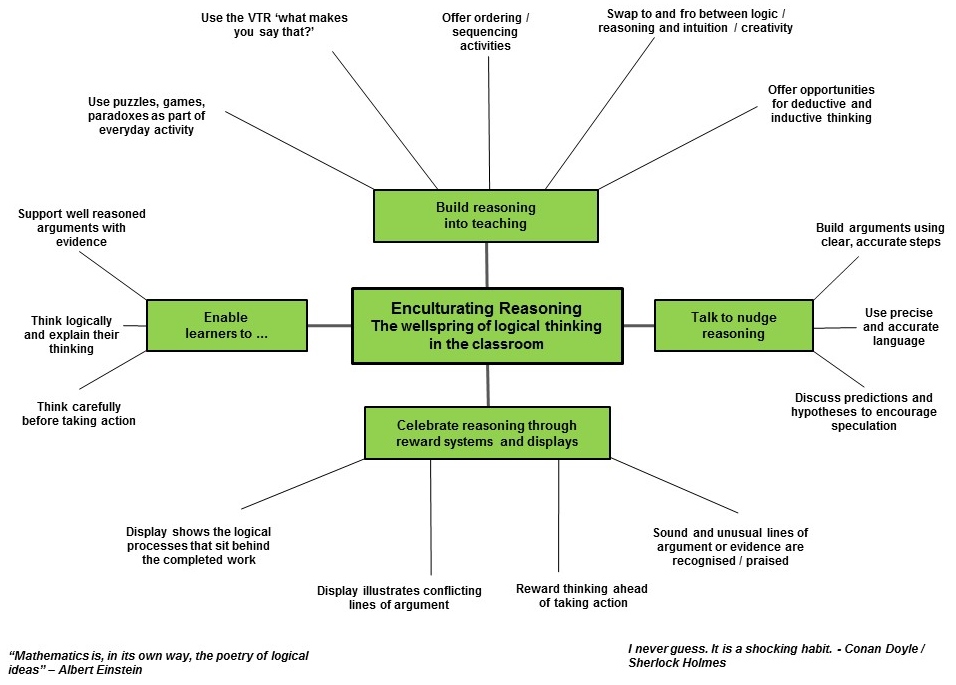
Here is a selection of features that might begin to shape the emotional climate of your classroom to encourage reasoning.
The diagram has 4 sections:
- Top – strategies you could build into the way you teach to stimulate reasoning;
- Right – indications of the sort of language you might use to stimulate reasoning;
- Bottom – ways in which you might celebrate / praise students’ use of reasoning;
- Left – things that you need to enable students to do.
Apply your own noticing and consider whether you already use any of these features and which you fancy trying.
Bridging the gaps – teaching ideas to cultivate Reasoning
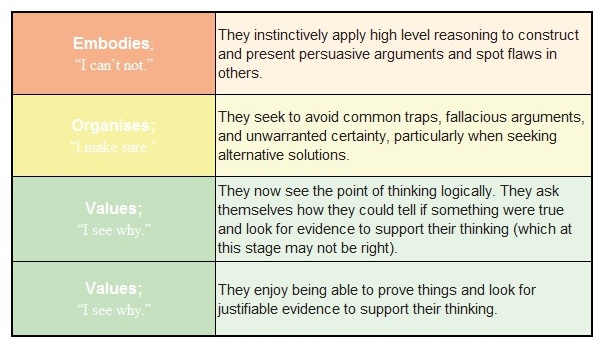
Teaching ideas to move learners from Blue to Green ⬇️
What you are helping your students to achieve
In the Values (green) phase, students understand the importance of needing to show how they worked something out. Now they can give a watertight argument based on generalisations (deductive reasoning). There is an assumption at this phase that students can communicate their solutions in a written form.
Your role as a teacher in this phase is to:
Devolve responsibility for reasoning… by encouraging the idea of finding the truth and looking for evidence
Talk about reasoning…by encouraging students to explain why they think they are right
Give students opportunities to practise reasoning…through deductive reasoning the use of symbols and diagrams to express what they have found/proved
Celebrate reasoning… by reflecting on, praising or displaying its use
1. Devolve responsibility for reasoning
Brain Teasers
Use brainteasers to stimulate logical, deductive reasoning. For example:
- Marie, Claude, and Jean are in a competition. Here are their results:
- The youngest person received the least points.
- Claude got half of the points of the eldest.
- Jean received as many points as both others combined.
- Who is the eldest?
- In the debrief, focus in particular on how the problem was solved, rather than on the correct solution. See
2. Talk about reasoning
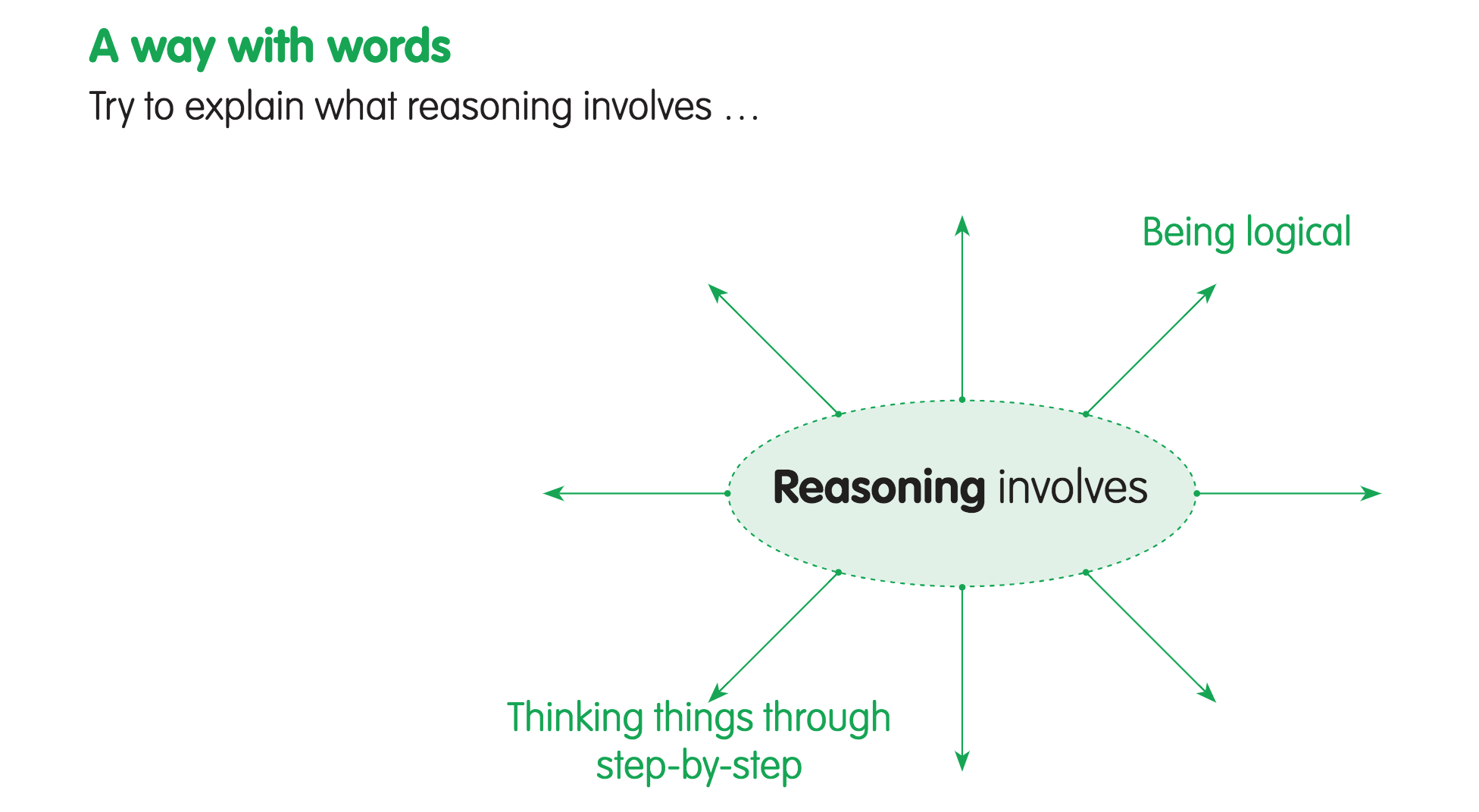
Explore the meaning of reasoning
Collect words that tell you how people learn to Reason.
Relate reasoning to well-known sayings
What do we mean when we say …
On the one hand . . .
One step at a time
It adds up
3. Give opportunities to practise reasoning
Use code-breaking
Present students with coded messages and require them to work them out using their deductive skills.
Start with simple substitution codes where, for example, each letter is replaced by the one after it in the alphabet. (i.e. b replaces a, c replaces b etc. etc.) Increase difficulty by using more complex ciphers.

4. Celebrating reasoning
Make reflecting on Reasoning part of everyday lessons
Here is a very practical example of how you might develop the emotional climate of the classroom and make it reasoning friendly
Learning Mats
Learning mats are A4 laminated sheets that show various aspects of a learning habit. Keep them on desks/tables or as part of a wall display.
Students refer to them during lessons, using them as prompts about the finer aspects of a learning habit that is being stretched.
Learning Logs to alert students to Reasoning across various aspects of their learning lives
A useful resource for tutor time to guide reflection and a wide ranging discussion

Teaching ideas to move learners from Purple to Blue ⬇️
What you are trying to help your students to achieve
In the Responds (blue) phase, students have more confidence in their reasoning although their answers may not be correct. In ‘convincing’ they may use the words ‘I reckon’ or ‘without-doubt’. They are also then able to justify forming a correct logical chain of argument. They use words like ‘because’ or ‘therefore’ or ‘and so’.
Your role as a teacher in this phase is to:
Devolve responsibility for reasoning… by introducing reasoning tools
Talk about reasoning…by encouraging the use of ‘because’ when explaining their reason
Give students opportunities to practise reasoning…by encouraging the use of questions ‘what might that be?’, ‘What if I did…?’
Celebrate reasoning… by reflecting on, praising or displaying its use
1. Devolve responsibility for reasoning
Get a feel for thinking logically
Using Mazes
Have a go at solving some simple mazes with small groups of children. Finding the way through a maze is a fun approach to helping young children with logical thinking.
You could also ask your Y5 or Y6 colleagues to engage their children in planning and designing 3D mazes for the younger children to solve. This would be an excellent open ended design DT project guaranteed to need lots of planning and revising!
You might also be lucky enough to find real mazes near enough for a visit with your class.

2. Talk about reasoning
Debate relevance by ranking
Offer students pieces of information or ideas or pictures or statements as a set of separate items, usually on cards.
The subject could be: possible causes of global warming; the sayings of a religious leader; discoveries of the last 20 years; the music of Gershwin; causes of WW1; poems of Sylvia Plath; healthy lifestyle indicators; famous people etc.
The criterion for ranking the cards is given or negotiated with students. For example rank the cards in order of;
- importance
- appeal
- relevance
- how controversial
- any other appropriate criterion.
The point of the activity is to debate the relative merits, place them in rank order according to the chosen criterion, and to be able to explain and justify the ranking based on evidence rather than opinion.
Also good for making links.

3. Give opportunities to practise reasoning
Use Visible Thinking Routines
What’s happening here?
What makes you say that?
This is one of many visible thinking routines to be found on the visible thinking website
The first question in this routine is flexible: it is useful when looking at objects such as works of art or historical artefacts, but it can also be used to explore a poem, make scientific observations and hypotheses, or investigate more conceptual ideas (i.e., democracy).
The first question invites students to describe what they notice, see or know, but it is the supplementary question (What makes you say that?) that requires them to build explanations. It promotes evidence-based reasoning and when the students share their interpretations it encourages them to understand alternatives and multiple perspectives.
4. Celebrating reasoning
For most learning behaviours, we have offered a learning mat, usually at the ‘Green’ phase when students will be beginning to take control of and reflect on their own learning.
Here we offer you a blank one so that you can create one of your own, tailored to your own students’ learning needs, at this phase of development.
Since it is designed to help students to move their Reasoning from Purple to Blue, you might include . . .
Some nudges to remind them of reasoning behaviours that are already secure at the Purple level that you expect them to continue using:
- I thought about why . . . . . happened
- I spotted an important difference in . . . . .
- I spotted a similarity between . . . .
And some that indicate the reasoning behaviours they are seeking to secure at the Blue level:
- I explained what I was thinking to . . . .
- I told my friend why I think that . . . . .
- I spotted a pattern in . . . .
The same strategy, could of course be applied to any of the 12 learning behaviours, at any phase of development.
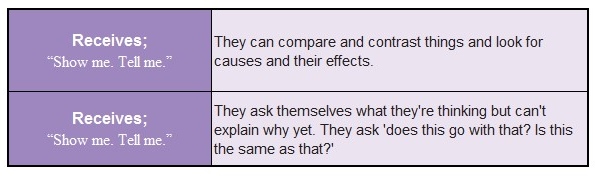
Teaching ideas to move learners from Grey to Purple ⬇️
What you are trying to help your students to achieve
In the Receives (purple) phase, students become more curious about things. They may enjoy talking about (describing) what they are thinking but as yet find it hard to explain why they think it. ‘Describes’ is seen as a step 1 in reasoning, while ‘Explaining’…offering some reasons for what they did (correct or incorrect) is seen as step 2. They will enjoy the challenge of comparing and contrasting things or guessing or estimating how things might be. Precision isn’t yet part of their bag.
Your role as a teacher in this phase is to:
Devolve responsibility for reasoning… by introducing the word and concept
Talk about reasoning…by encouraging students to talk about what they are finding
Give students opportunities to practise reasoning…by allowing time on compare and contrast
Celebrate reasoning… by reflecting on, praising or displaying its use
1. Devolve responsibility for reasoning
Explore reasoning through stories
Hide and Seek
2. Talk about reasoning
Draw out reasoning in Strategy Games
Use games that require strategy and logical thinking. From noughts and crosses to chess, from hangman to backgammon, such games help to develop and refine reasoning skills.
Many appear in the form of maths investigations and problems: Frogs; Tower of Hanoi; Nim; Connect 4; etc.

Draw out the language of reasoning through jigsaws
Sit at the jigsaw table with groups of children and work on the jigsaws together. Model your reasoning out loud to the children explaining what you did first second, third, etc. so that they begin to understand a methodical, step by step approach. Explain why you put a piece in a certain place and why it couldn’t go elsewhere. Develop conversations around…What can we see? Why does this fit here? What tells you it is right? Does this make sense? and so on.

3. Give opportunities to practise reasoning
Practice making an intelligent guess
Get in the habit of requiring pupils to make estimates and to predict what should happen. This is quite different from asking them to say what might or could happen – that’s closer to speculation and Imagining. Here you are asking pupils to use what they already know to make a prediction. Often referred to as hypothesising in Science, this is about using logic to make an intelligent ‘guess’.
Once they have made their prediction, encourage them to explain why they think that – it helps to move their thinking from describing what they think will happen to explaining why they think it will happen. It is the ‘giving reasons’ bit of Reasoning, that will in time mature into justification and proof.

Work out logical orders
Sequencing
Cut up;
- a cartoon,
- series of pictures of a production process,
- a flow diagram,
- a mathematical proof,
- a story line,
- a musical score,
- a poem,
- a sequence of events, and so on.
Invite students to reassemble the pieces in what they think is a viable order and explain their reasons for this. Model and listen for the language of reasoning to strengthen the process.
[Lift the level of challenge by omitting one or two of the pieces, or by including a red herring or two, or by interleaving two sequences that need to be separated before the sequencing can be completed.]
4. Celebrating reasoning
Create a wall display . . .
of reasoning-specific ‘if/then’ statements to nudge / remind students how to think and behave logically. You might include statements like:
- If I am thinking something through, then I will explain to my friend what I am thinking
- If I decide to do something, then I will ask myself why I chose to do it
- If I am explaining what I think to my friend, then I will use words like ‘because’ to help me to give my reasons for thinking it.
- If I am writing down what I am doing/thinking, then I will make sure that I show my reasons for doing/thinking it.


Comments are closed.