
Open Me
1. A description of the phases of a lesson built around Revising
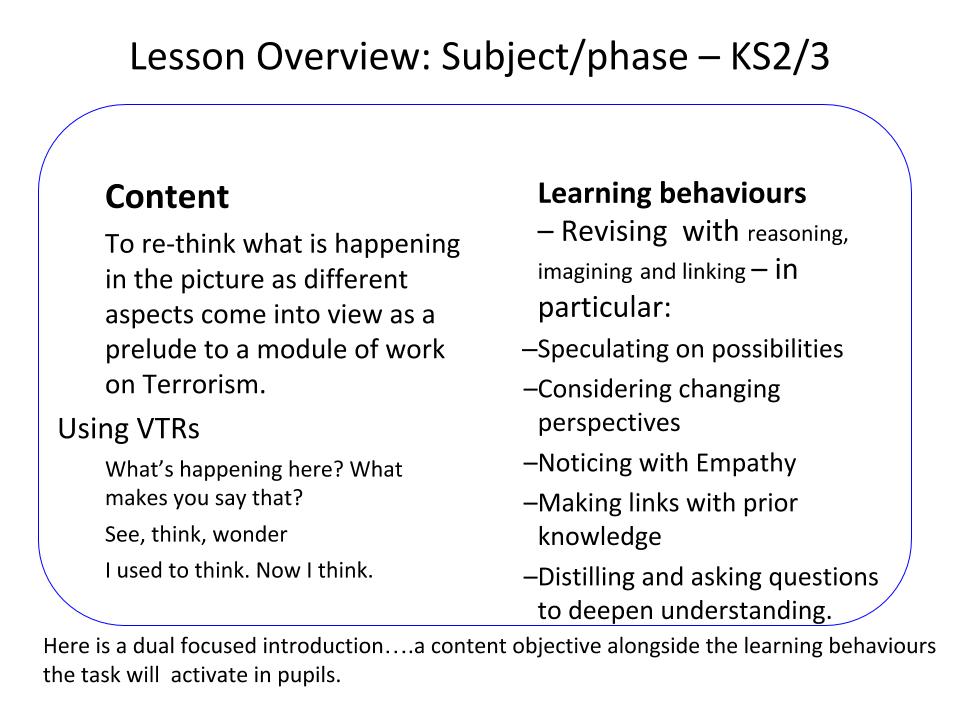
Look through the lesson below. It uses a slow-reveal strategy to encourage pupils to speculate based on limited information, only to have to reappraise those thoughts as further information is revealed. To work effectively, it needs an image that contains a surprise, a contradiction, something misleading so that first impressions are unlikely to be correct.
The lesson focuses primarily on the first column of the Revising chart – Attitude to Change. It creates a situation in which a change of mind is almost inevitable.
Notice how, despite the focus on learners changing their views as the evidence is revealed, other learning behaviours ‘bubble up’ as the lesson proceeds. It reminds us that learning behaviours don’t function in isolation, that an effective learner not only has a wide range of learning behaviours to call on but also the flexibility to move seamlessly from one to another as required.
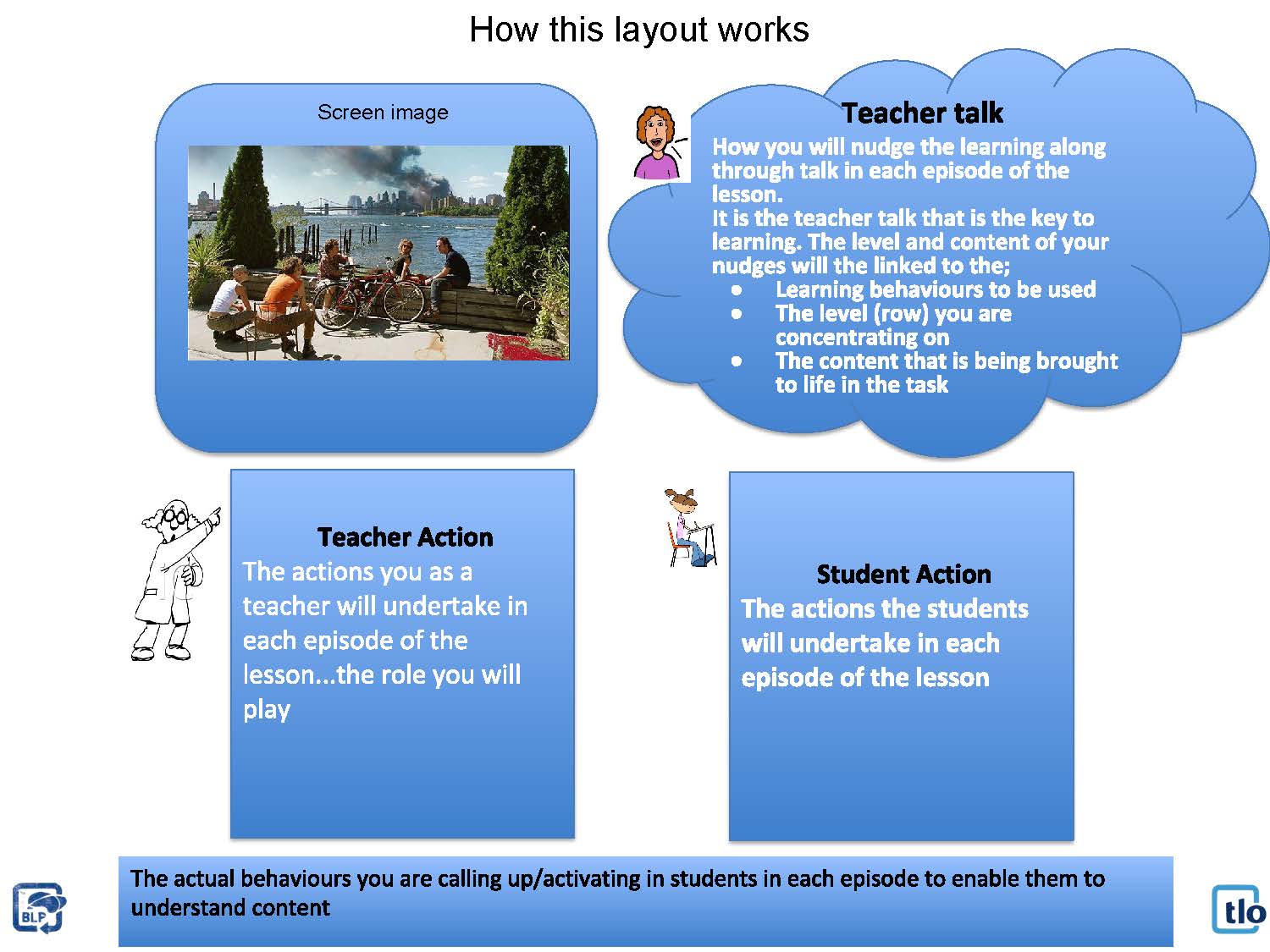
Firstly, the lesson plan layout that we are using here:
What’s happening here?
This lesson plan template looks at a lesson episode by episode, as in the models used in the Questioning and Collaborating units. There are sections for Teacher Action,(what you do) Pupil Action,( what you are expecting pupils to do) Teacher talk (what you will say to nudge learning along) and Learning Behaviours activated ( the learning behaviours that this type of activity/nudging comments will stretch). The image/information that is being used by the teacher at each stage of the lesson is shown in the box top left.
NB. The Learning Behaviours identified in the banner at the bottom of the slides identify the learning behaviours the episode will stretch. Note that they can change from episode to episode since none of the behaviours act in isolation.
In the ‘What’s happening here’ section below each episode, these learning behaviours are expanded and described more fully to represent the level of particular rows/cells in the relevant progression grids.
2. Now to the lesson itself:
Episode 1
What’s happening here?
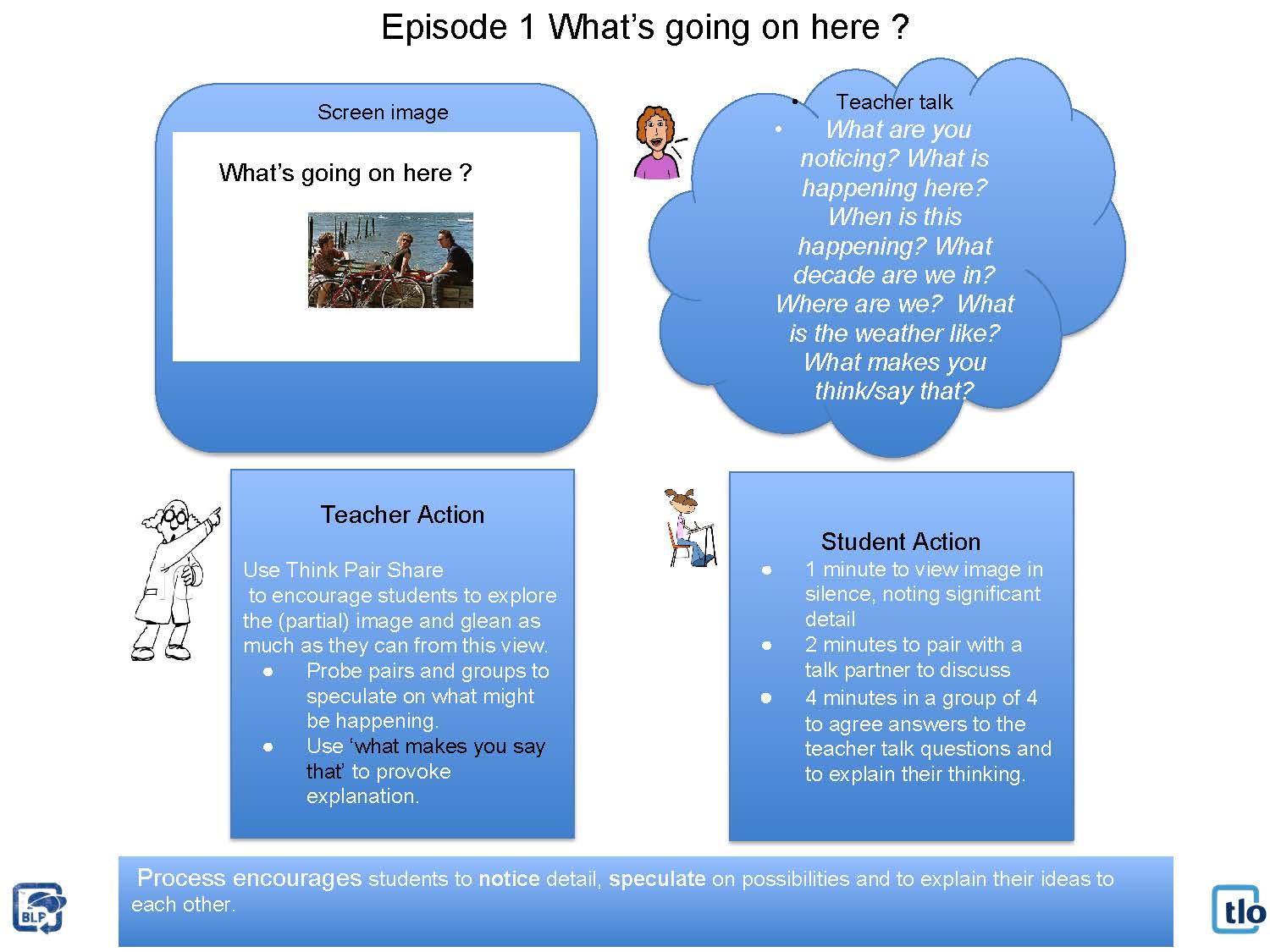
Pupils are invited to speculate on a range of possibilities based on very limited information,. Just think about this for a minute… asking pupils to speculate activates a blend of noticing, imagining, inferential reasoning, and group working skills. There’s a lot going on in pupils heads! But it’s the way you are doing this, through slow reveal, that will encourage students to develop as flexible learners.
In order to scaffold and nourish this noticing and speculation this episode uses Think, Pair, Share together with the VTR ‘What makes you say that?’
Think/ Pair /Share gives pupils time to think about it for themselves before they get caught up in the cut and thrust of group work, a chance to refine their thoughts in the Pair stage, and again in the Share phase. The visible thinking routine ‘what makes you say that’ encourages pupils to offer explanations and evidence to justify what they are speculating.
In the bottom blue box, the Learning Behaviours being activated are identified as:
- To notice detail, speculate on possibilities and to explain their ideas to each other.
But what you are working towards in terms of the Revising disposition is Recognises learning involves constant rethinking/redoing. (Green/Values level)
However, by looking at information in the progression charts the behaviours you are activating could be described much more deeply as:
- To notice in order to describe and raise questions about what is observed, to pull ideas together and consider ‘what could be’, and to explain why they think that.
Such augmented explanations can be found in the:
- Noticing chart, Receives and Responds phases: ‘To notice in order to describe and raise questions about what is observed’
- Imagining chart, Responds phase: ‘To pull ideas together and consider ‘what could be”
- Reasoning chart, Responds phase: ‘To explain why they think that’
Episode 2
What’s happening here?
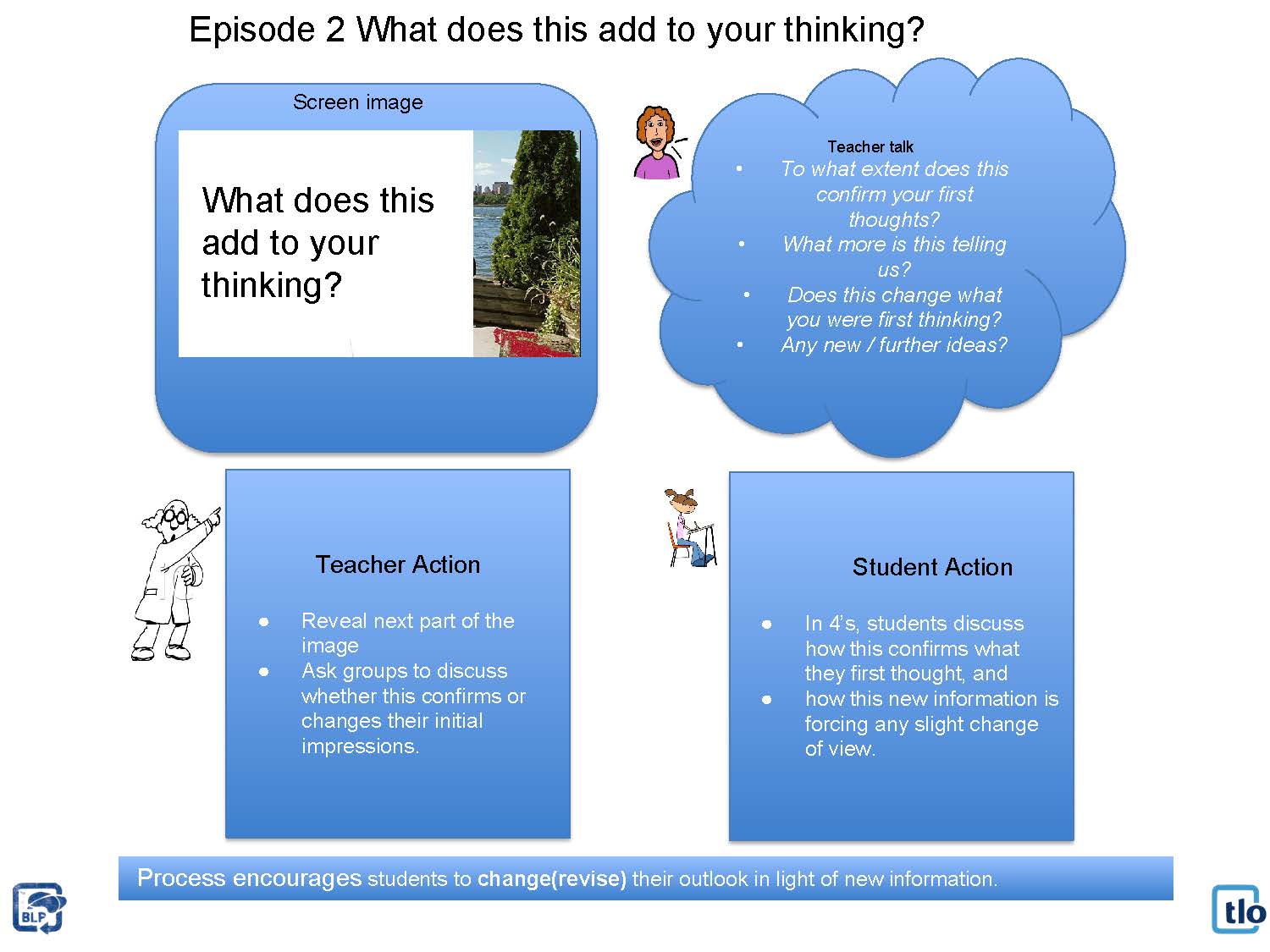
This is a key part of the lesson. The addition of a new perspective gives the learner cause to, possibly, amend their first idea. The second reveal provides evidence to support some speculations (it is a river bank in a city) and to dispel others (it is looking out to sea). How does this second bit of the picture change how you are seeing the three people in Episode 1?
In the bottom blue box, the Learning Behaviours are, at this stage, identified as:
- To change (revise) their outlook in light of new information.
However, by looking at information in the progression charts the behaviours you are activating could be described much more deeply as:
- To attempt to change or rethink something and amend things
Such augmented explanations can be found in the:
- Revising chart, Receives and Responds phases: ‘To attempt to change or rethink something and amend things’
Episode 3
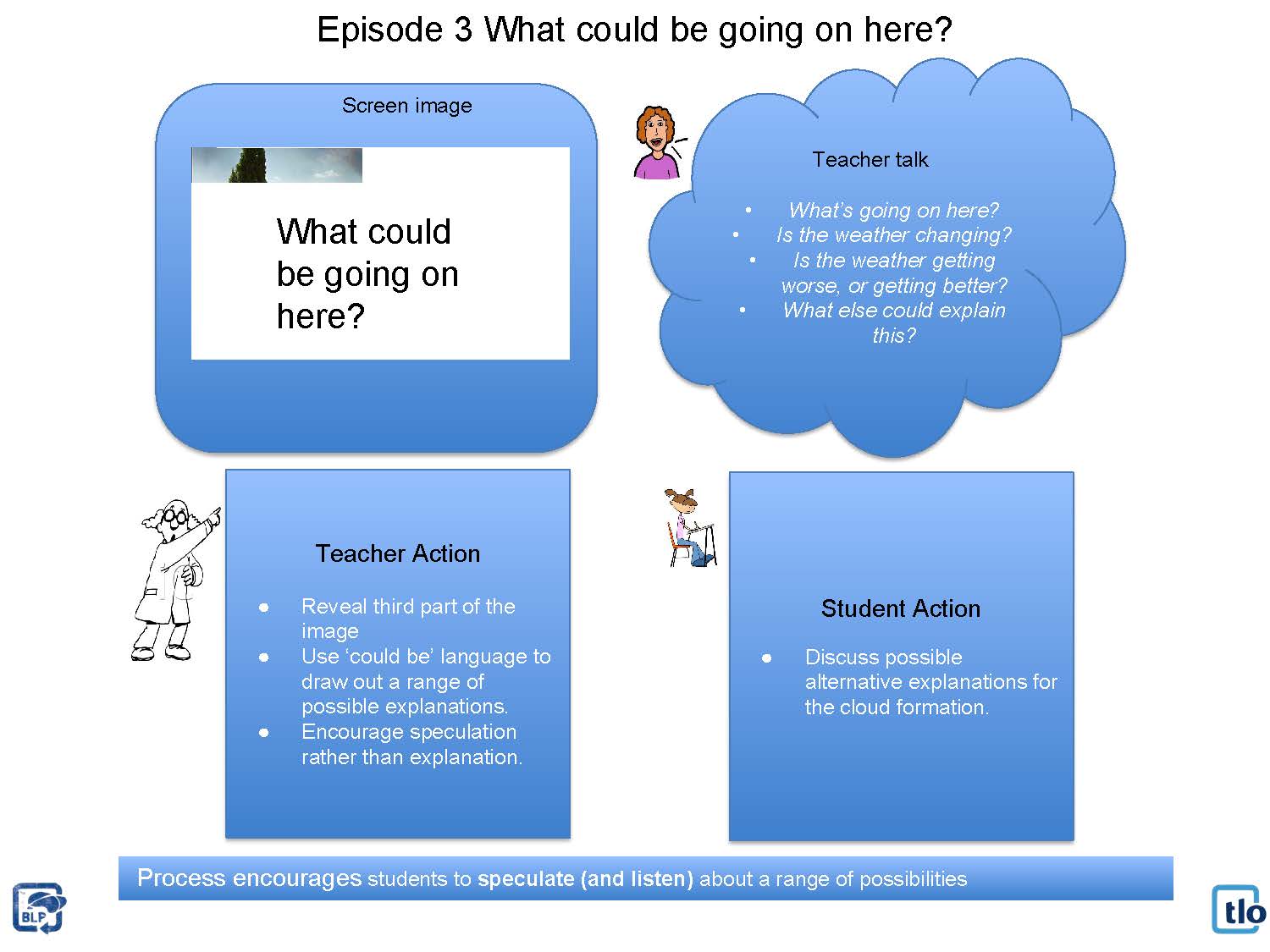
What’s happening here?
The teacher is encouraging speculation here. The evidence is flimsy and inconclusive, but is in contrast to the weather shown in Episodes 1 and 2. The use of ‘Could Be’ language encourages pupils to come up with a range of possible explanations. The teacher may well say things like: “That’s an interesting idea, but if that is not true, what else might explain it” to gain alternative interpretations.
In the bottom blue box, the Learning Behaviours are, at this stage, identified as:
- To speculate (and listen) about a range of possibilities
In terms of the revising progression chart your wider purpose is to help pupils to work towards being able to ‘Edits as they go along.Thinks on their feet within the given variables.’ Green/values
However, by looking at information in the progression charts the behaviours you are activating could be described much more deeply as:
- To imagine alternatives to turn ‘what is’ into ‘what could be’, to share/offer own views and show interest in understanding the views of others.
Such augmented explanations can be found in the:
- Imagining chart, Receives and Responds phases: ‘To imagine alternatives to turn ‘what is’ into ‘what could be’
- Collaboration chart, Receives phase: ‘To share/offer own views’
- Listening chart, Receives phase: ‘To show interest in understanding the views of others’
Episode 4
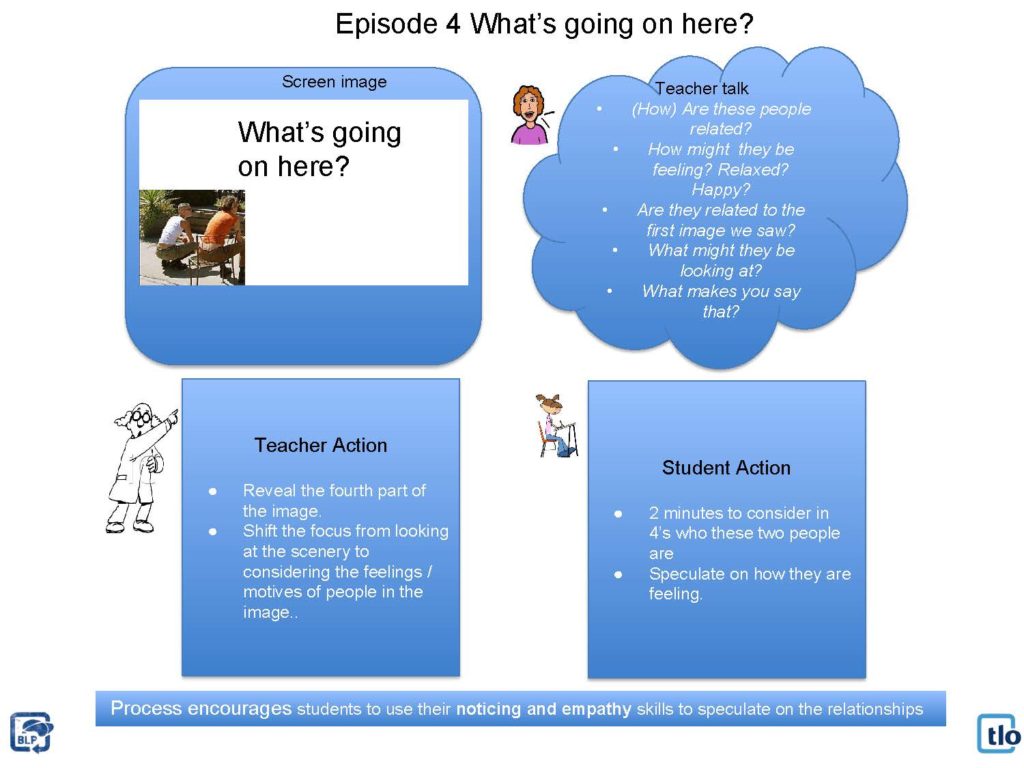
 What’s happening here?
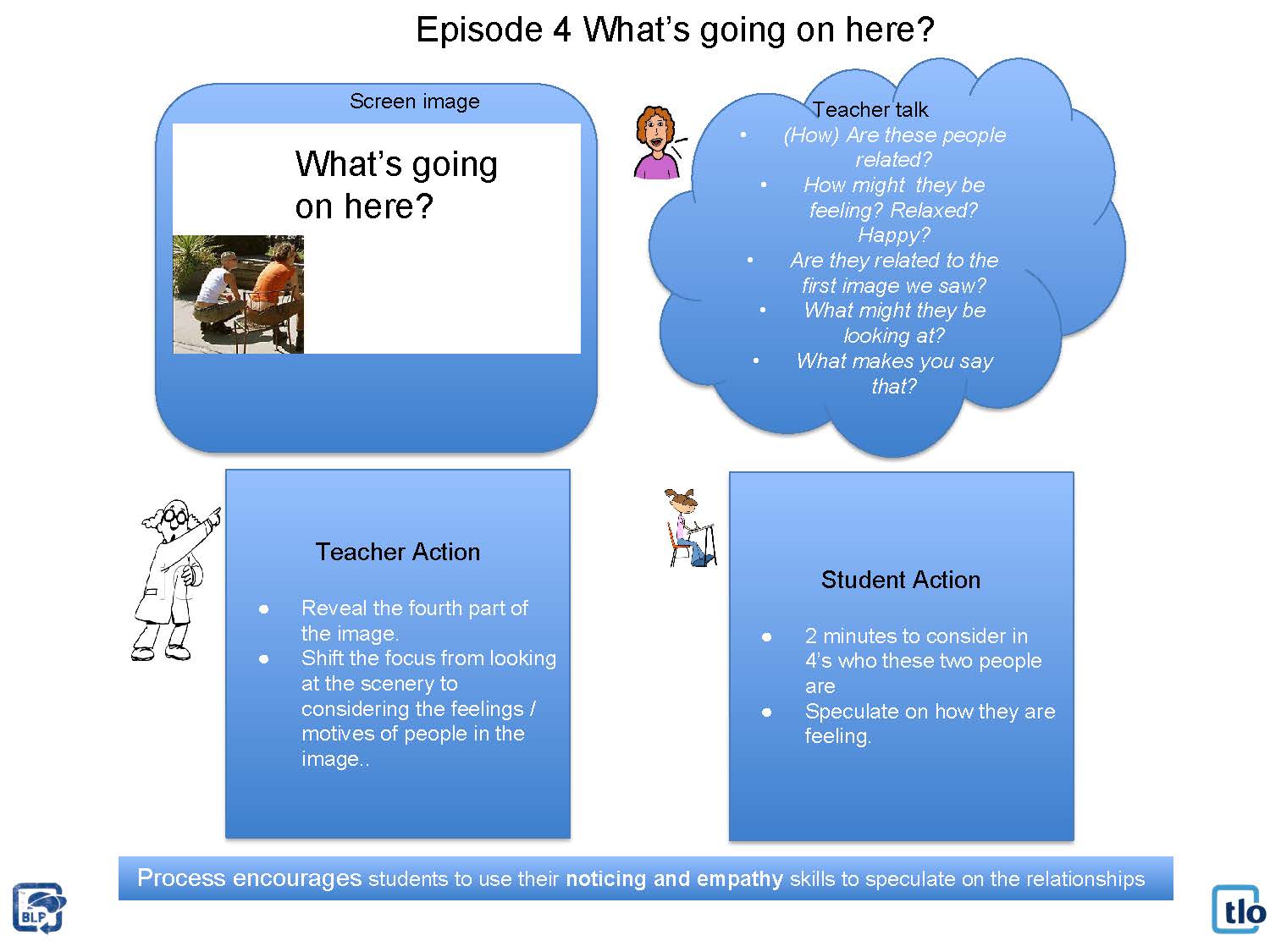
A shift of focus here, away from what pupils could see in the previous Episodes, towards speculation that requires Empathy, and ‘seeing’ beyond the image. Who are these people? What can we infer from the way they are sitting? What might this mean? Do they know the first three people in Episode 1?
In the bottom blue box, the Learning Behaviours are, at this stage, identified as:
- To use their noticing and empathy skills to speculate on the relationships
In terms of the revising progression chart your wider purpose could be to help pupils to work towards being able to ‘Rethink and restart to change direction.Yellow/organises
However, by looking at information in the progression charts the behaviours you are activating could be described much more deeply as:
- To notice to explore possibilities to understand people’s feelings and perspectives.
Such augmented explanations can be found in the:
- Noticing chart, Values phase: ‘To notice to explore possibilities’
- Imagining chart, Organises phase: ‘To understand people’s feelings and perspectives’
Episode 5
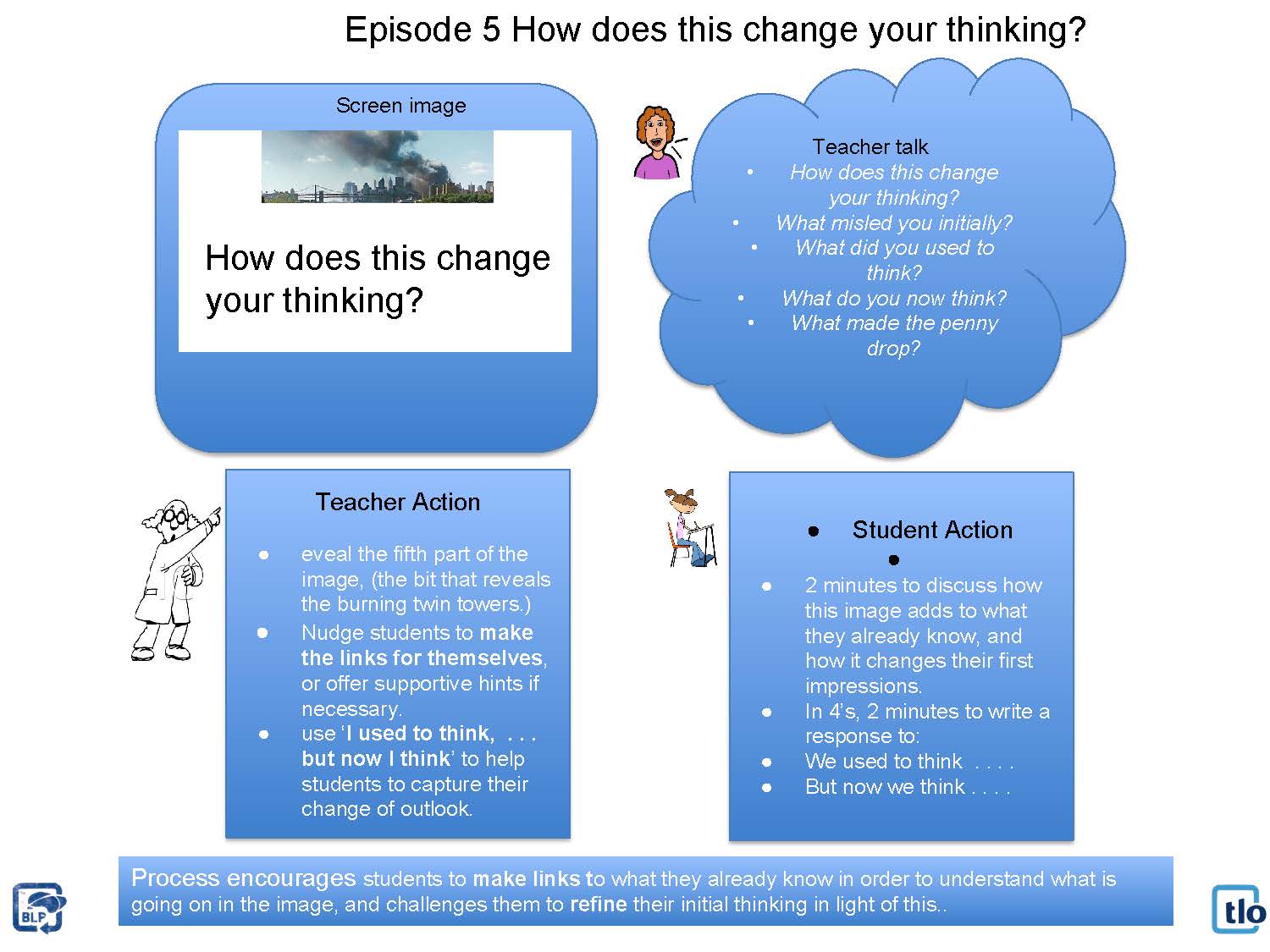
What’s happening here?
This is the key slide – it either dispels or supports the hypotheses that have been developing. Thus far the teacher has been encouraging speculation and accepting all answers as possible, but now there is a focus for what the observers in Episodes 1 and 4 are looking at, there is an explanation of the cloud in Episode 3. Few pupils will have seen this coming – the relaxed demeanour of the observers on this bank is in stark contrast to the tragedy unfolding on the opposite bank. The visible thinking routine: “I used to think . . . . . . But now I think . . . . .” is used here to help pupils to structure an explanation about how their views have changed.
In the bottom blue box, the Learning Behaviours are, at this stage, identified as:
- To make links to what they already know in order to understand what is going on in the image, and challenges them to refine their initial thinking in light of this.
In terms of the revising progression chart your aspiration for your pupils could be to help them to work towards being able to be ‘Constantly on the look out for how to improve/change/reinvent something. Orange/Embodies
However, by looking at information in the progression charts the behaviours you are activating could be described much more deeply as:
- To relate what they are learning to past experiences and to use new learning to review prior learning.
Such augmented explanations can be found in the:
- Making Links chart, Receives phase: ‘To relate what they are learning to past experiences’
- Making Links chart, Responds phase: ‘To use new learning to review prior learning’
Episode 6
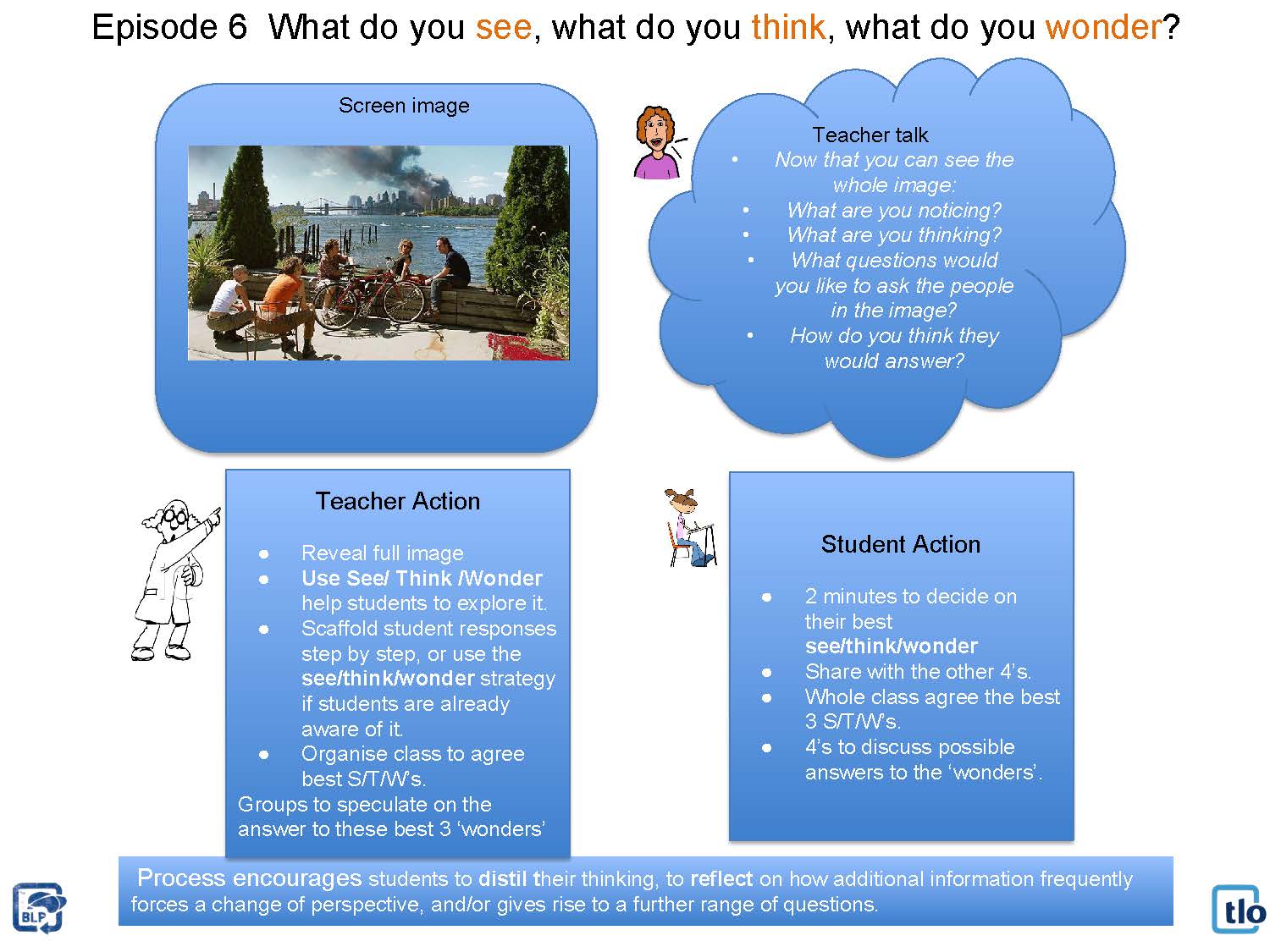
What’s happening here?
Putting it all together. Using the visible thinking routine See/Think/Wonder helps pupils to notice, reason and/or imagine, and question. Prioritising the best STW’s is an evaluation activity. Beginning to seek answers to the best ‘Wonders’ frames future enquiry.
The underlying message to be distilled here is that first impressions, based on partial or incomplete information, are invariably less than perfect. As more information becomes available, views are refined and clarity slowly emerges, but only if we are prepared to let go of those first impressions.
In the bottom blue box, the Learning Behaviours are, at this stage, identified as:
- To distil their thinking, to reflect on how additional information frequently forces a change of perspective, or gives rise to a further range of questions.
In terms of the revising progression chart your aspiration for your pupils could be to help them to work towards being able to ‘Question and moderate normal rules/ideas to detect errors and improve things’ Yellow/Organises
However, by looking at information in the progression charts the behaviours you are activating could be described much more deeply as:
- To notice to explore possibilities, to raise questions and identify what is important, to seek evidence to support their thinking, and to link new information to what you already know and develop new ways of thinking about it.
Such augmented explanations can be found in the:
- Noticing chart, Responds and Values phases: ‘To notice to explore possibilities, to raise questions and identify what is important’
- Reasoning chart, Values phase: ‘To seek evidence to support their thinking’
- Meta Learning chart, Responds phase: ‘To link new information to what I already know and develop new ways of thinking about it’
What do you think?
- Have you thought of a lesson as a blend of teacher actions, pupil actions, learning behaviours, and teacher talk before?
- The key box is the learning behaviours box across the bottom. Could you write the contents of that box for each Episode in one of your lessons?
- How could you use the slow reveal strategy to advantage in your own classroom?
- What image would you choose?
Make a note of…

- Your initial reactions to the slow reveal strategy.
- A situation in which you might use it.
2 A distillation of this lesson.
This is a simple streamlined use-able tool that includes:
- What you do (teacher action);
- What pupils do (pupil action);
- What the learning behaviours being called upon are (learning behaviours);
- What you say (learning talk) to nudge the learning behaviour along.
The format is divided into episodes to show the change of purpose, action and use of learning behaviour across the course of the lesson.
Download a blank lesson plan as a MS Word document: Lesson Planning Grid
Here you will find the template populated with the episodes explored in section 1 above. This format helps you to gain a swift overview of the lesson from the various perspectives.
What do you think?
- What are your reactions to this lesson plan template?
- Does planning for four aspects – teacher action, pupil action, learning behaviours, teacher talk – seem useful?
- How does sequencing the lesson as ‘episodes’ help or hinder planning?
- Which do you prefer – the blue box approach in section 1 or the grid in this section.
Make a note of…
- The extent to which your existing planning template enables you to think about lessons in this way.
- What you would like / need to add to it.
3 Extend your thinking about this slow reveal technique
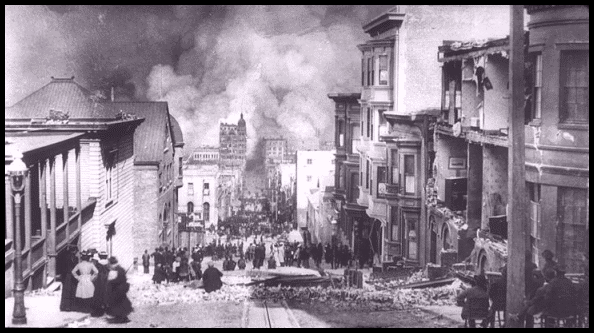
Consider the 4 images below. They are:
- “An Experiment on a Bird in the Air Pump” by Joseph Wright;
- Street art by Julian Beever – all of the Batman bit is painted on the pavement;
- A b&w photo of the great 1906 earthquake in San Francisco;
- An image from Erik Johansson’s website.
Consider each in turn. How would you carve each image up – what would you reveal first, then second . . .
Can you find a reveal sequence that gives very little away in the early stages, or even better that initially misleads the viewer?
Which curriculum area might make use of each of these images?
Do you know of any other images that relate to your planned curriculum that can be treated in the same way?


What do you think?
- Where / when / why might you use the slow reveal strategy?
- How will you ensure that the slow reveal is an integral part of the lesson, and not just a ‘catchy’ activity before the ‘serious’ work begins?
Make a note of…
- Which class you might try the slow reveal with.
- When you will try it.
This unit explores how you might build the habit of xxxxxx in your pupils.
Sections 1 – 4 look at;
- xxxxxx and how it develops. Unpick the meaning of xxxxxx, how it develops over time and use the xxxxxx chart to plot where your pupils are now.
- Taking xxxxxx into classroom culture. Offers numerous suggestions to develop a xxxxxx friendly culture and build pupils’ xxxxxx skills.
- Blending xxxxxx with content. Suggests a series of questions and steps you might use to ensure the development of xxxxxx claims its place in the curriculum and is designed into lesson/activities to aid understanding.
- Team reflection and planning. Share the impact of your experiments with colleagues and plan what you need to do next.
The resource materials in the Learning Diary: xxxxxx help you to distil important messages, home in on the key bits of information and design learning experiments specifically for you. PICTURE AND DOWNLOAD BUTTON
ARE THE TIMINGS IN THIS BOX CORRECT ??
Comments are closed.