

Task design toggle in case we need it
Designing tasks to encourage independence.
Very young learners may well display a degree of independence, but such ‘innate’ learning behaviours rarely withstand ‘schooling’ – curiosity is a similar casualty.
In order to help learners to become increasingly independent and self-sufficient, teachers need to design tasks that, over time, afford learners opportunities to do more for themselves as the teaching scaffold is slowly reduced.
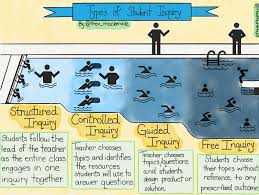
In the early stages, tasks may be highly structured with the whole class following a path pre-determined by the teacher. As the amount of teacher direction reduces, the teacher may still set the agenda and provide the necessary resources to answer the questions that they set, but how the questions are to be tackled is beginning to shift towards the learner – controlled enquiry.
At the level of guided enquiry, the teacher still identifies the topic / area of study, but learners decide how to tackle it. And at the level of free, independent enquiry, learners determine the area of study and how they wish to pursue it.
Ask yourself the hard questions:
- Which type(s) of enquiry are evident in your classroom?
- How could you begin to gradually shift task design away from Structured Enquiry and towards Free Enquiry?
- Think about the oldest students in your school – which level of Enquiry might they be capable of working at? How will you plan, at whole-school level, to achieve this?
Designing ‘wild tasks’.

Much of the time, classrooms are structured to ‘deliver’ the curriculum. Tasks are carefully designed by teachers to ensure that every child gets their pre-determined dose of curriculum content, content that can be assessed so that progress can be evidenced. But what if we occasionally design tasks that are ‘wild’, that have no pre-determined outcomes, that give learners free rein to explore areas of their own interest?
Begin by asking students to identify questions to which they would like to know the answer – as one school calls them, ‘big awe and wonder questions’. You may choose to sift them so that everyone chooses from a range of questions that the class consider of greatest interest rather than allow complete freedom of choice. Students then design and undertake their own enquiry into their preferred area of interest as a home learning project. Agreed, you could not operate like this all of the time (or could you??!!), but once in a while? What could possibly go wrong? What might the benefits be?
Comments are closed.