

A startling truth
Learning is impossible without resilience: that tendency to be ready, willing and able to lock onto learning – knowing how to work through difficulties when the pressure mounts or the going gets tough. Without a willingness to stay engaged, research tells us that we tend to revert prematurely into defensive mode which, although it maintains our security it does nothing to increase mastery. Loss of resilience breeds a brittle and impatient attitude.
All these beliefs and anxieties can affect anyone. The massive disruption to life caused by COVID 19 will have affected all students in one way or another. So, students’ learning attitudes before lockdown will have been affected; all students will be different having returned to school.
This resource is designed to help teachers to enable their students re-energise and secure those learning behaviours that contribute to being a Resilient learner.
The resource draws on ideas teachers have developed for building their students’ resilience. Based on a background of sound research it offers you rapid access to classroom-focused material that will help to re-energise, revive and develop students’ emotional learning dispositions and behaviours.
A simple framework for a wide range of activity
Re-energising Your Learners’ Resilience addresses;
- four aspects of Resilience in students, across
- four levels of growth, with
- practical packages of ideas, across
- four aspects of teaching practice.
This four-by-four framework is presented in a simple grid, illustrated below.
How the resource is designed.
The four aspects of Resilience are;
- Dealing with being stuck, the strategies we can use for overcoming it
- Managing distractions, ensuring continuing engagement with learning.
- Rising to the challenge, learning to enjoy challenge and the satisfaction of triumphing over difficulty
- Working towards goals, learning to design goals and pursue them with tenacity and independence
The four stages of growth are about students developing their learning attitudes;
- from implying ‘I can’t or I won’t ‘to ‘show me, tell me’ (‘Lacks’ to ‘receives’)
- from implying ‘show me or tell me’ to ‘I’ll try’ (‘Receives’ to ‘responds,)
- from implying ‘I’ll try’ to ‘I see why’ (‘Responds’ to ‘values, )
- from implying ‘I see why’ to ‘I’ll make sure’ (‘Values’ to ‘organises’)
The four aspects of teaching are;
- devolving responsibility to students (things you can give away)
- a language to help students understand learning as a process (things you can say)
- classroom routines that will nurture resilience (things you can do every day)
- the look and feel of the classroom that serves to strengthen students resilience (things you can display)
Clicking on any one of the sixteen yellow cells will take you into the corresponding package. The pattern of these activities is consistent across all sixteen packages, so you will quickly become familiar with the approach.
Beyond the 16 cells of activities the framework also offers;
- Background know-how (the green cells along the bottom) summarising the sort of thing you need to know before tackling any particular column. It explains;
- the learning behaviour in question
- the stages of growth and how they work
- the components of a learning friendly classroom
- how to use two questionnaires. One that explores where your students are now. One that explores your current approach to classroom cultures. Please complete the questionnaires before seeking relevant activities.
- Emotional outcomes (blue cells on the right) summarise what learners might be like as a result of absorbing the feelings and action of the activities over time; the sort of changes you will want to look out for in your learners over the next few months.
How the resource is designed.
Getting Started
Finding your way around the resource . . .
The big picture of the resource is below.
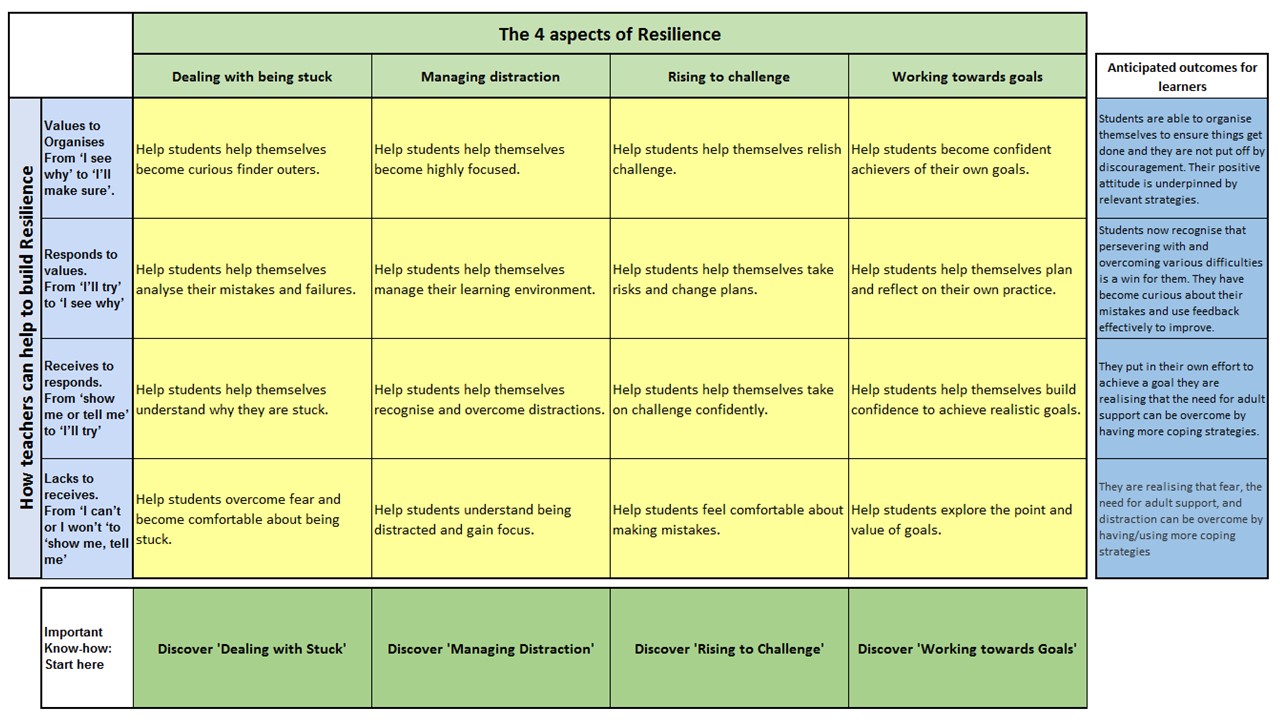
The table below, which is a very shortened version of the image above, is the primary means of navigating this resource. Most of the cells are interactive, and clicking on the text will take you to the relevant section. Clicking top left will bring you back to this page.
This table appears at the end of every section and enables you to move around all of the resources without the need to return to the front page and start again.
Importantly, it is essential that you start each column with the green cell in the bottom row – the one called ‘Discover xxx’. It is in this section that you will find 2 quizzes that are the essential starting point before you begin to explore the teaching ideas lying behind the 16 yellow cells.
Please be aware – the content behind the majority of these links is only available in the full version of this resource. In this Open Source version, the links in the ‘Stuck’ column are live so that you can gain a feel for the full version and judge whether it might be right for your school.
| Return to the front page ⏎ | Dealing with being stuck | Managing distraction | Rising to challenge | Working towards goals |
|---|---|---|---|---|
| Values to Organises. | . . become curious finder outers. | . . become highly focused. | . . relish challenge. | . . confident achiever of own goals. |
| Responds to Values. | . . analyse mistakes and failures. | . . manage their environment. | . . take risks and change plans. | . . plan and reflect on their own practice. |
| Receives to Responds. | . . understand why they are stuck. | . . overcome their distractions. | . . take on challenge confidently. | . . achieve realistic goals. |
| Lacks to Receives. | . . comfortable about being stuck. | . . understand distraction and focus. | . . comfortable about making mistakes. | . . see the point and value of goals. |
| Important Know – How: Start Here | Discover ‘Dealing with Stuck’ | Discover ‘Managing Distraction’ | Discover ‘Rising to Challenge’ | Discover ‘Working towards Goals’ |
Comments are closed.