
You are now in Unit 3. Constructing learning. Introduction.
A. The intention of this introduction is to..
…give you a big picture overview of Unit 3. This unit is possibly the one most teachers need. It will help you to answer the question ‘how do I put a learning powered lesson together?’ or ‘how can I put a lesson together that focuses on, for example, questioning?’.
B. The best way of tackling this Unit is to..
…have a quick look at the contents of each section and decide where you want to start. There’s a logic to the order of the sections but you don’t have to follow it.
Timing. The section descriptions below will take you seconds to read. But the whole of Unit 3 of the programme is worth spending at least two or three months on, and is a unit you will want to keep returning to as your practice grows and improves.
Treat it like an encyclopaedia, somewhere to return to again and again find out more.
Unit 3, Team Meeting 1. Scheduled at the end of Section 3C, probably one month after starting Unit 3.
Unit 3, Team Meeting 2 . Scheduled part way through Section 3D, the Catalogue of Activities.
C. As a result it should have the following impact.
Reading the outlines below will help you decide where to go first in this unit.
You are now in Unit 3 Introduction
Use the Unit Navigation Bar to move from unit to unit.
| Overview: Playing the Learning Power Game | Unit 1: Understanding Learning and Cultures | Unit 2: Classroom Cultures | Unit 3: Constructing Learning | Unit 4: Broadening the range |
|---|
3. The big picture.
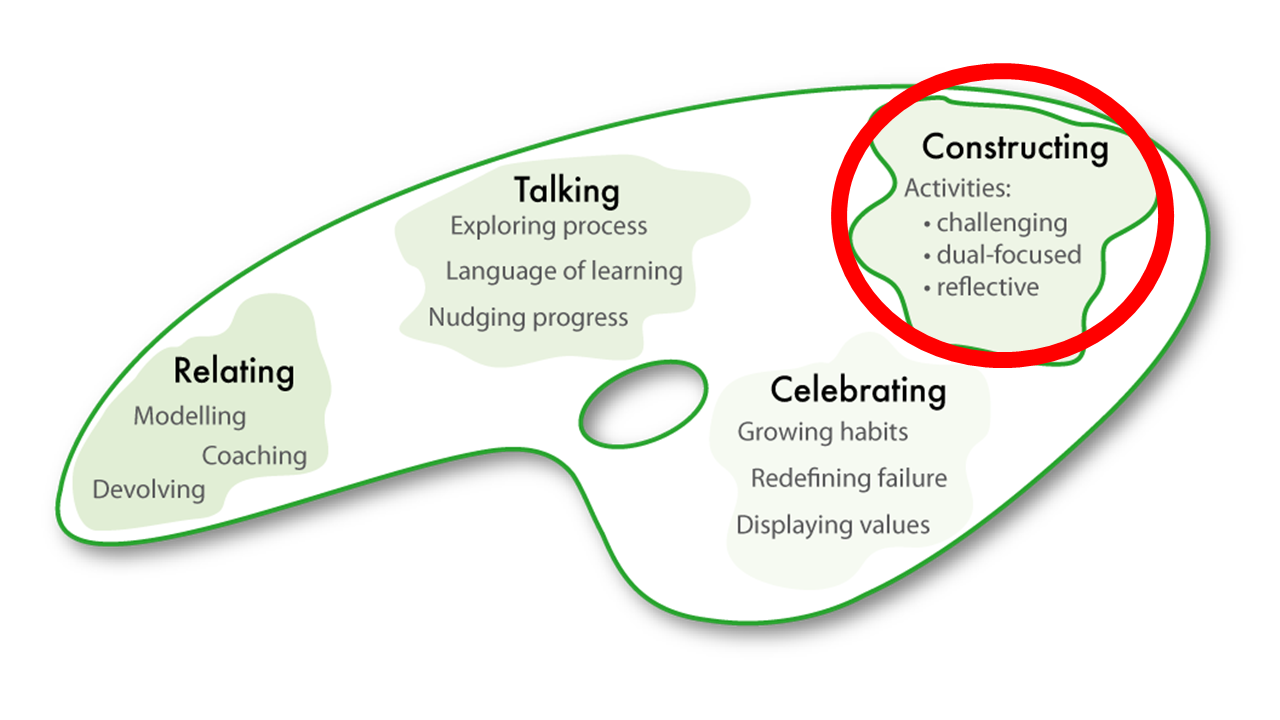
In unit 2 we looked at three aspects of the framework known as the Teachers’ Palette…relating, talking and celebrating. Now we come to a focal point in that framework, Constructing, where classroom culture meets curriculum culture. What can teachers do with a given curriculum to ensure it is ‘taught’ in a way that will enhance and strengthen students’ learning behaviours?
This unit is about direct teaching, curriculum design and planning lessons. It’s about how you as a teacher handle the day to day, hour by hour stuff that will enable your students to understand themselves as learners. It’s about looking at the curriculum in general and thinking about how to infuse learning behaviours into it. It’s about thinking and planning schemes of work or day to day lessons to ensure students consciously use and improve their learning behaviours. It’s about making learning power come alive across the curriculum.
3A. The big picture of curriculum planning
Absorbing learning habits into the whole curriculum
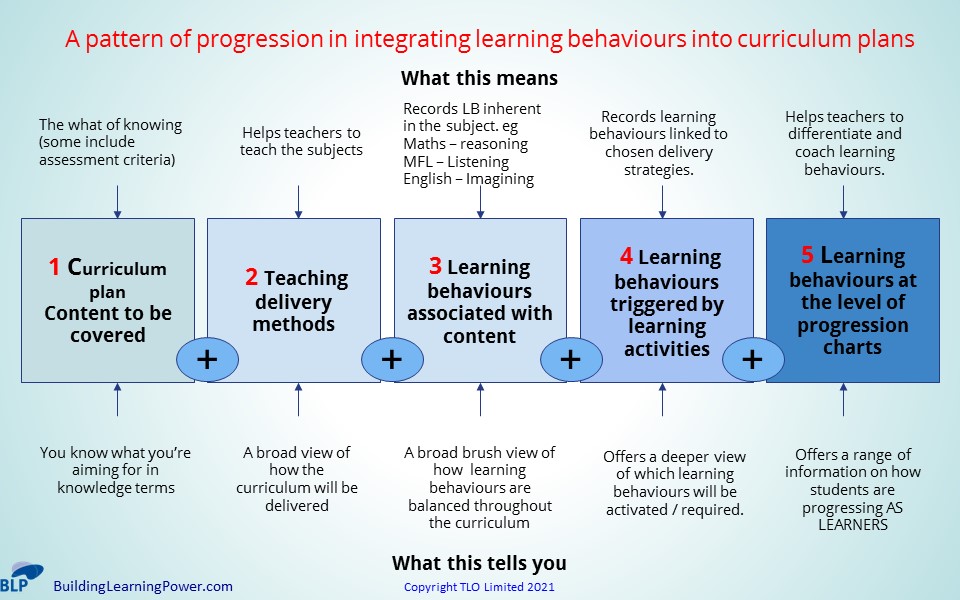
The level of detail in curriculum plans varies in part due to the time-frame of the plan. A yearly plan for a subject or year group will necessarily be more broad-brush than a medium term plan for a unit of work, which in turn will be less detailed than an individual lesson plan. All such plans identify what is to be taught, and most will indicate how it will be taught and assessed, but fewer identify and plan for the learning behaviours that students will require to access this content, nor for the development of those learning behaviours.
In section 3A we consider the transition from content-only planning through to curriculum planning that integrates progression in content with progression in learning behaviours.
3B. Designing units and lessons
Absorbing learning habits into units of work and lessons
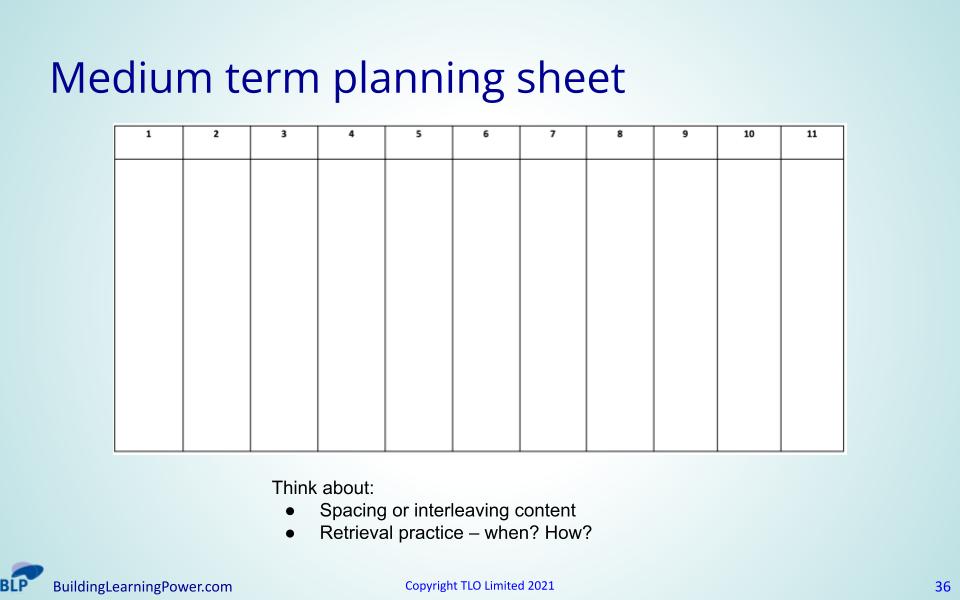
In this section we look at how you might plan a unit of work and then just one lesson to ensure learning behaviours are firmly embedded. In fact without the use of learning behaviours the plan would be unsuccessful. What are the stages of filling in blank unit plans like the one shown here? What are the must haves and top tips to planning a worthwhile lesson? We offer tips, formats and examples to get you going.
3C. Activity types to stimulate learning habits
Absorbing learning-rich activities into lessons
Activities come in all shapes and sizes – some are highly structured by the teacher, while others encourage learners to engage in independent enquiry; some are brief events in a part of a lesson, while others may extend over a period of days or weeks. No activity type is particularly ‘better’ than any other as each serves a different purpose and requires/activates different levels of learner independence. As with most things, variety is key and planning should range across all activity types over a period of time/unit of work.
In section 3C we explore different types of learning activities and the learning behaviours that they stimulate.

3D. A catalogue of activities
Absorbing the foundational four learning behaviours into lessons
Here we offer you a unique catalogue to explore. It has over 100 ideas that you might blend into your lesson designs.
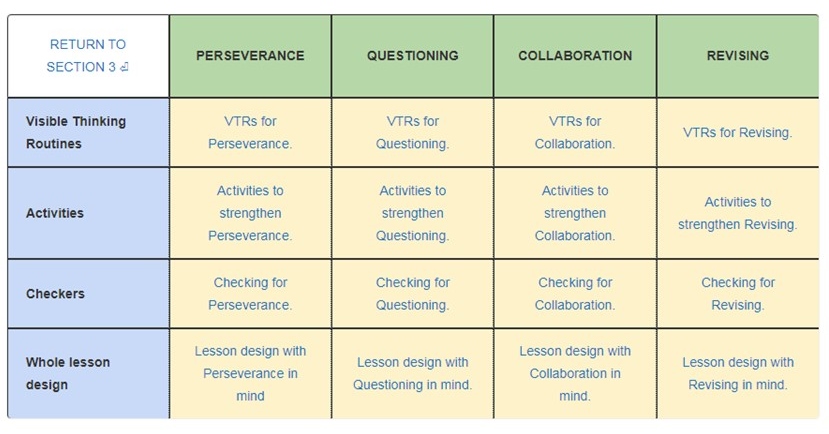
These ideas are organised into 4 categories for each of the 4 foundational learning behaviours. The 4 categories are:
- Visible Thinking Routines – Some visible thinking routines to activate each of these learning behaviours;
- Classroom Activities – Some activities to strengthen each of these learning behaviours;
- Monitoring Strategies – Some strategies for checking how each of these learning behaviours are developing;
- Exemplar Lessons – A lesson plan that integrates each of the four learning behaviours into a complete lesson.
It’s your must-have pick and mix. Expect to come back to it frequently.
You are now in Unit 3 Introduction
Use the Section Navigation Bar below to find your way around the sections of unit 3.
Comments are closed.