

1. The what of this resource
This resource is for teachers who are joining schools involved in developing students’ learning power.
It offers teachers new to the school:
- information about the power of learning behaviours and how they grow;
- guidance on teacher talk, lesson design and classroom cultures to help strengthen learning habits;
- tools to enable teachers to assess and amend their classroom culture and teaching styles;
- a tool to enable teachers to analyse their students’ learning behaviours.
This will enable you, as a new teacher, to ease into growing the learning power culture of the school and enable you to ensure your students continue their development as learning powered learners.
Or, put another way, this resource will help you to:
- put your students’ learning behaviours (not attainment) front and centre in the school’s approach to improving learning;
- use some basic tools and techniques to raise students’ awareness of how they can take control and build their learning behaviours;
- understand and apply the teaching approaches needed to strengthen learning behaviours;
- explore, estimate and record students’ growth in learning behaviours and the impact on their learning.
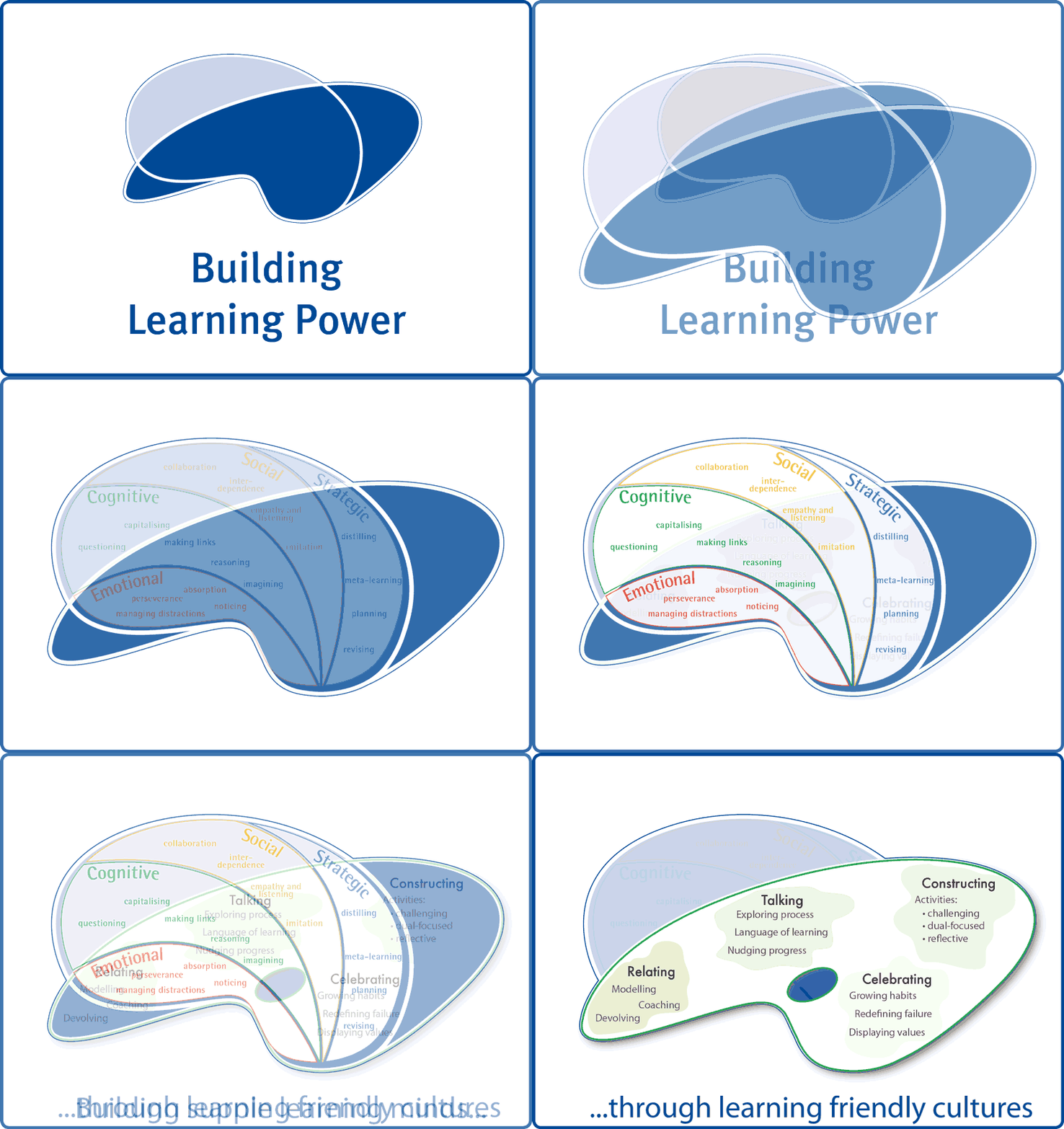
2.The content of this resource
Looking through each numbered section will lead you through the basic story of introducing learning power, but content in the toggle boxes adds deeper, richer information that you could return to later.
Each section deals with a key aspect of understanding, introducing and testing the approach.
The first three sections look at learning itself
- Section 1 What makes a difference in learning?…introduces and explores the meaning, purpose and attributes of learning power.
- Section 2 Up close and personal with learning…invites you to look at yourself and a couple of students through the lens of learning behaviours.
- Section 3 Finding learning characteristics…explains how you, and the school, can gather evidence to profile students’ learning characters and use this as a basis for selecting appropriate activities. Material in this section should be used after discussion with the school.
The next three sections encourage you to try things out
- Section 4 Shift classroom culture…explores how your classroom practice can encourage the growth of learning behaviours.
- Section 5 Start with the basics…explains the first ‘must do’ aspects of learning activities that strengthen learning behaviours.
- Section 6 A catalogue of ideas…offers a range of practical classroom solutions that are directly linked to phases of learning behaviours and blend into your teaching.
- The final section shows you how to assess for impact
- Section 7 What is the impact?…suggests how to assess the impact of your interventions on your classroom culture, students learning and their attainment. This section will be appropriate at the end of your first year

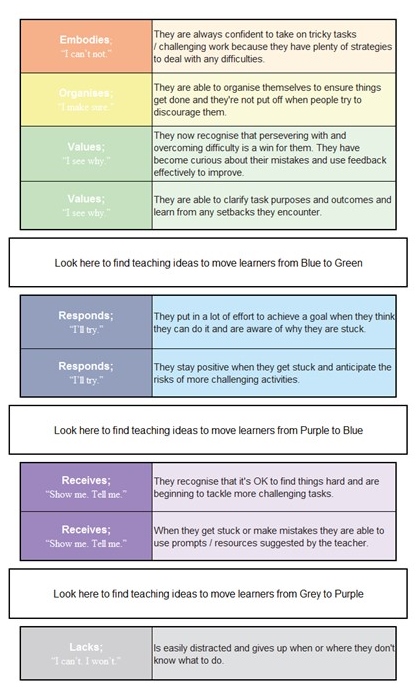

3. Resourcing your learning journey
As we all know it’s difficult to blend in and absorb the culture and practices of a school that’s new to you. This is just as true for experienced teachers as it is for new entrants just starting out. And this blending into the culture is particularly tricky if the ‘new school’ has an approach to learning that’s somewhat different to what you’re familiar with.
3a. This online induction resource:
- is to help explain as clearly as possible what the school is basing its culture on and how this affects classroom practice;
- is to offer you enough background information to help stimulate your own questions about the approach;
- is to offer you observation tools to help you spot aspects of the approach in various classrooms;
- however it is not a substitute for the deeper online courses ‘Playing the Learning Power Game’ and/or ‘The Professional Learning Power Game‘ that staff have be working through.
3b. Further in-school support
Although it will differ in every school you will find further support along the lines of:
- occasional twilight meetings with new staff to discuss aspects of this resource;
- possibly a more formal ‘induction session’ involving several staff to kick start the process;
- an opportunity to join a Professional Learning Team to support you and other new colleagues (if numbers allow);
- being assigned an experienced mentor / coach to guide you through how you might translate these materials into practice.
Once you have experienced this short introductory programme, you should be enabled to join the professional learning teams who are exploring the full ‘Playing the Learning Power Game’ programmes.
3c. Professional Learning Teams
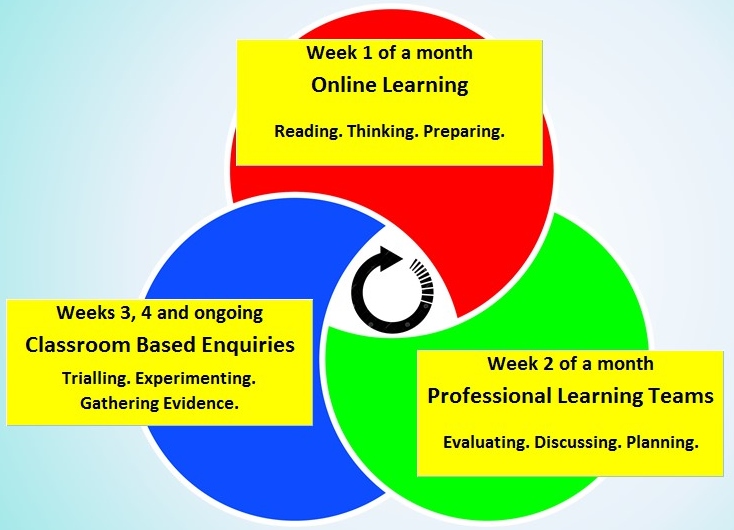
Changing working practices is hard and delicate work. Research shows it works best when you can meet in a safe professional environment in which to explore and plan how you could change, and then share and probe the triumphs, tribulations and outcomes of the classroom experiments. Research into teacher learning communities by Dylan Wiliam, of Assessment for Learning (AfL) fame, describes such teams as:
- a small group of teachers who meet together regularly;
- to deepen their understanding of an approach;
- to commit to trying out new things;
- to reflect on and share their experiments with each other.
Teacher learning communities are the engines of teacher development. As such it’s likely that this structured system forms the backbone of your new school’s support.
3d. The subsequent online courses
There are two phases for introducing and developing learning power. The Phase 1 course Playing the Learning Power game introduces the ideas of learning power and homes in on 4 foundational learning dispositions that encourage students to be disposed to Persevere, to Question critically, to Collaborate effectively and to Revise their thinking. This course usually takes a school a year to complete.
Phase 2 The Professional Learning Power Game offers deeper material, covers all the learning behaviours and takes at least two years to complete. Schools that have had the greatest success with the approach are the ones that have supported staff through Professional Learning Teams.


4. The where from of this approach to learning
The approach to learning explored here comes from the vision of twenty-first century education and the new sciences of learning that underpin it. It starts from first principles: that we now know an individual’s ability isn’t fixed; that the brain is like a muscle; that its intelligence grows with exercise. Selling this idea to learners brings, in itself, far more enthusiasm for engaging with the potential delights of learning, helping students to become more independent, more reflective, and better able to plan and evaluate their own learning. This, as John Hattie’s research has shown, is a better way of boosting students’ attainment than more drilling in the subject-matter.
The great strength of this approach is that there is already a wealth of tried and tested strategies that teachers can introduce immediately to begin to transform the learning experience of their students, and give them a language with which to think about the process of learning. You can boost the development of students’ confidence, capacity and appetite for learning itself.

This resource affords teachers an insight into the skills and attitudes their students use when learning… and how to fix them.
Comments are closed.