
Unit 4. Building the habit of persevering.
Welcome to Building Powerful Learners. This 8 part online programme aims to enable teachers to:
- explore how learners might become not just better at learning but effective lifelong learners;
- engage learners consciously with the ideas and processes of their own learning.
The programme combines three ways of helping you to understand, play with and become skilled in developing your students’ learning power:
1 Understand by using Read abouts…of which there are two types
- Essential Read …essential must read text.
- Extended Read …interesting, good to know, absorb when you can.
2 Analyse by using Find outs…tools to help you discover and analyse essential information
3 Experiment with Try outs…practical activities for you to try, check and perfect in your classroom
Unit 4 explores the “how” of building perseverance.
- What are the key aspects of perseverance? (Essential Read about 1)
- How perseverant are my students now? (Find out 1)
- How might I embed perseverance into my classroom culture? (Find out 2)
- What sort of approaches are useful for making a start? (Try out 1 – 5)
- How are my approaches working? Are they strengthening perseverance? (Find out 3)
Structuring and using the ideas below with your students over the next month or so is your fourth step in becoming a skilled learning power practitioner.


Essential Read about 1
Unpacking perseverance
A well formed Persevering habit involves being ready, willing, and able to:
- Keep going in the face of difficulties;
- Enjoy working at the edge of our comfort zone;
- Channel the energy of frustration productively, marshalling positive emotions to succeed;
- Maintain optimism when the going gets tough;
- Understand that learning is often a slow and uncertain process that requires grit, risk-taking and different ways of working;
- Relish working towards ever more challenging goals without fear of ‘failure’;
- Give it ‘one more go’, or come back to it later for another attempt.
- Recognise that being stuck is when learning really begins, not when it finishes;
Effective perseverers have a range of strategies that they use independently when stuck. They exhibit emotional toughness in the face of difficulty and are able to relish learning that is challenging. They form and pursue their own goals with tenacity, and have a range of strategies for maintaining focus if or when distracted.

Essential Read about 1. Introducing Perseverance ⬇️
The learning behaviour known as perseverance
Keeping going; edge of our comfort zone; maintaining optimism; taking risks; one more go.
Perseverance is often undermined by two common and erroneous beliefs. The first is that learning ought to be easy. If learners think that they will either understand something straight away, or not at all, then there is simply no point in persisting and struggling. The second is that bright people pick things up easily, so if you have to try it means you’re not very bright. Clearly the idea that effort must be symptomatic of a lack of ability makes persevering an unpleasant experience. Good learners develop perseverance when their parents and teachers avoid conveying these messages, even unwittingly.
Attention can be broken when learning gets blocked, but good learners have learnt the knack of maintaining or quickly re-establishing their concentration when they get stuck or frustrated. The quality of stickability or perseverance is essential if you are going to get to the bottom of something that doesn’t turn out as quickly or easily as you had thought, or hoped.
If you get upset and start to think there is something wrong with you as soon as you get stuck, you are not going to be able to maintain engagement.
Instead all your energy will go into trying to avoid the uncomfortable feeling, and this may mean drifting off into a daydream, creating a distraction, or blaming somebody else. A great deal of classroom misbehaviour starts this way. If students were better equipped to cope emotionally with the inevitable difficulty of learning, they would mess about less.
Try outs 1-5 offer a range of things that you can do to strengthen and build your students’ stickability.

Re-find out 1
Focus on the Perseverers in your class.
Just to get you tuned in – have a quick look back to what you discovered in Unit 3 about Perseverers in your class.
You should have a fairly clear idea of the perseverant behaviours your students do, and do not, currently exhibit.
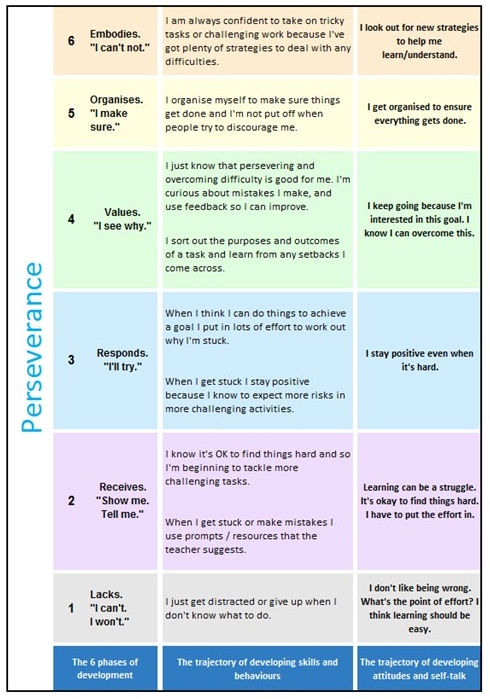
- The majority of students may well display a similar set of positive behaviours (i.e. the majority may be in the purple/blue phase)
- You will also be conscious of some students who still lack positive behaviours (i.e. they are still firmly rooted in the grey/lacks phase of the progression chart)
- But some students will appear to have made more progress than the majority.
A word of warning.
While you may be tempted to focus your efforts on the majority for greatest impact, you’ll need to take care not to do so at the expense of your ‘grey’ students, as these are your potential underachievers in the future.
What to look for.
In Try Outs 1 to 5, look out for teaching ideas that you think will have the greatest impact on your particular group of learners. Don’t attempt to try all of the ideas – better to do a few thoroughly than to adopt a scattergun approach.
Growing perseverance
A trajectory of developing behaviours, skills, attitudes and self-talk
Find out 2
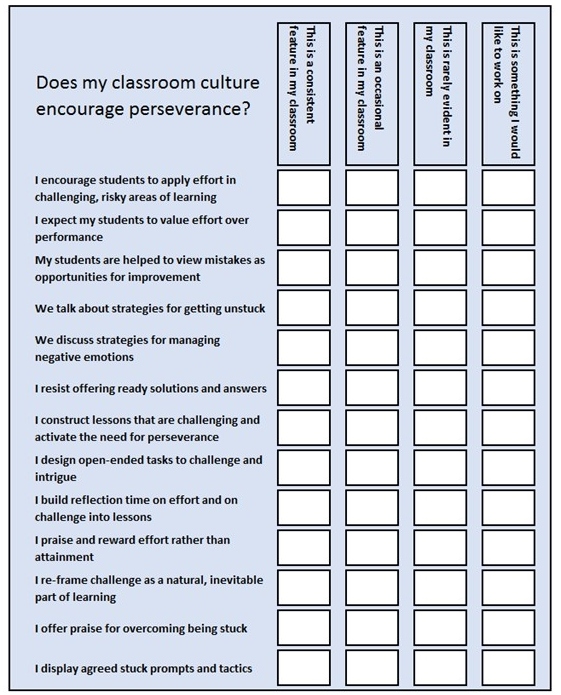
How much does my classroom culture encourage Perseverance?
Culture is the curriculum of the classroom, frequently hidden from the external observer, but always all too evident to learners. It is the minute by minute, hour by hour, day by day way that learners come to understand their role as a learner. Culture is the enacted values of the teacher, not the espoused ones – it is the shadow that the teacher casts in the classroom in terms of what they do do and what they do not do, what they say and do not say, what they believe and do not believe, what they value and do not value.
Here is a selection of features that you might begin to use in order to shape the emotional climate of your classroom to encourage the behaviour of perseverance.
Download and print a copy.
Reflect on your current classroom culture.
It’s worth noting that the list is made up of the four action types you first met in the Teachers’ Palette (Unit 2);
- ways of giving students more responsibility for their learning
- the sort of language you might use to stimulate perseverance
- ideas for constructing lessons to build perseverance
- ways of celebrating perseverance
Ask yourself which of the features of the perseverance-friendly classroom are:
- already a consistent feature of your classroom?
- an occasional feature of your classroom?
- rarely evident in your classroom?
Which of these features are you interested in developing further?
At this point it might be worth having an informal chat with some of your colleagues. Is anyone already making progress with one of the features you would like to work on? Do you have any consistent features that others might learn from? Take your completed sheet to discuss at the end of the unit meeting,
Try out 1
A range of little culture shifts
Have a think about your current classroom culture in relation to perseverance.
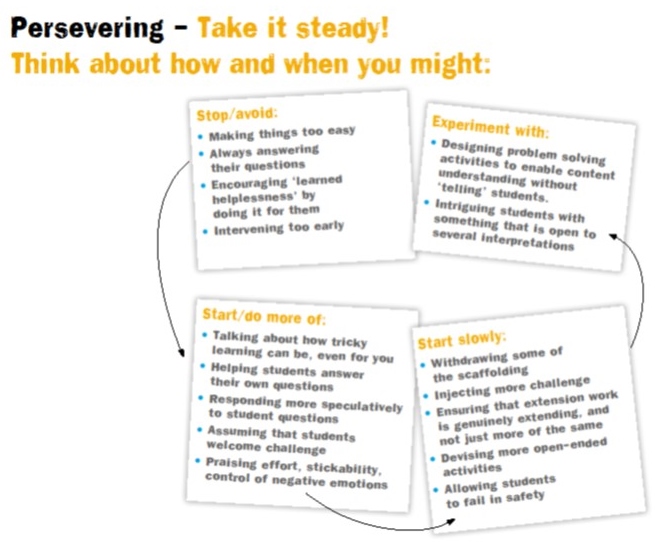
Begin with the ‘stop/avoid’ box – if any of these teaching behaviours are still in evidence in your classroom it would be worth thinking through how they can be eliminated, since failure to do so will undermine the changes you are hoping to achieve for your learners
Then cast your eye over the other 3 boxes. Which ideas appeal to you? Which do you think will have the greatest impact on your students?
Now seek out teaching ideas below in Try Outs 2/3/4/5 that you can use to move your classroom culture forward.
Try Out 2 focuses on ideas for moving more responsibility towards learners (Relating);
Try Out 3 focuses on developing a learning language for perseverance (Talking);
Try Out 4 focuses on how lessons/activities can be designed to activate perseverance (Constructing);
Try Out 5 focuses on how perseverance can be rewarded / praised / celebrated (Celebrating).
Try out 2
Build perseverance by extending students’ responsibilities.
From ‘I’m stuck ‘ To ‘I’m stuck because …‘
When a student says ‘I’m stuck’, resist the temptation to ask ‘what are you stuck on?’ – you know only too well they will probably reply ‘everything’. Better to explore ‘why’ they are stuck . . . .
Encourage students to identify the cause of their stuckness. Move students from saying “I’m stuck” to ” I’m stuck because…” Naming the problem will often suggest a reasonable next step.
It’s also useful to insist that students can’t call themselves ‘stuck’ unless they have tried to apply at least 1 solution.

Two more ideas for extending students' responsibilities. ⬇️
Explore the meaning of effort
Effort is a word that teachers use frequently, but what does it mean? How might students decode this and begin to do it purposefully?
- Explore what is meant by ‘effort’ with your students, and discuss with them the ways in which they might apply it.
- Encourage them to come up with a definition of effort and specific examples of what it might look like – for example by;
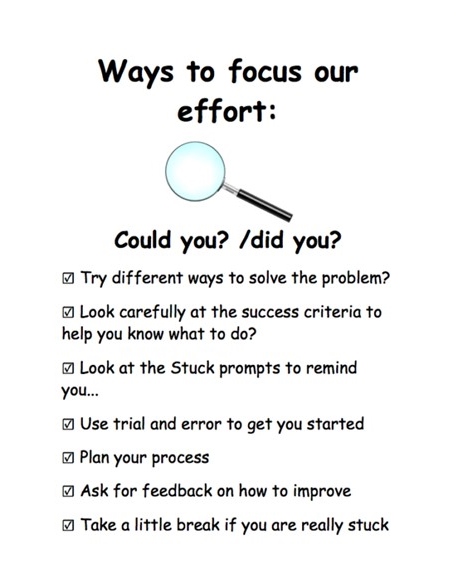
- trying different strategies to solve a problem;
- aiming to achieve challenging goals;
- using different un-sticking techniques when something is tricky;
- paying attention to whoever is speaking.
Students need to be aware of a connection between effort and improvement; that the sort of effort being used is causing their improvement. This is why it is important to give effort meaning. Meaning often underpins motivation which in turn drives behaviour.
Re-frame challenge: explore learning how to overcome a struggle
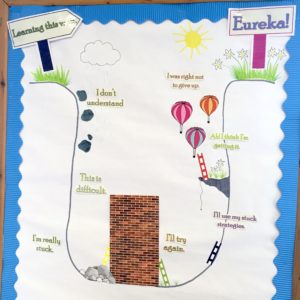
The Learning Pit: from struggle to success
Use the ‘Learning Pit’ as a means of opening up a conversation around the feelings involved when struggling with learning, and the journey to overcoming the struggle. It is essential that students know:
- that the ‘pit’ is only one staging post on the learning journey
- they can get out by using ‘stuck strategies’ and tools
It is also worth noting that the pit is not necessarily inevitable for all students in all learning – some will fly over the pit in some topics or curriculum areas.
The ability to cope with and overcome difficulty and challenge is a key aspect to becoming a successful learner.
James Nottingham introduced the idea of the Learning Pit as a way to explain that struggling is part of learning and that if we are to understand something we need to struggle with it first. Students move from unconsciously incompetent (an emotionally ‘safe’ area before learning), to consciously incompetent (the emotionally tricky “pit”), to consciously competent (the far side, after the learning has happened).
Find out more by visiting:
Try out 3
Build perseverance using a learning language
Teacher talk – as a learning coach
10 ideas to encourage your students to do the thinking for themselves
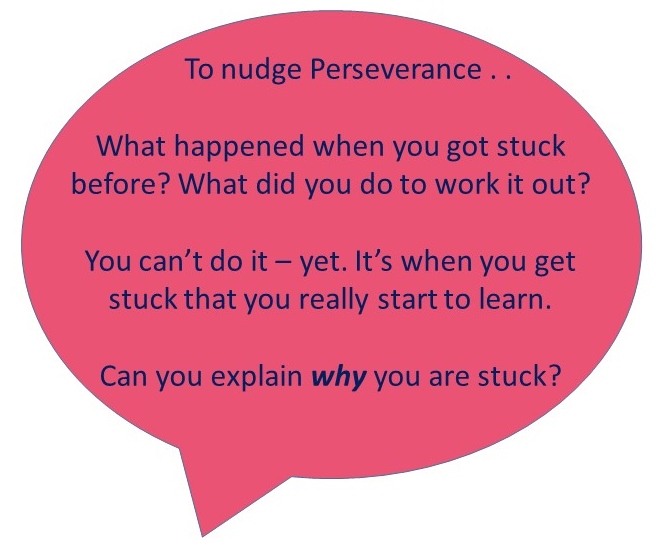
- What happened when you got stuck before? What did you do to work it out?
- Great! You have come through the confused / stuck feeling. What helped you?
- It’s when you get stuck that you really start to learn.
- How can you avoid that distraction?
- Is this goal worth going for?
- What do you know? What do you need to know? How might you bridge the gap?
- You can’t do it – yet.
- Can you explain why you are stuck?
- That’s an interesting mistake.
- Give it a go and see what happens.

Two more teacher talk ideas ⬇️
Talk about what happens when you get stuck?
Try this type of mindset shifting language:
- Being stuck is a good place to be.
- Getting stuck means your brain is working hard on something new.
- When you learn new things your brain gets bigger.
- If you don’t get stuck you’re probably not learning anything new
- Getting stuck is good for you.
- It’s not too hard, it’s just a bit tricky right now.
- When you say you can’t do this, just add ‘yet’
- Being stuck means you are about to discover something new
Develop self-reliance
Support to continue: questions not answers
If students freeze when they are stuck, offer supportive questions not answers. A basic support to continue is ‘What do you do next?’, and when this has been answered or done ask the question again, and then again
Support to continue’ prompts are seen as helpful by students. You are encouraging them to take over the job themselves and reminding them that uncertainty shouldn’t lead to paralysis. It’s about weaning students off depending on you and activating their positive self-talk about learning.
To extend the ‘support to continue’ approach, try using phrases like:
- What have you already tried? What else might work?
- What did you do when you got stuck before?
- I wonder what you did to move on?
- How about taking a short break and coming back to it later.
- Have you looked at the stuck prompts ?
- Who seems to be managing this ok ? What are they doing
- I can see that [this task] is important to you. Well done for keeping going.

Try out 4
Build perseverance into your lesson design
It is through learning activities that learning behaviours get a workout. Their role is to enable your students to access and wrestle with information and ideas; to help them use and understand something; to ensure their effectiveness as a learner. The ‘right’ activity helps to make new concepts more concrete. The ‘right’ activity provides insights into new ideas and subject matter. The ‘right’ activities need to be carefully chosen and, critically, linked to the learning goal.
Look first at learning goals (sometimes called objectives)
Put the ‘how’ before the ‘what’.
If you write a goal relating to ‘understanding xxxxx’ or ‘knowing yyyyy’ it’s less likely to motivate learners to make the effort than a goal that starts with some indication of the sort of ‘effort’ or way of doing something you want them to make. In other words learning goals that relate to doing something or researching something, or creating something . . . are better motivators than goals that relate to knowing something.
Goals with perseverance in mind
In one sense every lesson should engage students’ perseverance and you’re likely to support this constantly through the culture of your classroom. But, every now and again it might be wise to set lessons off with goals that start by picking out the persevering skills students will need to use to complete the task effectively. By doing so you are giving students some indication of the sort of ‘effort’ you want them to make. For example;
- select a harder level of challenge than you would normally go for and work out what the success criteria could be.
- identify three areas when you got stuck and work out a possible solution for yourself.
- assess your own story/written piece using the checklist you made last week
- work out your own checklist which will help to ensure you are successful with this task….
- look over your learning this term and estimate what has made you become more successful/bold/confident/accurate.
The big addition to lesson plan thinking . .
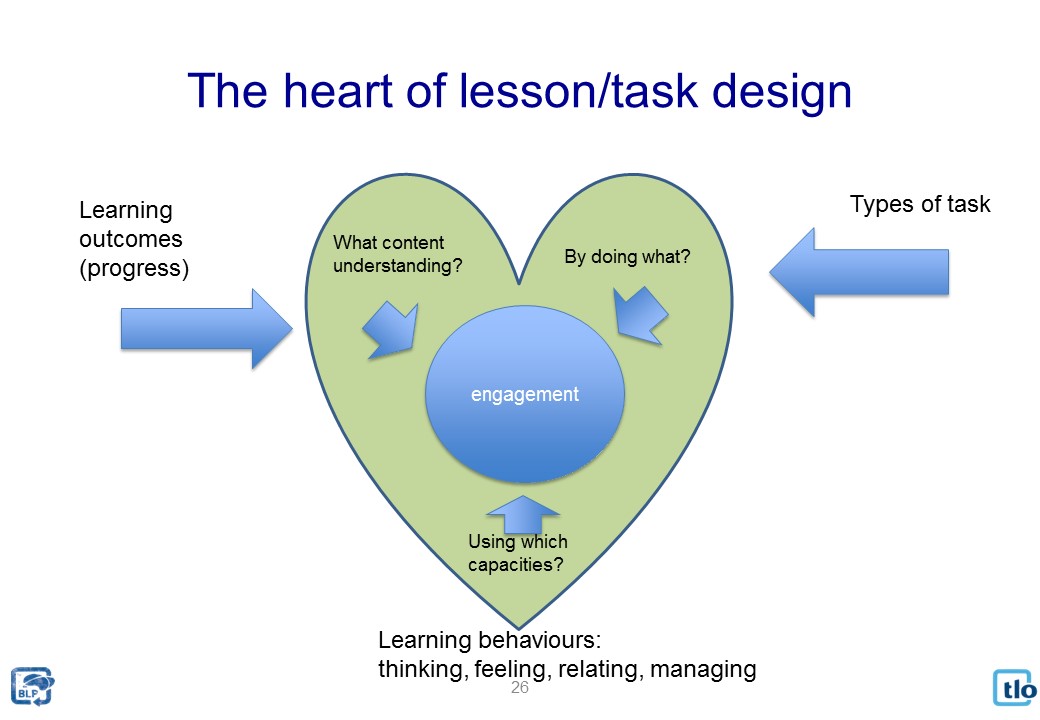
In putting a lesson together the 3 key questions to ask yourself are;
- what is to be learned? (goals)
- by using which learning behaviour(s)?
- by doing what sort of activity?

Two more lesson design ideas ⬇️
Plan to get students stuck
Start some lessons with something like:
- In this lesson I expect you to get stuck 3 times.
- If you get half-way through and haven’t become stuck move to more challenging activities.
- When you get stuck make a note and try to explain to yourself why you are stuck at that point.
- Later in the lesson we will spend a few minutes reflecting on what we learned from being stuck and decide which strategy worked best.
The explicit message is that students need to expect to be stuck during the lesson. The implicit message is that being stuck is a good thing – something you want to see. Using this technique regularly means students come to accept being stuck as a natural part of learning. It begins to build their curiosity about the why and possible patterns to stuckness.

Build in trial and improvement
Coupling content and process: Trial and Improvement; promote the idea that being stuck is okay. If students know we expect them to try things out, make slip-ups and have another go, their perception of being stuck is likely to turn to curiosity. Weave trial and improvement into lessons by, for example: –
- Include a trial and improvement success criterion when asking students to complete an activity or create a piece of work. For example: I want to see evidence that you have tried and improved at least a couple of different layouts before settling on…
- Include a designated focused trial and improvement time in lessons; time to test out ideas. Use scrap paper, mini whiteboards or rough books. Include opportunities for discussion to encourage editing, refining and clarifying of thinking
- Mark the working out that students do. Extend this common in maths idea across the curriculum.

Try out 5
Build perseverance by celebrating it.
Rethink achievement in learning
Invite your students to brainstorm their own definitions of achievement and come up with a list.
An achievement is something;
- you can be really proud of
- you have never done it before
- that you kept trying to do and finally succeeded
- you have done that you found difficult
- you have worked hard to finish
- you have done what teachers tell you is good
Notice that all these are aimed towards building the idea that achievement comes in many ways. Ensure your praise matches these statements.

Two more Celebrating learning ideas ⬇️
Help your students to change their thinking about failure
Turn the lens around, make it clear that we FAIL before we succeed, shift the thinking . . .
- From ‘Challenge’ to ‘Interesting challenge’
- From ‘Mistake’ to ‘Learning opportunity’.
- From ‘It’s hard’ to ‘It’s tricky’.
- From ‘Too hard’ to ‘Tricky learning builds my brain.’
- From ‘I can’t do it’ to ‘I can’t do it yet’.
- From ‘I’m stuck’ to ‘I’m about to learn’.
- From ‘I can’t . . . ‘ to ‘How can I . . . .?’
- From ‘I’m good at this’ to ‘This is too easy for me’.
- From ‘I don’t know how to’ to ‘I’m learning how to’.
This is about building a positive mind set and self-belief, challenging that little voice that says ‘I can’t . . . ‘ Create a display around these ideas to initiate a learning conversation to shift the pessimistic, ‘glass half empty’ outlook towards an optimistic, ‘already half full’ attitude.

Re-enforce the values of learning
A learning-friendly culture is for living, not for laminating.
Do displays support your desire to build a learning-friendly culture?
Beware displays
- that are jaded,
- too high on walls,
- rarely referred to,
- laminated to lengthen their life,
- bought in from Twinkle and don’t reflect the underlying culture,
- over reliant on quotes from the great and the good of learning.
Where quotes are used in displays ensure the sentiments behind the words are understood and the classroom organisation allows the implications to happen!

Find out 3
Create opportunities for students to Find Out about how / when they are persevering
For KS2:
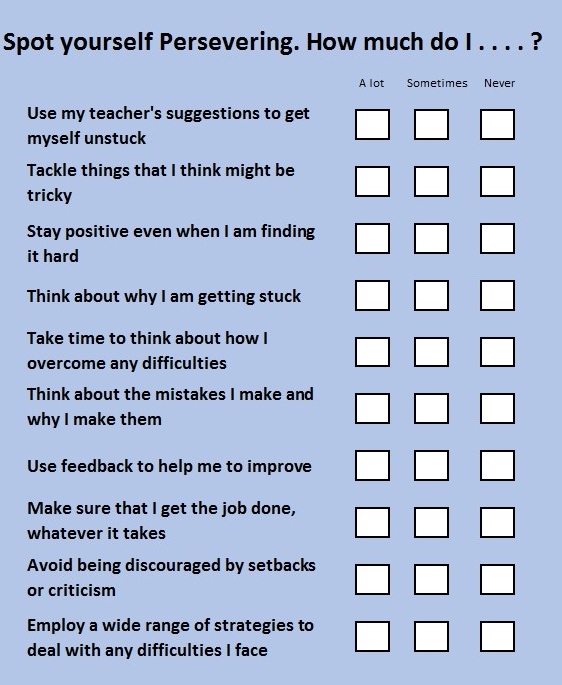
Encourage students to monitor and reflect on their own persevering habits. Copy and laminate the chart alongside, refer to it in lessons and invite them to consider how often they display these characteristics.
As a result of their self-evaluations, challenge / support students to create a target for their own development as a perseverer by identifying something that they do sometimes that they would like to do more frequently.
These perseverance behaviours tend to become more subtle and challenging as you move down this list, so it is better to set targets relating to doing more of what they currently ‘sometimes’ do, rather than trying to jump towards the bottom of the list and tackle a behaviour they currently ‘never’ employ.
Download as a pdf
For KS1:
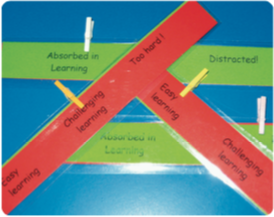
Little strips of laminated card and a peg can put children in charge of their learning a little more. Labelled ‘Easy learning’, ‘Challenging learning’ and ‘Too hard’ on one side, students use them to let you know whether you are meeting their learning needs or if they could do with more extension or more support. It is powerful when learners realise that challenge is an essential element of their learning; that finishing easy tasks quickly does not signal cleverness but indicates time-filling rather than real learning.
For the teacher, it provides valuable, instant feedback. ‘Challenging Learning’ is, of course, the sweet spot – tricky but doable, the place where perseverance is both necessary and likely to pay off. Intervene here only if it becomes too difficult. For the child who is on ‘easy learning’, prepare to inject more challenge; for the child on ‘too hard’, explore whether that is really the case or whether a nudge in the right direction might bring it back to ‘challenging learning’.
Learning together. Meeting 4
Unit 4 Suggested meeting agenda
- Decide what you want this meeting to achieve (5 mins)
- Discuss what you have found out about students use of perseverance (15 mins)
- Re-cap and reflect on the action you have each undertaken in your classrooms (20 mins)
- Consider issues that would be beneficial if implemented across the school (10 mins)
- Review how the meeting format went (5 mins)

Learning Team Meeting 4 Agenda ⬇️
Item 1. Meeting Objectives. (5 mins)
Meeting objectives might include:
- discuss levels of perseverance displayed across the school
- share and learn from what we have each tried in our classrooms;
- feel confident about taking forward ideas from online materials into our practice;
- identify actions that would be more useful if everyone applied them in their practice;
Outcome. To have decided what the meeting should aim to achieve.

Item 2. Discussion about learning culture (15 mins)
Explore together your discoveries about your students as perseverers;
- what did you find out about your students as perseverers (Find out 1)
- are students improving as perseverers with age? Moving from grey to purple to blue etc?
- where did we each estimate our classroom to be in terms of its culture Find out 2?
- what did we each learn from Find out 2.
- which 3 are the weakest features
- which 3 actions are our strongest
- what surprised or baffled you
- are there significant differences between year groups
Outcome. A clearer understanding of current learning culture features across the school. Inklings about how the learning culture could be strengthened across the school.
Item 3. Explore action using the initial Try outs (20 mins)
Share and discuss the action you each took in making a start on strengthening perseverance in classroom practice.
- Which of the suggestions did you each use?
- Any concerns about or difficulties in putting the Try outs into action.
- Which seemed the most valid or successful.
- How the Try Outs affected different age groups.
- Ways of implementing these to ensure we can all learn from and adapt.
Outcome. A clear picture of our interest in and enthusiasm for amending classroom cultures to support learning to learn. A feel for which ideas are proving to be most effective and why. Recognition that these culture shifts will call for action on current school wide policies? i.e. how we all treat mistakes, being stuck and praise etc.
Item 4. Learning from practice (10 mins)
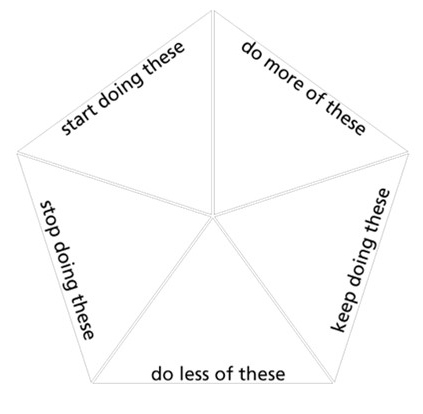
In relation to all the shades of practice you have been trying out, sharing, mulling over and observing using Find out 3, think about them now in two ways;
1. personally and 2. school wide.
Which ideas/practice stand out as:
- things you want to start doing
- things you think you need to stop doing (that’s harder)
- things you want to keep doing
- things you want to do more often
- things you want to do less
Outcome.
- At this stage it’s essential to note ideas arising from this discussion using 2 pentagon diagrams;
- one for each team member personally and
- one for decisions/suggestions that are school wide.
- Ensure that your school/group wide pentagon is shared with senior leaders.
Item 5. Evaluate team session. (5 mins)
- Did we achieve our objectives?
- Are we comfortable with what we are trying to achieve so far?
- Any concerns at this point?
- Next meeting date and time.

Comments are closed.