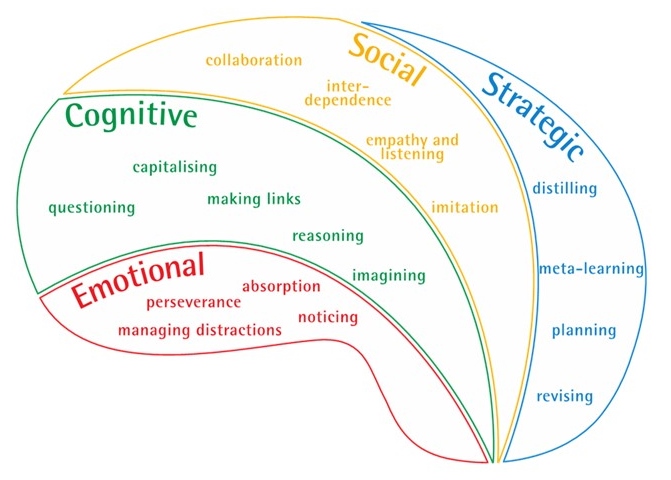
Having addressed students’ Resilience, Collaboration, Questioning and Revising in phase 1, students will now be ready and willing to engage constructively with their learning. Securing these key behaviours was an essential first step, but being ready and willing is but a first step. To become ready, willing and able, learners need to expand their all their cognitive skills, their social skills, and their strategic skills – as illustrated in The Supple Learning Mind.
‘Playing the Deeper Learning Power Game . . . ‘ consists of several online modules that offer progression charts, activities linked with teacher talk, and frameworks to help design dual focused lessons. They provide a deeper, richer look at helping learners to learn so that students:
grow their learning behaviours;
use the language of learning effectively;
recognise how learning behaviours are designed into lessons;
develop the confidence and skill to grow their learning powers.
The ‘deeper’ programme consists of twelve online modules, each expected to be introduced and put into practice over about four to six weeks. This doesn’t mean you will only look at them once. You can revisit them again and again as your students make progress using ever more useful learning behaviours. The modules offer easy to access information about one learning behaviour, suggestions for making classrooms learning friendly with lots of ideas to try out. Thus you are armed with material to support your efforts to broaden the learning friendly culture and apply a more forensic approach to learning.
[The modules for primary schools are known as Stepping Stones. The parallel modules for secondary schools are known as Nutshells.]
There are bundles of modules to select from:
1 Playing the Deeper Learning Power Game . . . . . Noticing, Questioning, Making links, Reasoning, Imagining and Capitalising
This bundle of 6 online modules helps teachers assist students to develop their dispositions in the cognitive or thinking aspects of learning.
2 Playing the Deeper Learning Power Game…. Collaboration, Listening, Planning, Revising, Meta Learning, plus a module to help you to review and evaluate progress.
This bundle of 6 online modules helps teachers assist students to develop their dispositions in the social aspects of learning and in the meta-cognitive or strategicaspects of learning.
[/twocol_one]
3 All 12 modules.
All these modules tackle using and stretching learning behaviours, spotting them in your students, using them productively in lessons, talking about them confidently and planning their use alongside other colleagues. This full set of modules is likely to take teachers a couple of years to work through and is broader and deeper than the initial ‘Playing the Learning Power game’
How each module of the 'deeper game' is structured
Each module has four sections:
Section 1 The learning habit and how it develops.
The learning habit and how it develops. The Progression Chart.
Section 1 introduces you what the learning behaviour is about and how it might progress or build through 5 phases. Participants are asked to plot where their pupils are now in being able to use the behaviour skilfully.
This section offers a concise way of getting to grips with the learning behaviour and how it progresses. It’s likely to take about 20 mins to get your head around it.
Section 2 Taking the learning habit into classroom culture
2. Taking the learning habit into classroom culture. Classroom activities. This section offers numerous suggestions to develop a friendly culture and build pupils’ learning skills.
Here you will find ideas for lesson starters/quick wins; classroom activities; learning reflection tools; ideas for the appropriate learning language for each progression phase in the learning habit. You are likely to browse in this section for about 30 minutes in preparation for the team meeting.(see below)
Section 3 Blending learning habits with content
3. Example dual focused lesson. This section suggests a series of questions and steps you might use to ensure the development of learning habits claims its place in the curriculum and is designed into lesson/activities to aid understanding.
Here we look closely at how to blend improving pupils’ learning habits into the content you have to teach. The section covers;The principles behind any learning powered lesson. Big questions to ask about lesson design. Lesson planning in action…an exemplar learning habit focused task
Section 4 Team reflection and planning
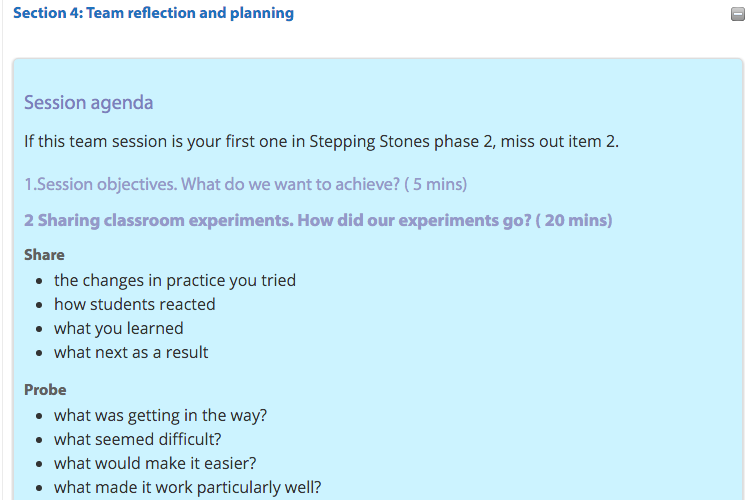
4. The final section gives a skeleton plan for the Professional Learning Team session It includes downloadable enquiry question and planning formats. In team sessions you are invited to share the impact of your experiments with colleagues, discuss the online materials, and plan how you might use these to change your classroom practice. All the activities are designed to help you bring the learning behaviour into active use in the classroom. The section also includes a range of indicators that you could start looking for to begin to measure the impact of teacher development across the school The team sessions are timed to last about 75 minutes.
Each unit is accompanied by a Learning Diary. This helps you to distil important messages, home in on the key bits of information and design learning experiments specifically for your pupils.
[/dropshadowbox]
[/toggle]
Reviewing our progress
A rich variety of tools help you review your progress in developing a learning friendly culture in your classrooms. This review provides you with relevant information on which to base your approach in the next phase of building students’ learning powers. Sections 1 – 4 consider:
Reflecting on your changing practice. Looking at what you have done and how your classroom has changed. This section answers the question “How far have you come?”
Giving students a voice. Finding out how your students have benefitted. This section answers the question “How well have the students taken to this way of learning?”
Learning with and from colleagues. Learning from learning walks and observations. This section answers the question “What are the variations on the theme and what can I learn from these variations?”
Team session: Learning together. Putting your heads together and thinking “what next?” This team session answers the questions “How are we doing, how are our pupils doing and where do we need to go next?”
As a result of working through these four sessions you can expect your students to have made solid progress in learning habits, have a working learning vocabulary, purposefully use their learning behaviours and have adopted some of the strategies of powerful learners.