Playing the Learning Power Game: strategic issues (DIY)
This is the companion module to ‘Playing the Learning Power game’. It is designed to support senior leaders in introducing teachers to their module and to take a strategic approach to sustaining momentum as the teachers’ programme develops.
Overview: strategic issues and a programme for staff
A distillation of key messages of Learning Power
Leadership strategies to secure Learning Power
Introducing The Supple Learning Mind to teachers
Introducing learning friendly cultures to teachers
Keeping an eye on progress
Where now: what next?
An overview
In this section you will find:
An overview of the purpose and content of;
this strategic resource for senior leaders
the accompanying programme for staff
This resource is designed to take a leadership perspective on developing student’s learning power, giving leaders a glimpse of the strategic concerns that will arise. The complementary programme for staff is titled Playing the Learning Power Game.
[/twocol_one]
Key points
Take a quick look at the content of this resource
note any concerns or queries to discuss with your TLO coach.
Take a quick look at the online course introductory for teachers (Playing the Learning Power Game)
TLO will give you access to a copy of the course to enable discussion
school staff will be given access when the school informs TLO of the start date
1 An overview of this strategic resource:
This resource is designed to give senior leaders a glimpse of the strategic concerns that will arise when a school decides to take on ‘Playing the Learning Power game’. It provides questions, think pieces, frameworks, PPts and diagrams to help leaders;
feel secure about the purpose, benefits and frameworks of learning power
explore important leadership roles when taking on the development of Learning Power through the school
introduce the Learning Power approach to staff
maintain momentum into the future
identify ways forward beyond the initial stages
These issues are considered over 7 sections
Overview: strategic issues and a programme for staff
A distillation of key messages of Learning Power
Leadership strategies to secure Learning Power
Resources for introducing the Supple Learning Mind framework.
Resources for introducing the Learning Friendly Culture framework.
Resources to support keeping track of progress.
Consideration of possible next steps on the journey.
A sneak preview: Monitoring development section 6
Monitoring development
In this section you will find:
Tools that senior leaders might use to ‘look for learning’.
Talking with students about learning
Classroom observation
Monitoring classroom cultures
Looking at the physical environment
Key points about monitoring learning
Monitoring is best done in a spirit of enquiry rather than judgement
What leaders choose to monitor reveals where their interests lie
An outcome of monitoring should be identifying and sharing existing good practice.
1. What you’re aiming for…
…is a shift in focus from teaching to learning
Senior leaders have a responsibility for monitoring and evaluating what is happening in classrooms. Traditionally this has meant looking at lessons in terms of the quality of the teaching. While that responsibility remains, what is being suggested here is that monitoring and evaluating should also look at classrooms through the lens of student learning.
2. Explore ways of monitoring learning
What senior leaders do, and do not do, sends a strong message about what is viewed as important. How can senior leaders demonstrate their commitment to ‘Playing the Learning Power game’?
2a Keeping an eye on the Big Picture
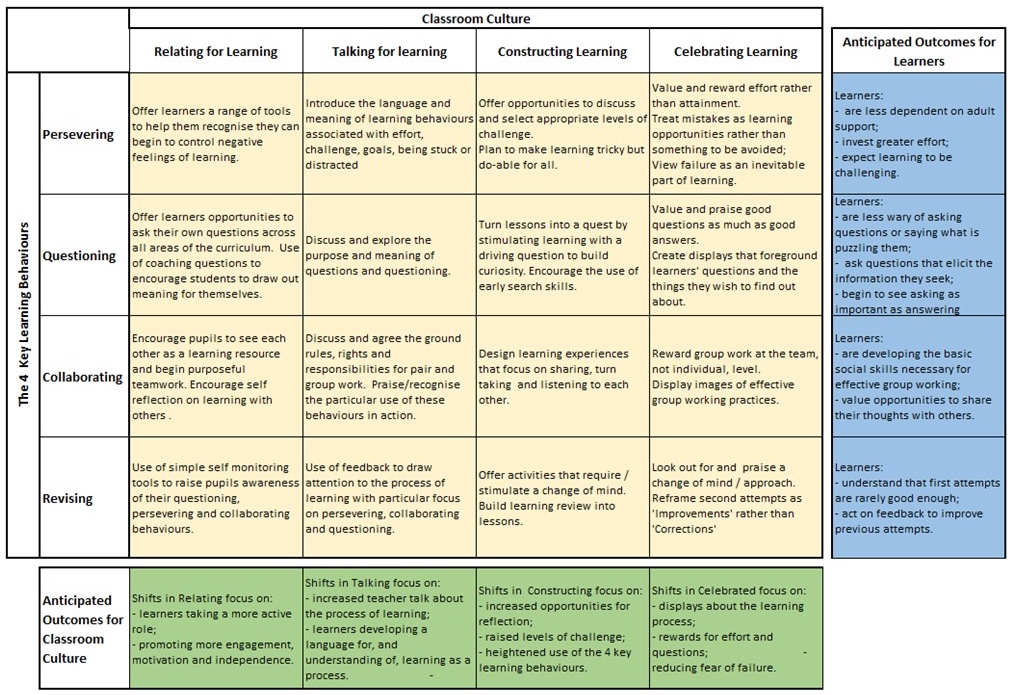
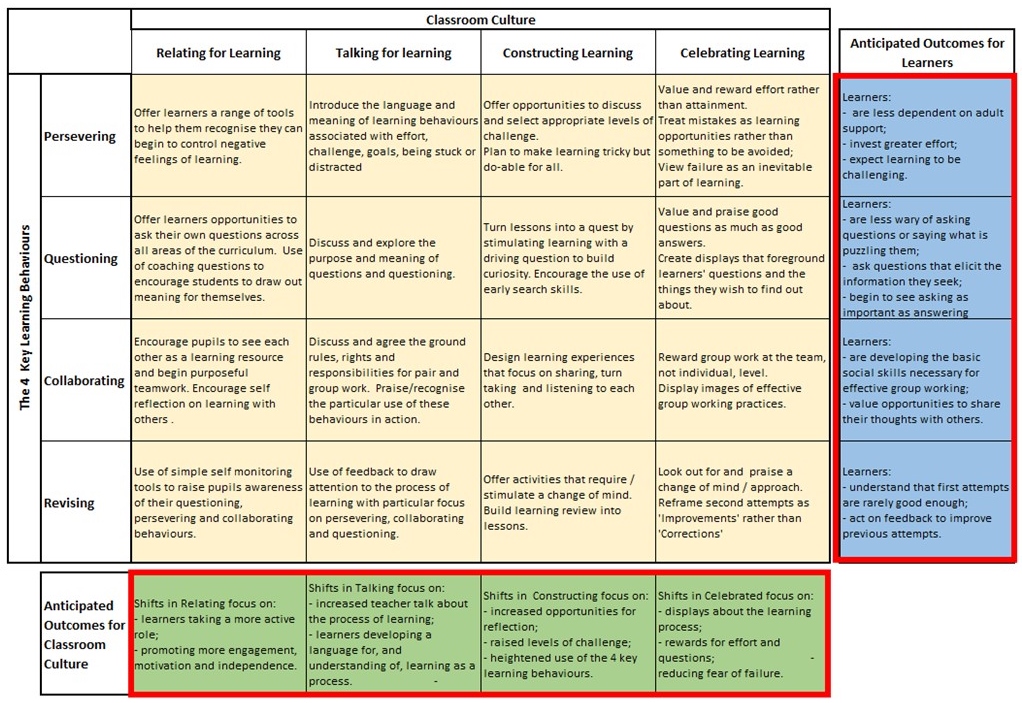
Here’s a condensed, distilled view of what you are likely to see happening in classrooms as a result of staff working through the Learning Power Game modules. See below for explanations.
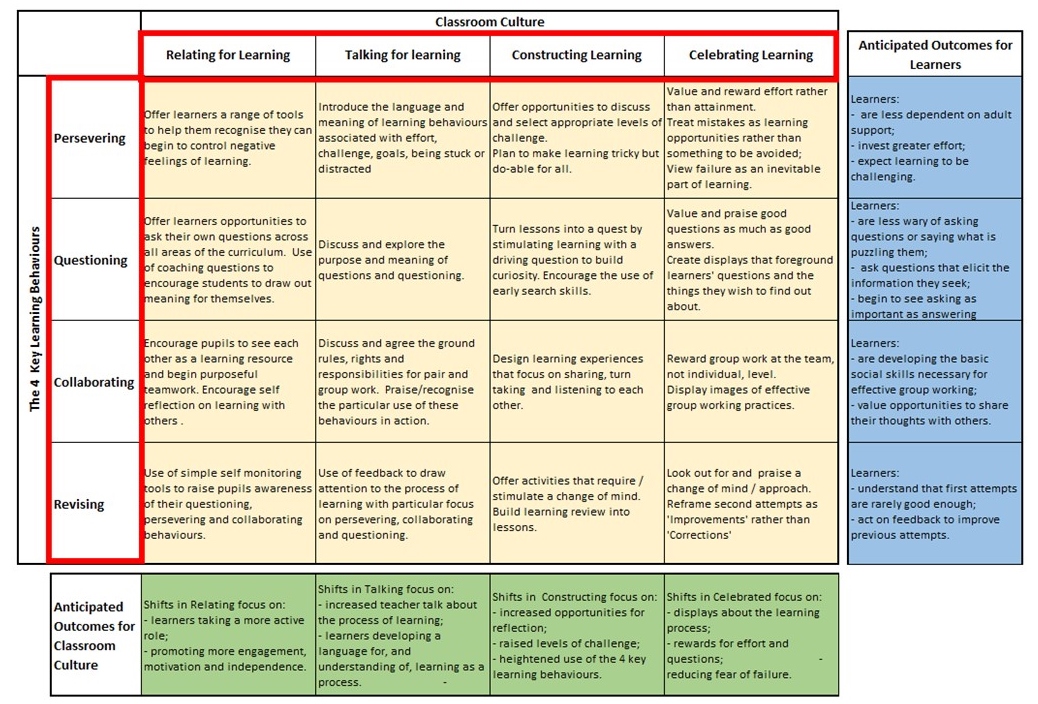
The vertical axis to the left shows the 4 learning habits the school is working to improve.
The horizontal axis across the top shows the 4 aspects of classroom culture that have to shift to being learning friendly.
On the downloaded spreadsheet, click on the Enable Editing tab and you can reveal reminders by hovering over the cells.
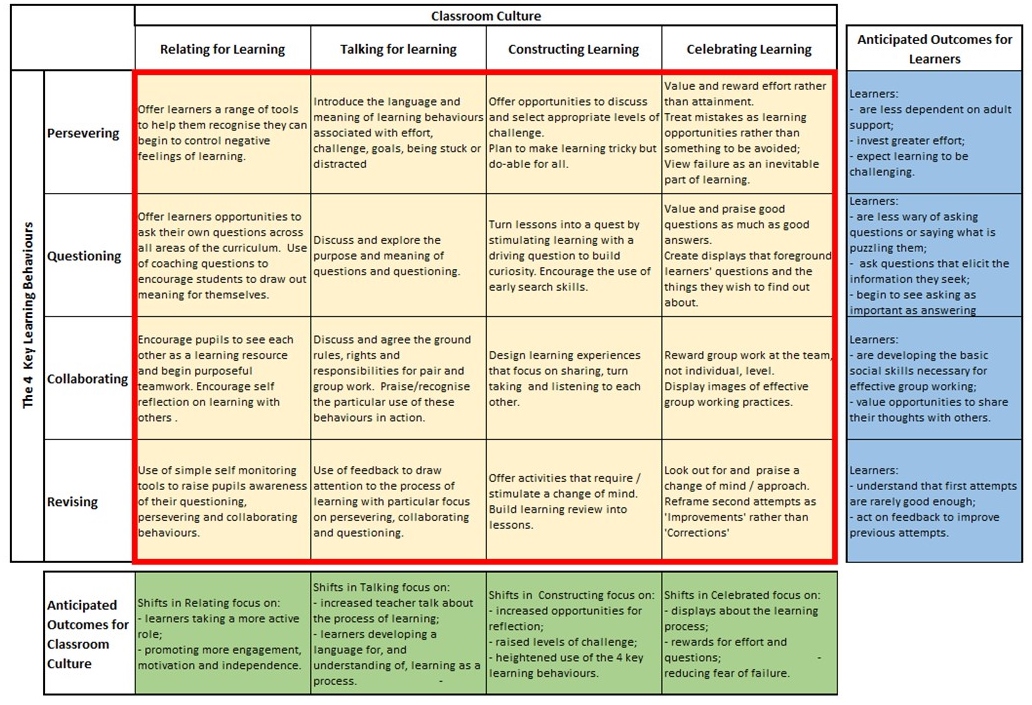
The central 16 cells
These cells serve 2 purposes.
Firstly:
The text in each cell gives an indication of the classroom culture that needs to be in place for learners to learn how to learn.
When looked at vertically down the page, they map out the 4 aspects of classroom culture.
When looked at horizontally across the page, they hint at the ways in which classrooms need to change to enable to 4 key learning behaviours to flourish.
Secondly:
On the downloaded spreadsheet, hovering over each cell reveals a teaching idea taken from The Learning Power Game module.
These teaching ideas are key to unlocking each cell. There are many other ideas in the module for each cell, but these are the ‘must do’ strategies.
The cells to the bottom and to the right
The green cells across the bottom give an outline of how the teacher’s role develops as they make changes in how they relate and talk to learners and how they construct and celebrate learning. Hovering over each cell gives more detail.
The blue cells to the far right give an indication of the anticipated outcomes for learners in terms of the 4 important learning behaviours and hovering over each cell suggests what you might look for in students.
Use the ideas behind each of the blue and green cells to sharpen what you might look for in classrooms as the school progresses through the Learning Power Game.
2b Learning focused discussions
Listen to these students talking about their learning. How fluently could your students discuss their own learning?
Talking with students
In terms of tracking shifts in students’ understanding of learning, hold discussions very early in the process, and repeat with the same students a year or so later.
You might choose to record these conversations so that you can compare and contrast.
Read Headteacher Chris Taylor’s account of how he does this below.
Classroom observation has a chequered history – too often judgemental, too infrequently developmental, too much about teaching and too little about learning.
Try using either of these observation tools to focus on student learning behaviours.
At the end of your observation, simply colour in each segment of the wheel depending on how much each learning behaviour was in evidence. You will end up with something like this:
Alternatively, sit down with the teacher and colour it in together.
Use it as a conversation starter with the teacher.
Over time, look over a number of completed ones to get a feel for which behaviours are getting regular exercise, and which ones less so.
[IMPORTANT: It might well be worth completing some of these ‘wheels’ early in the school’s engagement with the junior game, to achieve a baseline measure of where the learners were before the impact of teaching changes begins to take effect. Keep and, most importantly, date these observations for comparison with others you might make towards the end of the project.]
This tool explores aspects of the 4 key learning behaviours – Questioning, Collaboration, Perseverance and Revising.
This tool focuses on the 17 learning behaviours in the Supple Learning Mind.
Teachers will have met the three types of classroom culture in section 1 of ‘Playing the Learning Power game’. Initially, practice may well be rooted in panel 1 behaviours, along with some of panel 2.
Use the sheet as a means of capturing / sharing panel 2 and panel 3 behaviours observed in the course of your learning walks.
Perhaps use it in conjunction with the rating wheel in 2b.
2e What does classroom display reveal about learning?
Monitoring classroom display
Here you will see just eight examples of the sort of classroom display evidencing the four aspects of a learning friendly classroom:
devolving responsibility towards the learner: students questions and their explanations about getting unstuck
enriching their learning talk and understanding: teacher feedback mentioning the use of a behaviour and animals that help students ‘hook on’ to the learning vocabulary
constructing learning activities: learning behaviours to be used and reflecting on learning together
celebrating the growth of learning dispositions: learning ladders showing students growth in learning and catching the use of a behaviour on camera
Now take a look at the download of the Learning Amble and use it to focus your reflection on the range of displays in your school. What do they reflect about learning values in the school and where does the focus of change need to be?