Research tells us that our personalities and mental aptitudes change and develop over our lifespan. What this means is that as a teacher you have an opportunity to keep on deliberately influencing the development of these habits and dispositions in positive directions; both your own and those of your students.
Having made a good start you won’t want to stop there – but where next, what now? Is it just a case of trial and error, trying more of the same but harder, or might there be some pointers, some pathways, some inklings of a journey or even a potential route? What of your development? Can teachers build themselves into becoming teachers of learning power? Is there a route? Do some skills come before others? Is there progression? A progression in what? Would it be possible to capture this as a trajectory?
This Growing Your Teaching resource lays out a possible route for teachers who are seeking to become a learning power practitioner. What it’s trying to help you achieve is an understanding of where you are now, what you want to achieve next and possible ways to get there.
An overview
It has two very practical aims:
To help you grow your practice in a deliberate and measured way, across every aspect of the Teachers’ Palette. It draws on the effective practice we have observed over almost 20 years of BLP practice in schools and these descriptions have been ordered to offer a growth pattern – from traditional good teaching to the highly effective practice of a seasoned learning power practitioner. These witnessed growth pathways are something we hope you will debate, share, try out, add to or tweak, as you work to develop your practice.
To help you find a way through and select from a massive range of classroom based ideas. In support of phase 2 of your journey there are several detailed online modules (detailed below in section 3) to help you activate and build many more learning dispositions. This resource nudges you to find appropriate activities for both yourself and your students.
Growing Your Teaching has five sections:
Section 1 explores the big picture of teachers’ behaviour and talk that strengthen students’ power to learn over time.
Sections 2,3,4 and 5 home in on developing your practice across the four aspects of creating learning-friendly classrooms:
Relating for Learning; gradual steps you might take in devolving more responsibility to learners
Talking for Learning; gradual changes you might use to influence how learning is understood
Constructing Learning; how you might gradually shift your design of learning to enable independence
Celebrating Learning; how you might transform the look and feel of the classroom to encourage the growth of students’ learning habits
Each section first offers you just a few teaching ideas, some of which you may have tried already, and goes on to steer you towards other ideas and activities from across the range of Phase 2 modules (see below), helping you to move your classroom culture forward and sharpen your own practice.
A sneak preview; Section 1
A powerful learning journey
Serious, worthwhile books have been written about the why, what and how of students’ need to develop their learning dispositions into profitable learning habits. Hundreds of snippets of good practical ideas have been used in thousands of schools, increasingly, across the world. Over the last five years we have managed to have a go at documenting the growth of learning power in students. This has given teachers a more day to day purpose for their efforts and added rigour to their approach. But teachers were still left to rummage about looking for appropriate ways of ‘being’ in the classroom with little sense of their own progression.
This itch of a problem led us to asking some tricky and difficult questions. What of a teacher’s development? Can a teacher build themselves into becoming a teacher of learning power? Is there a route? Do some skills come before others? Is there progression? A progression in what? Would it be possible to capture this as a trajectory?
Now, after almost 20 years of enabling and documenting teachers’ practice that is designed to build their students’ learning power, we are ready to offer our findings in a way that teachers can try out, argue about, change, and help them to clarify and make sense of their own journey as a teacher of learning power.
Finding your way through this section
This resource lays out a possible route for teachers who are seeking to become a learning power practitioner
Its purpose is to help you to;
appreciate the whole game of developing students’ learning power
analyse your current practice across four aspects of teaching
select what you need from a vast range of staged teaching ideas
make renewed headway in your practice
re-check this growth chart and re-new your teaching as and when…
Re-acquaint yourself with the the Teachers’ Palette (Section1)
Get a feel for the Teachers’ Growth Charts (it’s easier than it looks!)
Estimate, roughly, where your teaching is pitched now on the chart
The teachers’ palette of learning friendly strategies
As a teacher, you are building your student’s learning power by helping them to recognise and expand their own learning capacities. This involves the ways in which you relate to students, talk to students, organise your classroom, and design activities, as well as what you notice and celebrate about learning.
This model of classroom practice draws heavily on the work of Chris Watkins, Institute of Education, University of London, and his work on developing learning centred classrooms. These classroom features help teachers to move beyond just wishing for ‘independent learners’ or ‘active citizens’, but rather they are the design principles that lie behind learning power teaching and will help to steer the development of pedagogy.
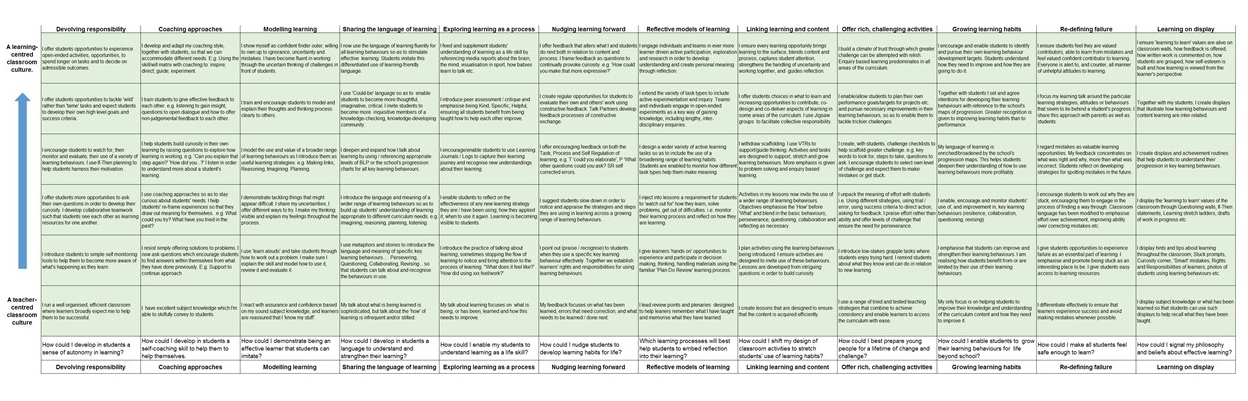
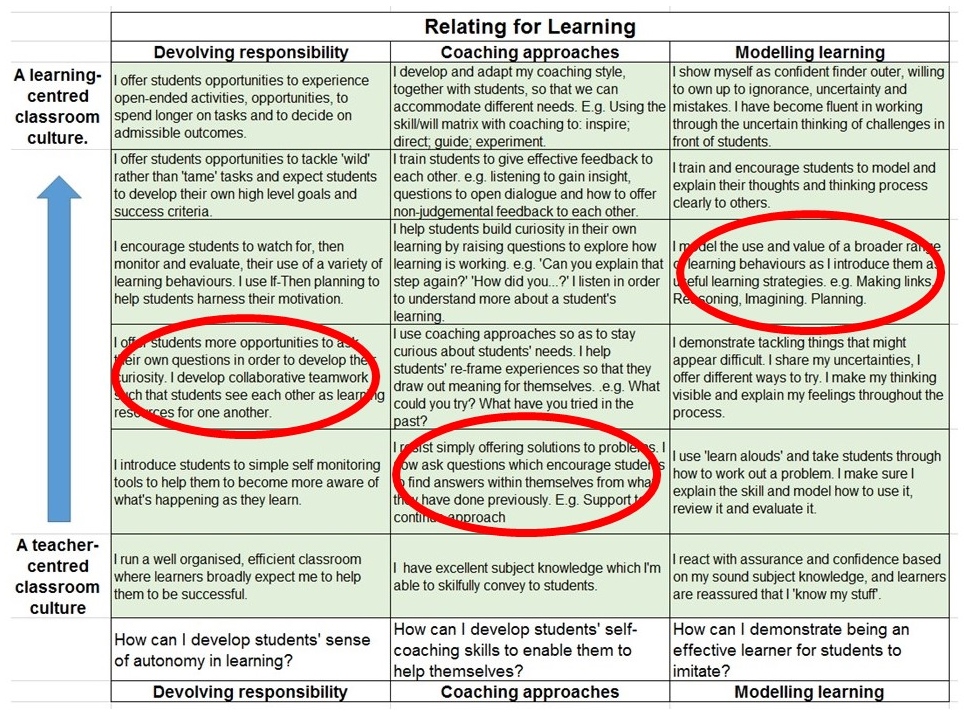
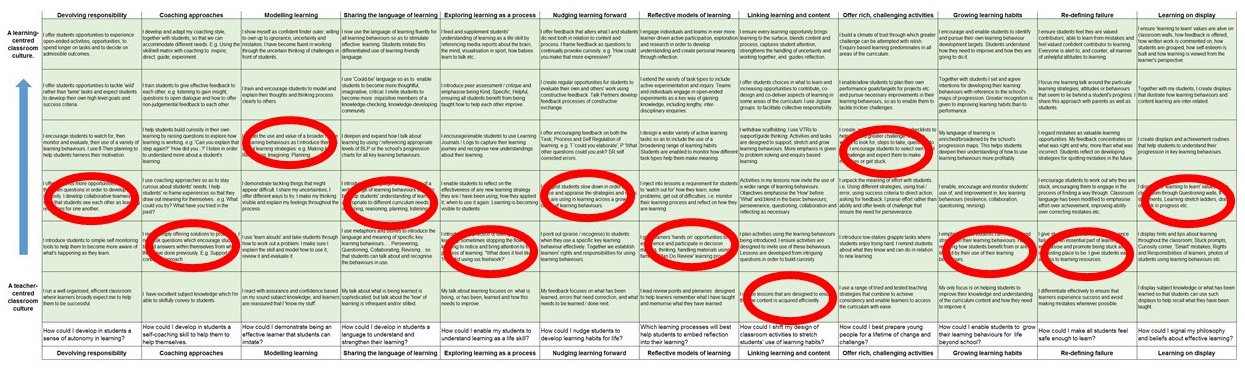
The somewhat forbidding chart opposite has emerged from asking lots of questions and taking a serious look at each aspect of the teachers’ palette. What do the twelve aspects of the palette mean in everyday practice in ordinary classrooms? What would that look like in terms of teacher actions?’ And then ‘ what might that mean in terms of teachers getting better at doing it?’ Is there a pathway or is this development just ‘suck it and see’?
Basically the chart captures what each aspect of the Teachers’ Palette can look like in practice; hence 12 columns. Instead of earnest sounding statements the chart is populated with real descriptions and examples of what teachers actually have to do. Furthermore, the descriptions have been ordered to offer a growth pattern – from traditional good teaching to the highly effective practice of a seasoned learning power practitioner. The chart might even be called The teachers’ growth chart.
Take a look at the what and how of jobs to be done.
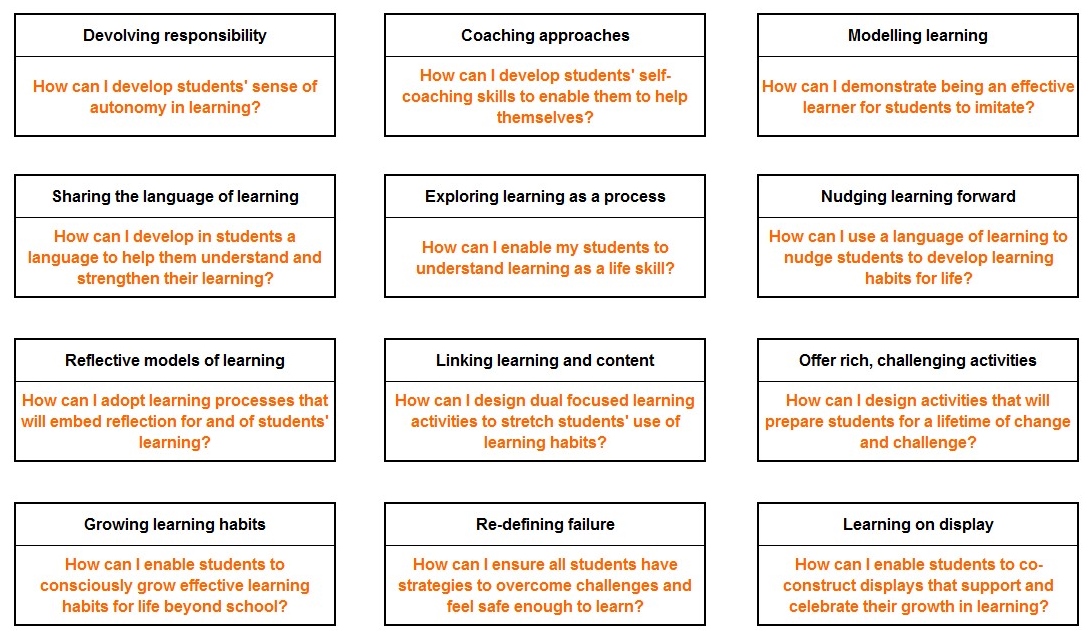
Each column has a simple label such as ‘Devolving responsibility’ or ‘Linking content and process’ that denotes the job to be done. The job to be done is followed by the question ‘How can I develop students’ sense of autonomy?’ ‘How can I design dual focused learning activities to stretch students’ use of learning habits?’ The questions explore what has to be done and for what reason. In other words the orange questions uncover why you are making these changes; in order to do what; in order to achieve what? This thrust of what, how and why has helped teachers keep hold of the bigger purpose as they try out and perfect the small practical ideas on a daily basis.
Take a look at the column purposes. Are they what you thought they might be? Would you want to amend any of them? Are any vital purposes missing?
The classroom as a learning community where everyone learns from each other and become more confident as learners as a result.
Any clue how you would tackle each of these questions?
Take a look at the stages of growth pattern
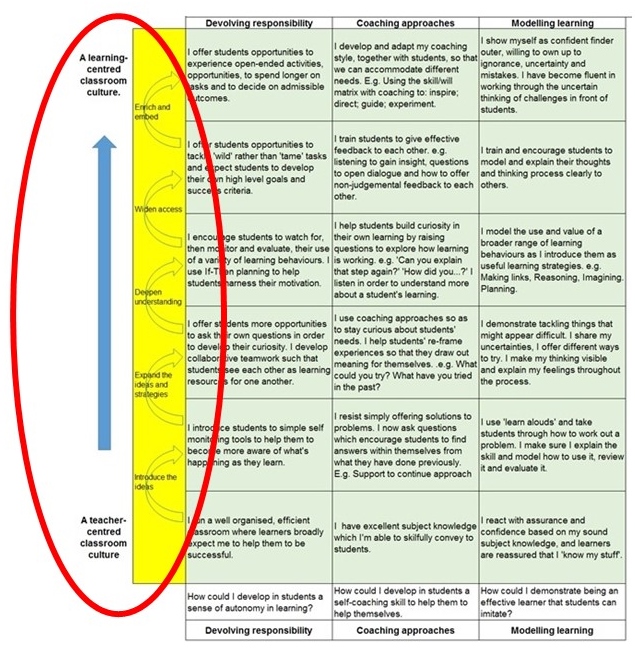
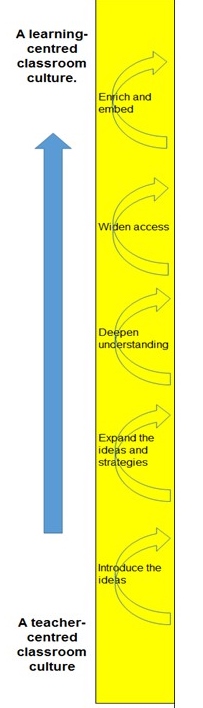
Here we try to capture a sense of progression in teachers’ practice. At the foot of the column lies a description of a traditional classroom where the power and responsibility for learning lies solely with the teacher. At the top of the columns lies a brief description of a full on learning friendly, learning centred classroom.
Reading across the tops of the columns gives a clear picture of the practice teachers are ultimately aiming for. The cumulative steps in between describe the journey and how it changes in focus. In the early stages you are probably dealing with a carefully chosen but limited set of learning behaviours. Later you will add more learning behaviours to your range, increase your skill and fluency and turn your attention to helping the students use and benefit from the same ideas.
The first stage of the journey is simply to introduce the idea of learning powers. This is often limited to four major LP behaviours – perseverance, collaboration, questioning and revising. i.e. the behaviours that you were introduced to in the programme Playing the Learning Power Game
At this introductory stage, across all the columns, you are only dealing with four key behaviours. You are developing learning talk for these four. You are setting up displays with students to capture their growth in these behaviours. You are developing lessons that use and stretch these behaviours.
Expanding the ideas and the strategies
At the second stage of the journey you add more learning behaviours to the mix. It might be those that are obvious players in your subject i.e. reasoning in Maths or imagining in English or listening in MFL. This is a tricky stage because you are becoming more familiar with a wider range of behaviours and becoming more skilful in each of the columns. It’s a lengthy stage.
Deepening understanding
At this third stage progress across the board hots up. You have got many of the learning behaviours in play now and within any of the columns you are deepening the behaviours. You are more aware of students growing their habits and this is proudly displayed. You are becoming bolder in how much responsibility you are allowing students. Your lessons use a greater variety of active learning tasks and the learning language is richer and mapped with the student progression charts. In areas of assessment too students are taking an active role in assessing each other and critiquing learning.
Widen access
At this fourth stage students are being encouraged and enabled to get in on the act. Coaching isn’t just you coaching students but now includes students coaching each other. In teaching each other, students have a role in co-designing and co-delivering lessons. Students are offered far more open ended or wild tasks and enquiry based learning opportunities. There’s an emphasis on being inquisitive and devolving responsibility to learners.
Enrich and embed
The final fifth stage students are in charge of their own learning. Teachers and students are able to adapt their coaching style to fit different needs. The language of learning is familiar to everyone and even formal feedback is framed as questions rather than suggestions or answers. All lessons are designed to deal with content and stretch learning behaviours with much of the curriculum covered through enquiry based learning. In such classrooms everyone feels a valued contributor, everyone is alert to and counters unhelpful attitudes to learning and all are becoming experienced independent learners.
4. Explore your journey
Take a closer look at the journey charts . . .
These are the same charts that you saw in section 2 above. Here we invite you to make a first stab at estimating where your current classroom practice lies. Which cell in each column best describes where you are now? Which cells’ meaning are a mystery to you?
Don’t expect your estimate to be at the same level in each column, we don’t develop in straight lines! Your practice will be stronger in some columns than others. Become intrigued about yourself as a growing, learning powered teacher.
Now that you’ve made a first stab at estimating where your teaching it pitched you’ll be curious to ask ‘so what and now what?’ stage of your learning process. The rest of this resource is designed to clarify, expand and support your professional growth as a learning powered teacher. Find out how later sections offer more information about what teaching statements mean, give immediate practical implementation ideas and give suggestions of where to find further ideas in other online modules that are now available to you.
So what have you found out and now what do you do about it?
What you have now is :
gained a sense of where you feel your classroom practice sits on the teaching trajectories;
get a feel for which columns and cells of these charts are perplexing you;
you may even have decided on an aspect of classroom culture that you want to focus on.
What’s next?
The next four sections – 2) Relating, 3) Talking. 4) Constructing, 5) Celebrating – aren’t necessarily in the order that you will want tackle them. This is your Learning Journey, and you can choose how to go about it for yourself.
Each section will help you:
make links between your classroom culture and how your students respond as learners;
understand what each progression statement means in practice;
consider a couple of teaching ideas to try (some of which you may already use);
suggest where you will find similar ideas from a vast selection in learning modules now available to you.
However, we would recommend that:
you begin with Relating for Learning as changes here pave the way for changes in the other three;
you do not try to do too much at any one time – maybe tweaking just two aspects of your practice drawn from sections 2 to 5 at any one time will be enough – you cannot possibly change everything simultaneously!
you consider carefully where your students are as learners before you start to practise developing your own teaching behaviours – you really do need to
start from where they are,
NOT
from where you want to be.
The idea of how you might link teaching behaviours with learning behaviours is explored at the outset of sections 2 through 5.
And remember:
learners will only change their learning behaviours in response to teachers changing their teaching behaviours.
Sneak preview: Section 3.3 Developing how you talk to learners
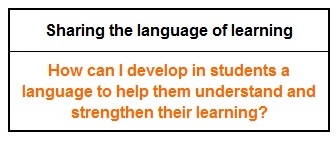
3. Practical ways to grow your practice in creating the language of learning
With the intended outcomes for learners that…
. . . they are aware of and use a sophisticated learning language drawn from the school’s chosen language and further refined by the school’s progression map, to underpin their understanding of the learning process.
Building powerful learners is all about being able to:
name
recognise
talk about using
select for use when appropriate
become skilled in using
evaluate the effect of
key learning behaviours
Using and extending the language of learning adds breadth and depth to how teachers and learners talk about, understand and improve learning.
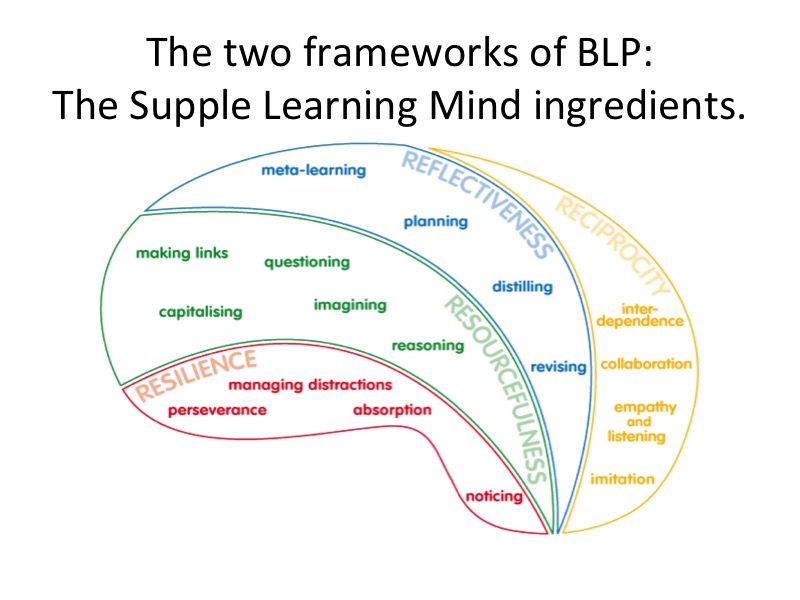
Emotional language – how we feel The first aspect of the language framework is about helping students to lock onto learning; to resist distraction; to become absorbed and to stay engaged despite the ebb and flow of learning. Learning behaviours include; absorption, managing distraction, attentive noticing, perseverance.
Cognitive language – how we think The second aspect of the learning powered mind is about being able to draw on a wide range of learning methods or ways of thinking. Learning behaviours include; questioning, making links, imagination, reasoning, capitalising.
Social language – how we relate The next aspect of the supple learning mind is about being able to make use of relationships in the pursuit of learning. Learning behaviours include; inter-dependence, collaboration, empathy and attentive listening, imitation.
Strategic language – how we manage our learning The fourth aspect of a supple learning mind is about building the ability to be reflective, to manage the learning process, to think profitably about learning and ourselves as learners; to become meta-learners. Learning behaviours include; planning, revising or refining, distilling, meta-learning.
Use of the language becomes essential in what people notice about learning. When used abundantly it makes learning visible and public.
1. Introduce the language of the learning behaviours being considered.
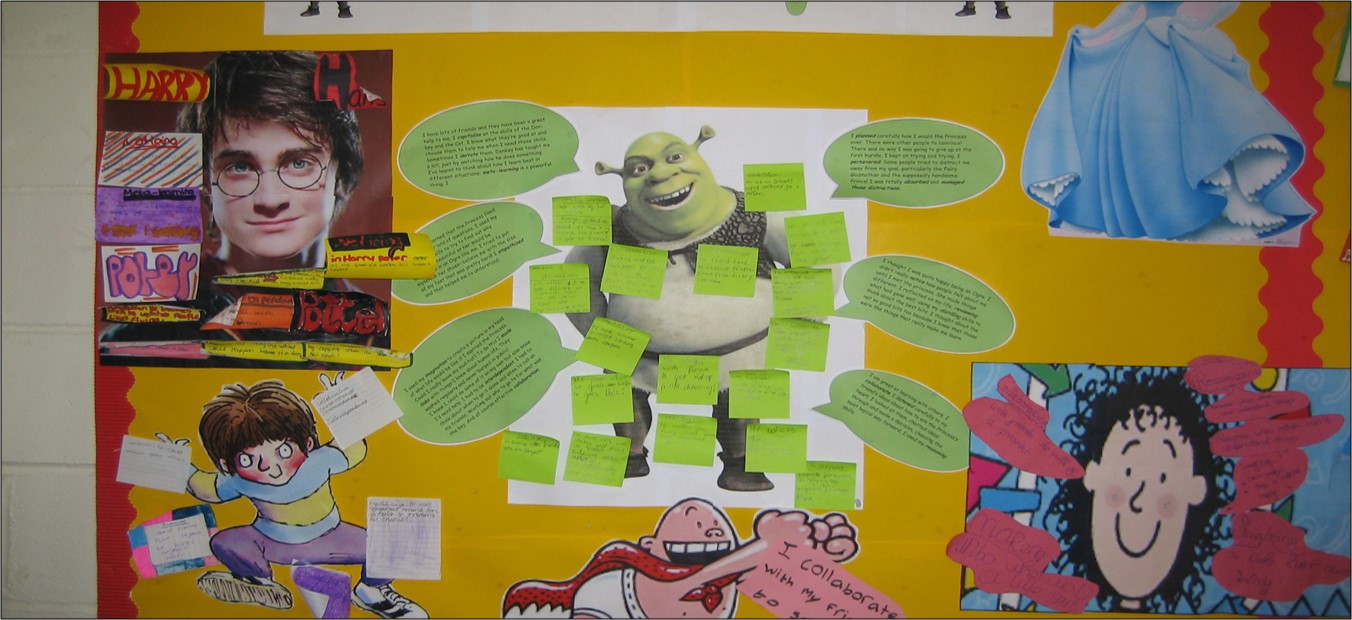
I use metaphors and stories to introduce the language and meaning of specific key learning behaviours… . Persevering, Questioning, Collaborating, Revising… so that students can talk about and recognise the behaviours in use.
Where to search for similar ideas to extend your practice
The idea of using Animals / puppets / icons to scaffold students’ thinking is introduced in the Stepping Stones / Nutshells Meta Learning module, section 2, i) Moving from Grey to Purple.
Start there for more teaching ideas.
2. Expand the learning language across a wide range of behaviours.
I introduce the language and meaning of a wider range of learning behaviours so as to build up students’ understanding of learning appropriate to different curriculum needs. e.g. imagining, reasoning, planning, listening.
I deepen and expand how I talk about learning by using / referencing appropriate levels of BLP or the school’s progression charts for all key learning behaviours.
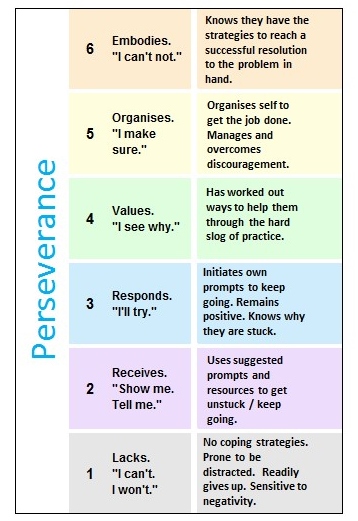
A key consideration of learning power is how the dispositions grow and how students become more skilled over time. In terms of the 4 key learning behaviours, teachers’ language may, at first, be restricted to encouraging learners to ‘stick at it’ or to ‘work in a group’ or ‘ask more questions’ or ‘think about what you have learned’. Learners’ understanding will inevitably suffer from these limitations.
Using the progression charts to talk about and explore learning enriches the learning language.
In increasing students’ disposition to persevere…what was previously ‘stick at it’ becomes:
What might you do to get unstuck?
You could use the stuck poster for an idea
What is putting you off? How might you deal with this?
What are you looking to achieve?
If it is not difficult, you are practising what you can already do!
That is an interesting mistake.
What might you do to avoid that mistake in future?
How are you going to make sure you get this done?
This is tricky, but I can see you are enjoying the struggle.
4. Widen access to the language of learning.
I use ‘Could-be’ language so as to enable students to become more thoughtful, imaginative, critical. I invite students to become more inquisitive members of a knowledge-checking, knowledge-developing community.
The importance of using ‘Could-Be’ language is well researched. It encourages more genuine engagement with what is being taught; how pupils will question and solve problems more readily if knowledge is presented as provisional. It’s about shifting the tone to more tentative, less cut and dried. The opposite is ‘Is’ language which positions the learner as knowledge consumers where their job is to try and understand and remember. ‘Could be’ language immediately invites pupils to be more thoughtful, critical or imaginative about what they are hearing or reading. For more on using ‘could be’ language, see page 69-71 in The Learning Powered School
Could be language includes phrase like;
5. Enrich the learning language.
I now use the language of learning fluently for all learning behaviours so as to stimulate effective learning. Students imitate this differentiated use of learning-friendly language.
Teachers who have become confident with BLP almost always find that the kind of language they use is different from what it was before. Their classroom talk is all focused on the process and the experience of learning itself. During an activity, as teachers go around helping students and checking on their progress, they quite easily start using more of the kinds of prompts and questions that are shown overleaf. They have, in effect, started to speak ‘Learnish’!
Nudging connecting
What does that remind you of?
What do you know that might help?
What would be a good analogy for that?
Nudging self-evaluation
Tell me about that
What are you not so pleased with?
How would you do it differently next time?
What would even better look like?
Nudging self awareness?
Does this way of working play to your strengths?
How could you organise yourself to help you learn better?
What learning behaviours would it help you to strengthen?
b) Take the conversation to another level . . . .
Thus far students have been reflecting on whether and / or how frequently they have been using various learning behaviours. Use this Rating Wheel to get them reflecting on how well they have used these behaviours.
Challenge students to explain why they believe they have used the behaviour effectively. How could you use their answers to build definitions of effective learning behaviours?
Teacher talk
Which learning behaviours have you had occasion to use today/this week?
Which have you used most often?
I notice you have completely coloured in the reasoning segment. So what does that mean? What does good reasoning mean to you?
Which one of the learning behaviours do you want to improve and learn to do better?
Where to search for similar ideas to extend your practice
The ‘How Well’ rating wheel is introduced in the Stepping Stones / Nutshells Meta Learning module, section 2, iv) Moving Beyond Green.