

This resource is designed to help you:
- tune in to the nature of the second introductory training session
- ensure you have the resources that support the training
- get a feel for the nature of the inputs and the group activities
- prepare you to be able to take on the post session tasks
- feel prepared to become engaged in and enjoy our second online training session
1a. Pre- session preparation: a film to watch
Take a look at this short film to tune you in to the ideas that we will talk more about during session 2.
Because the video is short and packed with interesting ideas we suggest you watch it at least twice, or more, to glean most benefit.
Take particular note of:
- how the role of the teacher changes
- how learning is talked about
- how learning activities are designed
- how growth in learning habits is recognised
1b.Pre-session preparation: a quiz to try
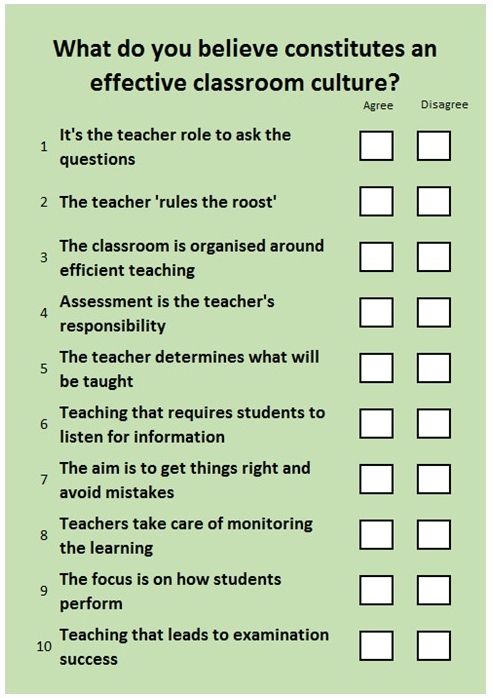
As a teacher in an age when the idea of direct instruction is, to some extent, being pitted against another important idea, self-regulation. Take a quick, and not too serious, look at some issues this debate raises.
Questionnaire
To tune you in to the current concerns about the role of the teacher take a quick look at this apparently simple quiz. Each statement uncovers a layer of debate about the role of a teacher and the culture of the classroom they manage. Think beyond your first reaction before deciding what the statement may be looking at and where you might currently stand.
We’ll look more deeply into these issues during session 2.
1c. Pre-session preparation: a booklet to print
The resource book captures the story of the session. It contains many of the presentation slides as well as important diagrams and interactive activities. It will act as a memory jogger into the future.
Resource book
Please download and print a copy of the Resource Book you will need for online session 2.
Download Resource BookBring the Resource Book with you to the session with your name on it…we have found people don’t like to lose their copy when they have carefully recorded information in it.
Session 2 Resource Book
2. How the session is organised
This second interactive training session is designed to introduce you to the idea of learning friendly classrooms and the role of the teacher in developing students’ learning behaviours. and some practical ideas to start things off. .
The session knits together research based inputs with interactive analytical activities. These serve to encourage you to consider your own teaching style, its impact in the classroom and what you might do to change this for the benefit of learning behaviours.
Session objectives
Our second session is designed to achieve the following objectives;
- become aware of four aspects of the Teachers’ palette framework
- recognise where you are now in building a learning friendly classroom
- become more aware of the strong link between how you teach and how students learn
- recognise how learning activities impact on students’ learning habits.
Session 2 Timetable
- x.00 Introduction and objectives
- x.05 Learning cultures. Input
- x.20 Where are we now? Group discussion
- x.3o Means and Ends of a new culture. Input
- x.40 Ends and school values Group discussion
- x.50 Practical ideas for classroom use Input
- x.10 Post session tasks (see details below)
- x.25 Session review
- x.30 Cheerio for now
3 Making the most of in-session group tasks
During this second session there are 3 types group discussions.
For the first two of these please assign a group member to distil the feedback/findings and report back on behalf of the group.
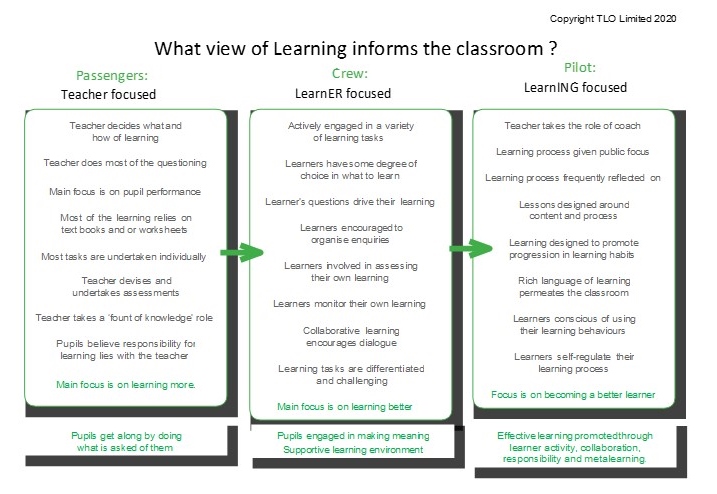
Culture 1 diagram. The first involves you considering where your classroom culture lies on the ‘teacher…learner….learning’ trajectory. This is a useful discussion with the addition of a quiz to help you. Many of you may never have thought in terms of these three very different classroom styles.
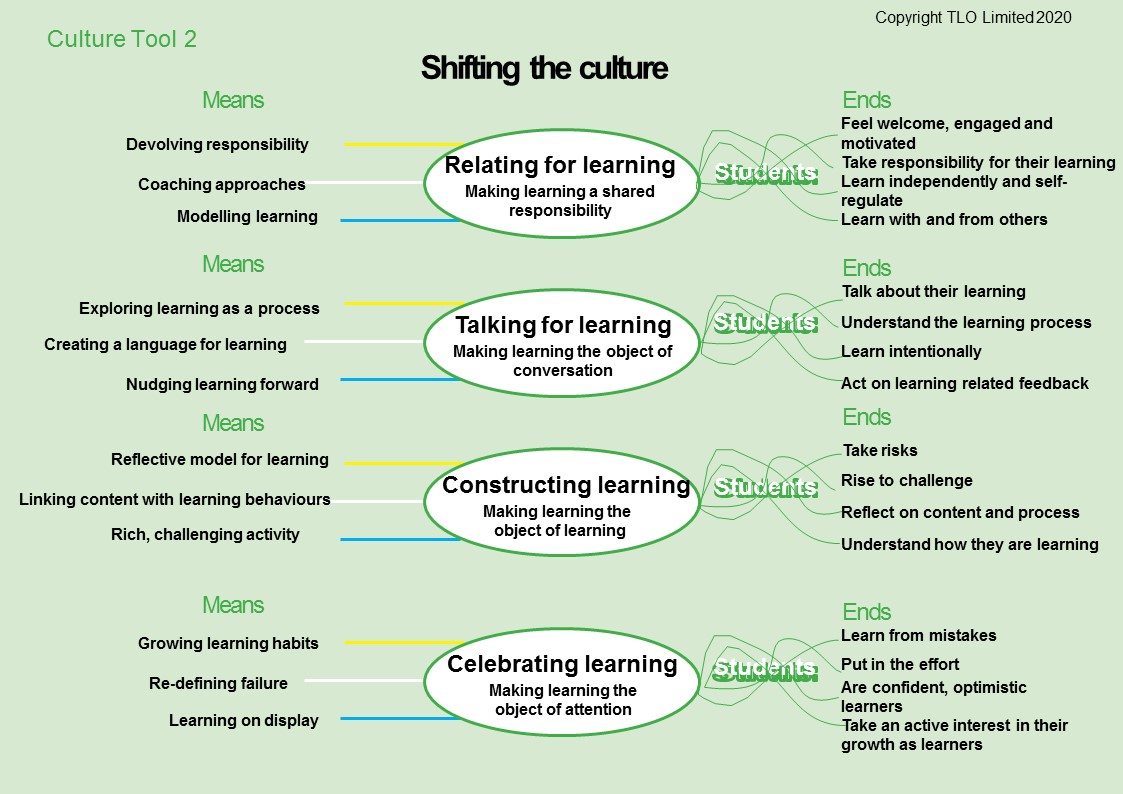
Culture 2 diagram. The second involves you in considering the type of shifts needed to make classrooms more learning focused. The point here is to think about the broad teacher behaviours that are needed and the resulting outcomes for students – i.e. the link between what you do as a teacher and the sort of learners this produces. The big message is …if we want students to change (the output) then teachers need to change their input; how they teach, not what they teach..
The third is best described as a short series of mini discussions with colleagues re. the ideas for developing classroom practice. The input on these ideas will break off every now and again to let you debate what you have just heard and add notes to your Resource book.
Gathering group feedback
Discussion 1: please discuss and feedback on;
- which panel has most statements highlighted in the Culture 1 tool?
- Does this square with how we have completed to quiz on pages x and y of the Resource book?
- which panel has least statements highlighted?
- what does that imply?
- would your students see it the same way?
- which statement in the middle panel would you most want to be able to highlight to make your classroom more learner friendly?
- OR
- what do you need to work on first in the right hand panel to make your classroom more learning friendly
Discussion 2 please discuss and feedback on;
- what do we understand by the ‘Ends” statements?
- which of these can we be confident of now?
- how does the school’s vision and policy for learning relate to/chime with these statements?
- where do we differ?
- what do we understand by the ‘Means / Input’ statements?
- which do we feel comfortable with?
- which do most of the group feel uncomfortable with?
- why might that be?
- which statement would you most like to be comfortable with?
This rich discussion will serve to show the importance of understanding, using and developing learning behaviours.
Discussion(s) 3 please discuss and make notes on in your Resource books
- the teaching ideas you are comfortable with
- whether they would fit with/ be useful for your students
- whether you would need to adapt the idea(s)
- Which idea you intend to use and perfect in your classroom over the coming weeks
5.Post session tasks: securing your learning
(To be tackled after session 2.)
Our intention here is to secure your learning from the online training session by relating the somewhat abstract ideas to what actually happens in the classroom. .
These two activities are designed to encourage you to work together as a team (or in several teams), to think about the materials collaboratively, to decide possible ways forward individually and collectively, and to support each other’s learning.
Activity 1
Promoting ‘unsticking’ throughout the school
Much has been said about ‘stuck prompts’ for classroom walls, however it’s important that you discuss the sort of stuck prompts you are using and to make sure the prompts become more stretching from year to year.
In other words stuck prompts need to grow up! What are you expecting of students in year one? How do those change by year two? How independent do you expect them to be by their last year in your school?
It’s a good idea to debate these issues as a whole staff over time because what appears on classroom walls will essentially indicate the school’s trajectory for independent learning; it implies how independent you expect learners to be at certain stages.
Have a go! You will keep coming back to refine and update these ideas as you learn more and expect more of your students as learners.

Activity 2
Getting your heads around what you want students to notice about their collaborative behaviours.
Task a.
- Look closely at the Revising learning mat on page 13 of your Resource book. Take note of the behaviours we want students to watch out during a lesson or a day. This mat virtually tells you about the revising behaviours we want students to move to in the next few months
- Now look at the simplified progression chart (page 11) and the Collaboration column in particular. Ask yourself what this simple column uncovers about collaboration
- Then, using a sense of what collaboration is about, use your ideas to complete a Collaboration learning mat for your students. What do they need to become aware of when they are working together in groups.
Task b.
- Which of the ideas you have selected for your class Collaboration learning mat should be adopted by the whole school so that everyone uses them ( i.e. they become part of your Learning and Teaching policy).
Task c.
- Over the coming weeks get used to looking at the changes you are making in your teaching and the impact on your students. It’s the best way of sustaining your development as a ‘learning power coach’.
- You might find it useful to start a Learning Journal to note down what you have been doing, what you’ve noticed and how students have reacted to the changes.
If you haven’t familiarised yourself with the online course yet here’s…
6…an overview of – ‘Playing the Learning Power game‘.
The course contains all the key elements you will need to introduce the values and activities of building your students’ learning power.
The course has 7 sections:
- What do we mean by learning power?
- Classroom relationships
- Talking about learning power
- Designing learning powered lessons
- Celebrating learning power
- How are our classrooms and learners developing?
- Where next?
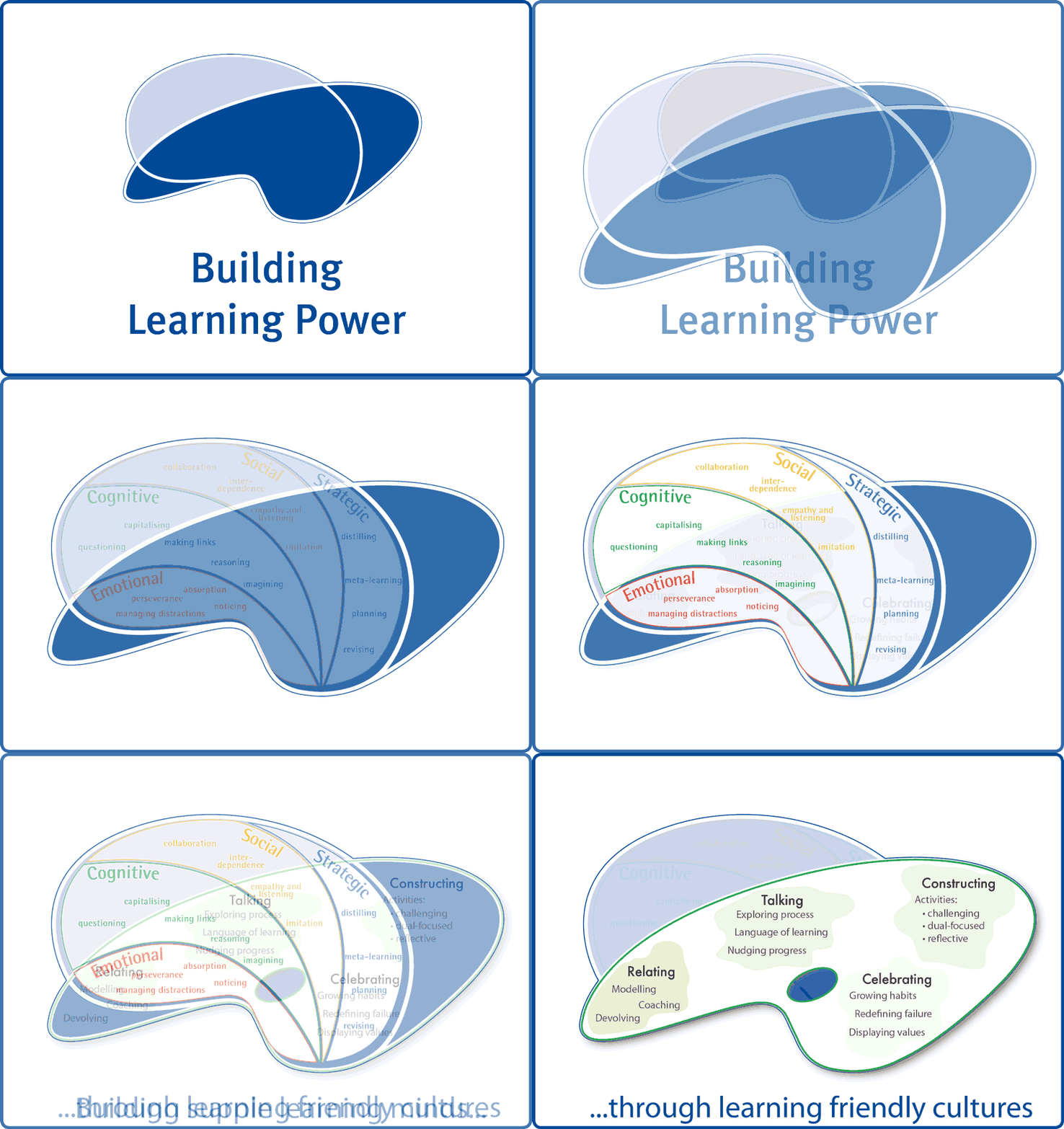
Read More detail about 'Playing the Learning Power game' course
How the course is designed
Sections 1–6…
have exactly the same structure in order to ease familiarity with the material and guard against getting lost. Each section deals with a key aspect of understanding learning power and has:
- an introduction to what it is about … take particular note of the key points
- part 1 aims to give you an idea of the sort of practice you are aiming for
- part 2 highlights the main ideas of the section’s content
- part 3 offers a few practical ideas to start things off
- part 4 broaches the idea of redesigning your practice and invites you to make a plan
The content of the course
Section 1 What do we mean by learning power?
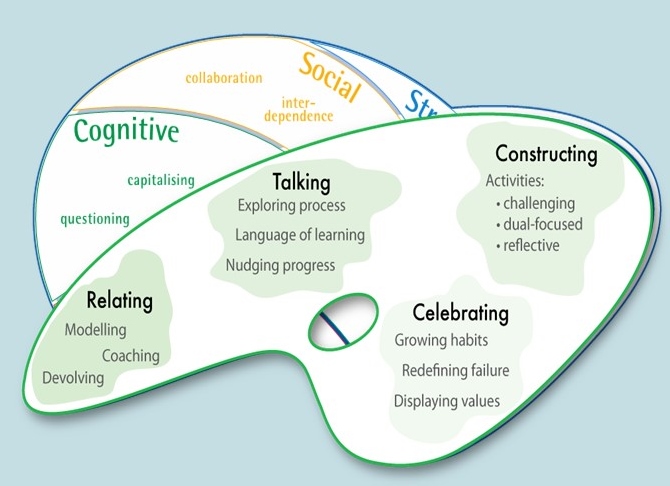
The underlying ideas, research and models
Here you will find:
- the two interlinking models of building better learners
- examples of how the models work in practice;
- the four learning behaviours to make a start on
- the essential aspects of classroom practice
- links with educational research
- encouragement to try things out with your learners
- suggestions for how amendments to your teaching will help students to be better learners
Section 2 Classroom relationships
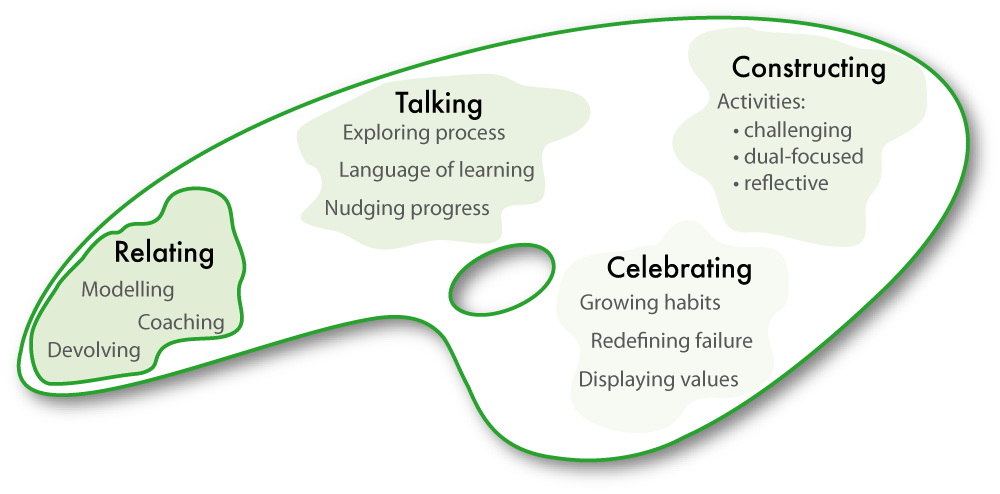
Important shifts in classroom roles
Here you will find:
- examples of the sort of responsibilities you might devolve to learners
- examples of different ways to be as a teacher
- modelling the process of learning
- acting as a coach; asking not telling
- enabling greater learner responsibility
- encouragement to try things out with your learners
- suggestions of ways to plan to expand devolving responsibility to students
Section 3 Talking about learning power
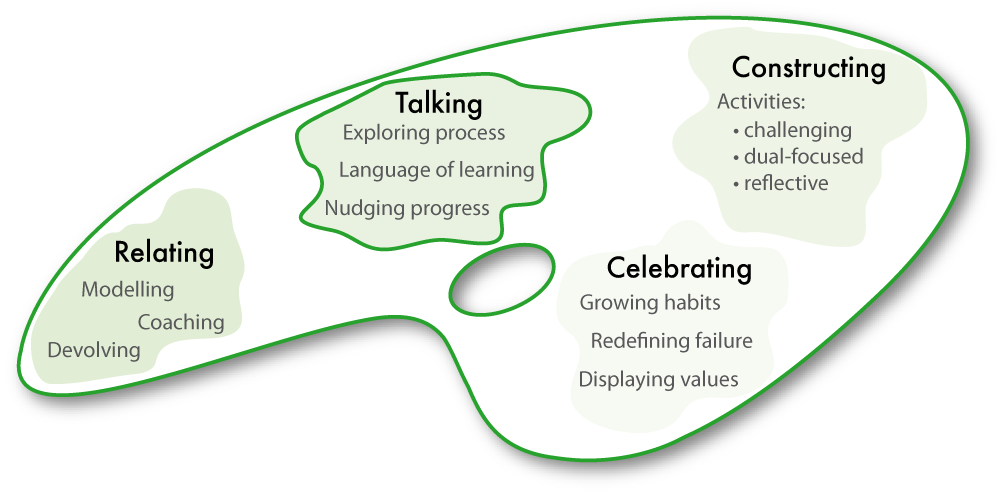 How and when to talk ‘learnish’.
Here you will find:
- examples of how learners can talk about learning
- examples of different ways to talk about learning
- nudging the process
- offering feedback
- encouraging reflective self-talk
- encouragement to try things out with your learners
- suggestions of ways to plan to expand your learning language
Section 4 Designing learning powered lessons
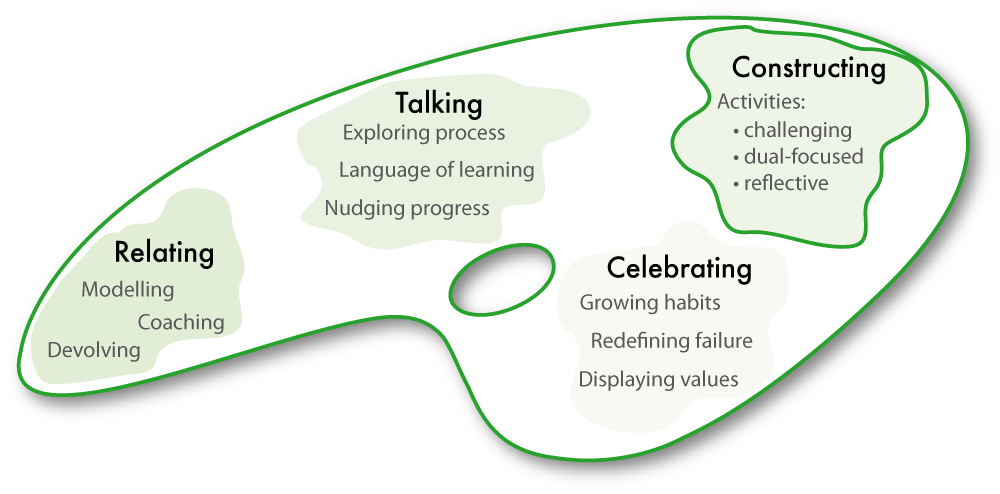 How to put dual-focused lessons together
Here you will find:
- explanations of the three fundamentals of dual focused lessons
- linking content and process
- rich and challenging activities
- building in reflection
- a format to assist designing dual-focused lessons
- an example maths lesson using the lesson design format
- activities to help start this journey
- examples from teachers in classrooms
Section 5 Celebrating learning power
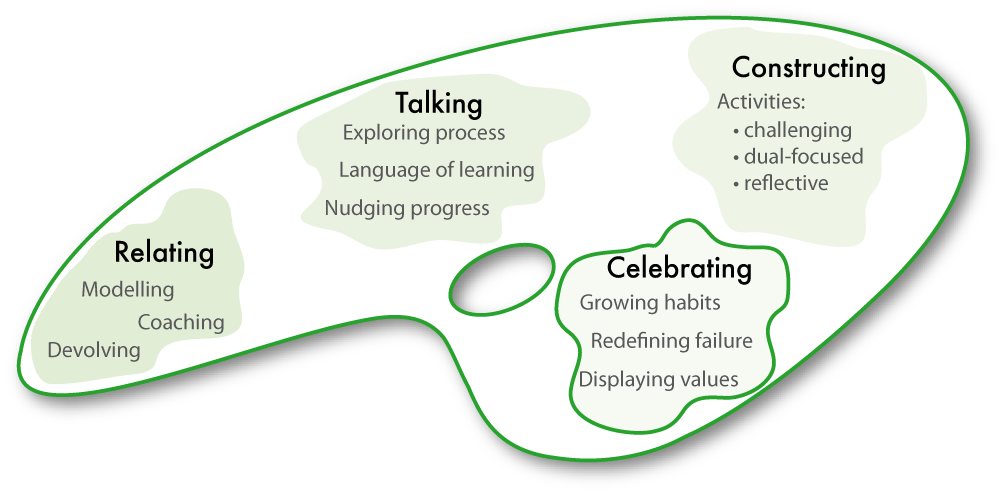 What’s seen as important in learning friendly classrooms
Here you will find:
- examples of how learners can celebrate their learning
- examples of different ways to celebrate learning
- in the growth of learning behaviours
- in re-defining failure
- in displays in the classroom
- encouragement to try things out with your learners
- suggestions of ways to plan to expand what you celebrate about learning
Section 6 How are our classrooms and learners developing?
Section 6a. How is my classroom culture developing?
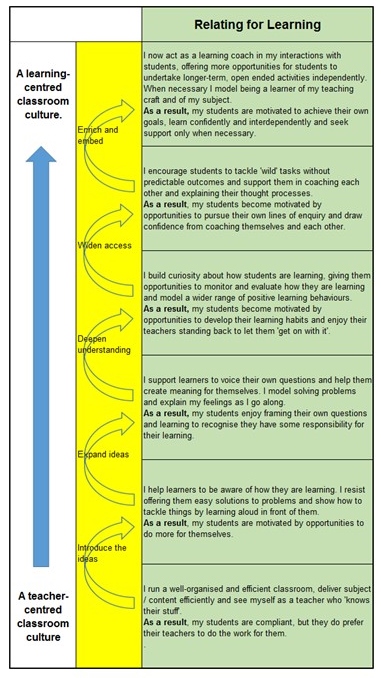 What to look for and record about your classroom culture
Here participants will find:
- Charts showing what the phases of teachers’ growth look like in relation to;
- relating
- talking
- constructing
- celebrating
- with links to the anticipated outcomes for learners
- ideas for developing further developing your classroom culture
- in order to create increasingly learning-friendly classrooms
Section 6b. How are my learners developing?
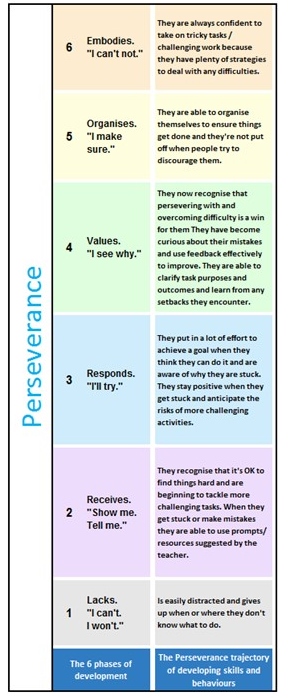 What to look for and record about better learning
Here participants will find:
- explanations of three aspects of progression – frequency, scope and skilfulness in use
- Charts showing what the phases of growth look like in relation to;
- perseverance
- questioning
- collaboration
- revising
- examples of things to try out with your learners
- ways of tracking the growth of learning dispositions over time
- suggestions of ways to plan to expand what you might track about learning
Section 7 Where now: where next?
Here you will find:


an opportunity to briefly reflect on what has been achieved across the school by taking on the blended learning programme ‘Playing the Learning Power Game’;
- descriptions of a broader set of modules that make up the next phase of the programme.
- brief explanations of why and how the next phase enables students to become better learners
Comments are closed.