
Unit 6. Building the habit of collaborating.
Welcome to Building Powerful Learners. This 8 unit online programme aims to enable teachers to:
- explore how learners might become not just better at learning but effective lifelong learners;
- engage learners consciously with the ideas and processes of their own learning.
The programme combines three ways of helping you to understand, play with and become skilled in developing your students’ learning power:
1 Read abouts…offering two types of information
- Read about A…essential must read text.
- Read about B…interesting, good to know, absorb when you can.
2 Find outs…tools to help you discover and analyse essential information.
3 Try outs…practical activities for you to try, check and perfect in your classroom.
Unit 6 explores the “how”of building collaboration.
- What are the key aspects of collaboration? (Essential Read about 1)
- How confident are my students now as collaborators? (Find out 1)
- How could I embed building collaboration into my teaching? (Find out 2)
- What sort of approaches may be useful in making a start on this? (Try out 1 to 5)
- How are my approaches working? Are they building confidence in collaborating? (Find out 3)
Structuring and using the ideas below with your students over the next month or so is your sixth step in becoming a skilled learning power practitioner.

Essential Read about 1
Unpacking Collaboration
A well formed habit of Collaboration involves being ready, willing, and able to:
- Work effectively with others towards agreed, common goals, acting flexibly in response to circumstances.
- Adopt different roles and responsibilities in pursuit of agreed goals and the well-being of the team.
- Hold and express opinions coherently, compromising and adapting when appropriate.
- Seek to understand what others are saying; sharing, challenging, supporting and building on ideas.
In short…
Collaboration: Having both the skills and the inclination to contribute positively to group work in order to learn productively with and from others.

Essential Read about 1. Introducing Collaboration ⬇️
The learning behaviour known as Collaboration
Collaboration involves knowing how to learn with others, as part of a team, in situations where no one person knows all parts of the puzzle. This complicated yet essential learning habit develops in several different ways. First of all it hinges on social interaction; how well we get on together, whether we are patient with others and respect their views. Then how we are able to bounce off others to build ideas; making the most of several brains rather than one. Next, how we learn to be part of a team and to perform different roles when needed. Fourthly, how we talk to ourselves about learning with others, where our real understanding of the process is revealed. Fifthly, how we contribute to the process of actually getting things done. Not just being there but doing something helpful. And lastly how we contribute to improving team performance by evaluating not just outcomes but the process of getting there.
In a learning context we have come to understand collaboration as being able to manage yourself effectively in the give and take of a collaborative venture, having a range of interpersonal skills that enable you to work and learn with and from others, being willing and able to contribute constructively and with sensitivity, and adding to and drawing strength from the team itself.
At its least sophisticated, it is little more than being cooperative. At its most sophisticated and complex levels it goes beyond learning ‘in a team’ and becomes learning ‘as a team’. It is an invaluable life skill.
Try outs 1-5 offer a range of things that you can do to strengthen and build your students’ inclination to learn with and from their peers.
Re-find out 1
Focus on the Collaborators in your class.
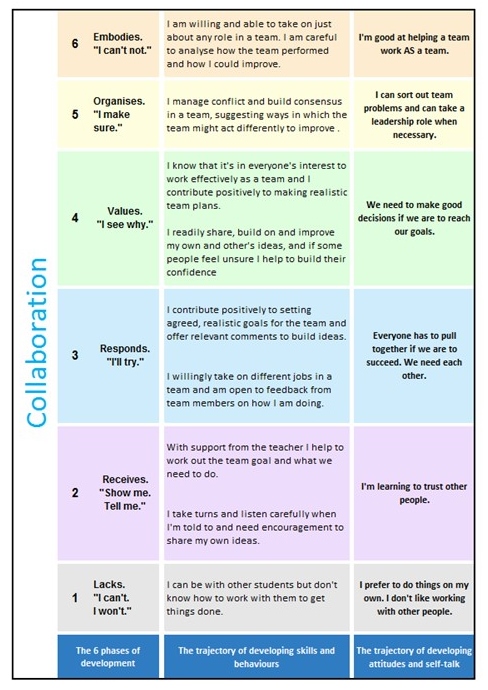
Just to get you tuned in – have a quick look back to what you discovered in Unit 3 about Collaboration in your class.
Through the lens of the Collaboration progression chart you should have a fairly clear view of the collaborative behaviours that your students do, and do not, currently exhibit.
- The majority of students may well display a similar set of positive behaviours (ie the majority may be in the purple/blue phase)
- You will also be conscious of some students who still lack positive behaviours (ie they are still firmly rooted in the grey/lacks phase of the progression chart)
- But some students will appear to have made more progress than the majority.
A word of warning.
While you may be tempted to focus your efforts on the majority for greatest impact, you’ll need to take care not to do so at the expense of your ‘grey’ students, as these are your potential underachievers and ‘group work terrorists’ in the future.
What to look for.
In Try Outs 1 to 5, look out for teaching ideas that you think will have the greatest impact on your particular group of learners. Don’t attempt to try all of the ideas – better to do a few thoroughly than to adopt a scattergun approach.
Growing Collaboration
A trajectory of developing behaviours, skills, attitudes and self-talk
Find out 2
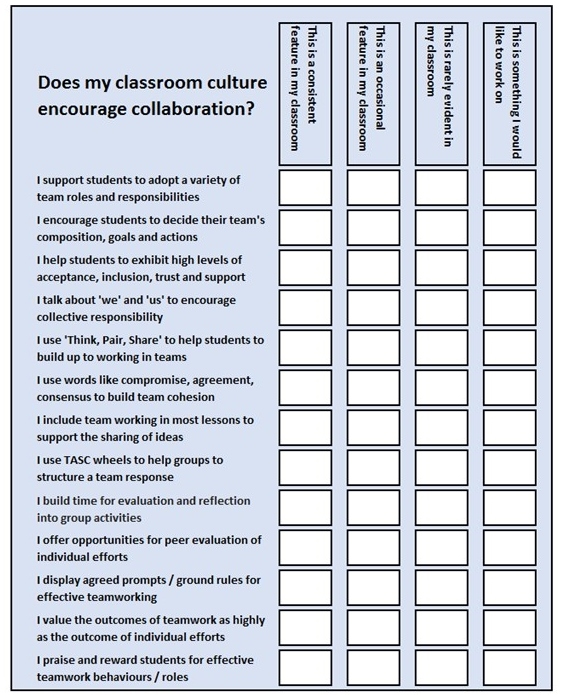
How much does my classroom culture encourage Collaboration?
Culture is the curriculum of the classroom, frequently hidden from the external observer, but always all too evident to learners. It is the minute by minute, hour by hour, day by day way that learners come to understand their role as a learner. Culture is the enacted values of the teacher, not the espoused ones – it is the shadow that the teacher casts in the classroom in terms of what they do do and what they do not do, what they say and do not say, what they believe and do not believe, what they value and do not value.
Here is a selection of features that might begin to shape the emotional climate of your classroom to encourage collaboration.
Download and print a copy.
Reflect on your current classroom culture. Which of the features of the collaboration-friendly classroom are:
- already a consistent feature of your classroom?
- an occasional feature of your classroom?
- rarely evident in your classroom?
And, which of these features are you interested in further developing?
Take your completed sheet to the end of the unit meeting, but in the meantime have an informal chat with some colleagues. Is anyone already making progress with one of the features you would like to work on? Do you have any consistent features that others might learn from?
Try out 1
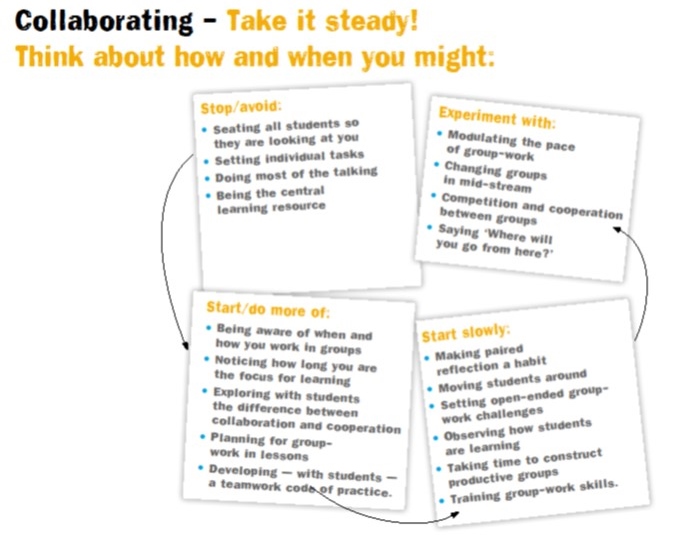
A range of little culture shifts
Have a think about your current classroom culture in relation to collaboration.
Begin with the ‘stop/avoid’ box – if any of these teaching behaviours are still in evidence in your classroom it would be worth thinking through how they can be eliminated, since failure to do so will undermine the changes you are hoping to achieve for your learners.
Then cast your eye over the other 3 boxes. Which ideas appeal to you? Which do you think will have the greatest impact on your students?
Now seek out teaching ideas below in Try Outs 2/3/4/5 that you can use to move your classroom culture forward.
Try Out 2 focuses on ideas for moving responsibility towards learners (Relating);
Try Out 3 focuses on developing a learning language for collaboration (Talking);
Try Out 4 focuses on how lessons/activities can be designed to activate collaboration (Constructing);
Try Out 5 focuses on how collaboration can be rewarded / praised / celebrated (Celebrating).
Try out 2
The start of working together
Use the Visible Thinking Routine ‘Think Pair Share’
The basic building block of collaboration is pair work. Through brief and focused conversations, peers get the opportunity to voice their thoughts and start a dialogue about them. TPS is a well-known strategy for ensuring that students build up to learning in a team. One way of using this might be to:
- Pose a question or problem, give pupils 1 minute to think individually about their own personal response;
- give 2 minutes in pairs to compare their first reactions with a partner;
- give fours 3 minutes to share their views in a group.
Use as a simple strategy to prepare students for working together in teams.
Read more about Think Pair Share from the VTR website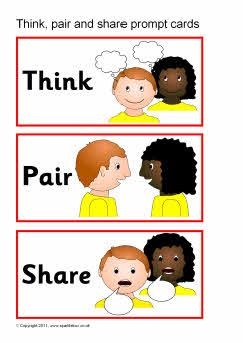
Two more ideas for extending students' responsibilities. ⬇️
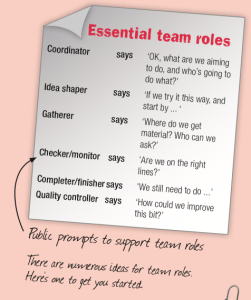
Start slowly with team roles
Introduce students to a few essential team roles, for example.
- Coordinator
- Resource gatherer
- Completer/Finisher
There are many ideas for team roles.
Visit:
- https://en.wikipedia.org/wiki/Team_Role_Inventories#Belbin_Team_roles
- https://www.kaganonline.com/free_articles/
Think we need a better and up to date reference here ( just simple role definitions)
Ground rules for resolving conflicts
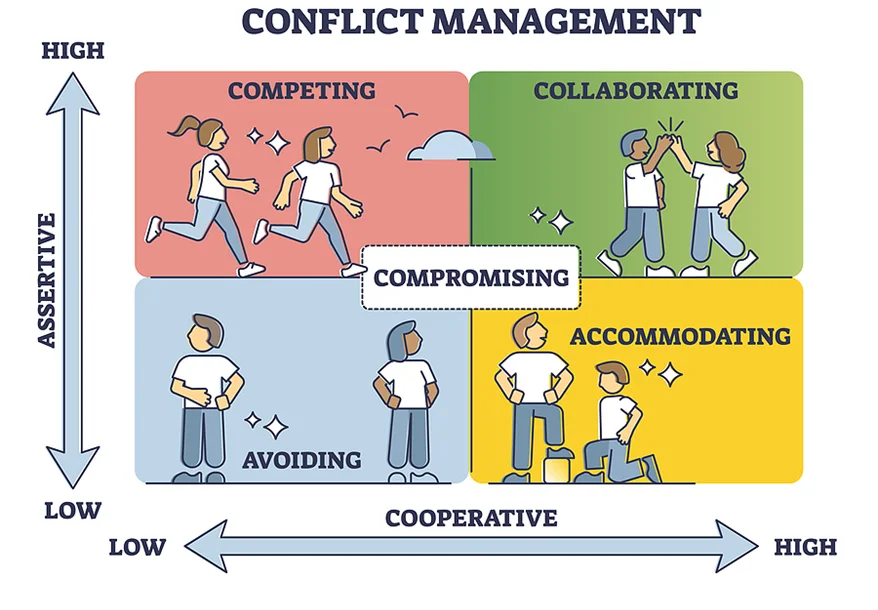
As students become used to working together it’s wise to agree with your class a routine to be followed when conflict arises; ground rules for how students should behave. This could form the basis of a display to help students to remember what they have signed up to do.
You might end up with a variation on
Resolving Conflicts – Without Fighting
- STOP Don’t let the conflict escalate.
- SAY What the conflict is about.
- SAY What each of us want.
- THINK of positive things we could do.
- CHOOSE a positive option that all of us can agree on.
- ASK someone for help if we can’t agree
Ground Rules
- Listen to each other, try to understand how others feel
- Take turns, don’t interrupt
- Say how you feel and be truthful
- Brains, not hands
Try out 3
Build collaboration using a learning language
Teacher talk – as a learning coach
- Choose different groups today so that you work with different people.
- Who is going to be responsible for how the team gets on?
- Time to check you are on the right lines.
- Are you making the most of everybody’s talents?
- How will you / did you help your team?
- Have you worked together to discover what this task/problem is about?
- How can you / did you help to get everyone more involved?
- Will you / did you contribute your own ideas and listen to the ideas of others?
- How will you find a way to agree / make a decision?
- How and why was your team successful?

Two more teacher talk ideas ⬇️
Teacher talk
Introducing the idea of different roles in a group
- What sorts of jobs are there to do in a team?
- How can we each do a special job to help get things done?
- What is your role going to be?
- I would like you to be the ……today
- What does the ……(role)… do in /for the team?
- What will you do to make a contribution to the team ?
- What else needs doing, and who will do it ?
- You don’t all have to do the same thing !

Talk for agreeing relevant goals
- What do we think we have to do?
- What’s this task really about?
- What are we trying to end up with?
- What will that look like?
- How will we know we have been successful?
- Which is the best idea so far?
- So, what is our goal?
- Does this goal sound do-able/worthwhile/right for us?
- What do we need to do together?
- How will you agree what needs to be done?
- What will the end product be?
- Does/will that answer the question / solve the problem

Try out 4
Build collaboration into lesson design
It is through learning activities that learning behaviours get a workout. Their role is to enable your students to access and wrestle with information and ideas; to help them use and understand something; to ensure their effectiveness as a learner. The ‘right’ activity helps to make new concepts more concrete. The ‘right’ activity provides insights into new ideas and subject matter. The ‘right’ activities need to be carefully chosen and, critically, linked to the learning goal.
Pizza the action; working out what’s to be done.
Provide each team member with a piece of ‘pizza’, plus have one spare. Ask students to write their own ideas or responses or solutions or questions or answers etc on their own piece. Once complete, the pizza is assembled and the team together distil their thinking and complete the final piece of the pizza. Display either each team’s pizza, or the distilled pieces from all teams to form a composite view.
Alternatively the groups could be formed after students have completed their personal ‘pizza’ piece. You then form groups deliberately putting students with opposing ideas into the same group, thereby creating the need for seeking consensus.
Alternatively, the teacher could form groups of like-minded students, so that when it comes to forming the composite class view there are polarised group views that need to be accommodated.
This illustrates an important and occasionally neglected aspect of group work – minor shifts in how you handle the activity can impact significantly on the teamworking behaviours that it activates.
Consider how you can deliberately adapt team-working strategies that you currently use in order to build in disagreement and the need for resolving it through seeking consensus.
Teacher talk to support the task
- What do we think we have to do?
- What’s this task really about?
- What are we trying to end up with?
- What will that look like?
- What will the end product be ?
- Does/will that answer the question / solve the problem?

Two more lesson design ideas ⬇️
Building on others’ ideas
Prepare the way for students to build on the ideas of others when working in a group by making ‘ABC’ a routine that you use during whole-class teaching. Once a student has answered a question, ask another student to Add to it, to Build on it, to Challenge it, to Defend it, to Elaborate on it, or to Find a Flaw in it. As easy as ABC! This improves students’ listening skills at the same time!

Teacher talk
- Can you add your ideas to this?
- What can you add to what xxx said?
- Who can build on xxx’s idea?
- Can we make that a bigger idea/expand it?
- Do we need to think smaller?
Offer tools to help guide groups in tackling problem based learning
Offer students choices in what to learn and increase their opportunities to contribute, co-design or co-deliver and pursue their own necessary improvements in learning behaviours in appropriate areas of the curriculum.
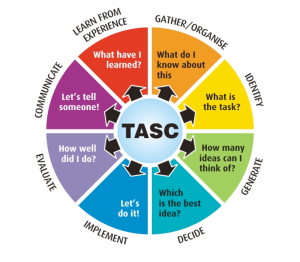
A graphic organiser that is much used in primary schools to help students to plan their approach to an investigation or problem. The TASC wheel, derived from Thinking Actively in a Social Context, is a framework that helps develop thinking and problem-solving skills. With TASC, learners can think through a problem to the best outcome – and understand why it’s the best outcome.
TASC will guide groups through the stages of thinking and problem-solving in an organised way, starting at one o’clock working clockwise. If you have a complex or wide-ranging problem you want to tackle, it offers a means of organising and synthesising a range of ideas.
Much like PEE (Point / Evidence / Explain) that helps students to structure a paragraph, the TASC wheel gives a simple way of helping groups to sequence what they do to undertake an investigation.
Try out 5
Celebrate improvements in collaboration.
Learn from the data…how to build collaboration
Of course it’s a good idea to celebrate growth in collaboration but what do you know about what is getting better or what else needs to be improved. It’s a good idea to collect data both before you begin concentrating on collaboration because using the same data collection method later provides fascinating information and what to celebrate. The impact of improvements in collaboration.
Read how teachers in Cumbria explored Collaboration with their students.
See toggle box below.
Understanding what you are celebrating in growing collaboration ⬇️
How children were empowered to take control of their learning, by investigating effective strategies for collaboration.
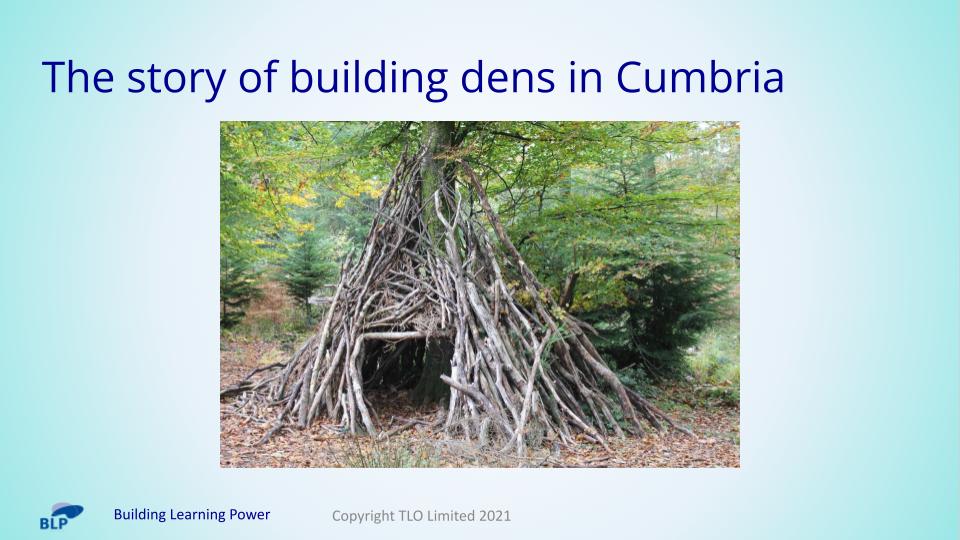
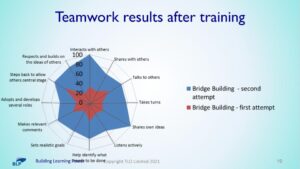
Three primary schools in Cumbria determined to enable their students to improve their collaborative behaviours. The children were taken out to build dens in the woods. Their teachers observed the collaborative den building carefully using the collaboration wheel shown here.
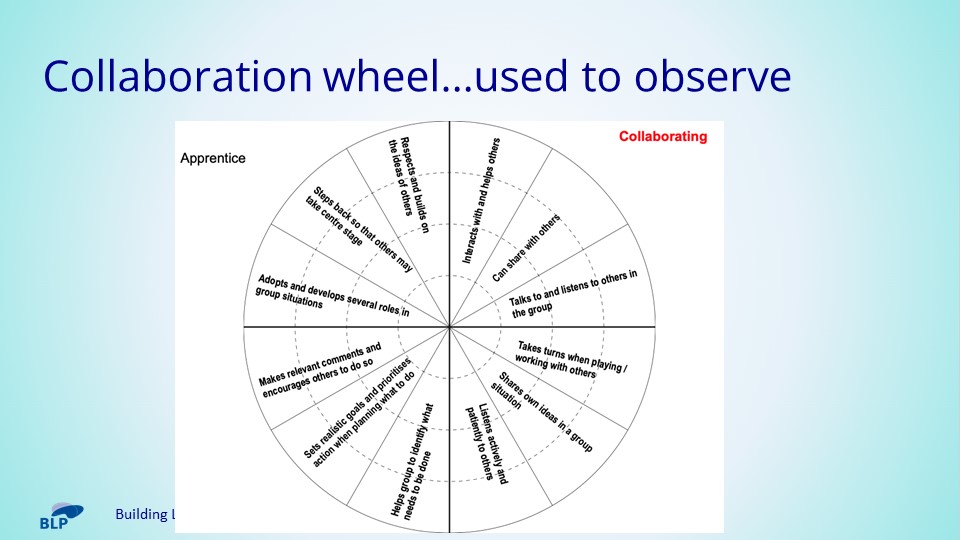
Teachers’ were surprised when their 7–10 year olds not only failed in their den-building task, but became ill-tempered and sullen. As the teachers observed and recorded students’ behaviours they were ‘quite shocked’. The problem — the students just didn’t know how to work together effectively: their collaborative skills were near rock-bottom.
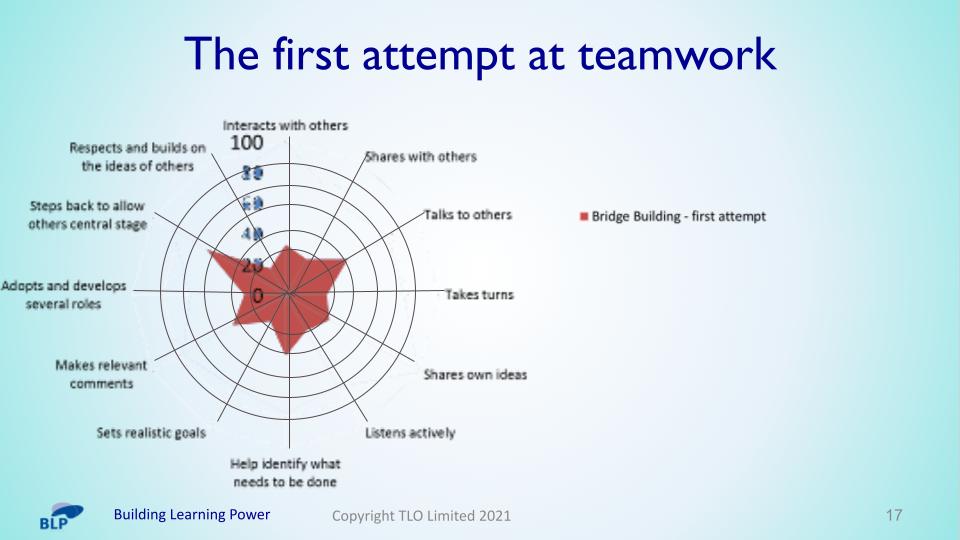
The teachers charted how much the students used behaviours such as taking turns, making a plan, sharing ideas, helping others, listening actively, identifying what the task calls for, setting realistic goals, and so on. The data revealed that students were poor at listening actively, sharing and building ideas, and setting realistic goals. Hence the dens were, as the students themselves said, ‘rubbish’.
Over the next six weeks, the schools worked with their students on collaborative skills. Classes generated lists of good collaborative skills and talked about how those help to get things done. They made wall displays, took part in collaborative learning challenges with minimal adult intervention, and the rich and sophisticated language of teamwork became everyday classroom talk.
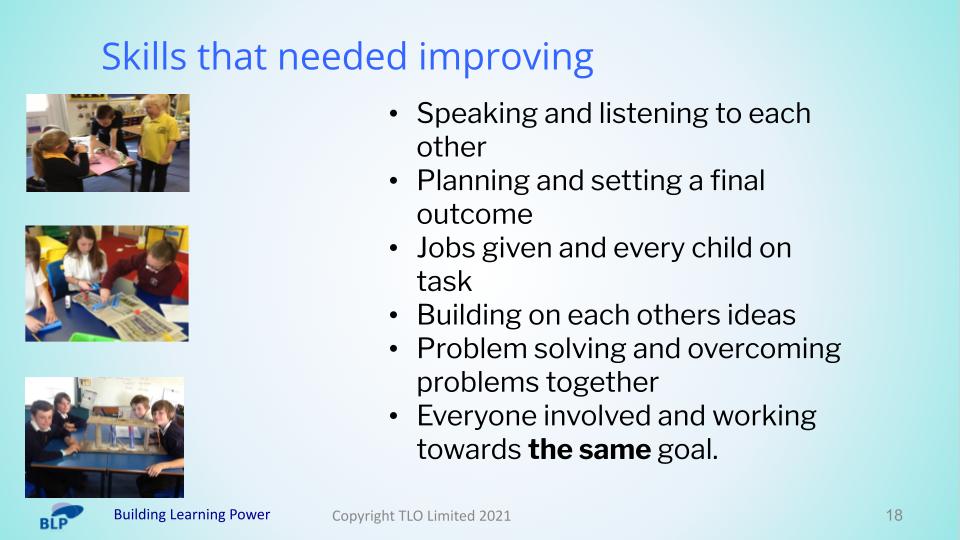
Learning challenges involved things like building bridges with newspaper and cardboard and designing and baking cakes.
Over the course of those six weeks, working through at least two significant collaborative learning challenges a week, the students were found to be taking more responsibility for their own learning. They became very aware of the importance of planning and of listening to others. As time went on they relied less on adult guidance and were far more prepared to persist when things went wrong.
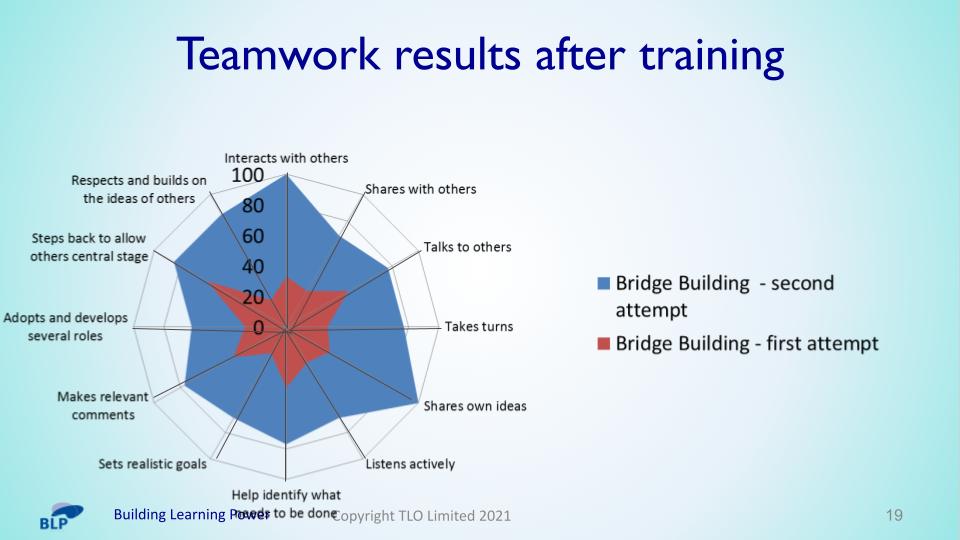
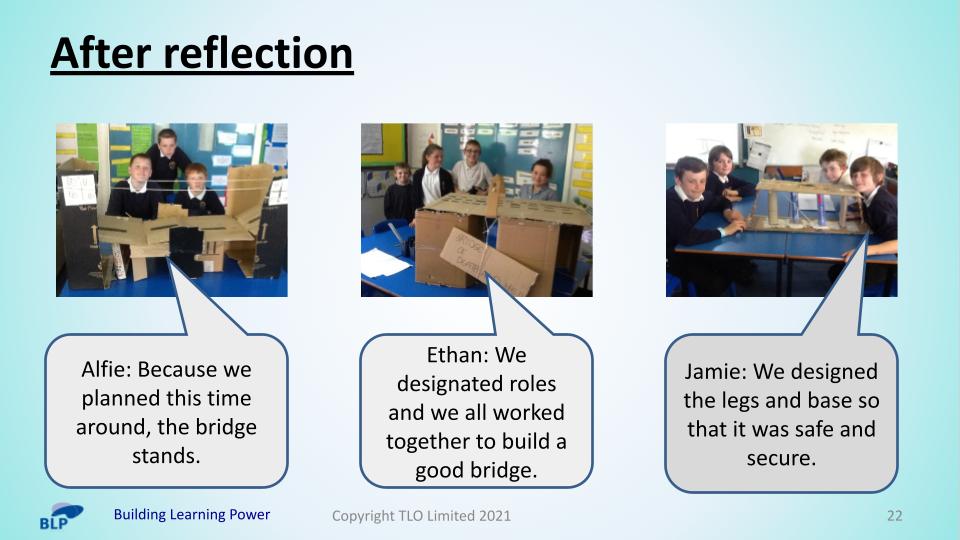
Those students who built bridges from ‘junk’ material, for example, made huge improvements between their first and second attempts. They were proud of their success and, importantly, were able to make the connection between the behaviours they had used and their success. As Alfie said, ‘Because we planned this time round, the bridge stands.’
This learning power research has had many other positive and influential effects on teaching and learning.
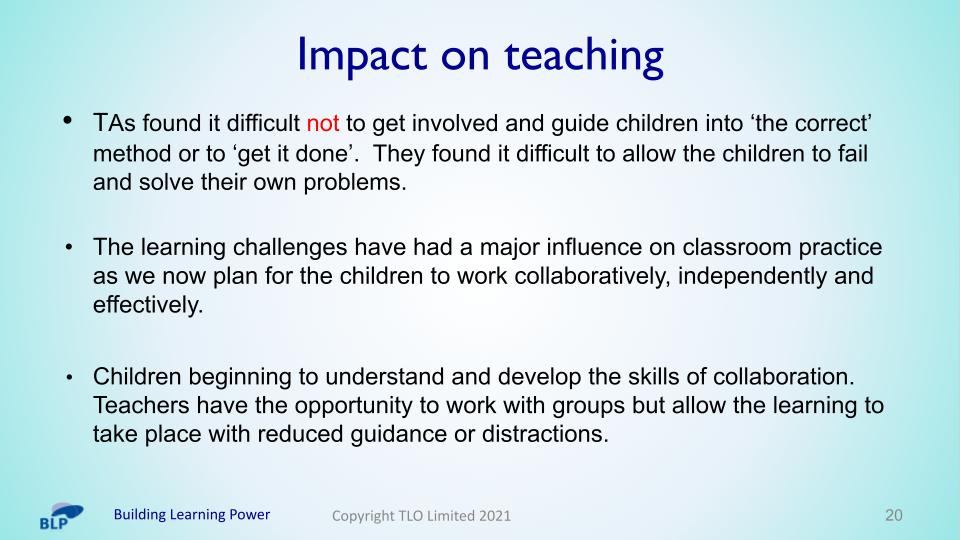
- Yes, the children’s collaborative skills shot up, and have been sustained;
- They now initiate their own collaborative learning tasks;
- The challenges enabled them to show their creativity and take risks;
- They now guide their own learning and take charge of their own progress;
- They are highly motivated even to the point of asking for collaborative challenges instead of ‘extra play’ as a treat for best class attendance!
It’s when children recognise that their behaviour has a real impact on their success that building learning power really takes off.
How do you think your students would take to a collaborative exercise? How could you measure your students’ collaborative skills?
Find out 3
Helping your students to Find Out about their own collaborative behaviours
At the end of a group task, the whole group reflects together on how they functioned as a group and agree a development target. Choose the review tool that best fits your students’ current collaborative behaviours:
Download as a pdf – Emerging collaboration Download as a pdf – Developing collaboration Download as a pdf – Secure collaboration
Learning together. Meeting 6
Unit 6 Suggested meeting agenda
- Decide what you want this meeting to achieve (5 mins)
- Discuss what you have found out about students use of collaboration (15 mins)
- Re-cap and reflect on the action you have each undertaken in your classrooms (20 mins)
- Consider issues that would be beneficial if implemented across the school (10 mins)
- Review how the meeting format went (5 mins)

Learning Team Meeting 6 Agenda ⬇️
Item 1. Meeting Objectives. (5 mins)
Meeting objectives might include:
- discuss levels of collaboration displayed across the school
- share and learn from what we have each tried in our classrooms;
- feel confident about taking forward ideas from online materials into our practice;
- identify actions that would be more useful if everyone applied them in their practice;
Outcome. To have decided what the meeting should aim to achieve.

Item 2. Discussion about learning culture (15 mins)
Explore together your discoveries about your students as collaborators;
- what did you find out about your students as collaborators? (Find out 1)
- are students improving as collaborators with age? Moving from grey to purple to blue etc?
- where did we each estimate our classroom to be in terms of its culture Find out 2?
- what did we each learn from Find out 2.
- which 3 are the weakest features
- which 3 actions are our strongest
- what surprised or baffled you
- are there significant differences between year groups
Outcome. A clearer understanding of students as collaborators and the extent to which our classroom cultures are set up to support and develop effective collaboration.
Item 3. Explore action using the initial Try outs (20 mins)
Share and discuss the action you each took in making a start on strengthening collaboration in classroom practice.
- Which of the suggestions did you each use?
- Any concerns about or difficulties in putting the Try outs into action.
- Which seemed the most valid or successful.
- How the Try Outs affected different age groups.
- Ways of implementing these that we can all learn from and adopt.
Outcome. A clear picture of our interest in and enthusiasm for amending classroom cultures to support learning to learn. A feel for which are proving to be most effective and why. Would any of these culture shifts call for action on current school wide policies?
Item 4. Learning from practice (10 mins)
In relation to all the shades of practice you have been trying out, sharing, mulling over and observing using Find out 3, think about them now in two ways;
1. personally and 2. school wide.
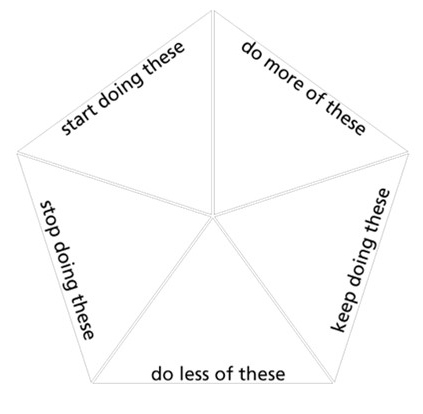
Which ideas/practice stand out as:
- things you want to start doing
- things you think you need to stop doing (that’s harder)
- things you want to keep doing
- things you want to do more often
- things you want to do less
Outcome.
- At this stage it’s essential to note ideas arising from this discussion using 2 pentagon diagrams;
- one for each team member personally and
- one for decisions/suggestions that are school wide.
- Ensure that your school/group wide pentagon is shared with senior leaders.
Item 5. Evaluate team session. (5 mins)
- Did we achieve our objectives?
- Are we comfortable with what we are trying to achieve so far?
- Any concerns at this point?
- Next meeting date and time.
==================================
Essential Read about
Introducing
lhs
pic
Essential Read about
Why all this matters
lhs pic
Find out 1
Look at yourself as a learner.
lhs
pic
Find out 2
Look at
lhs
pic
Extended Read about
The
lhs pic
Try out 1
xxx
pic
Try out 2
Text for col 1 …
pic
Try out 3
Text for col 1 …
pic
Try out 4
Text for col 1 …
pic
Try out 5
Text for col 1 …
pic
Find out 3
Text for col 1 …
pic
Learning together meeting 6
Unit 6 Suggested meeting agenda
- Decide what you want this meeting to achieve (5 mins)
- Discuss what you have found out about students use of collaboration (15 mins)
- Re-cap and reflect on the action you have each undertaken in your classrooms (20 mins)
- Consider issues that could or should be implemented across the school (10 mins)
- Review how the meeting format went (5 mins)
Item 1. Meeting Objectives. (5 mins)
Meeting objectives might include:
- share and learn from what we have each tried in our classrooms;
- feel confident about taking forward ideas from online materials into our practice;
- identify actions that would be more useful if everyone applied them in their practice;
- plan further personal developments in classroom practice.
Outcome. To have decided what the meeting should aim to achieve.
Item 2. Discussion about learning culture (15 mins)
Explore together your reaction to The Teachers’ Palette classroom culture model and discoveries about yourself and your students as learners
- what were our first impressions of Unit 2?
- where did we each estimate the school was in terms of the Culture Tool 1/Find out 1?
- what did you find out about yourself as a teacher (Find out 1)
- what did we each learn from using Culture Tool 2.
- which 3 of the teacher actions do we tend not to use
- which 3 teacher actions are our strongest
- what surprised or baffled you
- are there significant differences between year groups
Outcome. A clearer understanding of the thinking behind the idea of a learning culture, the teacher’s role in creating it and where we are as a school.

Item 3. Explore action using the initial Try outs (20 mins)
Share and discuss the action you each took in making a start on developing a learning culture
- Which of the suggestions did you each use?
- Any concerns about or difficulties in putting the Try outs into action.
- The impact of these actions. See Find out 3.
- Which seemed the most valid or successful.
- How the Try Outs affected different age groups.
- Ways of implementing these that we can all learn from and adopt.
Outcome. A clear picture of our interest in and enthusiasm for amending classroom cultures to support learning to learn. A feel for which are proving to be most effective and why. Will any of these culture shifts call for action on current school wide policies? i.e. how we all treat mistakes, being stuck and praise.
Item 4. Learning from practice (10 mins)
In relation to all the shades of practice you have been trying out, sharing, mulling over and observing using Find out 3, think about them now in two ways;
1. personally and 2. school wide.
Which ideas/practice stand out as:
- things you want to start doing
- things you think you need to stop doing (that’s harder)
- things you want to keep doing
- things you want to do more often
- things you want to do less
Outcome.
- At this stage it’s valuable to note ideas arising from this discussion using 2 pentagon diagrams;
- one for each team member personally and
- one for decisions/suggestions that are school wide.
- Ensure that your school/group wide pentagon is shared with senior leaders.
Item 5. Evaluate team session. (5 mins)
- Did we achieve our objectives?
- Are we comfortable with what we are trying to achieve so far?
- Any concerns at this point?
- Next meeting date and time.
[/toggle] [/twocol_one]
Comments are closed.