

Building a classroom culture that supports students to learn about learning
Welcome to Building Powerful Learners Phase 2. This four unit online programme looks at how your development as a teacher can enable and strengthen the development of a learning-friendly classroom culture.
The programme combines three types of action to help you to experiment, analyse and understand how you can create an increasingly learning-friendly classroom culture.
1 Understand by using Read abouts…of which there are two types
- Essential Read …essential must read text.
- Extended Read …interesting, good to know, absorb when you can.
2 Analyse by using Find outs…tools to help you discover and analyse essential information.
3 Experiment with Try outs…practical activities for you to try, check and perfect in your classroom.
This unit explores how your development can create a classroom culture to develop students’ ability to learn from their own learning.
- What are the key aspects of Constructing Learning? (Essential and Extended Read about 1)
- With regards to constructing learning, is my classroom currently more teacher focused, or more learning focused? (Find out 1)
- How are my students responding to the changes I have made in my classroom culture? (Find out 2)
- What sort of approaches will be useful in moving this forward? (Try out 1 to 4)
- Take a deeper look at the anticipated outcomes for learners of developing a constructing-friendly classroom culture (Find out 3)
- Find out about 8 further learning behaviours that will, in time, be added to the key behaviours of Perseverance, Questioning, Collaborating and Revising (Find Out 4)
Structuring and using the ideas below in your classroom over the next few months or so will edge your classroom culture towards supporting students to learn about learning.
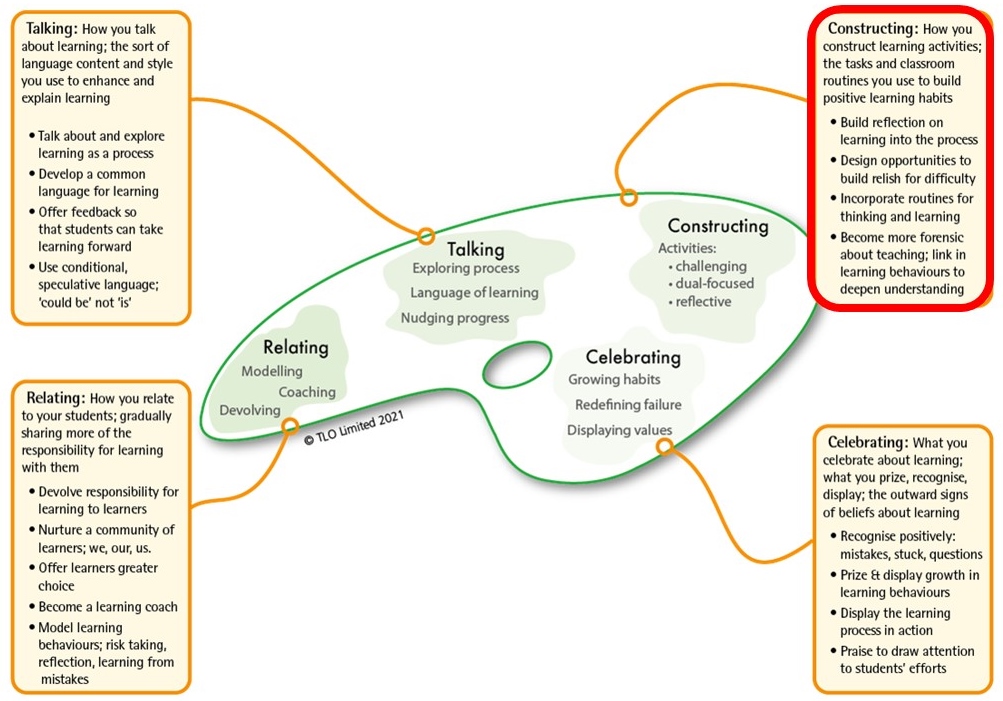
Essential Read about 1
Unpacking Constructing Learning
From this…
In most classrooms responsibility for organising learning rests almost exclusively with the teacher. It’s the teacher who decides the what and how of learning, and undertakes its review. The main focus is on student performance and many tasks are undertaken individually. Hence in these classrooms it’s the teacher who assumes responsibility for assessment and adopts a ‘fount of knowledge’ role. So it is that students come to believe and accept that responsibility for learning lies with their teacher and hence become increasingly dependent on them.
But does it have to be like this? What if learners are enabled to understand how to learn and take responsibility for their own learning? How would the management and organisation of the curriculum and individual lessons change?
To this…
Gradually enabling students to take responsibility for their own learning involves careful orchestration of how learning is organised; where activities are designed to stretch and challenge not just in outcome terms but in the very nature of ‘doing’ a task. Students’ emotional engagement is a prerequisite when learning is organised in these ways, and the value of learning is in pushing yourself so that your capacities are stretched and strengthened.
For many students, the word ‘learning’ means ‘knowing / remembering stuff”. The cultural shift to learning about learning, or making learning the object of attention, is about understanding how they are learning as well as what they are learning.
In short:
- Make learning, rather than performance, the object of exercise;
- Build reflecting on, and reviewing learning into the learning model used in the classroom;
- Design learning activities to stretch and challenge students’ use of their learning behaviours;
- Make conscious choices about which learning behaviours to introduce and couple these with content to make lessons more interesting and challenging;
- Add a third dimension to teaching: 1. Subject matter, 2. Assessment, plus 3. The learning behaviours being used in order to learn.
Extended Read about Constructing Learning. ⬇️
The three aspects of constructing learning:
- Linking learning behaviours with lesson content;
- Offering rich and challenging activities;
- Building reflection on both content and learning behaviours into lessons.
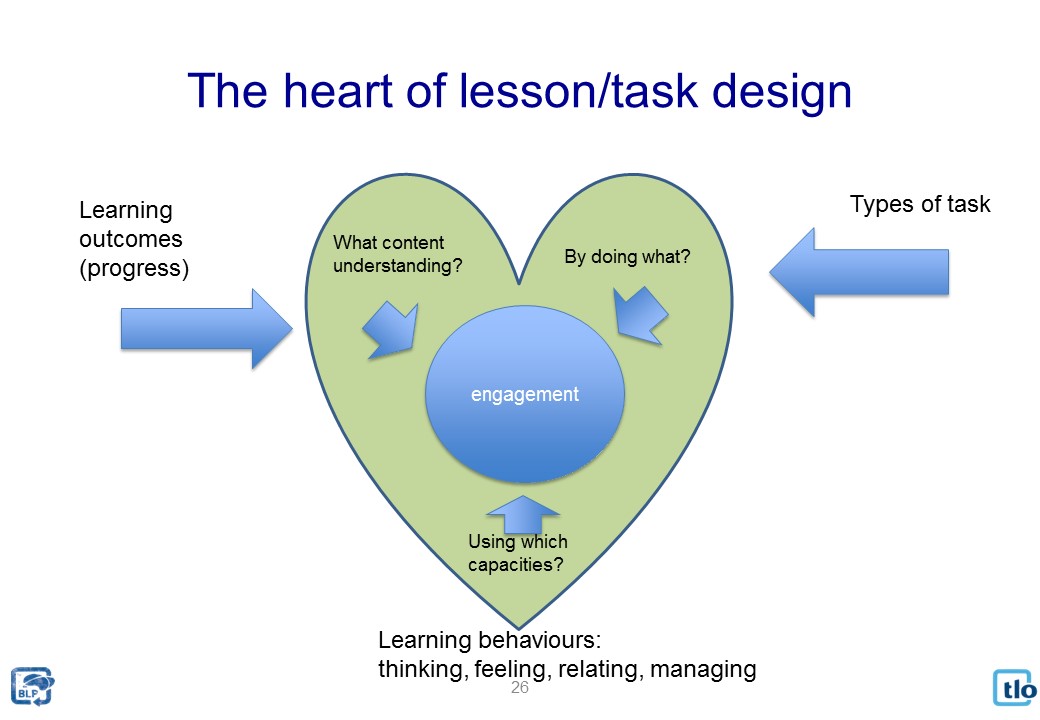
Aspect 1: Lessons with a dual focus – lessons are designed intentionally to deliver content and to exercise learning behaviours, and students are made aware of both. The learning behaviours drive the content acquisition, the content is the exercise regime for the learning behaviours, each enhancing the other.
Linking content with learning behaviours
 Whether we realise it or not, all lessons have a dual purpose:
- The content dimension, with material to be mastered
- The ‘epistemic’ dimension, with some learning skills and habits being exercised.
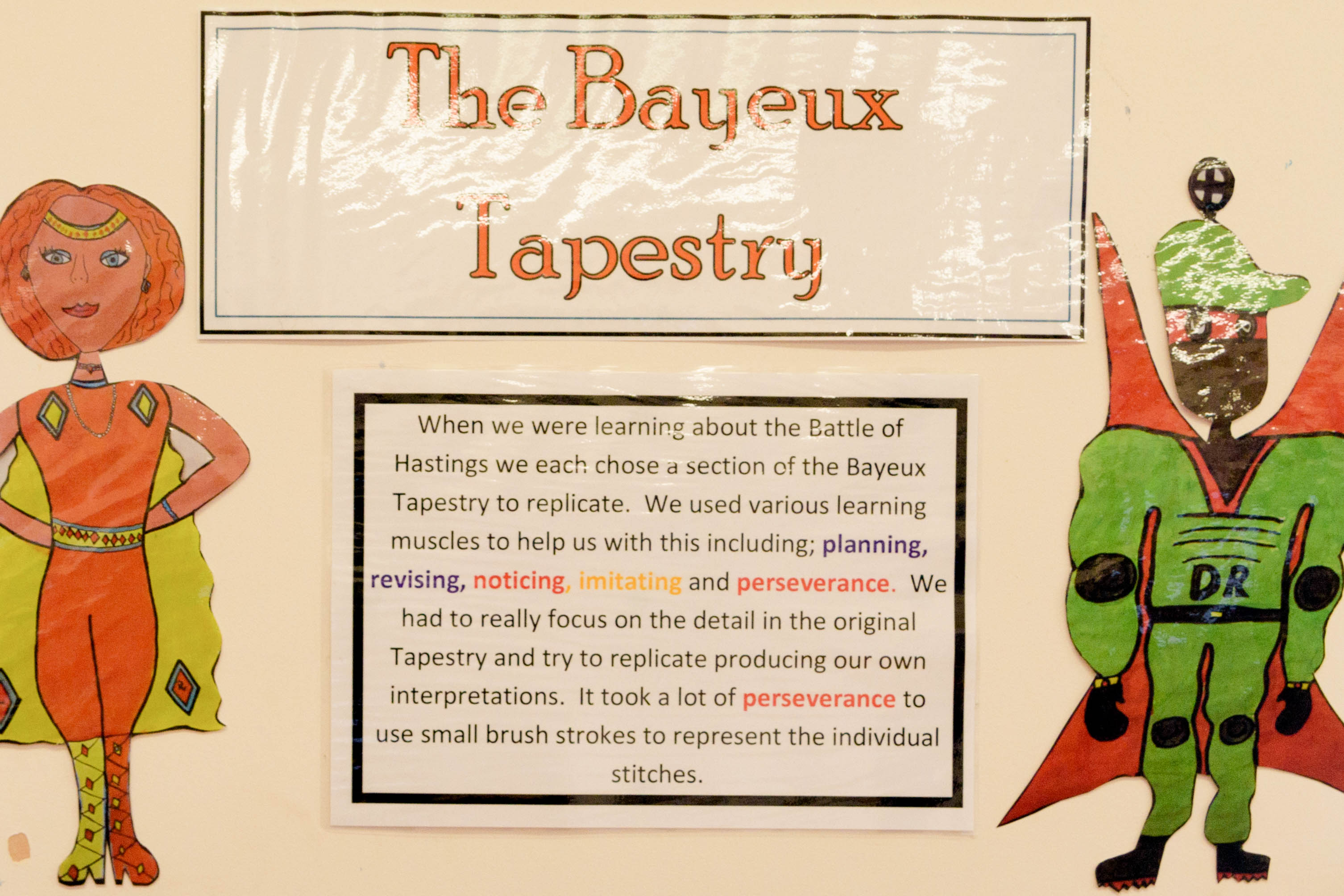
In conventional lessons where the teacher remains the focus of attention and the initiator of all activity, and where the epistemic dimension is not acknowledged, students gain habits of compliance and dependence, rather than curiosity and self-reliance. In developing learning power, teachers are making conscious choices about which habits to introduce and stretch and how best to couple these with content so that lessons become more interesting and challenging. Through such overt coupling of content and specific types of process, students come to know, understand and take control of their learning behaviours – they knowingly use and develop the whole range of learning behaviours.
Ask yourself:
- Do I ask myself “How are my students going to learn it?” instead of ‘How am I going to teach it?”?
Aspect 2: Lessons with rich and challenging activities – increasingly open-ended activities are designed to engage, to stretch and to challenge. The learning is not over-scaffolded, and the inherent difficulties are not avoided or diluted by overly-helpful teachers. The activities stretch and challenge both content understanding and learning behaviours.
Rich, challenging activity
 Learning is always an emotional business and learning how to manage this is best done ‘on the job’ in the course of learning rather than as a separate stand-alone activity. Emotional engagement is a prerequisite of powerful learning, it’s what gets you interested enough to be willing to put in the effort to get better and see the value of pushing yourself. So lessons aren’t just designed to make use of different kinds of learning behaviours but to give those behaviours a good work-out. Activities are designed to:
- be challenging and where being stuck and confused are regular and fruitful experiences.
- give students the opportunity to ‘learn what to do when they don’t know what to do’ – to work on wild tasks, rather than tame ones, where there’s plenty of scope to get lost and perplexed.
“The presence of challenging learning intentions has multiple consequences. Students can be induced to invest greater effort, and invest more of their total capacity than under low demand conditions.”
(Hattie, Visible Learning)
Ask yourself:
- What proportion of tasks in my classroom are rich and challenging?
Aspect 3: Lessons with in-built reflection – reflection on content and reflection on learning behaviours is routinely built into lessons. Review points, rather than the formulaic plenary, focus students on what they have learned and how they have learned it. Reflection is done by students for themselves, not by teachers on their behalf.
Models of learning
Active Learning cycle 


This familiar learning cycle highlights what is needed in order to learn from experience. By active learning we mean active engagement with materials, with ideas, with relationships and with other resources.
The teacher’s role is to facilitate the cycle using questions such as;
- What’s happening?
- What do you notice?
- How are you feeling about this?
- What else is happening?
- What struck you?
- What did you see operating?
- How was that significant?
- What seemed effective?
- How did you make sense of that?
- What does that mean to you?
- What might help explain that?
- Where does this leave you?
- Where does this take you?
- Do you know other situations like this?
Meta cycle
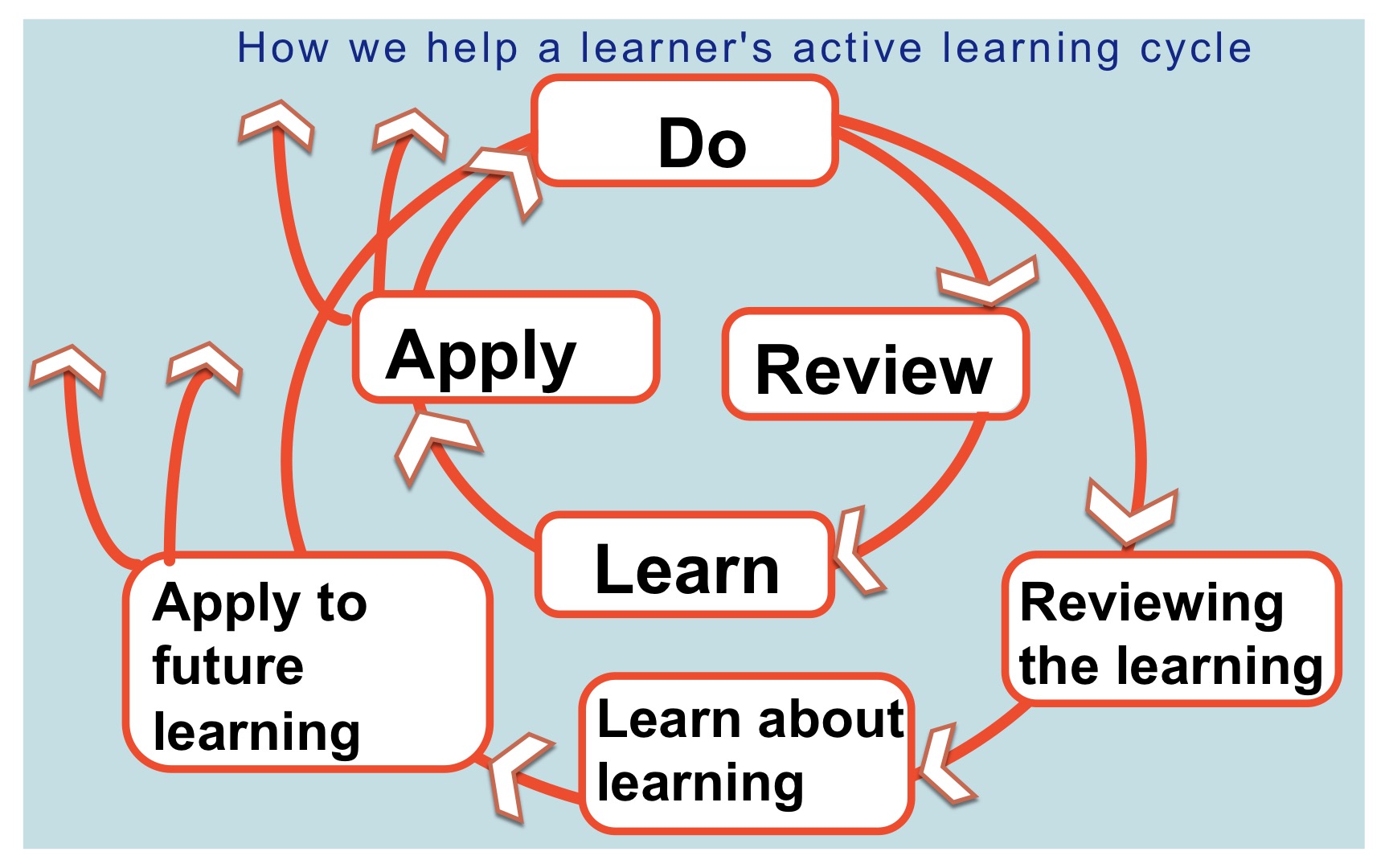
It’s not sufficient to simply have an experience in order to learn. Without reflecting on the experience it may quickly be forgotten or its learning potential lost (Gibbs 1988). This is the model that best drives the learning in learner and learning focused classrooms.
Ask yourself:
- To what extent do I use Reflection, on either content or process as a consistent feature in my classroom?
Find out 1
How do teachers construct learning to create a learning-centred classroom culture?
The chart alongside shows how the classroom culture for the three aspects of Constructing Learning:
- Creating lessons with a dual focus on learning behaviours and on lesson content
- Creating rich and challenging activities
- Creating lessons with in-built reflection
may grow as the culture moves from being teacher centred towards being learning centred.
Download and print a copy.
Look over these trajectories. For each of the 3 columns, ask yourself the key question:
- Which cell in each column do you think best describes your current classroom culture?
It is worth taking your time over this. The outcomes from this self-reflection, coupled with the outcomes from Find Out 2, will help to identify the teaching strategies that will move your current classroom culture towards a learning centred classroom culture.
Growing Constructing Learning, from a teacher centred classroom culture towards a learning centred classroom culture.
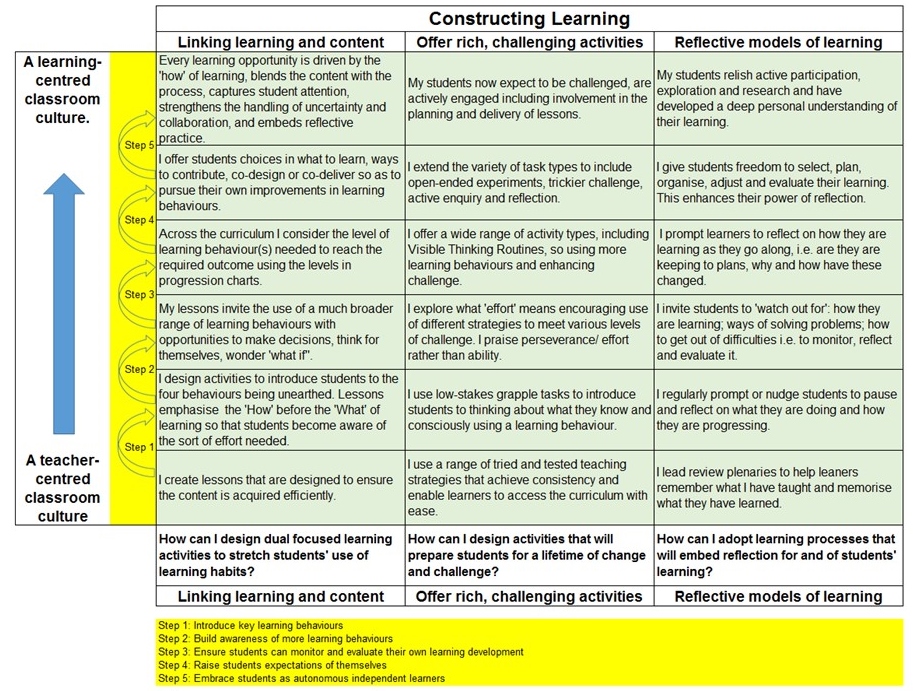
Which cells best describe your classroom culture now?
Download as a pdfFind out 2
How are your students responding to changes in classroom culture?
Culture is the minute by minute, hour by hour, day by day way that learners come to understand their role as a learner; it’s always all too evident to learners. Culture is sometimes seen as your enacted values in the classroom – what you do and what you don’t do, what you say and don’t say, what you believe and don’t believe, what you value and don’t value.
How are your students reacting to the learning climate of your classroom? How are they reacting to the changes you are making to build learning behaviours into lesson design?
Download and print a copy.
Look over these three groups of statements.
The first 5 statements are about linking learning with content, the second about creating rich, challenging activities, and the third about building reflection into learning.
For each of the 3 groups, ask yourself the key question:
- Which statement in each set do you think best describes the majority of your learners at this time?
It is worth taking your time over this. The outcomes from this, coupled with the outcomes from Find Out 1, will help to identify the teaching strategies that will move your current classroom culture towards a learning centred classroom culture.
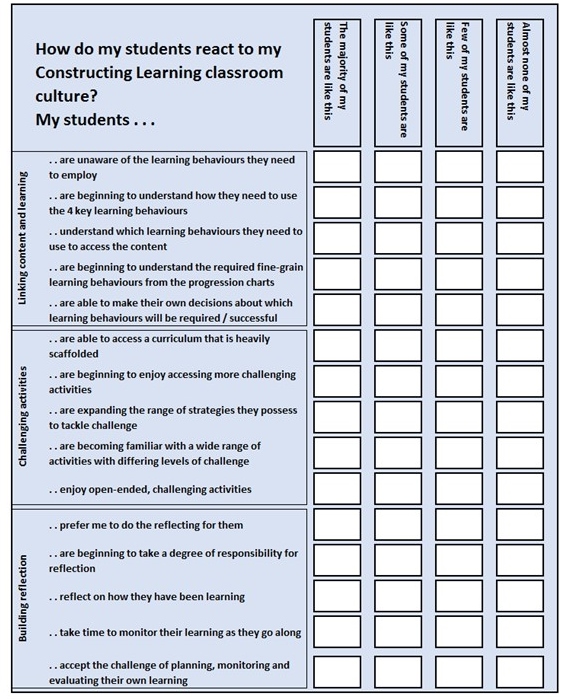
Try out 1
A range of little culture shifts
Teachers are in the habit forming business
As a teacher you are an influential character builder and so need to be mindful of how your classroom culture helps students to form, replace, re-form and strengthen their learning habits. Which aspects of your classroom culture are helpful in this respect, and which are perhaps less so? After all, if you are unable or unwilling to make changes to your classroom culture, learners are unlikely to change how they respond to it!
What to stop and start
Here are a few ideas you might want to try. Take it steady, this way of teaching can be a big but exciting shift so it’s worth doing it slowly and thoughtfully.
Begin with the ‘stop/avoid’ box – if any of these teaching behaviours are still in evidence in your classroom it would be worth thinking through how they can be eliminated, since failure to do so will undermine the changes you are hoping to achieve for your learners
Then cast your eye over the other 3 boxes. Which ideas appeal to you? Which do you think will have the greatest impact on your students?
Now seek out teaching ideas below in Try Outs 2/3/4 that you can use to move your classroom culture forward.
Try Out 2 focuses on ideas for linking content with learning behaviours;
Try Out 3 focuses on ideas for creating rich and challenging activities;
Try Out 4 focuses on building reflection on learning into lessons.
Try out 2
Build lessons with a dual focus
Lessons with a dual focus – lessons are designed intentionally to deliver content and to exercise learning behaviours, and students are made aware of both. The learning behaviours drive the content acquisition, the content is the exercise regime for the learning behaviours, each enhancing the other.
Use what you have found out about your classroom culture in Find Out 1 (the green tables) and how your students are responding to it in Find Out 2 (the blue quiz) to identify the best place to start in linking content with learning behaviours. There are five possible growth stages to consider.
Explore the teaching ideas for creating lessons with a dual focus here

Try out 3
Build rich and challenging activities
Lessons with rich and challenging activities – increasingly open-ended activities are designed to engage, to stretch and to challenge. The learning is not over-scaffolded, and the inherent difficulties are not avoided or diluted by overly-helpful teachers. The activities stretch and challenge both content understanding and learning behaviours.
Use what you have found out about your classroom culture in Find Out 1 (the green tables) and how your students are responding to it in Find Out 2 (the blue quiz) to identify the best place to start on creating rich and challenging activities. There are five possible growth stages to consider.
Explore the teaching ideas for creating rich and challenging activities here

Try out 4
Build reflection on learning into lessons
Lessons with in-built reflection – reflection on content and reflection on learning behaviours is routinely built into lessons. Review points, rather than the formulaic plenary, focus students on what they have learned and how they have learned it. Reflection is done by students for themselves, not by teachers on their behalf.
Use what you have found out about your classroom culture in Find Out 1 (the green tables) and how your students are responding to it in Find Out 2 (the blue quiz) to identify the best place to start on building reflection into lessons. There are five possible growth stages to consider.
Explore the teaching ideas for building reflection into lessons here

Find out 3
Developing a deeper understanding of how learner behaviours may respond to the changes you have made in your classroom culture.
We have thus far, with the exception of Find Out 2, focused on changes you can make to your classroom culture, focusing on the three ‘Means’ of Constructing Learning:
- Linking content with learning behaviours;
- Rich,challenging activity;
- Reflective model for learning.
Here we turn our attention to the two ‘Ends’, the anticipated outcomes for learners, and how these are linked to the changes you are making / have made:
- Growing reflection;
- Growing an appetite for challenge.
Ask yourself:
- Which cell in each column best describes my learners at present?
- Is there a good match with the Steps I have been working on in Try Outs 2/3/4?
- Are they responding in the ways anticipated?
- Are they ready to be challenged to become increasingly reflective and ready for challenge, or is there a need for a period of consolidation while the changes you have made take full effect?
And critically – what next? You should probably choose to turn your attention to one of the other units so as to maintain a degree of consistency of approach across the four aspects of classroom culture (Relating, Talking, Constructing, and Celebrating).
But, do not forget – you can always return to this unit in the future with the intention of further progressing your classroom culture and their responses.


Find out 4
Investigate a further 8 learning behaviours to broaden the range of behaviours you can actively promote in your classroom.
This Find Out, which appears in all units, is a reference tool to be accessed when / if you need it.
It gives a short introduction to 8 additional learning behaviours: Noticing; Reasoning; Imagining; Making Links; Capitalising; Listening; Planning; Meta Learning.
Each contains 5 short sections:
- What do we mean by this learning behaviour?
- How do teachers create a classroom culture for it.
- How does the behaviour grow?
- Some teaching ideas to encourage the behaviour.
- How to develop your learning language to support the behaviour.
You will find these introductions most useful as you begin to tackle Steps 2 and 3 in the Try Outs (above).
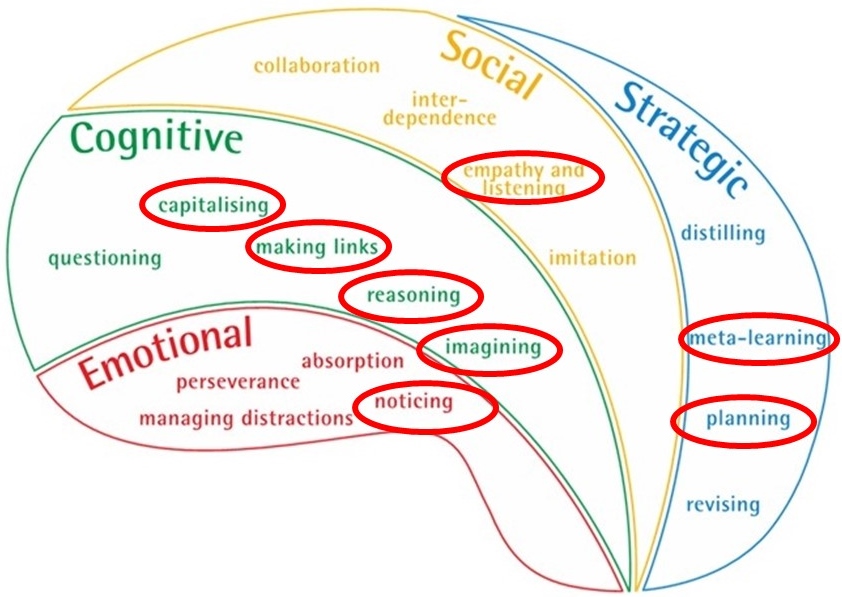
Review and Evaluate
Suggested termly review activity
You may well be working hard at trying to develop your students’ use of valuable learning behaviours but in your enthusiasm simply forget to keep any sort of record or track of it. So here’s a simple form for you to either use as is or adapt to fit your circumstances. Capture your significant shifts in teaching and your students’ shifts in learning.
Suppose that your main focus over the Spring term was on Constructing Learning:
- You were working mostly on Step 3, with a focus on developing a wider range of activity types and blending VTRs into everyday classroom practice;
- You explored the hierarchy of activity types and reflected on your ‘default’ activity types;
- You have explored and integrated a range of Visible Thinking Routines into everyday classroom conversations and have realised that the VTRs can point the way to expanding the activity types you employ;
- You may well also have had some associated actions in the other 3 aspects of classroom culture;
- You have noticed that the majority of the activities you design are of the Listening / Practising types and have begun to integrate Manipulating and Assembling type activities into project work; that students are engaged by these activity types; that it takes time and repeat use for VTRs to become established;
- And in the future you intend to work on creating a ‘Finding’ type activity that can be used in the upcoming summer term project on xxxx.
Download and complete your own review and evaluation sheet. Keep it as an ongoing record of what you have done, and pass a copy to senior leaders so that they can keep an eye on developments across the school.
Download a blank copyUse this or design your own format to capture your actions and their impact.

Comments are closed.