

Think this first page needs a paragraph about what we are talking about i.e. dispositions which of course pave the way for skill. Haven’t found quite what we need yet from our past stuff yet.
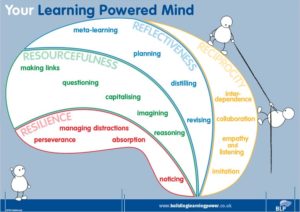 Perseverance

When you use this learning muscle, you …
- are not put off by being stuck
- tolerate feelings of apprehension, frustration or confusion without getting upset
- recognise that learning can be a struggle
- keep on going despite difficulties and find ways to overcome them
This para needs amending to make it parent friendly. it means a rewrite but keeping the meaning
The purpose of this resource is to help parents to help/facilitate their children grow the high value psychological characteristics in order to strengthen their learning characters. These skills, attitudes and values, when used with increasing competence and confidence across many learning opportunities, become learning habits; the characteristics of successful lifelong learners.
‘A person’s Learning Power determines, even dictates, their propensity for change, and directs those behaviours that influence and underpin performance throughout life.
The power to learn is the essential ingredient in implementing strategies for change i.e. to learn.‘
The activities, think pieces and questions in this online unit aim to help parents make a start on:
- introducing children to one of the key learning behaviours;
- using the language of learning effectively with children;
designing the use of learning behaviours into the way they teach;- developing the confidence and skill in helping children to grow their learning power.
Below needs taking out of a toggle box and amending for parents
How to navigate the module. Ignore if you are familiar with this advice.
Ideas in this module will take you into a new way of thinking about learning. The notes below will help you gain a coherent feel for how the material fits together and apply in your classroom practice.
Take it slowly and try to avoid any inclination to skim through the whole resource.
Spend about 15 mins on each of the 5 steps below; sufficient time to both read, think about and note down your learning.
Start with section 1.This will be amended after all the sections have been rewritten
Read – ‘What is . . . ?’
Maybe go over it again because there may well be some features of this behaviour that you haven’t met before.
Spot the Perseverers in a class you know well and fill in the names of your learners.
Ask yourself:
Which of my learners appear to do all / most of these things already?
Which of my learners don’t appear to exhibit any of these positive learning behaviours?
What you’re discovering.
Make a note of your musings ready for discussion at the Professional Learning Team meeting.
Now go to section 3.
Carefully read ‘Understand how Perseverance grows’, this is likely to be brand new information
Take time to find out how the phases of growth work (see toggle box)
Focus on the class you know well and think about where they might fit on this trajectory
Think through the questions shown below the trajectory but don’t assume higher achievers will automatically be further up the trajectory than lower achievers
Ask yourself the hard question – could my learners make progress up this trajectory this year?
If yes, how might I help make this happen?
If no, what might I do to make learners more secure at their current stage?
Make a note of your musings ready for discussion at the Professional Learning Team meeting.
Now go to section 2.
Get a sense of what is meant by classroom culture and look at the diagram that shows some aspects of culture that encourage and enable Perseverance to flourish. . . ‘
Think about your own classroom culture:
which of these aspects are a regular feature in your own classroom?
which might you consider introducing into your classroom?
which sound interesting but you do not understand what they might look like in practice?
Make a note of your musings ready for discussion at the Professional Learning Team meeting.
You’ve now looked at the nature of the learning behaviour, considered how it might grow, and looked at features the classroom culture that supports it.
Now turn to section 4 to explore some teaching ideas that could be used to build these behaviours in your own classroom.
Read through section 4 – Ideas to Practise
look at both the primary and secondary columns because many of the ideas can be amended to fit different ages
Which of these ideas might fit your needs or simply appeal to you?
Which do you already use?
Which might work well in your own classroom?
Make a note of your musings ready for discussion at the Professional Learning Team meeting.
Section 5 Develop your talk
Take a look at a few statements you could use to nudge the behaviour. Using this language can be a big shift for many teachers because what you are doing here is talking in a way that will nudge the use of a particular learning behaviour. This is intentional and precise learning language.
Ask yourself:
How much do you currently talk about the process of learning, as opposed to the outcomes of learning?
Have you ever considered, in advance, how you might talk about the process of learning, or do you tend to just ‘trust yourself to say the right thing at the right time’?
Might you need to make a conscious decision to prepare in advance the language that you use?
Which of the suggested phrases/comments would best resonate with your students and fit with any of the teaching ideas you might try from section 4?
Make a note of your musings ready for discussion at the Professional Learning Team meeting.
Comments are closed.