

Helping your new teachers access and benefit from Coming on board
This short resource is the companion to Welcome to…Coming on board, a 7 section, self-study induction pack for teachers new to your school.
This resource offers you, as a senior leader, a description of the self-study pack for new teachers and some suggestions for ways to support and ease those teachers into the learning powered culture of your school.
As you will know, teachers often find it difficult to absorb the culture and practices of a school that’s new to them. This is as true for experienced teachers as it is for new entrants who are just starting out and it’s particularly so if the ‘new school’ has an approach to learning that may be somewhat different to what they are familiar.
The purpose of this introductory programme is to:
- furnish teachers with a considered broad brush outline of the approach;
- offer particular practical support to teachers new to a school during their first term;
- but it is not a substitute for ‘Playing the Learning Power Game’ or ‘The Professional Learning Power Game‘;
- indeed, we would recommend that once new teachers have experienced this short introductory programme, they should be enabled to join the professional learning teams who are exploring the full ‘Playing the Learning Power Game’ programmes.
1. What does the Coming on board pack contain?
The Coming on board resource pack has two bits and two functions:
- an introductory resource for teachers new to any school that is working through, or has already completed aspects of a learning power programme. e.g. ‘Playing the Learning Power Game‘ and/or ‘The Professional Learning Power Game‘;
- a supportive resource for senior leaders responsible for the induction of new teachers (i.e. what you are reading now).
For teachers:
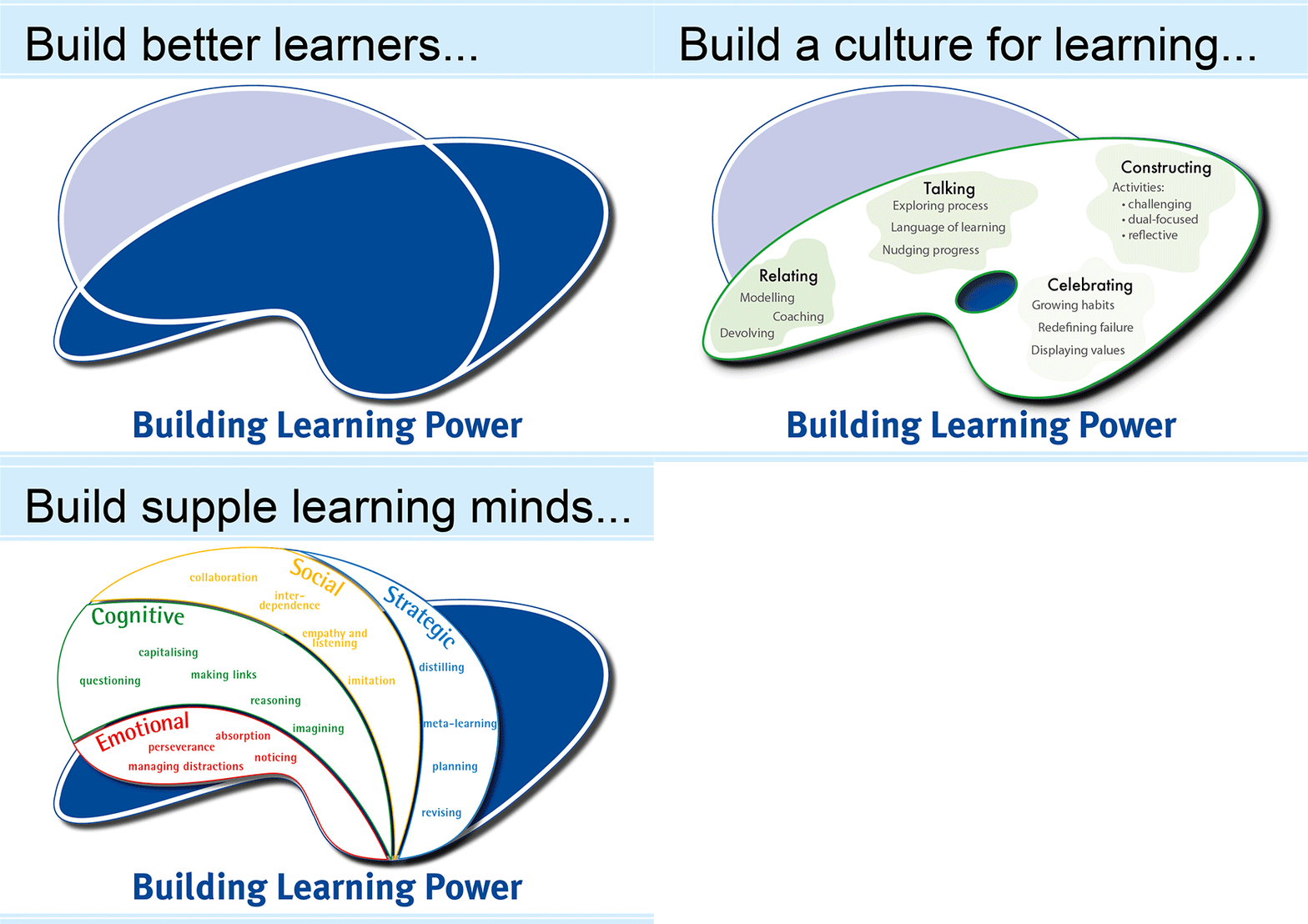
- 1 online quick read unit titled ‘Coming on board, an introductory read’. This offers an overview of the key ideas about building better learners, supple learning minds and classroom cultures;
- 1 online unit called ‘Welcome to…Coming on board’, made up of 7 sections which provide a quick start on understanding the nature of learning power and the classroom culture that enables learning power to flourish.
For leaders responsible for induction (this unit):
- advice on how the 7 sections might best be tackled;
- training materials to help you to introduce ‘The Supple Learning Mind’ and ‘Learning-Friendly Classroom Cultures’ (should you wish to do so).

2. Start with some gentle ‘holiday reading’
Developing students’ learning power involves engaging your students consciously with the ideas and processes of their own learning in the knowledge that learning itself is learnable. It sounds enticing but how to do it is far from obvious. Hence it’s important to offer new staff a considered route to understanding the basics such as: What is learning power? Why we need it. What are the essential ideas, values and practicalities of building students’ learning power?
An online overview:
- ‘Coming on board, an introductory read‘ offers seven glimpses of learning power that capture the essence of why, what and how. Through 7 big questions teachers can explore the purpose and meaning of learning power before making a start on putting it into practice;
- This might usefully be introduced as essential ‘holiday reading’ before the teacher joins your school at the start of a term.
This introductory unit offers:
- an overview of the key ideas;
- background research on dispositional learning;
- the two interlinking frameworks that underpin building better learners;
- examples of how the two frameworks work in practice.
It’s wise to ensure this is the first unit that new teachers engage with because it sets the scene for the substantial online unit titled ‘Welcome to… Coming on board’.
This resource is freely available online at:
www.buildinglearningpower.com/units/7-glimpses-a-shortened-read/
However if senior leaders would rather introduce these ideas themselves, there are materials in section 5d (below) to support you in doing so.

You could send the link to incoming teachers if you have been unable to set up their Learning Power account prior to them taking up post.
3. Coming on board. The self-study pack to support teachers new to the school.
The Coming on board resource is available to schools that have already begun working on Phase 1 ‘Playing the Learning Power Game’ and/or Phase 2 ‘The Professional Learning Game’ and want to provide specialised induction activities for teachers joining the school. The resource is designed as a self-study pack but with aspects that will help new teachers to join an established professional learning team after a couple of months.
Here’s a rundown of the sections
- Section 1 What makes a difference in learning?…introduces and explores the meaning, purpose and attributes of learning power.
- Section 2 Up close and personal with learning…invites teachers to look at themselves and a couple of students through the lens of learning behaviours.
- Section 3 Finding learning characteristics…explains how a teacher, and the school, can gather evidence to profile students’ learning characters and use this as a basis for selecting appropriate activities. Material in this section should be completed in full after discussion with the school. See 4.3 below.
- Section 4 Shift classroom culture…explores how teachers’ classroom practice can encourage the growth of learning behaviours.
- Section 5 Start with the basics…explains the first ‘must do’ aspects of learning activities that strengthen learning behaviours.
- Section 6 A catalogue of ideas…offers a range of practical classroom solutions that are directly linked to phases of learning behaviours to blend into their teaching.
- Section 7 What is the impact?…suggests how to assess the impact of their interventions on their classroom culture, students learning and their attainment. This material should be considered during induction but acted on at the end of the educational year.


4. The substantial 7 section unit, ‘Welcome to…Coming on board’.
While each section could easily take teachers a couple of weeks to read, digest and act on, some sections are more action packed than others. Hence we hope the unit will fit comfortably into half a term and prepare new teachers to join the school’s existing professional learning communities fairly quickly.
Section 1 – ‘What makes a difference in learning?’
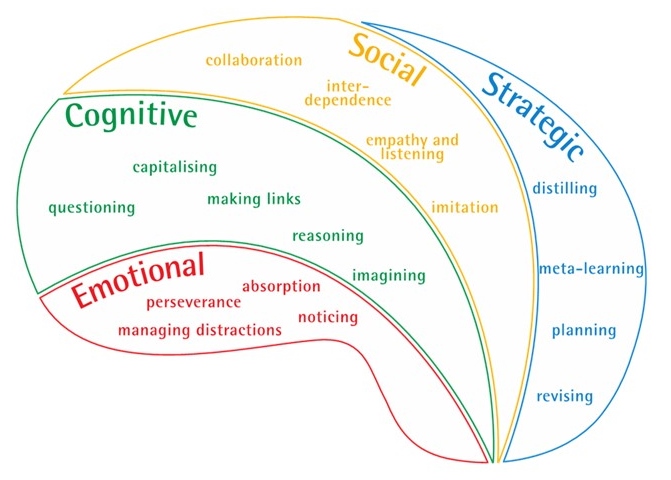
Section 1 introduces the key ideas of learning power. It looks at The Supple Learning Mind, explores its origins and rationale.
The section takes a whistle stop tour through the what and why of learning power. It’s an approach to learning that looks at the building blocks of learning, what they are, the part they play and why they matter. The basic learning behaviour framework, known as the supple learning mind, itemises the high value learning behaviours most of which will be broken down in detail in section 2 to become learning journeys in their own right.
Section 2 – ‘Up close and personal with learning’.
Section 2 invites teachers to consider their own learning behaviours through the lens of learning power, and begins the process of thinking about the learning behaviours of the students they teach. Here for the first time the level of detail about learning behaviours is uncovered to enable teachers to:
- discover and understand the learning behaviour features of students;
- learn about the possible learning behaviour differences of students;
- become familiar with students’ growth in learning power behaviours;
- feel confident to introduce students to their own learning behaviours;
- adapt their teaching so as to strengthen growth in learning behaviours;
- monitor and evaluate their own practice and the subsequent growth in students’ learning behaviours.
Having got the idea by looking at themselves as a learner they are invited to look at just a couple of their students; a low and a high attaining student. This gives them a glimpse into what it is that makes the difference in how students approach and achieve in learning
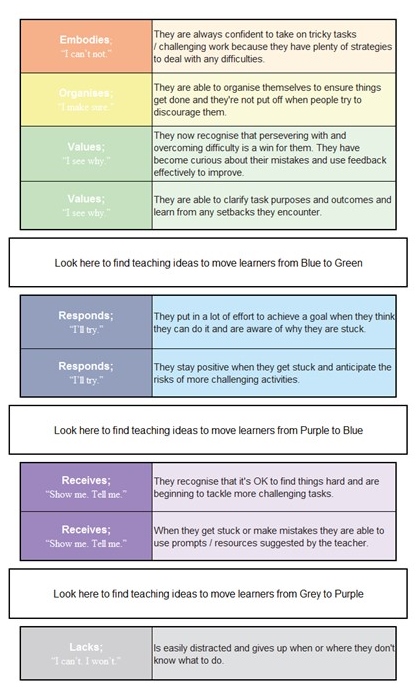
The slimmed down learning power growth chart

Section 3 – ‘Finding learning characteristics’
EDIT HERE
Section 3 invites teachers to complete a learning profile for each member of their class and to reflect on what these profiles might be telling them about sub-groups of learners. This is one of the best ways for teachers to really understand learning power in their students.
Although this section, on the preparation of learning profiles for the class or group, logically fits here in the sequence of topics, the timing might not coincide with the school’s collection of this data. Senior leaders will need to inform new staff when the school intends to schedule the collection of students’ learning profiles. New staff might use this section to best advantage by looking at it carefully in the induction period, but complete all the student profiles when they are required to by the school.
Student profiles

Section 4 – ‘Shifting your classroom culture’
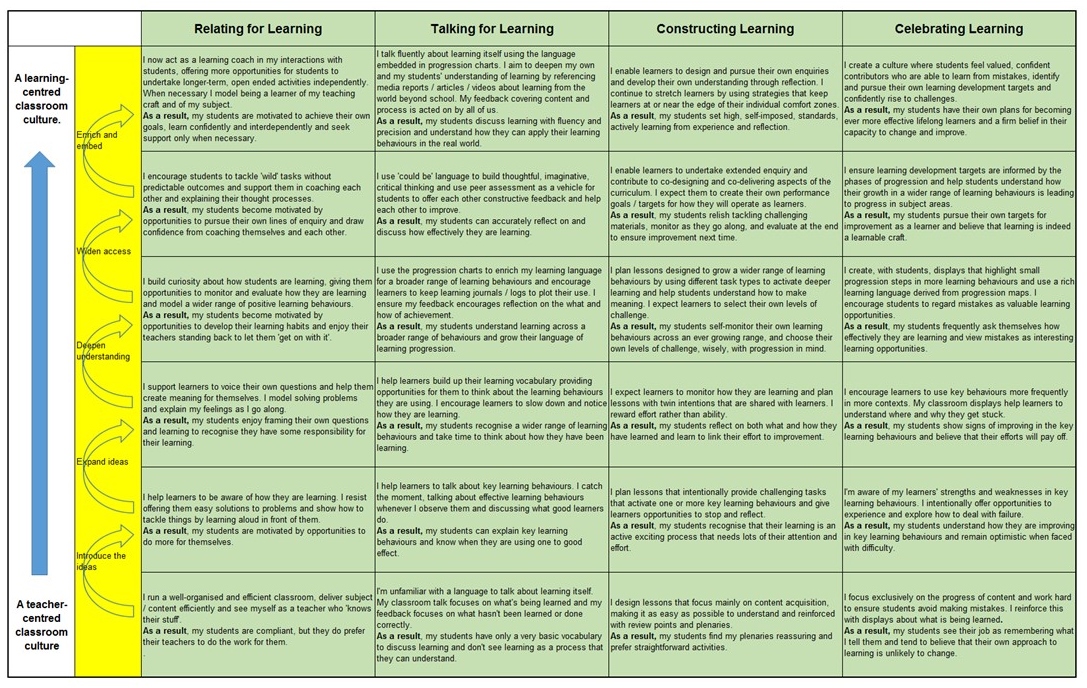
If we want students to become better learners we first need to offer them more opportunities to use and cultivate their learning powers. This obvious truth often involves shifting the culture of the classroom so that it systematically cultivates the positive learning habits and attitudes of young people. ‘Culture’ is about all the little habits, routines and practices that implicitly convey ‘what we believe and value round here’; where, hour by hour, day by day, term by term students experience the values and practices that are embodied in the school.
Section 4 introduces the idea of classroom culture and how it can help, or hinder, learning power. It looks at the 4 aspects of classroom culture – Relating, Talking, Constructing and Celebrating – and introduces the ideas around teacher’s progression in making classroom culture happen.

Section 5 – ‘Starting with the basics’
Fostering students’ learning dispositions is a wide ranging and multifarious business. However, there are a few straightforward things teachers can do to start engaging their students in developing their learning dispositions.
EDIT AND CHECK HERE AFTER SECTION 5 IS UPDATED IN SEC UNIT
Section 5 identifies 11 basic strategies or ‘quick wins’ that can underpin classrooms where learning power can flourish. It invites teachers to consider changing their practice to incorporate one or more of these quick-start basics. Its premise is that small changes in teaching practice can create big changes in learners.
While all the suggestions are fairly standard your school may already have particular ways of interpreting them. We have suggested it would be wise to check which of the 11 ideas are common features of classrooms and whether the school has some common formats that they should follow (e.g. Learning mats no 11). They will also need to know which learning behaviours students are already familiar with as they’ve already been introduced throughout the school.
Section 6 – A catalogue of ideas: Decide where to start.
Section 6 is a substantial section and is obviously worthy of several weeks of study. The catalogue offers teaching ideas in the 12 learning behaviours, organised by phase of learner development. It invites teachers to look at the learner profiles created in Section 3, to seek and implement teaching ideas relating to a chosen learning behaviour at an appropriate level for their learners.
While it is not expected that teachers will access ideas for all 12 learning behaviours, they should be encouraged to explore beyond one behaviour. Maybe it would be an idea to challenge them to look at one from each of the 4 domains of learning – Emotional, Cognitive, Social, Strategic.
Section 7 – ‘What is the impact?’
Section 7 is a nod to the future. There is no expectation that the small-scale changes made during the hurly burly of the first term in a new school will have resulted in measurable changes in such a short period of time. It illustrates the direction of travel and could be returned to at the end of teachers’ first year of engagement.
However, it would be good to end with a less formal opportunity to review the impact of the first 6 sections of the unit. Why not conclude the term using the visible thinking routine ‘Connect, Extend, Challenge’?
Invite your new teachers to discuss 3 questions:
- How are the online materials connected to what they already knew?
- How have the online materials extended their thinking?
- What challenges do they now face, what questions are they asking themselves?

5. Issues to be considered by leaders
As mentioned at the outset, teachers often find it difficult to absorb the culture and practices of a school that’s new to them. This is particularly so if the ‘new school’ has an approach to learning that may be somewhat different to what they are familiar. The purpose of the introductory programme is to support teachers new to a school during their first term. However, it is not a substitute for ‘Playing the Learning Power Game’ or ‘The Professional Learning Power Game‘ and we recommend that once new teachers have experienced this short introductory programme, they should be enabled to join the professional learning teams who are exploring the full ‘Playing the Learning Power Game’ programmes.
5a. Supporting the introductory programme
Things to think about:
- how and when might you find time to support new colleagues to work through these materials;
- whether you need to have the occasional twilight meeting with new staff?
- whether you need, say, an ‘induction afternoon’ to kick start the process?
- whether it might be a good idea to support new colleagues to form their own new Professional Learning Community (if numbers allow);
- and/or whether each new colleague should be assigned an experienced mentor / coach to guide them through translating these materials into practice.
5b. Ongoing support for new teachers . . .
Two aspects to think about:
- How you will support them during the first half term (6/7 weeks) using these materials;
- How you will support them thereafter.
Active support. Think about. . .
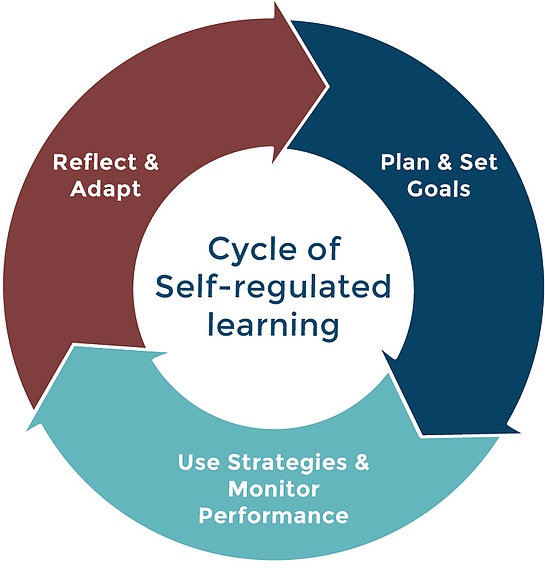
Establishing a cycle of read / act / reflect so that the 7 sections can be covered appropriately.
Build in meetings to share ideas and reflect on the key messages to:
- explore how teachers found the materials and
- critically, how they intend to alter their practice;
- explore teachers’ experiences of and thoughts about the changes they have made.
Decide who will lead these review meetings, when they will be held etc.

After they have made a solid start…
- you won’t want them to continue working at this overview level indefinitely
- offer them access to either
- the full Phase 1 ‘Playing the Learning Power Game’ materials to help them expand their teaching repertoire or
- to Phase 2 ‘The Professional Learning Power Game‘ if the school has got that far
- enable them to move from being ‘a new teacher’ to working with the appropriate Professional Learning Team.
To do this:
- contact TLO and ask for new teachers to be given access to either Phase 1 or Phase 2 materials, whichever the school is currently working with.
- 0117 937 8080
- [note – deleting ex members of staff and inserting new ones is done at no cost to the school].
5d. Support materials for leaders
The Coming on board online unit forms a self-study pack for teachers new to the school. However if senior leaders would prefer to take a more hands-on approach and launch the key ideas themselves, we have gathered some materials and slide presentations you may find useful. There is nothing here that you have not already met during your own engagement with ‘Playing the Learning Power Game‘, but they are clustered here for convenience.
Introducing classroom culture
Downloads to the right:
- A powerpoint presentation about classroom cultures – download it and edit it to create your own introductory session;
- Guidance notes will support your delivery;
- A resource book for teachers to accompany the ppt.
Introducing the Supple Learning Mind
Downloads to the right:
- A powerpoint presentation about The Supple Learning Mind – download it and edit it to create your introductory session;
- Guidance notes will support your delivery;
- Resources necessary for the Chase in the Crypt activity;
- A resource book for teachers to accompany the ppt;
- In case you need them, we also include detailed guidance notes about how you might talk about the 17 learning behaviours in the Supple Learning Mind.
Comments are closed.