

One of your Learning Champions wishes to seek accreditation as a ‘Lead Practitioner of Learning Power’, and you have agreed to act as their ‘verifier’.
This module contains:
- An overview of the criteria for being accredited as a ‘Lead Practitioner of Learning Power’ and the role of the verifier (this section)
- Section 1 – a guide for verifiers – the nuts and bolts of the verification process, the do’s and the don’t’s
- Section 2 – a copy of all of the materials that your colleague is accessing (in addition to ‘Playing the Deeper Learning Power Game’)
What is ‘a Lead Practitioner of Learning Power’?
The award of ‘Lead Practitioner is a new departure for The Learning Organisation (TLO). It is currently restricted to teachers who have acted / are acting as Learning Champions for Playing the Learning Power Game / Playing the Deeper Learning Power Game. It is designed to be a means of accrediting the very best practitioners who are seeking to further improve their teaching skills and their classroom culture – to build a learning-friendly classroom.
As such, the process should be a celebration of the best things that are happening in a school.
The criteria to be met
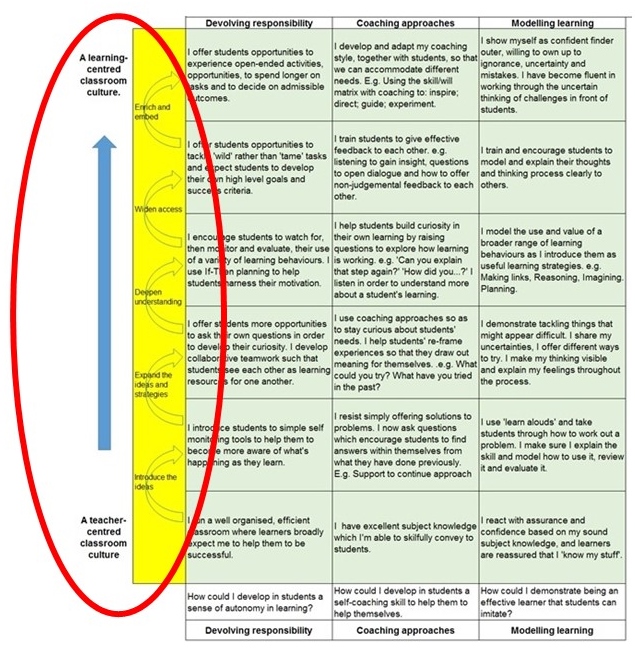
Your colleague is seeking to evidence their growth as a learning power practitioner and to build a portfolio of evidence that will confirm that their practice lies in the top 2 rows of the growth chart opposite.
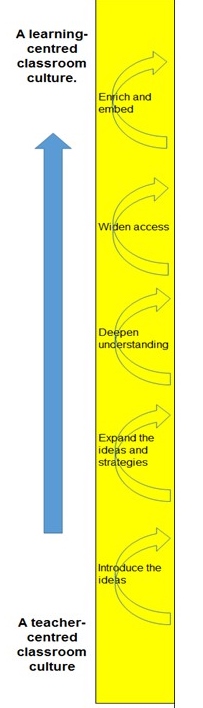
The rows move from the bottom row (the teacher-focused classroom) through 5 phases of development as the classroom becomes increasingly learning-friendly.
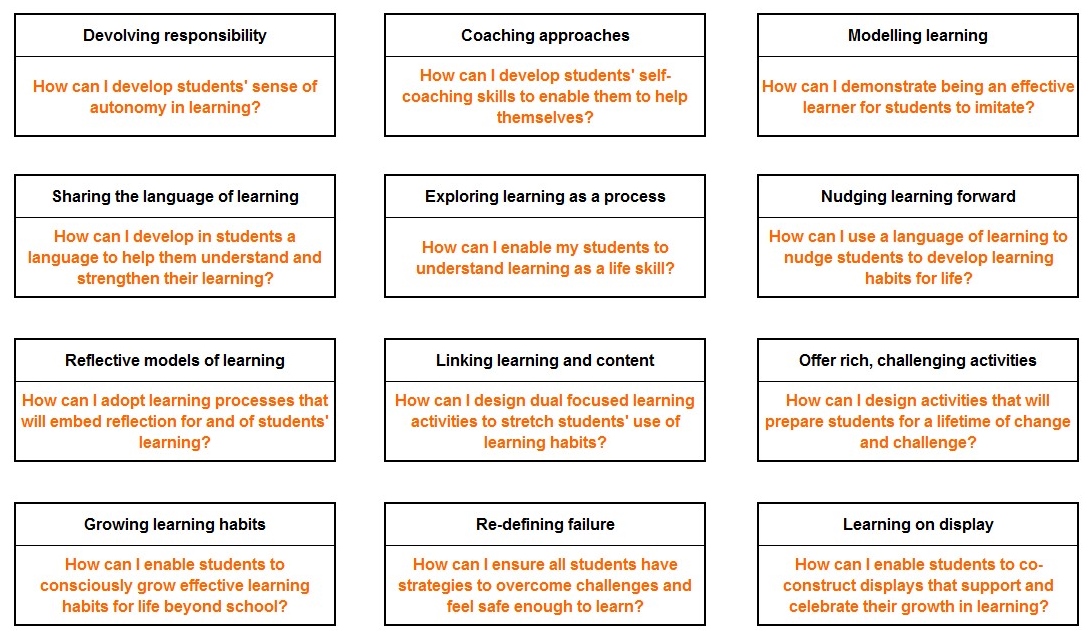
The grid has 12 columns – each column refers to one of the aspects from the Teachers’ Palette (opposite).
Engagement with ‘Playing the Learning Power Game’ should have already moved practice to the 2nd and 3rd rows. Engaging with the ‘Deeper Game’ will provide the impetus to continue the journey.
[You can read more detail about this by opening the following toggle box.]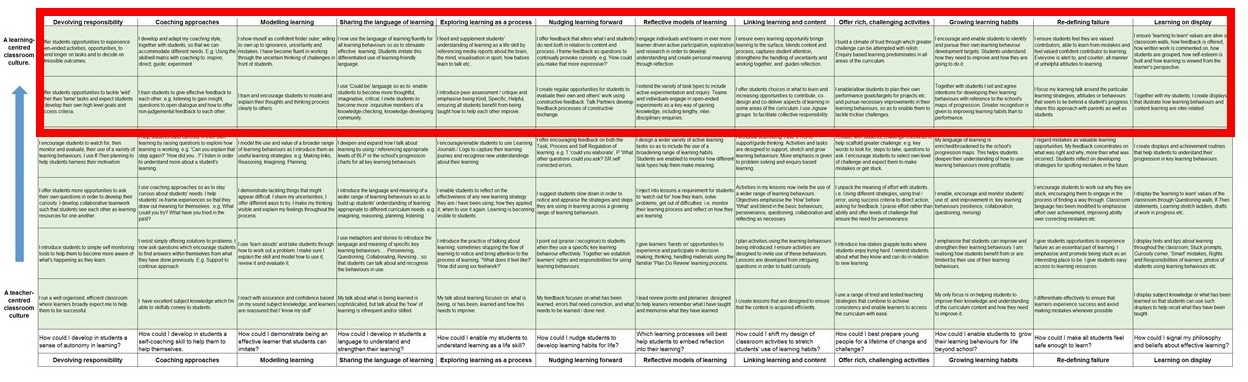

Read more about the teachers' growth chart
The Teachers’ Growth Chart: piece by piece.
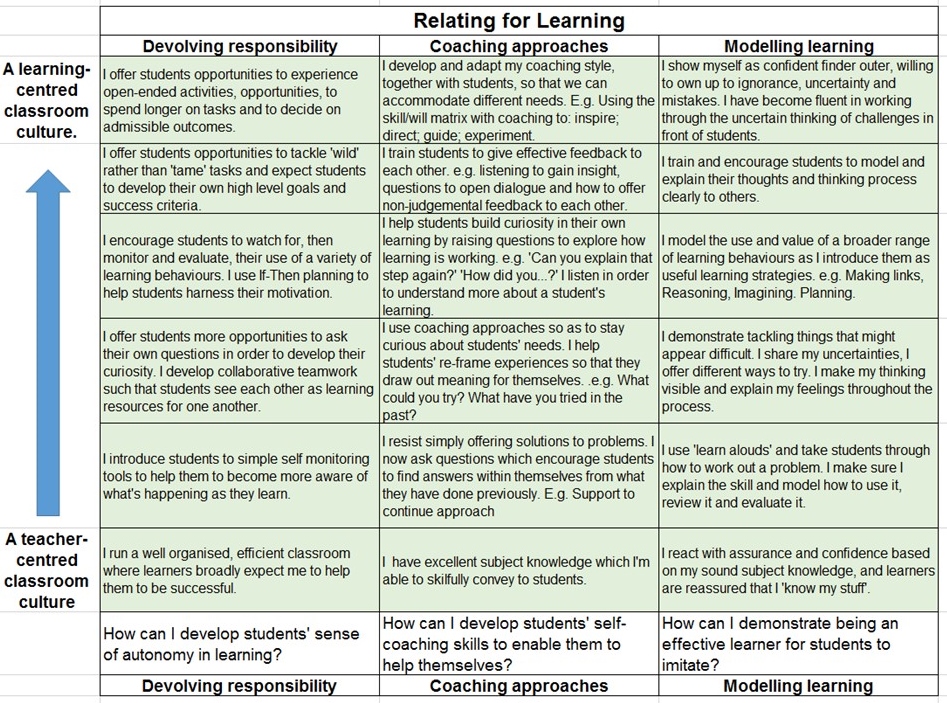
1. Relating for learning . .
Here we consider the three aspects of Relating for Learning – Devolving Responsibility; Coaching approaches; Modelling learning – and begin to explore how each might change as the classroom becomes increasingly learning friendly.
Just take a quick look:
- Consider the bottom row. These cells should remind you of the teacher-focused classroom you met early in ‘Playing the Learning Power Game’?
- What about the next line up? Do those statements, and maybe the ones in the next row up, reflect what teachers have been doing to build students’ learning power as they worked their way through ‘Playing the Learning Power Game’?
2. Talking for learning . .
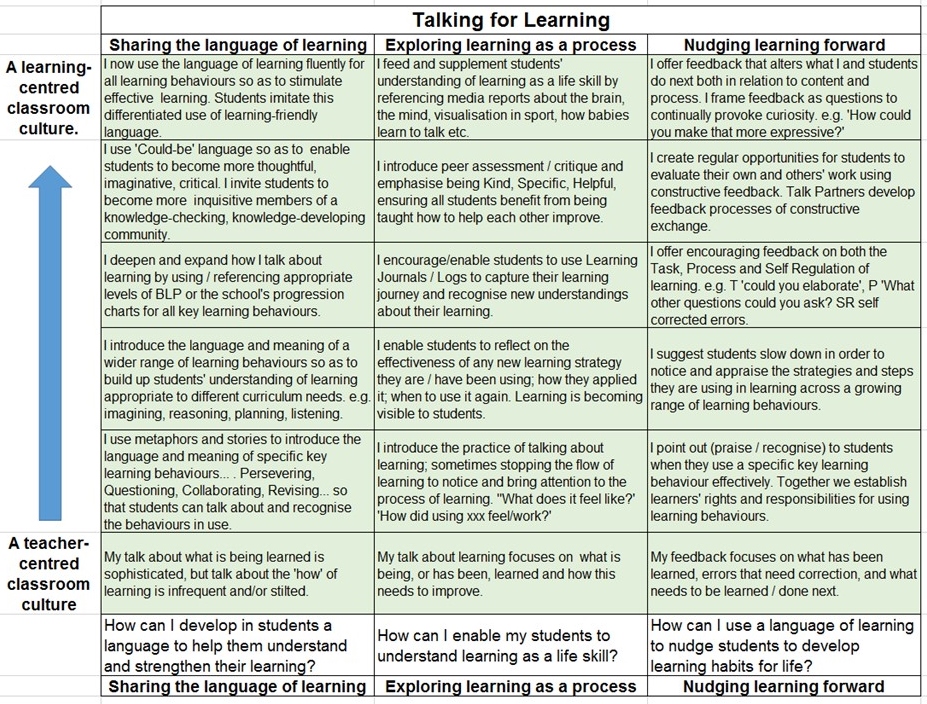
Here we consider the three aspects of Talking for Learning – Sharing a language of learning; Exploring learning as a process; Nudging learning forward – and begin to explore how each might change as the classroom becomes increasingly learning friendly.
3. Constructing learning . .
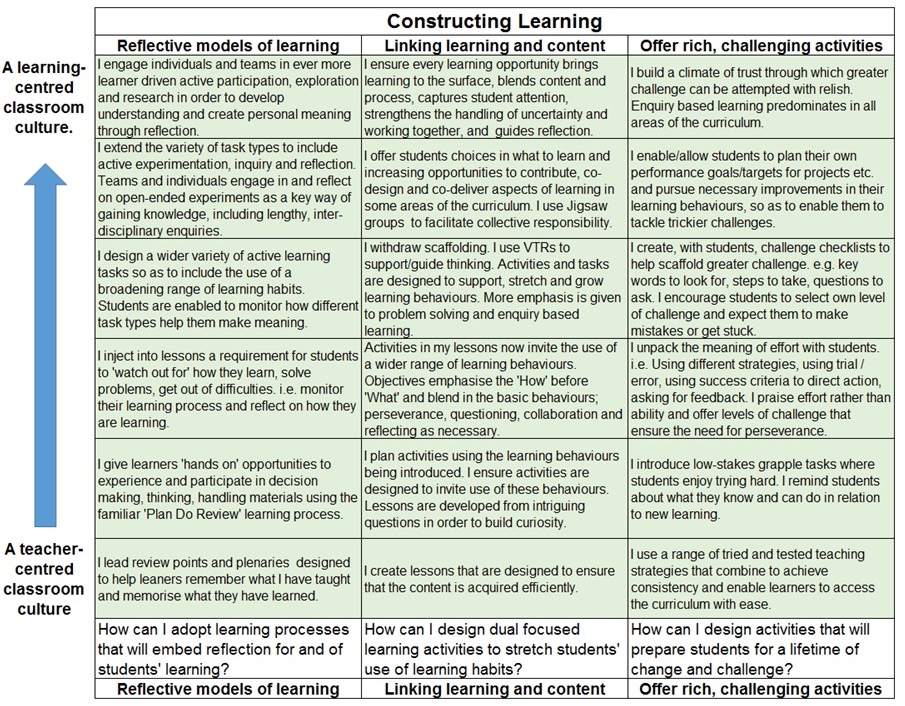
Here we consider the three aspects of Constructing Learning – Reflective models of learning; Linking learning and content; Offering rich, challenging activities – and begin to explore how each might change as the classroom becomes increasingly learning friendly.
4. Celebrating learning . .
And finally we consider the three aspects of Celebrating Learning – Growing learning habits; Re-defining failure; Learning on display – and begin to explore how each might change as the classroom becomes increasingly learning friendly.

Exploring the axes
Each column has a simple label such as ‘Devolving responsibility’ or ‘Linking content and process’ that denotes the job to be done. The job to be done is followed by the question ‘How can I develop students’ sense of autonomy?’ ‘How can I design dual focused learning activities to stretch students’ use of learning habits?’ The questions explore what has to be done and for what reason. In other words the orange questions uncover why you are making these changes; in order to do what; in order to achieve what? This thrust of what, how and why has helped teachers keep hold of the bigger purpose as they try out and perfect the small practical ideas on a daily basis.Take a look at the what and how of jobs to be done.
Here we try to capture a sense of progression in teachers’ practice. At the foot of the column lies a description of a traditional classroom where the power and responsibility for learning lies solely with the teacher. At the top of the columns lies a brief description of a full-on learning-friendly, learning-centred classroom. Reading across the tops of the columns gives a clear picture of the practice teachers are ultimately aiming for. The cumulative steps in between describe the journey and how it changes in focus. In the early stages you are probably dealing with a carefully chosen but limited set of learning behaviours. Later you will add more learning behaviours to your range, increase your skill and fluency and turn your attention to helping the students use and benefit from the same ideas. [These ‘early stages’ were explored as teachers worked with ‘Playing the Learning Power Game’. The programme ‘Playing the Deeper Learning Power Game’ will help teachers to access the upper rows of the progression chart.]Take a look at the stages of growth pattern
 A closer look at the stages of the journey.
Introducing the ideas
The first stage of the journey is simply to introduce the idea of learning powers. This is often limited to four major LP behaviours – perseverance, collaboration, questioning and revising. i.e. the behaviours that you were introduced to in the programme Playing the Learning Power Game.
At this introductory stage, across all the columns, you are only dealing with four key behaviours. You are developing learning talk for these four. You are setting up displays with students to capture their growth in these behaviours. You are developing lessons that use and stretch these behaviours.
Expanding the ideas and the strategies
At the second stage of the journey you add more learning behaviours to the mix. It might be those that are obvious players in your subject i.e. reasoning in Maths or imagining in English or listening in MFL. This is a tricky stage because you are becoming more familiar with a wider range of behaviours and becoming more skilful in each of the columns. It’s a lengthy stage.
Deepening understanding
At this third stage progress across the board hots up. You have got many of the learning behaviours in play now and within any of the columns you are deepening the behaviours. You are more aware of students growing their habits and this is proudly displayed. You are becoming bolder in how much responsibility you are allowing students. Your lessons use a greater variety of active learning tasks and the learning language is richer and mapped with the student progression charts. In areas of assessment too students are taking an active role in assessing each other and critiquing learning.
Widen access
At this fourth stage students are being encouraged and enabled to get in on the act. Coaching isn’t just you coaching students but now includes students coaching each other. In teaching each other, students have a role in co-designing and co-delivering lessons. Students are offered far more open ended or wild tasks and enquiry based learning opportunities. There’s an emphasis on being inquisitive and devolving responsibility to learners.
Enrich and embed
The final fifth stage students are in charge of their own learning. Teachers and students are able to adapt their coaching style to fit different needs. The language of learning is familiar to everyone and even formal feedback is framed as questions rather than suggestions or answers. All lessons are designed to deal with content and stretch learning behaviours with much of the curriculum covered through enquiry based learning. In such classrooms everyone feels a valued contributor, everyone is alert to and counters unhelpful attitudes to learning and all are becoming experienced independent learners.
To gain accreditation as a ‘Lead Practitioner of Learning Power’, practice needs to be at the ‘wider access’ or ‘enrich & embed’ rows of these growth charts.
What does a ‘Verifier’ do?
A verifier is the member of the senior leadership team tasked with considering whether the portfolio of evidence produced by the Learning Champion provides secure and complete evidence that the criteria for being a Lead Practitioner have been met.
But . .
It should not be a quasi-inspection exercise.
Treat it as an opportunity to learn alongside a colleague, to support them to refine and hone their practice, to act as critical friend, to help them to become a ‘Lead Practitioner’.
Senior leaders spend much of their time trying to improve relatively weaker practice. Treat this as the opposite – the chance to build excellence alongside an already good practitioner.

Comments are closed.