
1. The why of this resource
This online resource and its companion booklet (available in printed or electronic format) came into being to help meet cries for help from schools. Many schools, both primary and secondary, are wrestling with the growing challenge of a widening attainment gap between, most notably, disadvantaged and looked after children (Pupil Premium), and other students. The schools that contacted us had an inkling that maybe, just maybe, helping students to become aware of and improve their learning habits could offer an effective way to tackle the problem.
Having seen the positive effect of a learning power approach on students’ learning for several years now we agreed wholeheartedly with their ‘inkling’, but it raised some complex questions. Our understanding of the progression of learning habits led us to ask; which learning habits would schools need to concentrate on; at what sort of level; how would they know their starting points; how might they put a plan together (Intent); what sort of activities would teachers need to implement; what would they be monitoring to keep plans on track; how could schools and teachers keep it manageable (Implementation); what would count as evidence; how would they look for it (Impact)?
So what has arisen here comes from intriguing links between school inquiries about how to generate evidence of impact of building powerful learners and our work on students’ progression in all aspects of learning power.
The approach to building students’ learning habits explored here is commonly applied in primary schools as a whole school strategy. But the whole school approach has proved trickier to achieve in secondary schools where teachers meet students far less frequently and for less time. Nevertheless, this resource attempts to overcome this problem and offers individual teachers and schools a manageable way forward.
And because we know this work is so essential to schools and the lives of millions of children we have written it to enable any school, learning power knowledgeable or not, to be able to take it on and run with it.
2. The what of this resource
This resource offers teachers and schools;
- clear information about the power of learning behaviours and how they grow
- a manageable tool to enable schools to analyse their students’ learning behaviours
- guidance on teacher talk, lesson design and classroom cultures to help strengthen learning habits
- tools to enable teachers to assess and amend their classroom culture and teaching styles
- a spreadsheet package to help schools to monitor, evaluate and manage their data
…in order to help schools narrow the achievement gap, ensure students don’t fall further behind and enable their students to become lifelong learners.
Schools that are subject to Ofsted could regard sections 1, 2 and 3 as laying out your Intent, what you are intending to achieve; sections 4, 5 and 6 your strategies for Implementation, what you are intending to do to achieve it; and section 7 as generating evidence of Impact, what you have achieved.
Or, put another way, this resource will help you to;
- put students’ learning behaviours (not attainment) front and centre in the school’s approach to improving learning,
- use the basic tools and techniques to raise students’ awareness of how they can take control and build their learning behaviours,
- understand and apply the teaching approaches needed to strengthen learning behaviours,
- explore, explain, estimate and record students’ growth in learning behaviours and the impact on their learning.
3. The how of this on-line resource
Each section is based around the points raised in the Narrowing the learning gap booklet but adds more detail and features of interest. Looking at the numbered sections will lead you through the basic story but there are also toggle boxes which add richer information and could be returned to later.
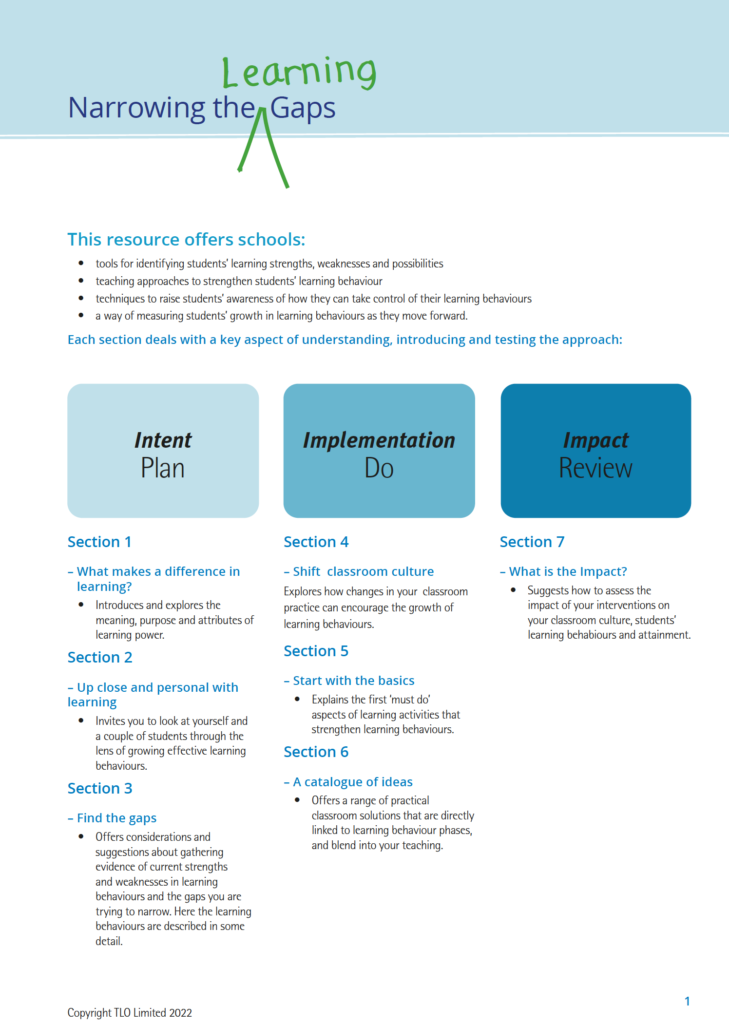
Each section deals with a key aspect of understanding, introducing and testing the approach.
Intent (Plan)
- Section 1 What makes a difference in learning?…introduces and explores the meaning, purpose and attributes of learning power.
- Section 2 Up close and personal with learning…invites you to look at yourself and a couple of students through the lens of learning behaviours.
- Section 3 Find the gaps…offers serious considerations about gathering evidence with regard to the gap in learning you are trying to narrow.
Page 2-11 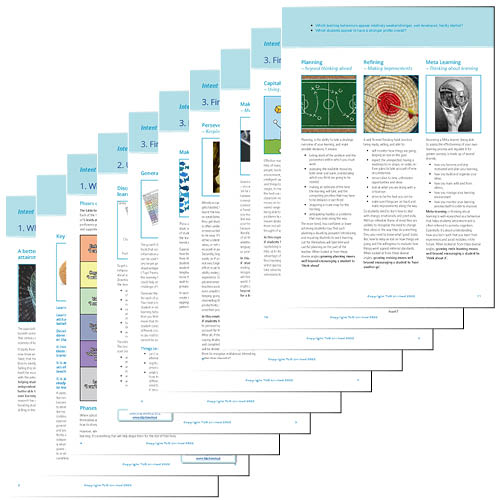
Implement (Do)
- Section 4 Shift classroom culture…explores how your classroom practice can encourage the growth of learning behaviours.
- Section 5 Start with the basics…explains the first ‘must do’ aspects of learning activities that strengthen learning behaviours.
- Section 6 A catalogue of ideas…offers a range of practical classroom solutions that are directly linked to phases of learning behaviours and blend into your teaching.
Pages 12-19 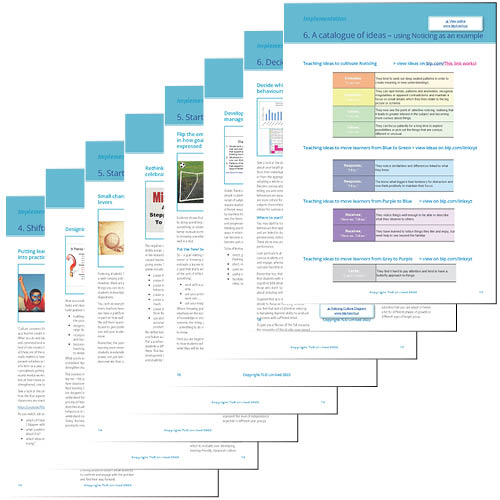
Impact (Review)
- Section 7 What is the impact?…suggests how to assess the impact of your interventions on your classroom culture, students learning and attainment.
Pages 20-21 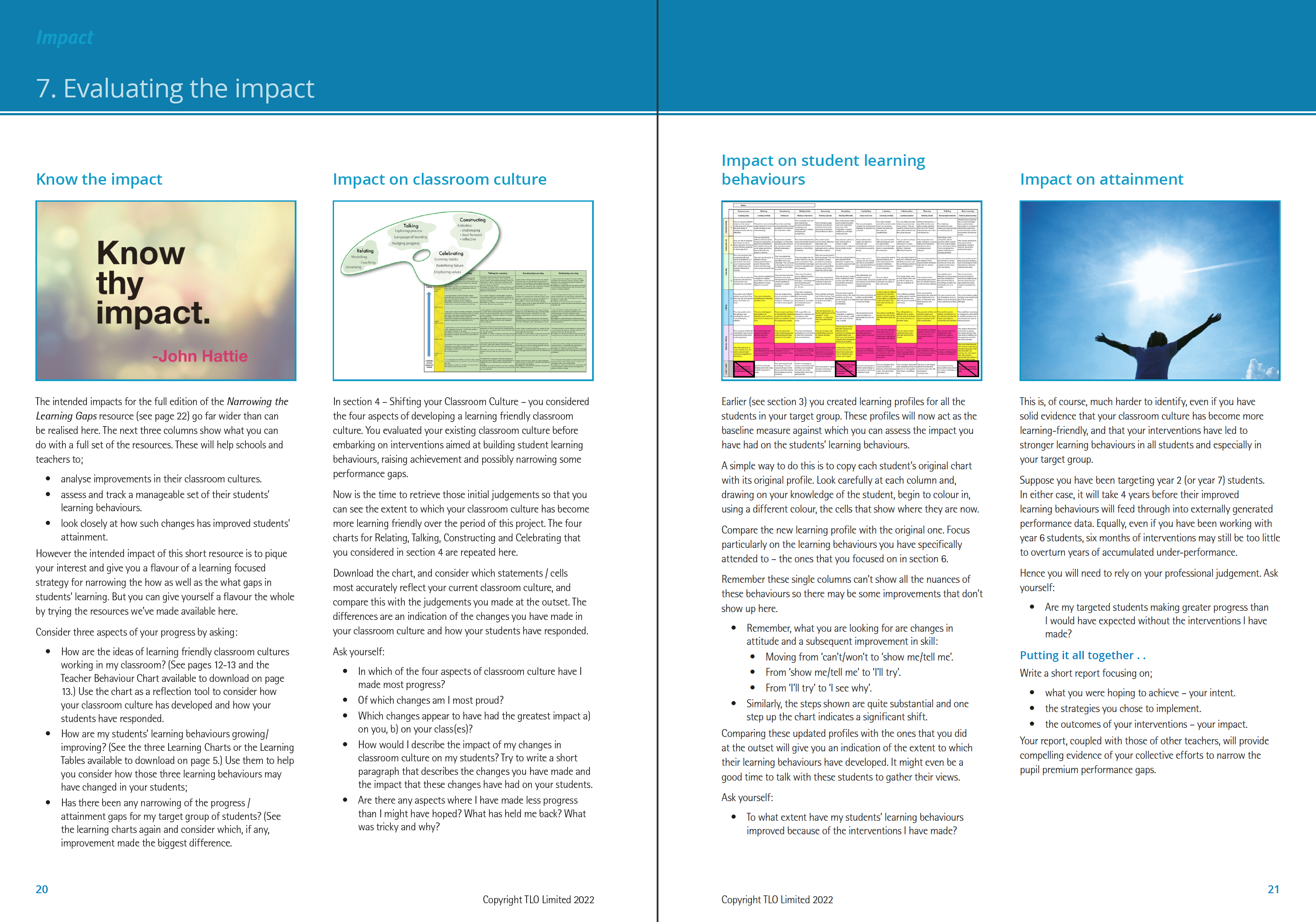
4. The where from of this resource
The approach to learning explored here comes from the vision of twenty-first century education and the new sciences of learning that underpin it. It starts from first principles: that we now know an individual’s ability isn’t fixed; that the brain is like a muscle; that its intelligence grows with exercise. Selling this idea to learners brings, in itself, far more enthusiasm for engaging with the potential delights of learning, helping students to become more independent, more reflective, and better able to plan and evaluate their own learning. This, as John Hattie’s research has shown, is a better way of boosting students’ attainment than more drilling in the subject-matter.
The great strength of this approach is that there is already a wealth of tried and tested strategies that teachers can introduce immediately to begin to transform the learning experience of their students, and give them a language with which to think about the process of learning. You can boost the development of students’ confidence, capacity and appetite for learning itself.
This resource affords teachers an insight into the skills and attitudes their students use when learning… and how to fix them.
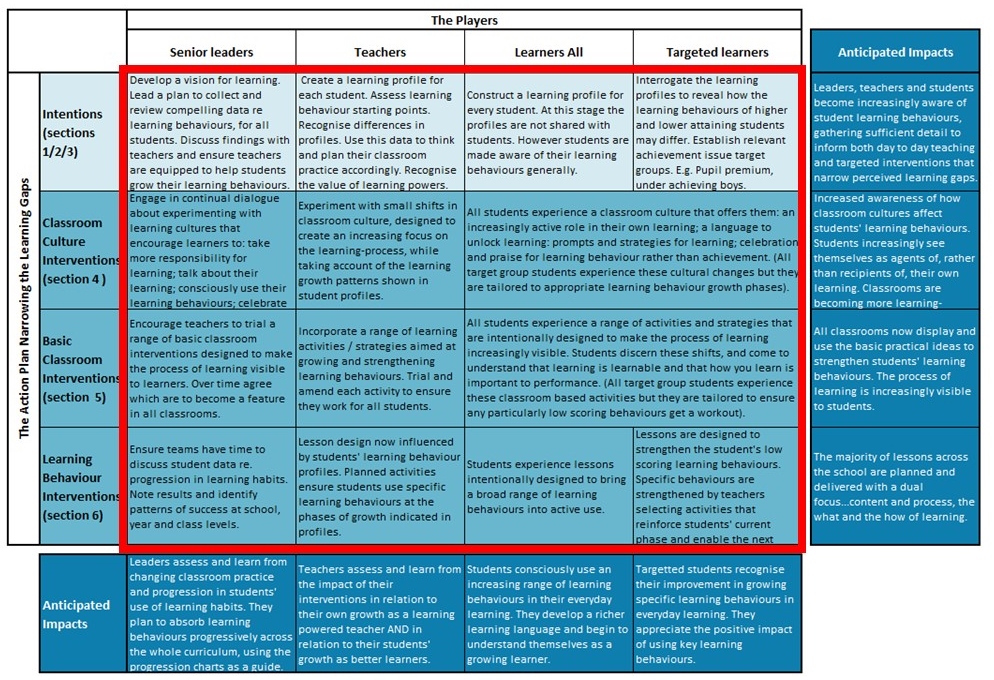
5. For the big picture thinkers who want a overview, this is the Big Picture of the course.
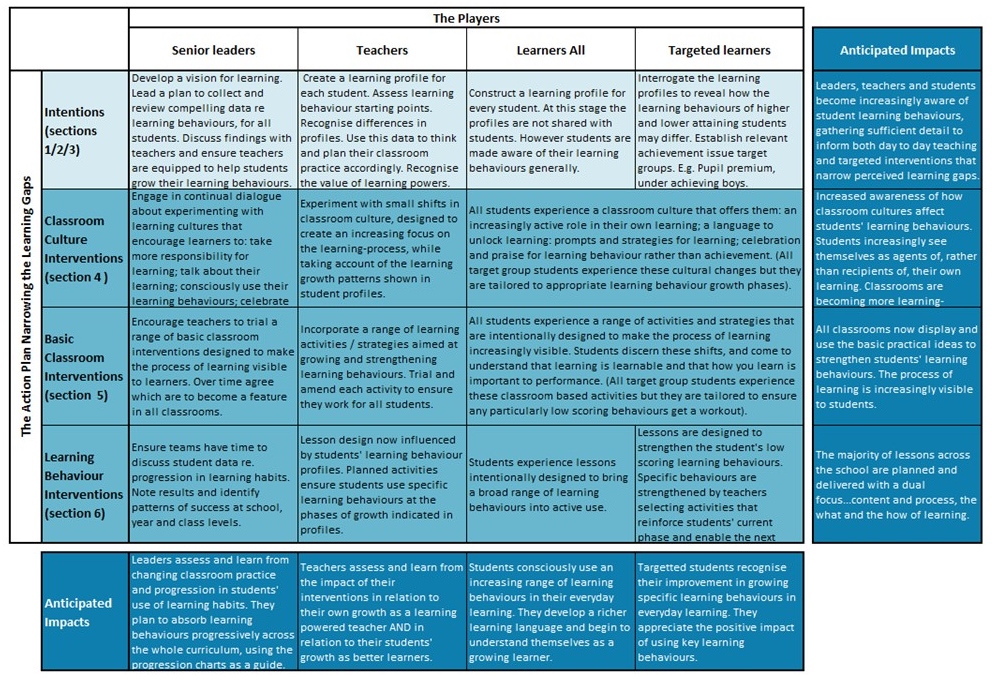
The vertical and horizontal axes of the grid
The vertical axis to the left shows 4 aspects of development process – intentions, cultural interventions, basic teaching interventions; learning behaviour interventions.
The horizontal axis across the top shows 4 groups that are involved and impacted – leaders, teachers, all learners, and targeted learners.
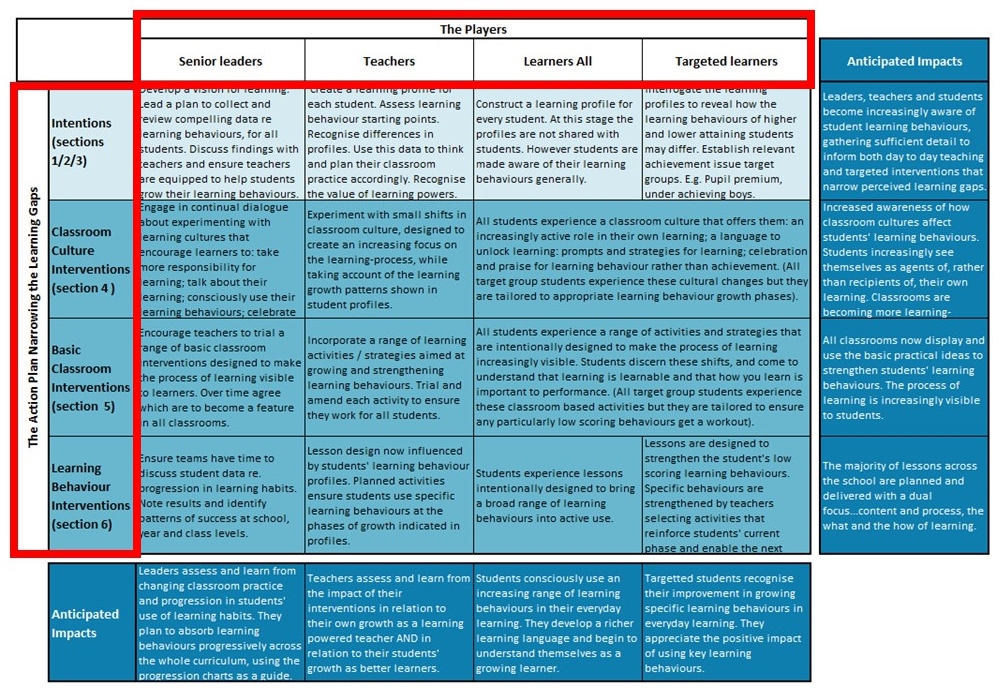
The central 16 cells:
- The text in each cell gives an indication of what needs to done and by whom;
- When looked at vertically down the page, they map out the developing role of leaders, teachers and learners;
- When looked at horizontally across the page, they hint at the ways in which the intentions and interventions will play out in practice.
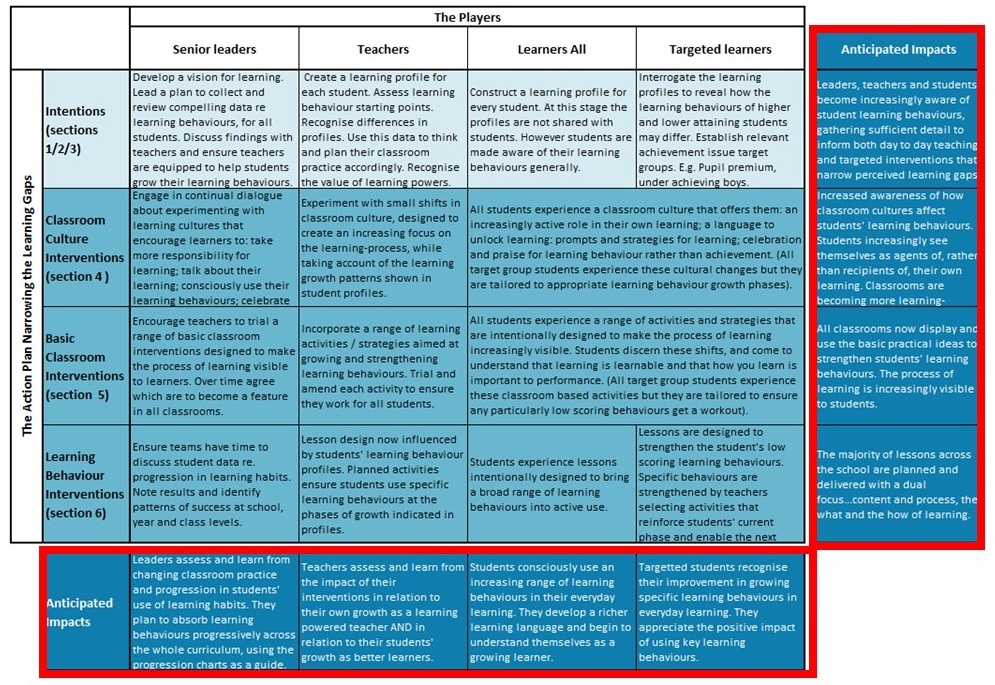
The cells to the bottom and to the right
The dark blue cells across the bottom offer an outline of the intended impact on leaders, teachers and learners.
The dark blue cells to the far right offer an indication of the intended impact of the intentions and interventions on classroom practice.
Comments are closed.