
10. Planning – Thinking ahead
Training the process of thinking ahead often starts simply by asking students to find the resources they will need to carry out a task. But planning your own learning is a sophisticated task. It involves a personal, silent assessment of your learning skills (‘What can I feasibly achieve? What am I capable of doing? What resources would bolster my chances of success?’) The more timid, less confident or lower achieving students may find such planning a daunting prospect. Introducing and requiring students to work learning out for themselves will take time and careful planning on the part the teacher. 
How well does your classroom climate encourage Planning? ⬇️
Does my classroom climate encourage Planning?
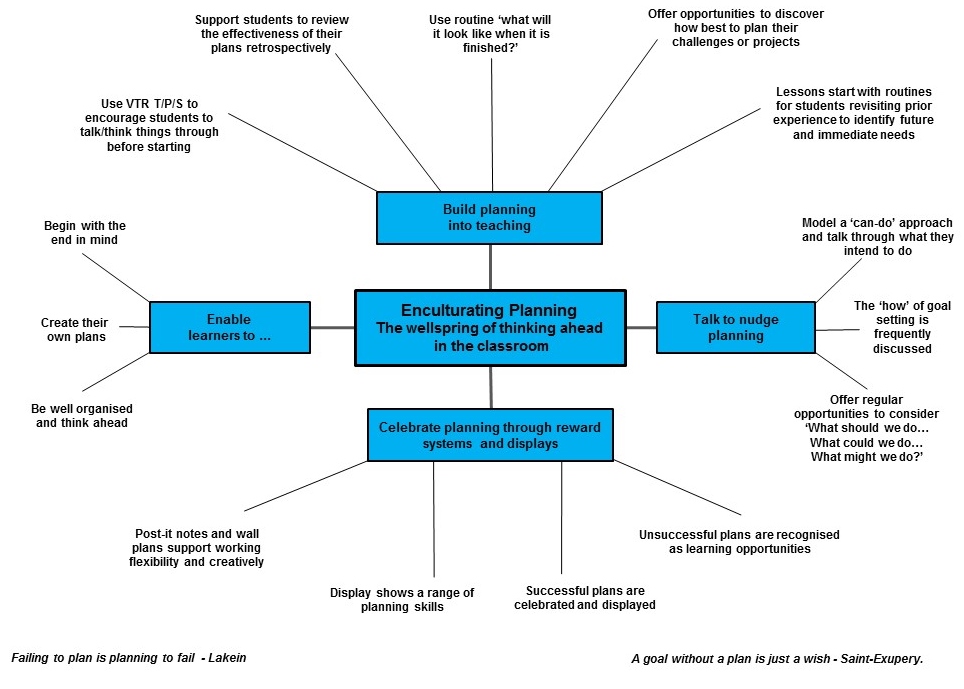
Here is a selection of features that might begin to shape the emotional climate of your classroom to encourage planning.
The diagram has 4 sections:
- Top – strategies you could build into the way you teach to stimulate planning;
- Right – indications of the sort of language you might use to stimulate planning;
- Bottom – ways in which you might celebrate / praise students’ use of planning;
- Left – things that you need to enable students to do.
Apply your own noticing and consider whether you already use any of these features and which you fancy trying.
Bridging the gaps – teaching ideas to cultivate Planning
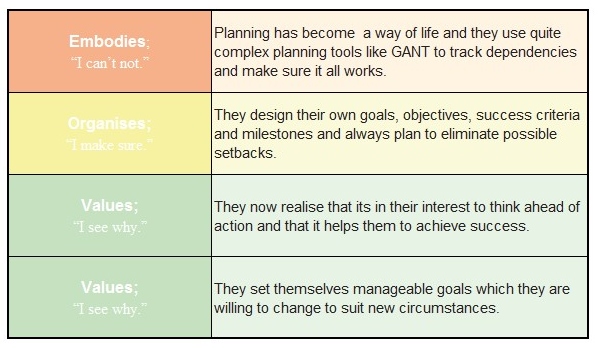
Teaching ideas to move learners from Blue to Green ⬇️
What you are trying to help your students to achieve
In the Values (green) phase, students now realise the value of planning and in particular the time it can save. Their own goals are now much more realistic, they have understood which tasks in a plan are significant and how long they might take. Their planning tools have become more complex or indeed they may have designed their own tools. They also realise that plans aren’t set in stone and may have to be amended to fit changing circumstances.
Your role as a teacher in this phase is to:
Devolve responsibility for planning… by exploring more sophisticated planning tools
Talk about planning…by exploring planning for goals through talk
Give students opportunities to practise planning…by allowing time to do so in lessons
Celebrate planning… by reflecting on, praising or displaying its use
1. Devolve responsibility for planning
Structure an extended project
Give students a pack of cards that describe the 10 or so sections in an extended project based on the Driving Question: Where’s the safest place to live? Ask them to sequence the material to make clearest sense. Ask them to give each section a generic heading.
Challenge students to prepare the outline structure for a response to other Driving Questions, for example, ‘Is Planet Earth injury prone?’ ‘Where did the dinosaurs go?’ ‘Why don’t people stay at home?’ ‘Should we choose to end a human life?’ ‘Is the idea of God more trouble than it’s worth?’
Agree with the class the generic headings for an extended piece of work – display it as an aide-memoire in the future.
2. Talk for planning
Growing the inclination to plan before taking action
To give time to planning
- Take time to decide what you are going to do
- With a good plan of action, you can do this
- Your last plan was really successful. So you could use that way of doing it again.
To believe in the value of planning ahead
- What’s it going to be like when you’ve finished?
- Why is it good to plan ahead?
- Which jobs require people to make plans?
- Fail to plan, plan to fail
To set realistic goals
- What do you want to have at the end?
- How do you want to express that as a goal
- Is that going to be possible ?
- Is your goal SMART ?
- What’s the difference between success criteria and objectives
3. Give students opportunities to practise planning
Visible Thinking Routine
How long will it take ?
This routine helps students to anticipate what needs doing and how long it might take. It also encourages them to consider the sequencing of the activity. There are three questions:
- What needs to be done ?
- What order will you do it in ?
- How long do you think it might take ?
The natural place to use this routine is prior to embarking on a piece of extended work in order to slow the impulse to ‘get on with it’ and to encourage a more strategic approach.

4. Celebrate planning
Use Learning Mats
Learning mats are A4 laminated sheets that show various aspects of a learning habit. Keep them on desks/tables or as part of a wall display.
Students refer to them during lessons, using them as prompts about the finer aspects of a learning habit that is being stretched.
A Learning Log to alert students to Planning across various aspects of their learning lives
A useful resource for tutor time to guide reflection and a wide ranging discussion.
Teaching ideas to move learners from Purple to Blue ⬇️
What you are trying to help your students to achieve
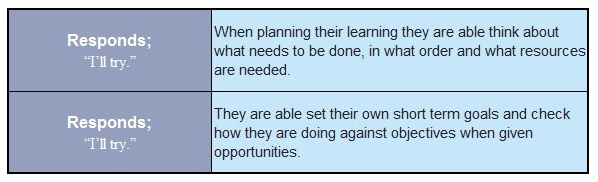
In the Responds (blue) phase, students can now set or describe their own short term goals. (I want to be able to …) They can also decide what needs to be done in order to reach the goal. They can also sequence the actions sensibly and decide what resources might help. Mind maps are likely to help them think things out and they can check how things are going as they work through their plan. This level of planning sophistication is a big step from the receive phase (purple) and this will take time to achieve.
Your role as a teacher in this phase is to:
Devolve responsibility for planning… by introducing short term planning tools
Talk about planning…by expecting them to set their own goals
Give students opportunities to practise planning…by giving students experience of ordering and resourcing short term plans
Celebrate planning… by reflecting on, praising or displaying its use
1. Devolve responsibility for planning
Introduce planning
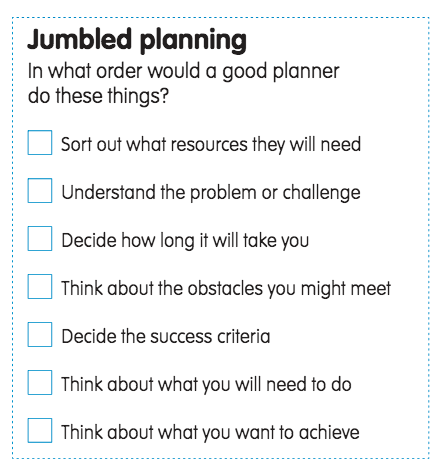
Jumbled up planning
Can you put these jumbled aspects of planning into a sensible order? Could you use the outcomes to create a planning flowchart with your class to guide future planning?
2. Talk for planning
Extend the language of planning
Collect words that tell you how people plan.
Relate planning to well-known sayings …
If you fail to plan, you plan to fail.
Hit the ground running.
Cross that bridge when you come to it.

3. Give students opportunities to practise planning
‘What will it look like when it’s finished?’
Too often students start a task without giving thought to what it will look like when it has been completed, what a good one will look like. Some find it easier to plan ‘in reverse’ – working backwards from the finished article to where they are now to establish a sensible plan of action.
Make WWILLWIF the regular precursor to any action. Ask students to determine WWILLWIF for themselves in conjunction with others. Help them to visualise this in an appropriate form.
4. Celebrate planning
TASC Wheel
Display, and use, the TASC Wheel.
A graphic organiser that is much used in primary schools to help students plan their approach to an investigation or problem. The TASC wheel, derived from Thinking Actively in a Social Context, helps develop thinking and problem-solving skills. With TASC, learners can think through a problem to the best outcome – and understand why it’s the best outcome.
But you could display this graphic organiser to celebrate how well it has been used in the task. Replace the standard words in each segment with answers to questions such as;
- What was tricky about…?
- What we found out about..,
- How we would do it differently next time
- What we are proud of.
And so on.

Teaching ideas to move learners from Grey to Purple ⬇️
What you are trying to help your students to achieve
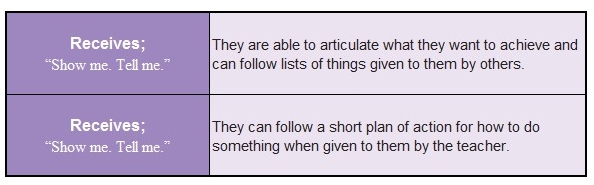
In the Receives (purple) phase, students are now using short given plans. They know what a plan is for and like following the steps. They can articulate what they want to achieve (start with the end in mind) and could make a list of what they think they need to do. These are short term plans but solid beginnings have been established.
Your role as a teacher in this phase is to:
Devolve responsibility for planning… by introducing the idea of planning
Talk about planning…by exploring with students what they want to achieve
Give students opportunities to practise planning…by having students follow and complete a short given plan
Celebrate planning… by reflecting on, praising or displaying its use
1. Devolve responsibility for planning
Planning events
A picnic for teddies
- Ask children to suggest things that might need doing and record on flip chart using picture prompts. They may well come up with ideas like food, games, music, invitations…
- Have different groups to plan each part. Support each group in turn
- Discuss what needs doing for one aspect of the picnic and act as their scribe. Summarise their plan back to them when everything is agreed.
- Bring everyone back together and share each aspect of the plan.
- Ask the children how they think they can work together to get everything ready for the party. Keep referring to the plan.
- This is also a very good exercise in collaboration and will offer lots of opportunities for revising as well when things need changing from the original idea.
Or, for older students . .
A party for pensioners
Tell students that they are going to plan an upcoming event, perhaps a party for pensioners or the like. Obviously lots of things need to be planned to make sure it goes well.
- Discuss together and record the things that might need doing.
- Assign groups a particular aspect of the event to plan.
- Gallery the completed plans.
- Is one plan, or planning format, particularly effective? Why is that?

2. Talk for planning
Discuss planning
Design a planning sheet to use with the children when you are planning an activity with them. You might include these and other headings:
- What are we trying to achieve? (agreed goal, outcome)
- How will we know we have been successful? (success criteria)
- What do we need to do? (actions, jobs)
- What will help us? (resources)
- What might be a problem? (traps, obstacles)
- What will we do about it? (What-if or contingency plans)
- Who will do what? (roles) [Simplify according to age range.]

3. Give students opportunities to practise planning
Clapping a pattern
Planning a short rhythm
- Sit pupils in a circle. You are going to clap a short rhythm for them, but first of all you are going to plan it.
- Think aloud as you plan what you are going to do. Mention “Beginning”, “Middle” and “End”. Then clap the pattern you have planned.
- Ask if they want to listen again and then have a go with you. Explain you remember it because you planned.
- Pupils to work in pairs to plan a short clapping pattern of their own. Practise with their fingertips on their palms so that they don’t disturb each other too much.
- Ask them to perform their rhythm in pairs for everyone to listen to. Some may also like to try to teach it!
- The emphasis is on planning what they are going to clap rather than just clapping straight off.
- You may want to encourage pupils to make some kind of paper plan with a mark for every clap.
Follow a treasure map
Plan a treasure hunt around the school. This could have a seasonal theme or simply be a fun one. Use a small area of the school and make a very simple large scale plan. Attach photographs or drawings to help the children follow the plan. Take them on the treasure hunt in small groups and regularly refer to the Treasure Map as a plan.
4. Celebrate planning
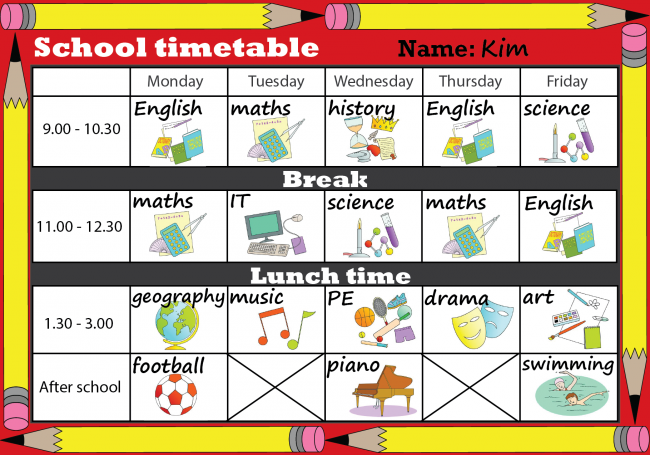
Display timetables …
Ask the students to think of other things that need a timetable or plan. Start a display table and board of anything the students suggest or collect. You could find some bus and train timetables, a plan of the school and playground or a dinner menu for the term and so on.
Click to enlarge

Comments are closed.