
12. Meta Learning – Thinking about learning
Becoming a meta-learner is about being able to assess the effectiveness of your own learning process and regulate it for greater success. It has several strands; how you become and stay motivated and plan your learning, how you build and organise your ideas; how you learn with and from others; how you manage your learning environment and how you monitor your learning process itself in order to improve. When looked at from these diverse angles, growing meta-learning moves well beyond encouraging a student to ‘think about your learning’.
How well does your classroom climate encourage Meta-learning? ⬇️
Does my classroom culture encourage Meta Learning?
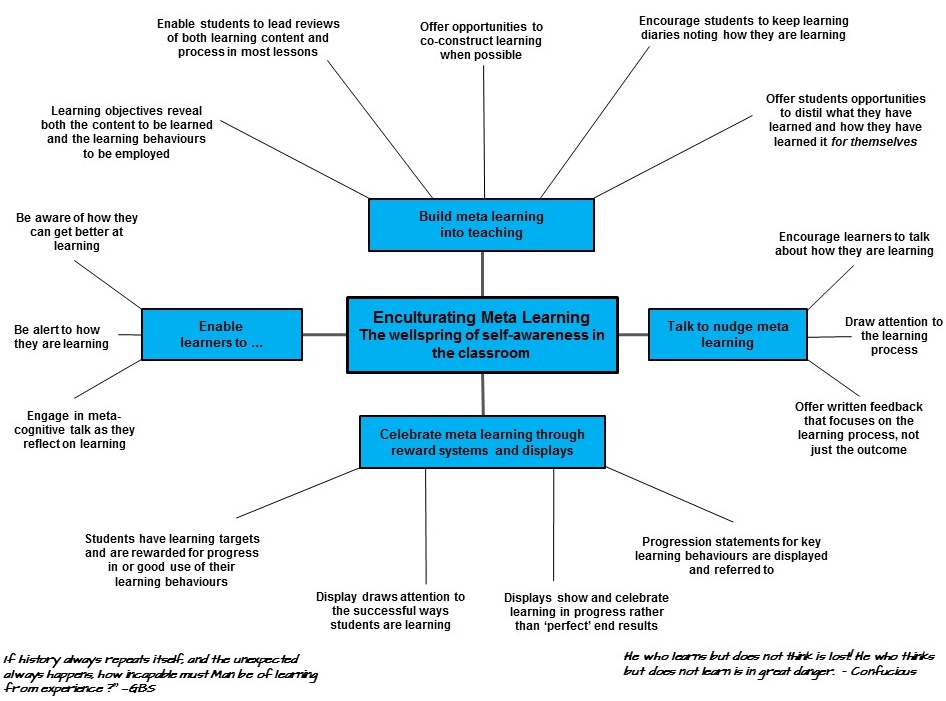
Here is a selection of features that might begin to shape the emotional climate of your classroom to encourage meta learning.
The diagram has 4 sections:
- Top – strategies you could build into the way you teach to stimulate meta learning;
- Right – indications of the sort of language you might use to stimulate meta learning;
- Bottom – ways in which you might celebrate / praise students’ use of meta learning;
- Left – things that you need to enable students to do.
Apply your own noticing and consider whether you already use any of these features and which you fancy trying.
Bridging the gaps – teaching ideas to cultivate Meta Learning
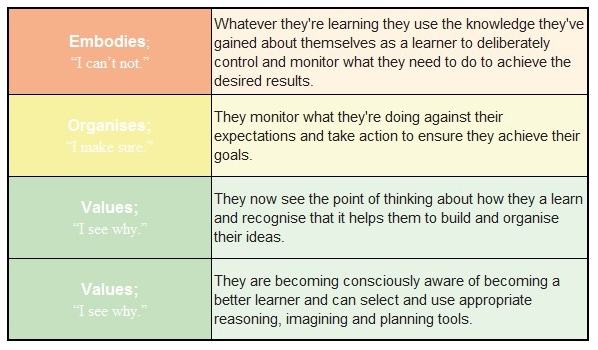
Teaching ideas to move learners from Blue to Green ⬇️
What you are trying to help your students to achieve
In the Values (green) phase, students are aware of how their learning is growing and they are careful to capture this new awareness in drafts or models or trial artefacts. They are moulding their environment to meet their needs and their enthusiasm helps them to keep going and manage distractions. They are using a wide variety of learning methods and value the opportunity to discuss things with others. They are consciously aware of keeping all these elements on track.
Your role as a teacher in this phase is to:
Devolve responsibility for meta learning… by encouraging students to use rough note books to capture draft thinking/models/diagrams
Talk about meta learning…by exploring through talk.
Give students opportunities to practise meta learning…by allowing students time for self-monitoring to keep themselves on track
Celebrate meta learning… by reflecting on, praising or displaying its use
1. Devolve responsibility for meta learning
Find out what students know about themselves as learners
A learning fitness quiz
Use this quiz to get students thinking about the process of learning and how they are as learners.
2. Talk for meta learning
How do you want / need to improve as a learner?
The question itself is deep and searching. It requires the student to have an accurate assessment of their existing learning strengths and weaknesses, and to have identified particular aspects on which they wish / need to work.
Supplementary questions along the lines of ‘what are you actually going to do to achieve that?’ forces the move from wishful thinking to action planning. Such questions, asked to students who understand their learning strengths and relative weaknesses, should elicit fluent responses. But for many, initially, you will need to be prepared to scaffold the conversation, to provide suggestions and to offer strategies that might be employed.

3. Give students opportunities to practise meta learning
Linking ‘Learning Objectives’ and ‘Learning Behaviours’
Rather than telling students how they will need to be as learners to be successful, share your Learning Objectives / Success Criteria and invite them to discuss and agree the types of learning behaviours that they expect they will need to use in the upcoming lesson / activity.
Ask:
- Why did they choose those particular behaviours?
- Have they missed any key ones?
- How precisely will they use these key behaviours?
- How will they monitor the use?
- What are their Success Criteria for the use of these key behaviours?
- What are my own?
Create opportunities for reflection
Pay equal attention to what has been learned and how it has been learned in plenaries and review points. Encourage students to describe and discuss the learning behaviours they have been employing. Build in such moments for reflection whenever possible.
You might use a Rating Wheel to capture their thinking – colour in the segments according to how much they feel they have used the learning behaviour.
4. Celebrate meta learning
Exploring how we learn best …
Firstly share what you know about yourself as a learner. No need to go into too much detail or it may limit students’ ideas – just enough to get them going. Try things like ‘I learn best when I think ahead’, or ‘I learn best when I think about what I already know about this.’ etc.
Then have students work with a partner. One talks about when they learn best, while the other produces a spider diagram capturing the main points. Then they swap places so that each generates their partner’s spider diagram.
Use the spider diagrams as a basis for exploring similarities (and differences), and to produce a class spider diagram showing ‘how we learn best’. Make it into a display that can be referred to by yourself and by students.

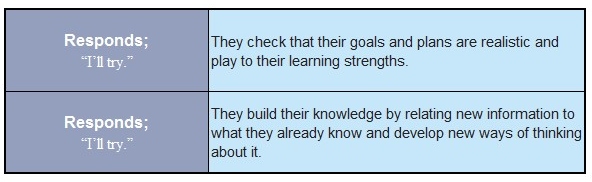
Teaching ideas to move learners from Purple to Blue ⬇️
What you are trying to help your students to achieve
In the Responds (blue) phase, students have the developed the skill of knowing what they want to achieve and be motivated to do so. They can visualise the broad direction they want to go in, call on others to guide their thinking and make a realistic plan based on their learning strengths. This phase is a big step up from the one before; it requires a broad range of skills which are undertaken consciously. (eg visualising, being aware of their learning skills, goal setting, outline planning, choosing surroundings.
Your role as a teacher in this phase is to:
Devolve responsibility for meta learning… by stimulating interest in learning itself
Talk about meta learning…by exploring how learning happens
Give students opportunities to practise meta learning…goal setting and early planning
Celebrate meta learning… by reflecting on, praising or displaying its use
1. Devolve responsibility for meta learning
Learning Detectives
What do I need ? A phone/camera that takes video footage
What is it for ? Capturing learning in action
How might I use it ?
Arm students with a phone/camera. Dedicate time for them to record successful learning moments in their class, and elsewhere around the school.
Appoint some as Learning Observers whose role it is to video learning and to feedback on what they have seen and why they chose to record it.
Consider creating a prompt sheet to formally record information relating to the footage.
Build a video montage of learning in your classroom/school. Use it to illustrate good learning behaviours and to encourage students to reflect on their own role, strengths and weaknesses as learners.

2. Talk for meta learning
To encourage students to check the quality of their goals / plans
- You could ask yourself if your goal or plan is realistic?
- How long do you think it might take you?
- You might think about whether you’ve got the skills necessary for this?
- If not, what could you do?
To help students to connect with prior learning
- Ask yourself how this fits with what you already know.
- How is this connected to what you already know?
- Ask yourself what this reminds you of.
- How does this fit with YOUR big picture?

3. Give students opportunities to practise meta learning
Flip the emphasis in how goals are expressed
Evidence shows that goals that relate to doing something or researching something, or creating something . . . ) are better motivators than goals that relate to knowing something or passing / doing well in a test.
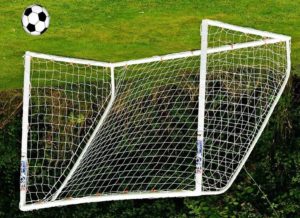
Put the ‘how’ before the ‘what’.
So – a goal relating to ‘understanding xxxxx’ or ‘knowing yyyyy’ is less likely to motivate a learner to make the effort than a goal that starts with some indication of the sort of ‘effort’ or way of doing something;
- work with a partner to decide why…….
- use your problem solving skills to work out……
- use your imagination to ….
Where ‘knowing goals’ place the emphasis on the successful acquisition of knowledge or creates a pass/fail scenario, the ‘doing goals’ focus on how – something to do rather than something to know.
What you are doing here is beginning to alert students to how they will be learning as well as what they will be learning.
Establish reflecting on learning as a classroom routine
- Begin each lesson with ‘Tell me Three … things we learned last lesson; ways we learned last lesson; things we still need to find out; things you hope to achieve today’.
- End each lesson with ‘Tell me Three … things we learned today; learning skills we used today; things we need to do next lesson; ways you could become a more effective learner’ etc.
- Ensure that students tell you three. Do not lapse into doing it for them!
4. Celebrate meta learning
Celebrate learning behaviours
1 Design stickers such as ‘Proud to be a learnatic’ and encourage students to show how proud they are to be learners. This is a simple and fun way to recognise efforts and they also get parents asking what it’s all about when they wear them home with pride. What would your students’ fun phrase be for ‘into learning’ stickers?
2 Use circle / form time to discuss learning each week and to positively identify students who learned well. Initially the students who are seen as being traditionally successful will be selected; good students as opposed to good learners. However, as discussion gradually changes through your modelling, the students will begin to realise that just because someone doesn’t get it ‘right’ doesn’t mean they aren’t a good learner. Talk about students who really persevere with their learning in, say, a science investigation by repeating the test when it had gone wrong. Or someone who has imitated the process a friend had used to solve a Maths problem, showing that copying how it had been done was fine. The students quickly come to value how they learn and take greater notice of how others learn too.
3 Write to learners on celebratory paper to congratulate them on their learning. Find a sheet of ‘special’ paper that is instantly recognisable. Write a short letter to a student when you notice impressive learning. You could leave it in their tray, send it home by post, attach it to their recorded learning on a display; whatever suits you and the child.

Teaching ideas to move learners from Grey to Purple ⬇️
What you are trying to help your students to achieve
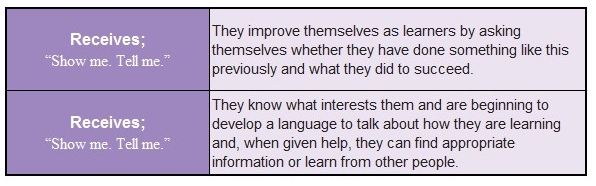
In the Receives (purple) phase, students are aware of what interests them and how to find information. They know that some surroundings are better than others for learning and that they can learn from other people. They are showing an interest in learning and enjoy finding out about lots of things.
Your role as a teacher in this phase is to:
Devolve responsibility for meta learning… introducing what learning as about
Talk about meta learning…by exploring students role in learning
Give students opportunities to practise meta learning…by exploring who and what can help them to learn
Celebrate meta learning… by reflecting on, praising or displaying its use
1. Devolve responsibility for meta learning
Give pupils a practical understanding of tools for learning
Discuss learning behaviours and link each one with a practical tool, following children’s ideas about the links. Display pictures of the tools labelled with the behaviour they represent. Collect real tools to be handled in class. When talking about learning behaviours ask pupils which tool would help them to learn something and why.
They will soon able to go and fetch say, a notebook representing planning, before going outdoors to build a rocket, or the mirror of imitation if they were going to learn by watching someone else first.

Send learning home and stimulate learning conversations
Select or create a soft toy and give it a name …Pansy. Develop Pansy as a well-loved model learner. Encourage pupils to consult Pansy to see how she would learn something new. When Pansy is well established in the classroom begin to send her home with pupils. By taking Pansy home for an evening or a weekend children are encouraged to talk about their learning… how/what they are learning at home as well as school. When back in school encourage pupils to write about what they learned with Pansy in their learning journal.
Where this idea has been tried with younger children, parents noted that the children were better behaved when Pansy ‘came to tea’ and asked when she could come again! This simple idea helps children to understand that learning can happen in environments other than school.

2. Talk for meta learning
Explore what do good learners actually do
Open up a conversation with students about what good learners do. At this phase, their answers are likely to be shallow and lack precision. This will be because they have not really thought of themselves as learners as yet, preferring perhaps to view themselves as people who are taught things. Equally the lack of a language with which to discuss the process of learning will be a second inhibiting factor.
Focus on someone they perceive to be a good learner. Ask questions like:
- What do they do?
- What don’t they do?
- What makes them successful?
- What do they believe?
- How do they approach their work?
Answers will, at this stage, be weak. Try to move students beyond simplistic notions of ‘(s)he is a good learner because they are clever’ to exploring what they actually do in order to succeed – shift the focus from ability to effort.
3. Give students opportunities to practise meta learning
Introduce learning through story
Our learning friend
The purpose of this story is to introduce thinking about learning. It doesn’t by any means introduce all the learning ‘muscles’ but it begins to focus thinking about how we learn and what it is that good learners do. It offers a way to introduce the idea that there are very particular things that we can learn how to do that will help us to become better learners.
Does your class need a ‘learning friend’?
Time to think … and share ideas
In a small group — Think of something that one of you is good at that the others would like to learn … could be a sport or a school subject, playing an instrument, playing a game, making a drawing.
Interview this person about what goes on in their head when they are practising the skill.
Try questions like;
- What have you tried that didn’t work?
- Can you describe what ‘better’ means?
- What goes on in your head when you are doing it?
- Do you talk to yourself whilst you are learning? – What do you say?
- How do you get better at this?
- What different ways do you try?
- When is it best?
- What hinders your learning?
- What helps you to learn?
4. Celebrate meta learning
Rating your learning behaviour
The Rating Wheel enables students to reflect on and record the extent to which they are using their learning behaviours. They colour in each ‘spoke’ depending on how much they believe they have used the behaviour, and end up with something like this:
It can be used to review a particular activity, at the end of the learning day, or even to look back over a week. Alternatively, ask students to think about their learning lives beyond the classroom – where and when do they use these skills when they are not in school?
Create a ‘What good learners do’ display, and add to it as ideas develop over time.


Comments are closed.