
Perseverance is about;
Keeping going in the face of difficulties; channelling the energy of frustration productively; knowing what a slow and uncertain process learning often is.
A mature learner understands that real learning requires effort and persistence, relishes opportunities to struggle with challenge, and believes that with effort they can become a more effective learner.
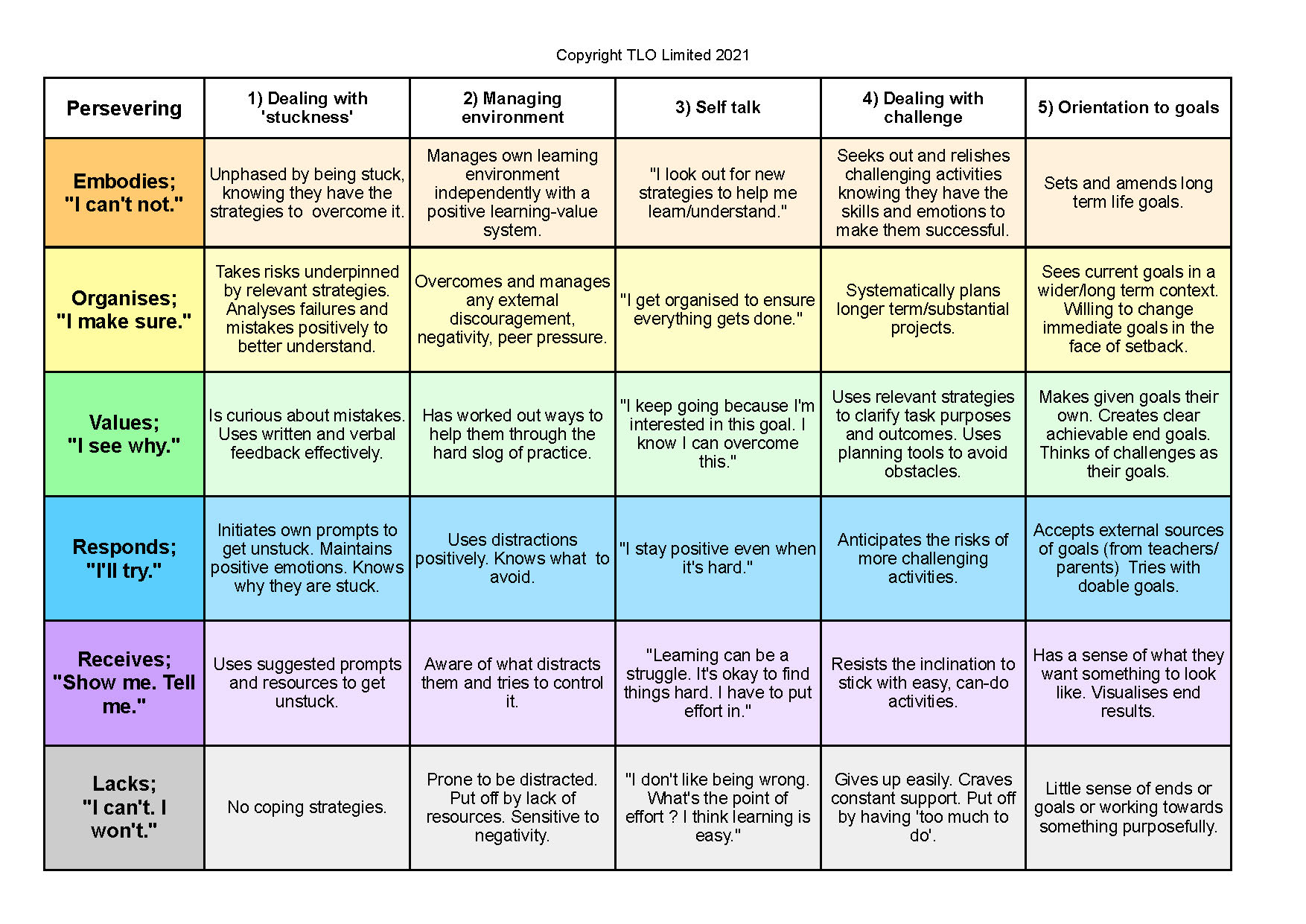
Perseverance grows and builds when it’s nurtured and supported. Furthermore, being perseverant involves gaining control of a range of linked skills and emotions. Take a look at how progression in Perseverance might grow across five components.
Overview of the grid
Perseverance is about the way we stick at things even when they are difficult. It’s one of the most useful but neglected learning behaviours. What makes us able to persevere more and more usefully? We think several things come into play here. How you are willing and able to deal with being stuck, how you are able to manage distractions and manage the learning environment, how you relate to a challenge and whether you are influenced by goals whether they be your own or imposed by others. All these things contribute to being able to persevere. And lastly there’s your own little voice of self-awareness: what you say to yourself and how this influences your beliefs and values.
Take a closer look at what each column of the grid is about
Unpick the rows; getting better at Perseverance
Of course the development of Perseverance does not grow neatly up each column or evenly across the phases in the grid. The five broad phases of dispositional growth (purple – orange) are affective ways in which people may be inclined to behave: we call this inclination ‘mindedness’.
Meaning behind the phases
The phases are drawn from Bloom’s taxonomy of the affective domain.
Phase ‘Receives’ (purple) is about doing something because you are told or expected to.
Phase ‘Responds’ (blue) is about gaining interest and doing things more willingly.
Phase ‘Values’ (green) is a key phase since the student now sees the value of behaving in this way. It’s a win for them; to behave like this is in their interest. It’s in this phase that the behaviour becomes more secure.
Phase ‘Organises’ (yellow) is the phase in which the student capitalises on this ‘in their interest’ behaviour and gets themselves organised to use it positively.
Phase ‘Embodies’ (orange), known as ‘characterised’ in the original taxonomy. In this phase the student has made this behaviour their own. It has become part of their character; they can’t not do it and they have become highly skilled in doing it.
We urge you to see this progression as long term. Some phases will take years for people to work through; some will never be worked through. None of the phases are inevitable. There is a lifetime of development captured here. Nevertheless the role of a teacher or parent should surely be to encourage and enable this journey.
Comments are closed.