
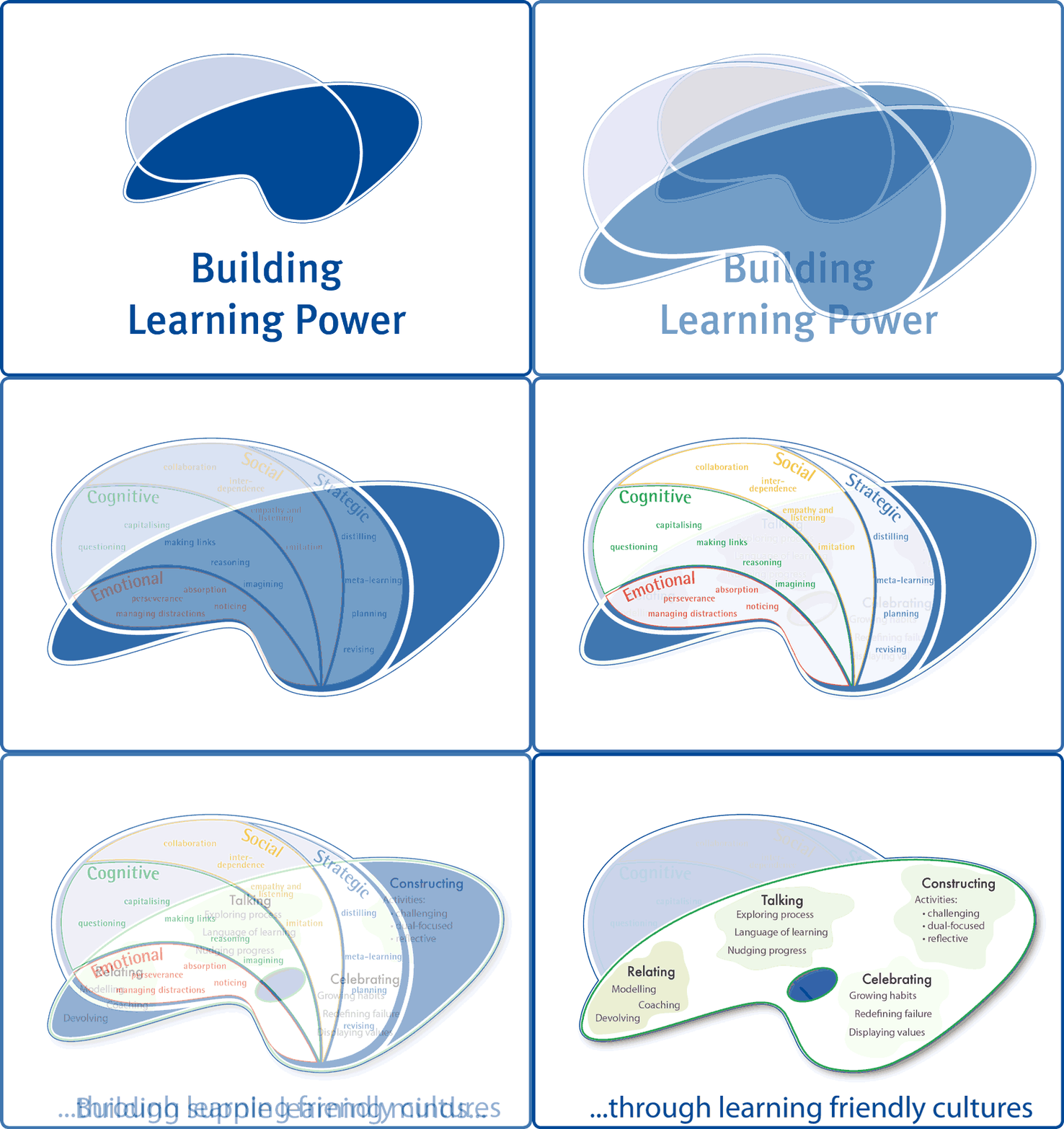
Why a learning power ‘game’?
Games can be used as a metaphor for learning anything and you tend to get better at anything if you treat it as a game. This programme is about learning to play the familiar game of learning but with an additional ingredient; that of learning dispositions or powers. This subtle addition changes the game of education to one of building learning character at the same time as building knowledge. So the programme explores certain guidelines and conventions that help to frame learning in ways that allow positive learning dispositions to flourish…how you might set up the game, get to grips with some new rules and tactics and learn to appreciate how you score it’s all important new endgame…that of the self-managed learner.
As with any game, it helps if you’re enabled to play the whole game from the start. If you were learning to play Scrabble you wouldn’t get far if all you were given to learn were lists of three, four and five letter words. Far better to start straight away by playing ‘Junior Scrabble’, so you get the feel for the whole game, and then build up your sophistication as you play.
So you might look on the programme you’re about to follow as the junior game of learning power. It has all the elements you will need to introduce the values and activities of building your students’ learning power. This junior game lays the foundation for greater sophistication in further programmes.
1. How the online course is designed
Section structure…
Each section deals with a key aspect of understanding learning power and has:
- an introduction to what it is about … followed by some suggestions about how to ‘navigate’ the content
- part 1 aims to give you an idea of the sort of practice you are aiming for
- part 2 highlights the main ideas of the section’s content
- part 3 offers a few practical ideas to start things off
- part 4 offers a couple of tools to help you evaluate what you have read
- part 5 offers an agenda for a Professional Learning Team meeting
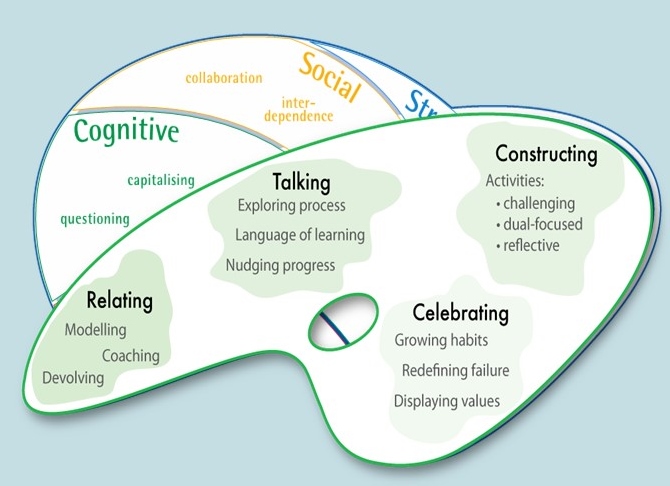
Find out more about the content of each section of the online course
The content of each section of the course
Section 1 What do we mean by learning power?
The underlying ideas, research and models
Here you will find:
- the two interlinking models of building better learners
- examples of how the models work in practice;
- the four learning behaviours to make a start on – perseverance, questioning, collaborating and revising
- the essential aspects of classroom practice
- links with educational research
- encouragement to try things out with your learners
- suggestions for how amendments to your teaching will help students to be better learners
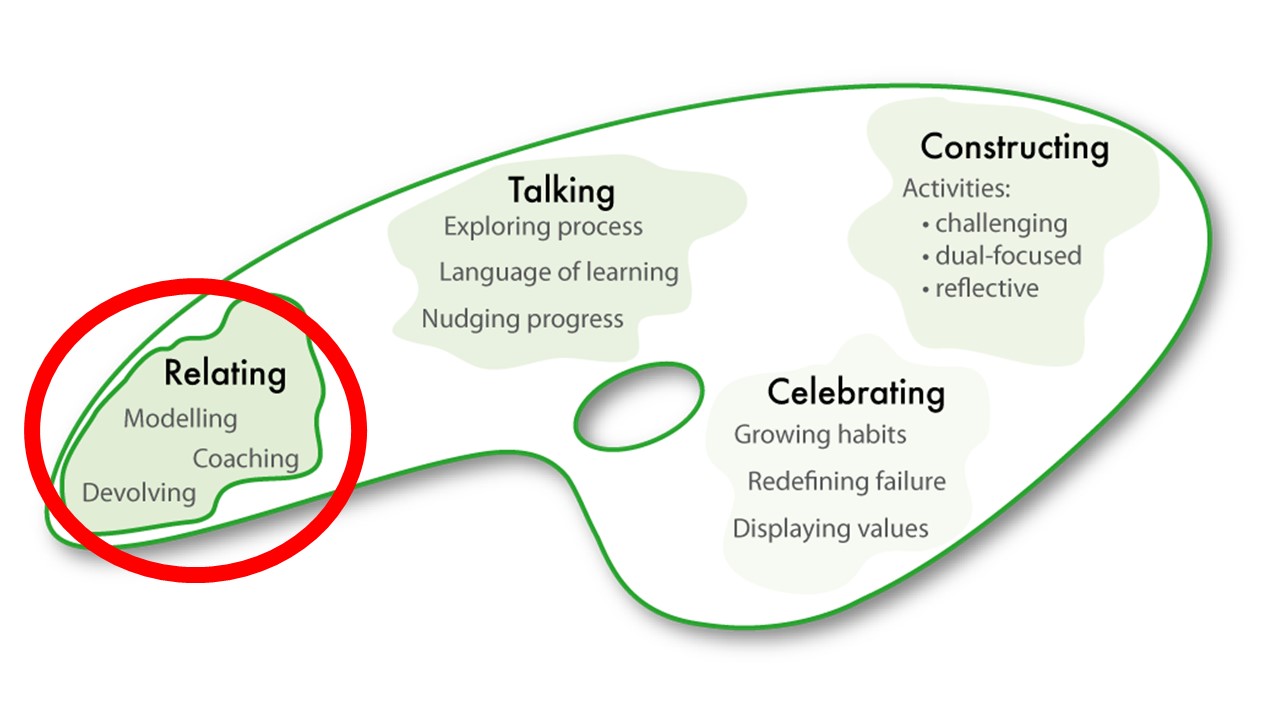
Section 2 Classroom relationships
Important shifts in classroom roles
Here you will find:
- examples of the sort of responsibilities teachers might devolve to learners
- examples of different ways to be as a teacher
- modelling the process of learning
- acting as a coach; asking not telling
- enabling greater learner responsibility
- examples of things to try out with your learners to enhance perseverance, questioning, collaboration and revising
- suggestions of ways to plan to expand devolving responsibility to students
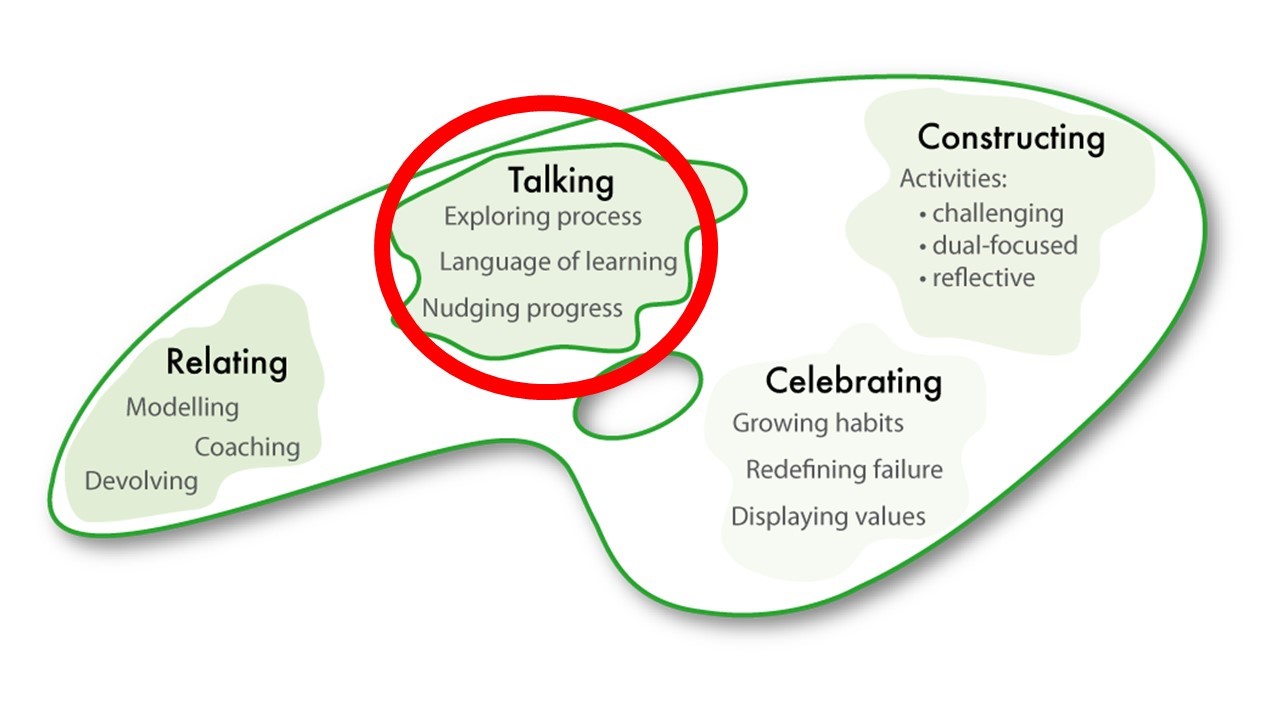
Section 3 Talking about learning power
How and when to talk about learning.
Here you will find:
- examples of how learners can talk about themselves as learners
- examples of different ways to talk about learning
- nudging the process
- offering feedback
- encouraging reflective self-talk
- examples of things to try out with your learners to enhance perseverance, questioning, collaborating and revising
- suggestions of ways to plan to expand your learning language
Section 4 Designing learning powered lessons
How to begin to put dual-focused lessons together
Here you will find:
- examples of how teachers manage learning in their lessons
- explanations of different ways to plan for learning
- long term planning
- medium term planning
- lesson planning
- a format to assist in planning dual-focused lessons
- activities to help start this journey
- examples of things to try out with your learners to enhance the foundational four learning behaviours
- suggestions of ways to plan to expand your lesson design

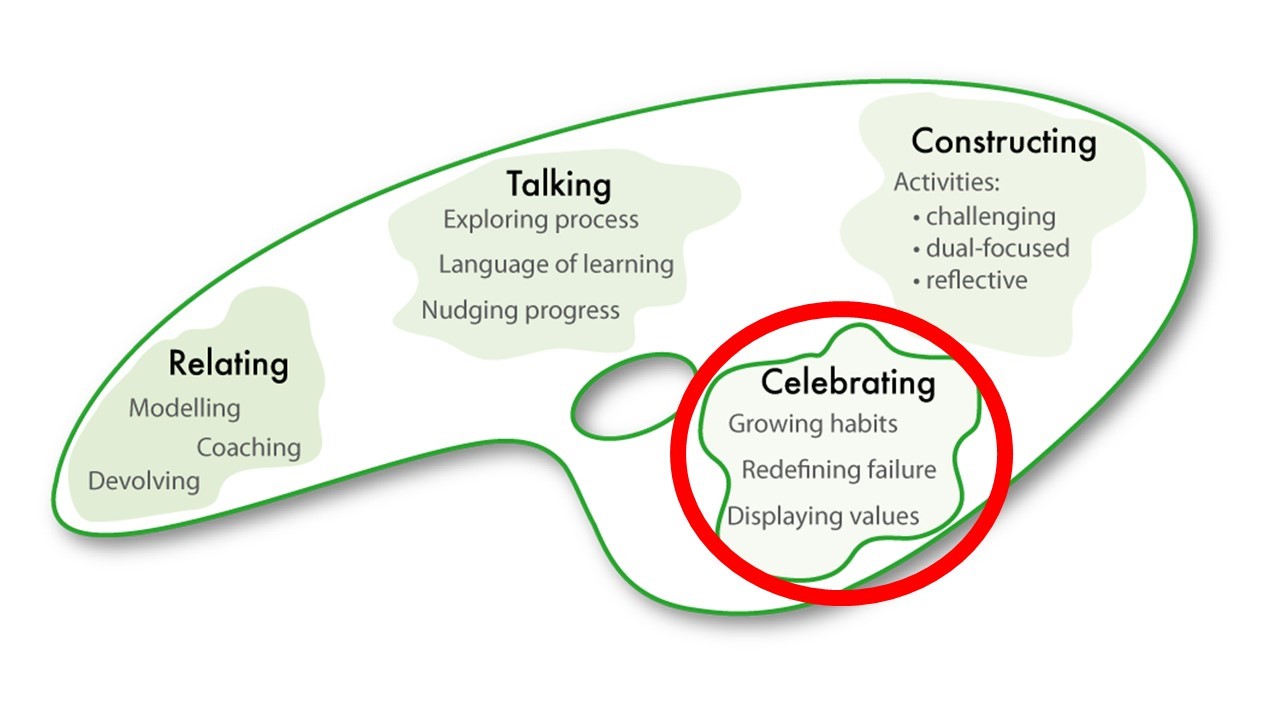
Section 5 Celebrating learning power
What’s seen as important in learning friendly classrooms
Here you will find:
- examples of how learners can celebrate their learning
- examples of different ways to celebrate learning
- in the growth of learning behaviours
- in re-defining failure
- in displays in the classroom
- encouragement to try things out with your learners
- suggestions of ways to plan to expand what you celebrate about learning
Section 6 How are our learners developing?
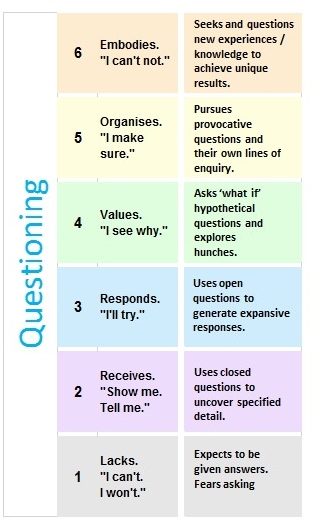
What to look for and record about better learning
Here you will find:
- explanations of three aspects of progression – frequency, scope and skilfulness in use
- Charts showing what the phases of growth look like in relation to;
- questioning
- collaboration
- perseverance
- revising
- examples of things to try out with your learners
- ways of tracking the growth of learning dispositions over time
- suggestions of ways to plan to expand what you might track about learning
Section 7 Where now: what next?
Here you will find:
- explorations of ways forward
- tools to help you consider your growth and development as a teacher
- descriptions of the next stage online courses to support teachers’ journey to becoming a skilled learning power practitioner
- a quick look at professional development approaches you might use in furthering your journey

2. How the wider blended learning programme works
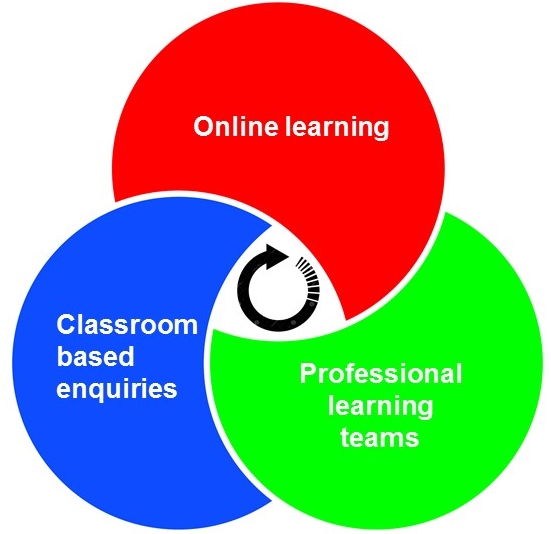
‘Playing the Learning Power Game’ is simply the online content aspect of the blended learning programme which, unless it’s blended with Professional Learning Teams and Classroom Based Enquiries is unlikely to help you achieve the desired outcomes.
A Professional Learning Team is your support mechanism in the blended learning cycle. We hope that time for PLTs has been built into the rhythm of the school’s meeting cycle, and offer you a safe, supportive space to discuss and explore the craft of the classroom. We hope to that PLTs will encourage you to learn with and from your colleagues – to become, in John Hattie’s words, ‘learners of their own teaching’.
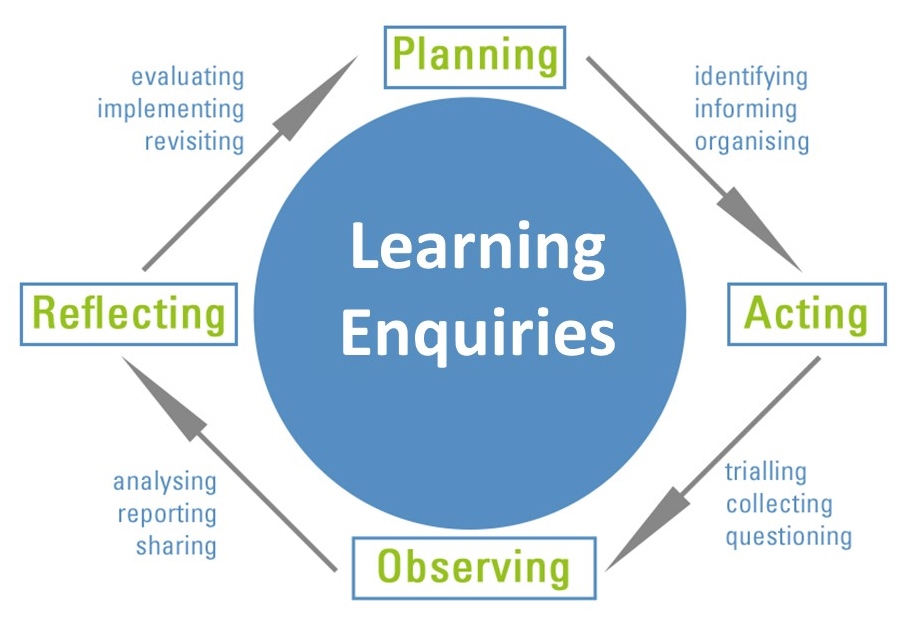
Classroom Based Enquiries are the third aspect of the blended learning programme. Sometimes known as Action Research, classroom based enquiries involve changing aspects of your practice in order to develop student learning behaviours. Enquiries are likely to involve you in making small changes, monitoring the impact of those changes, and sharing these outcomes at the next team meeting for professional discussion.
Most schools tend to blend these 3 aspects into a 4-week cycle.
2a. Talk, support and plan with colleagues
Professional Learning Teams; small groups of teachers who meet together regularly (usually monthly) to deepen their understanding of learning and how, by developing their classroom practice, they can make the learning process more visible and relevant to students.
The team learns and develops by:
- discussing and unpacking the online information;
- planning how to make use of it in their classrooms;
- questioning and probing their classroom experiments.
The delicate, hard work of changing practice requires a safe professional environment in which to explore and understand classroom triumphs and tribulations. The short guidelines (see download) are designed to be help a team set a collaborative, working climate to support the conversion of information and ideas in the online materials into “lived” practices in classrooms.
The format of a meeting agenda below is based on research into teacher learning communities by Dylan Wiliam, of Assessment for Learning (AfL) fame.

Learning Team meeting agenda. A resource to help structure PLT meeting
This team session is your first one in Playing the Learning Power game so it will be essential to spend the first part of the meeting considering the purpose and working guidelines for the team.
Session agenda
- Agreeing objectives and agenda (5 mins)
- Considering working practices (15 mins)
- Re-capping the on-line materials (15 mins)
- Personal Action Planning (20 mins)
- Evaluating the meeting process (5 mins)
1. Session objectives: What do we want to achieve? (5 mins)
- Feel confident about working as a team
- Feel able to apply the on-line materials in the classroom
- Decide the strategic cultural issues that everyone needs to apply in their classroom
- Plan some do-able shifts in classroom practice
2. Consider the working practices of the team (15 mins)
- Purposes of the group
- Format of the sessions
- Ground rules for working
- Expectations of outcomes
- See What-Why-How of PLT notes above for ideas
3. Recapping on-line materials: What did the content make us think? (15 mins)
Thoughts about:
- the progression from teacher focused cultures to learning focused cultures (section 2e)Culture review tool 1 ( three panels)
- where do most classrooms operate in relation to the three panels?
- which of the four learning behaviours need most assistance? (perseverance, questioning, collaborating, revising)
- things that are in place, things that need attention now/soon, things that will take longer to establish.
- ideas you picked up from the content that you could use immediately.
4. Personal action planning: What am I going to do? (20 mins)
While we haven’t highlighted any specific ideas to try in this section the material will have triggered some…’what if I tried’.. thoughts.
Think of;
- how you want to strengthen your classroom culture to encourage students to become more learning friendly?
- What you are going to do to bring this about?
- Develop an enquiry question.
You’ll gain more value from a plan by creating it around a question. Why a question? Because this is an enquiry, you want to find out if something will change (student behaviour) when you change something specific. Think of it like this:
If I do XXXX will it improve/develop/enhance YYYY?
This is the crunch question – the moment of truth. Students are unlikely to change unless your behaviour changes! Visualise how you want your students to be and then think about what you might do, or say, or model, or celebrate, or whatever…. differently to bring about this change in students. Developing an enquiry question – .pdf
The learning enquiry plan is a record of what you intend to do. It takes your enquiry question from what to how. The format below may help you think through the planning process. You can fill in your Personal Action Plan using the word document version.
Remember;
- you can adapt the activities/ideas that you chose to ensure they meet the needs of your students;
- make the plan specifically focus on development;
- concentrate on no more than three actions;.
- decide how to map your actions over the next three or four weeks;
- It’s useful to think about what you are going to do less of to make room for the changes.
DEVELOPING-AN-ENQUIRY-QUESTION-CULTURE.PDF.
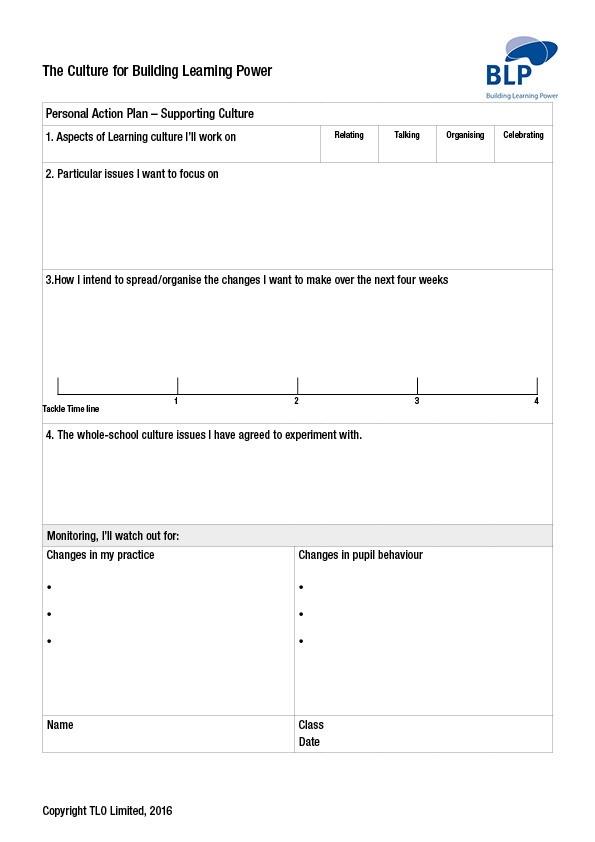 PERSONAL-ACTION-PLAN-CULTURE.PDF
For the monitoring bits of your plan you might want to look out for:
- an improvement in how students engage with learning
- improvement in behaviour
- showing less stress or worry about learning generally
- increased focus when working with other students
- reduced reliance on teacher support
5. Evaluate team session: How did we do as a team? (5 mins)
- Did we achieve our objectives?
- Are we comfortable with what we are trying to achieve?
- Any concerns at this point?
- Next meeting date and time.
2b. Classroom based enquiries
Classroom based enquiries operate in the spirit of enquiry or some would say action research. It’s a quest to find out more, to consider what needs to change, to wonder what might work, to track what happens and to refine practice. It’s a process in which you, as a teacher, investigate teaching and learning so as to improve your own and your students’ learning. In effect you become a researcher of your own practice. It helps you to develop new knowledge about your classroom, you become a reflective teacher who broadens your own teaching repertoire. Importantly it puts you in charge of how you teach and become very aware of the links between how you teach and how your students learn and achieve.
3. The online course in a nutshell
For those of you who like to see big pictures before the detail here is…
3a. The Big Picture of Playing the (Junior) Learning Power Game.
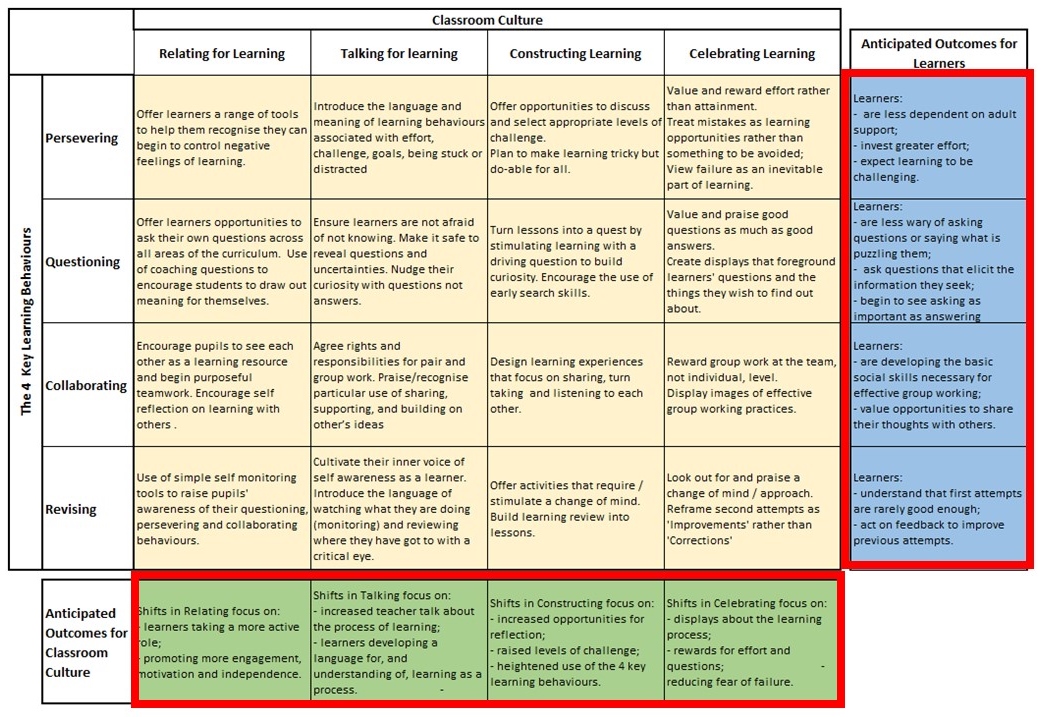
This chart distils what this course is all about;
- what it hopes to enable teachers to do (in the yellow boxes)
- what outcomes such changes could make in the classroom culture (in green boxes)
- the anticipated outcomes for learners (in blue boxes)
The downloadable spreadsheet will also reveal a practical idea for each yellow box. So this chart offers you an ‘at a glance’ resource to help you reflect on what and how you may be adapting your teaching over the next few months. See below for more details.
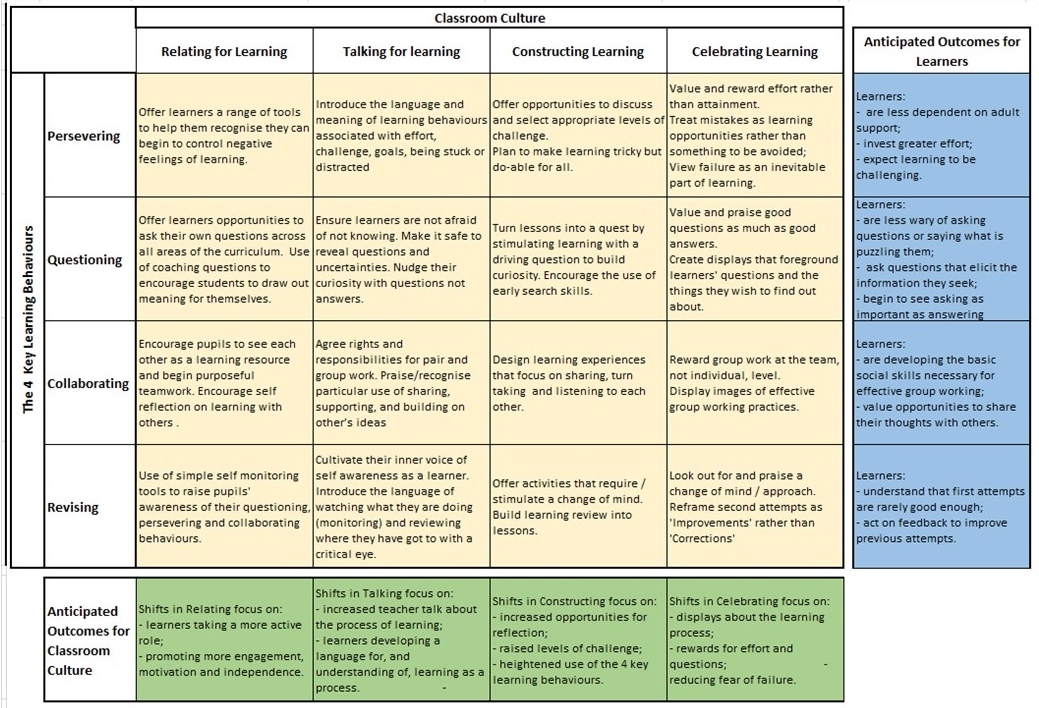
Read more about the big picture at your leisure
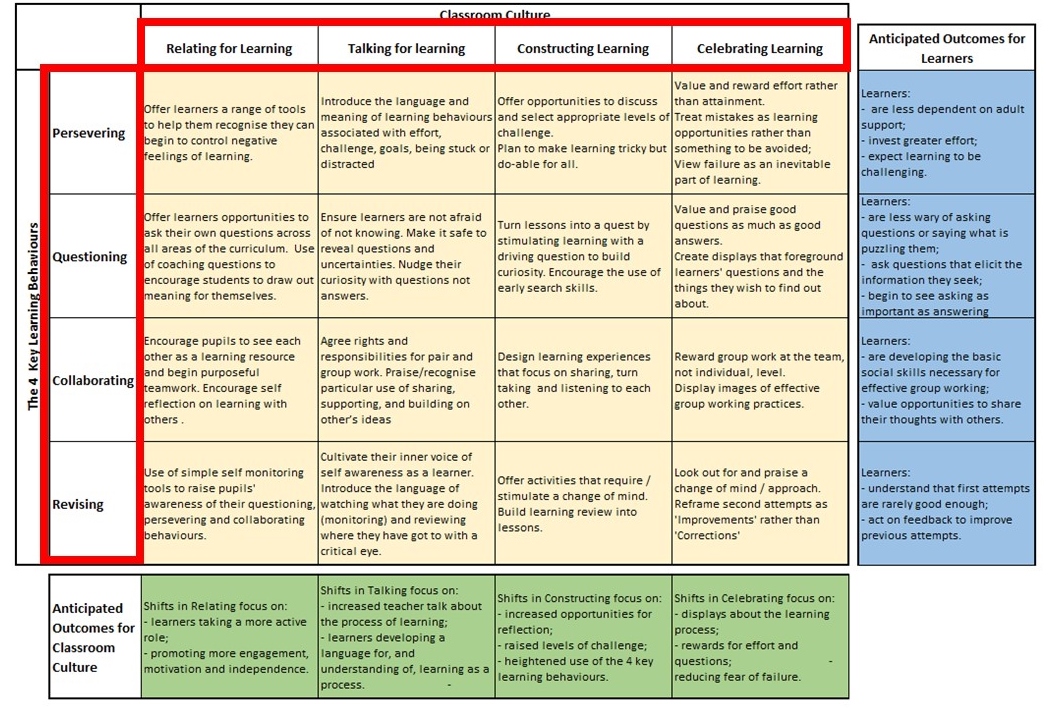
3b. The vertical and horizontal axes of the grid
The vertical axis to the left shows the 4 learning habits you will be working to improve. The horizontal axis across the top shows the 4 aspects of classroom culture that you will be shifting. On the downloaded spreadsheet, click on the Enable Editing tab to reveal reminders by hovering over the cells.
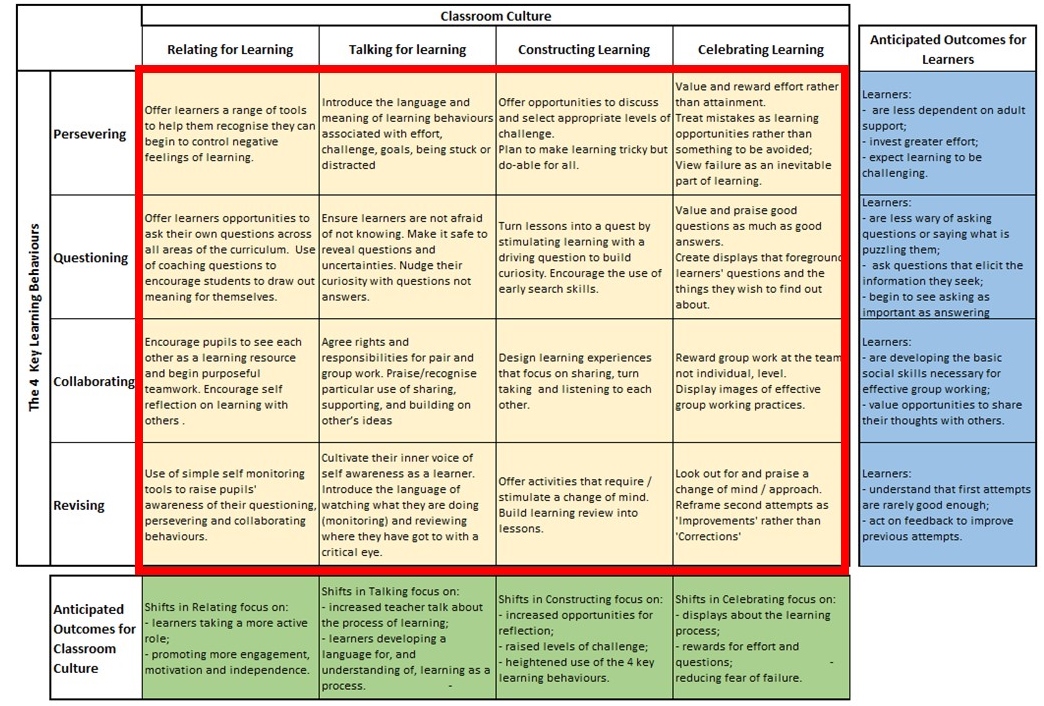
3c. The central 16 cells
- The text in each cell gives an indication of the classroom culture that needs to be in place for learners to learn how to learn.
- When looked at vertically down the page, they map out the 4 aspects of classroom culture.
- When looked at horizontally across the page, they hint at the ways in which classrooms need to change to enable the 4 key learning behaviours to flourish.
Secondly:
- On the downloaded spreadsheet, hovering over each cell reveals a teaching idea taken from The Learning Power Game module.
- These teaching ideas are key to unlocking each cell. There are many other ideas in the module for each cell, but these are the ‘must do’ strategies.
3d. The cells to the bottom and to the right
So – are you ready to make a start?
The first section of online learning is called ‘What do we mean by learning power?’
You can access it by using the ‘Unit Navigation’ box (top right on your screen).
Resist the temptation to skim read other sections – focus your efforts on ‘What do we mean by learning power?’ in preparation for your first Professional Learning Team meeting.

____________________________________________________
Comments are closed.