

How the resource is structured and how to make it work best for you
The Re-energising resource structure
The introduction talks about what the resource is about with some research to back it up.
Sections 1 to 4 each deal with a key aspect of understanding resilience, namely re-engaging with:
- unsticking learning
- managing distractions
- rising to the challenge
- achieving goals
Each section has exactly the same structure so that you quickly become familiar with the material and you won’t get lost. Each section gives you:
- a view of the sort of practice to aim for
- questionnaires to help establish the current state of play
- what ‘getting better’ at engaging this aspect of resilience looks like in students
- a selection of practical ideas to help students help themselves engage more strongly
- a nudge to make a few valuable changes in your practice
Blue box resources include . .
further information
key points
a video of practice
an illustration / image
How to make it work best
1. Read the introduction and think about which of the four ‘re-energising’ will most benefit your students in the first instance.
2. Go to the appropriate section and skim down the content to get the hang of the structure and line of argument. Don’t take any detours into ‘Read more’ sections on this first time through, or look at any downloads.
3. Look through the section again, still fairly rapidly but considering the more extensive information in the ‘Read more’ boxes.
4. Time now to look more closely at how you will use the material. Use the questionnaires, consider the results and decide which phase of development (grey to purple, purple to blue, etc.) you want to look at in detail for your students.
5. Go to the relevant phase (grey to purple, etc.) and select three or four ideas that you think might help.
6. Try them with your students! Spread them over perhaps three or four weeks.
6. Remember it takes about 21 days for a new habit to become solid practice, so you’ll need to be patient. Give your students lots of opportunities to behave in these new ways, and plenty of encouragement from you. Reward yourself by observing your students gradually increasing their engagement with their learning.
7a. As you see and hear students’ engagement strengthening and improving take a look at more advanced ideas (e.g. blue to green) and repeat steps 5 and 6.
7b. Alternatively, switch back to step 1 and consider whether one of the other aspects of resilience may be the best next stage.
3) Here’s how it works
The vertical and horizontal axes of the grid
The vertical axis to the left shows the 4 aspects of Resilience – stuck / distraction / challenge / goals.
The horizontal axis across the top show 4 aspects of classroom culture – things to give away / to say / to do everyday / to display.
On the downloaded spreadsheet, click on the Enable Editing tab and you can reveal reminders by hovering over these cells.
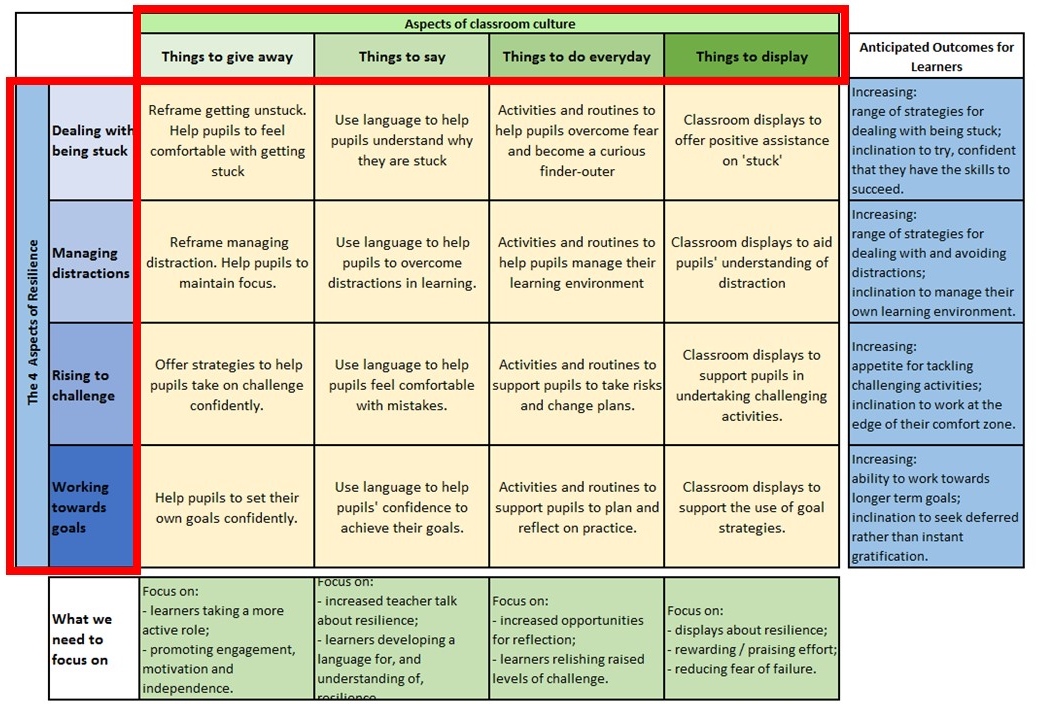
The central 16 cells
Are your launch pad.
Clicking on the link in any cell takes you to 5 related classroom activities.
16 cells, 5 ideas in each = 80 things you can select from and use in your own classroom.

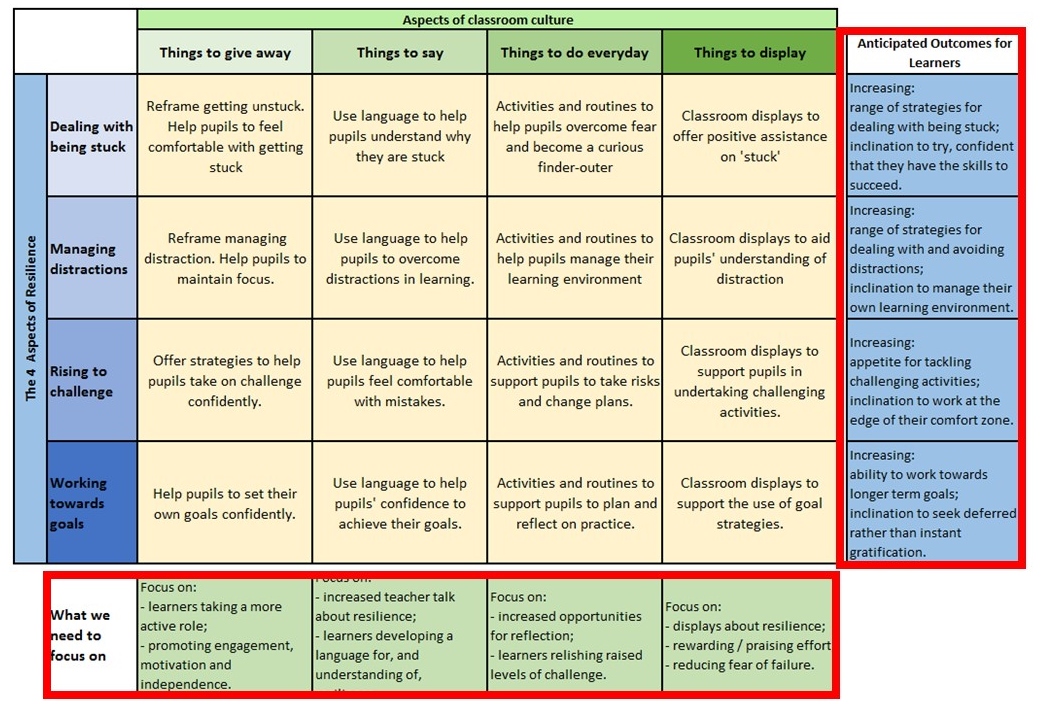
The cells to the bottom and to the right
The green cells across the bottom give an outline of how the focus of the classroom might change.
The blue cells to the far right give an indication of the anticipated outcomes for learners in terms of the 4 aspects of Resilience.
Before thinking ‘catch-up’
Before ever thinking about ‘catch-up’ or a recovery curriculum schools will, wisely, be trying to create the right culture for learning. To do so will be paramount if students are to prosper in this continuing age of uncertainty. Setting your students off on the right trajectory is crucial.
Research tells us that the hard thinking we often associate with school learning runs out of steam when the world becomes more complex or unfamiliar. You will only have to consider your own attitudes to life after lockdown to realise the truth and power of this statement. Before looking for detail in sections 1-4, take a look at the panel alongside for suggestions of the general feel of post lockdown classrooms that will help students to gain familiarity with their less controlled mental world.
What your students will crave from you is your professional guidance on how they can become a better, more self-regulated learner. When they decline to learn it’s not because they are lazy or unmotivated but because the brakes have to be un-jammed. This resource exists to help teachers to un-jam the brakes on learning.
Suggestions for post lockdown classrooms
strive to re-engage before the rush to catch up
encourage some of the quiet qualities such as patience and attentiveness
suspend purposeful striving for a while
think of the rhythms of effort and relaxation and do more of the relaxation
think the same about hard and soft thinking
balance social and solitary enquiry; quiet solitary thinking will still be important
encourage more open mindedness, to see new possibilities in familiar things
re-engage their practical intelligence; more working out and making stuff rather than heavy loading on memory.
Comments are closed.