

Building a classroom culture that extends students’ language for learning
Welcome to Building Powerful Learners Phase 2. This four unit online programme looks at how your development as a teacher can enable and strengthen the development of a learning-friendly classroom culture.
The programme combines three types of action to help you to experiment, analyse and understand how you can create an increasingly learning-friendly classroom culture.
1 Understand by using Read abouts…of which there are two types
- Essential Read …essential must read text.
- Extended Read …interesting, good to know, absorb when you can.
2 Analyse by using Find outs…tools to help you discover and analyse essential information.
3 Experiment with Try outs…practical activities for you to try, check and perfect in your classroom.
This unit explores how your development can create a classroom culture to develop students’ learning language and understanding of the learning process.
- What are the key aspects of talking for learning? (Essential and Extended Read about 1)
- With regards to talking for learning, is my classroom currently more teacher focused, or more learning focused? (Find out 1)
- How are my students responding to the changes I have made in my classroom culture? (Find out 2)
- What sort of approaches will be useful in moving this forward? (Try out 1 to 4)
- Take a deeper look at the anticipated outcomes for learners of developing a talk-friendly classroom culture (Find out 3)
- Find out about 8 further learning behaviours that will, in time, be added to the key behaviours of Perseverance, Questioning, Collaborating and Revising (Find Out 4)
Structuring and using the ideas below in your classroom over the next few months or so will edge your classroom culture towards developing a rich learning language that enables students to better understand the process of learning.
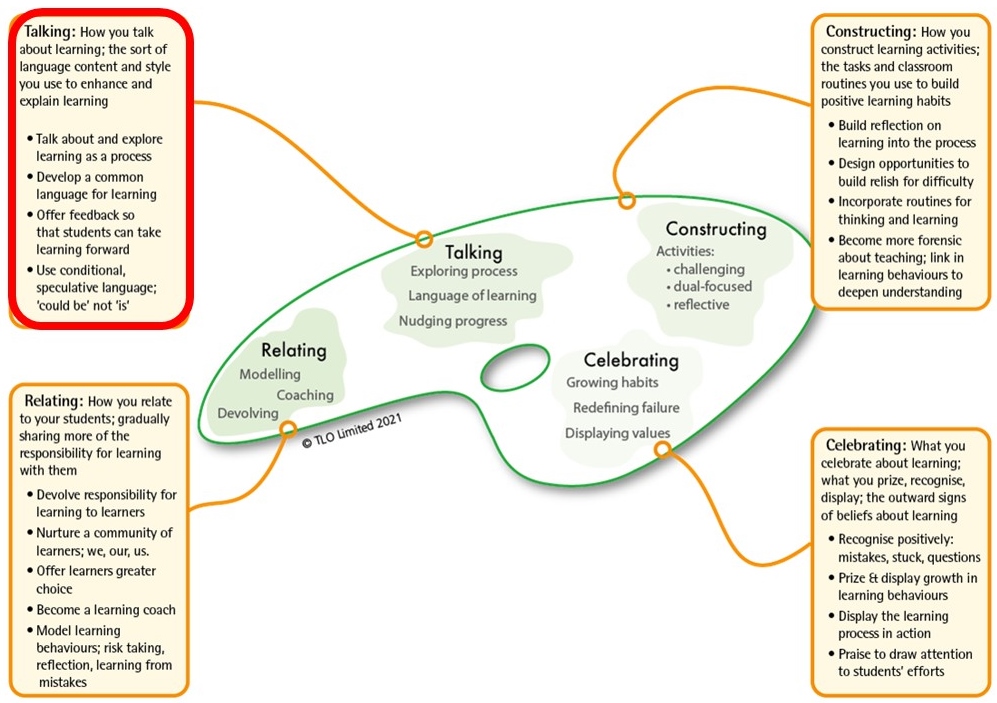
Essential Read about 1
Unpacking Talking for Learning
Talking about learning is about the sort of language content and style that enhances learning, making learning itself the object of conversation. The way you express yourself in the classroom creates a powerful linguistic environment that teaches young people the best of what we know about learning. Using the language of learning helps students to discuss, understand, and become conscious of using and improving their learning behaviours.
From this…
In most classrooms responsibility for talking about learning rests almost exclusively with the teacher. Teachers decide what and how to talk about learning, and they undertake most of the questioning. The main focus of teachers’ classroom talk is on how students are performing and what they have to show as a result of their learning So students hear very little about how they are learning or how to improve how they are learning
To this…
In classrooms where the aim is to build better learners the vocabulary and tone become quite different. Teachers begin to coach students in the how of learning and this gradually enables their students to take responsibility for their own learning. Students are enabled to talk about their learning behaviours, such as perseverance or revising. They are enabled to improve their use of, say, questioning or planning their learning. Thus talk about improving the ‘how’ of learning becomes a crucial dimension to classroom discourse enabling students to take far greater control of their learning.
In short:
- The process of learning, rather than learning performance, becomes the object of conversation;
- The gradual introduction of a learning language helps students to become conscious of using their learning behaviours;
- Using and extending the breadth and depth of the learning language helps learners to talk about, understand and improve how they learn;
- Encouraging learners to notice things about how they are learning, talking about their learning process and assessing how their learning is going means learners become meta-learners.

Extended Read about Talking for Learning. ⬇️
There are three main aspects to this cultural language shift:
- Creating and sharing a language for learning;
- Stimulating discussions that explore the process of learning;
- Offering learning related feedback.
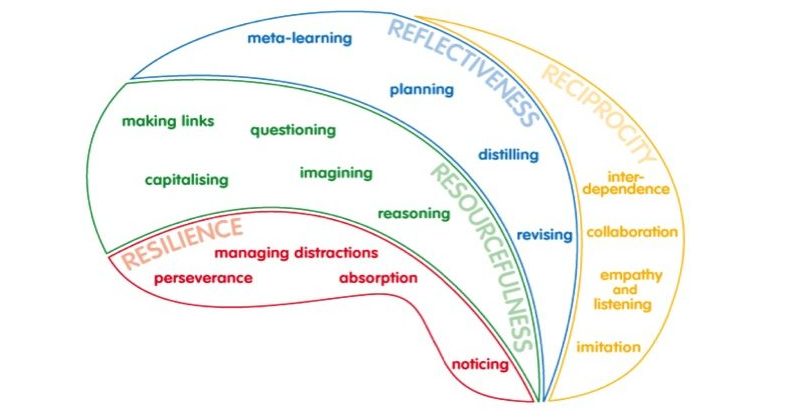
Aspect 1: Creating a language for learning – helping learners to understand and use a language of sufficient precision and subtlety that enables them to describe, discuss and understand the learning process. The learning language begins with naming the learning behaviours of the four strands of a supple learning mind. (emotional, cognitive, social and strategic) It moves on to exploring what these are, when we use them, how we might get better at using them and how we can become a better learner.
Creating a language for learning
click to enlarge
Building a language of learning will enable your students to:
- name
- recognise
- talk about using
- select for use when appropriate
- become skilled in using
- evaluate the effect of using their learning habits
Using and extending the language of learning adds breadth and depth to how you and your learners talk about, understand and improve learning.
Emotional language – how we feel
The first aspect of the language framework is about helping students to lock onto learning; to resist distraction; to become absorbed and to stay engaged despite the ebb and flow of learning.
Learning behaviours include; absorption, managing distraction, attentive noticing, perseverance.
Cognitive language – how we think
The second aspect of the supple learning mind is about being able to draw on and use a wide range of learning methods or ways of thinking.
Learning behaviours include; questioning, making links, imagination, reasoning, capitalising.
Social language – how we relate
The next aspect of the supple learning mind is about being able to make use of relationships in the pursuit of learning.
Learning behaviours include; interdependence, collaboration, empathy and attentive listening, imitation.
Strategic language – how we manage our learning
The fourth aspect of a supple learning mind is about building the ability to be reflective, to manage the learning process, to think profitably about learning and ourselves as learners; to become meta-learners.
Learning behaviours include; planning, revising or refining, distilling, meta-learning.
Use of the language becomes essential in what people notice about learning. Using it abundantly makes learning visible and public.
Ask yourself:
How fluent is your own talk about learning?
Aspect 2: Exploring learning as a process – the ways in which you enable learners to explore and reflect on the process of learning. It’s a shift away from talking about the ‘what’ of learning and broadens classroom discourse to include conversations about the process of learning, the ‘how’ of learning.
Exploring learning as a process
Deep talk about learning is what sets learning powered classrooms apart. Learning and how it works isn’t just talked about at the beginning of a term or year but is embedded in the everyday conversations of the classroom.
Conversations will include noticing things about learning:
- What do we mean when we say learning?
- When and where is it best?
- What helps you to do it?
- How does it feel? What hinders your learning?
It goes on into encouraging students to talk about their learning:
- What made it so good?
- What did you contribute?
- How did you make sense of that?
 And later learners can be nudged towards becoming meta-learners with questions such as:
- How do you plan to go about learning?
- How will you monitor how it’s going?
- How can you review how your learning has gone?
All the while a general interest in learning can be kept fresh by references to media reports and articles about the brain and the mind…. visualisation in sport coaching, or what happens to learning in Alzheimer’s Disease, or how babies learn to talk…
Learning as a process is brought to life by making it the subject of conversations.
Ask yourself:
How much do you talk with your students about the process (not content) of learning itself?
Which of the ideas above might you start using in your classroom?
Aspect 3: Nudging learning forward – offering feedback, both written and oral, to help learners to improve as learners. This is about how we catch learners actually learning, alert them to it, remind them about it, suggest how they might get better at it. Nudging the learning process broadens feedback to include the learning behaviours employed as well as content.
Prompting learning
The language of learning can help you to think about how you might talk in a way that helps to cultivate the learning behaviours and help students to gain a better personalised understanding of content.
- You can turn each of the learning behaviours into sets of casual prompts or nudges to move students along in learning. For example, to nudge curiosity/questioning:
- “What’s odd about that?
- What does that make you wonder?
- What do you want to find out?
- How else could you do that?”
- Where your classroom talk is all focused on the process and the experience of learning itself your comments should encourage students to pay attention to how they are learning. Your comments could ask them to slow down and notice and appraise the strategies and steps they are using along the way:
- “What would have made this easier for you?
- Where else could you use that?”
- What’s making you do it that way?
- This helps students to become more reflective and thoughtful about their own learning.
Promoting self-talk
Since you want young people to turn out to be robust confident learners you have to talk with them in terms of a growth mindset.
- You develop your students’ interest in the learnable skills and strategies.
- Your comments focus on effort, habit and disposition, focusing students on how to get better by looking for ways to try harder or differently.
- You steer students away from carving the world into things they are ‘good at’ or ‘not good at’ since developing learning behaviours will help them to become better learners.
Feedback prompts
In the learning centred classroom feedback can be seen at three levels. Notice that all the prompts ask rather than tell.
Task-Level Feedback Prompts (adapted from Nuckles et al, 2009)
- Does this answer meet the success criteria?
- Is this right?
- Could you elaborate on this answer?
- What aspect of your response to this assignment are you pleased with/unhappy about?
- What other information do you need to meet the criteria?
- What’s the sticking point in this task?
Process-Level Feedback Prompts (adapted from Nuckles et al, 2009)
- What strategies are you using?
- Are there more efficient strategies you could use?
- What other questions could you ask about this task?
- Do you grasp the concept underpinning this task?
- Have you done anything similar to this before?
Self-Regulation-Level Feedback prompts (adapted from Nuckles et al, 2009)
- What would be the best way of checking your work?
- How could you reflect on these answers?
- What happened when you …?
- How can you account for …?
- What learning goals have you achieved?
- How have your ideas changed?
- What aspect of this work could you now teach to others?
Ask yourself:
What proportion of my feedback is on the same lines as the examples above?
Which of these types of feedback could I start with?
Find out 1
How do teachers build a language for learning that changes their classroom culture?
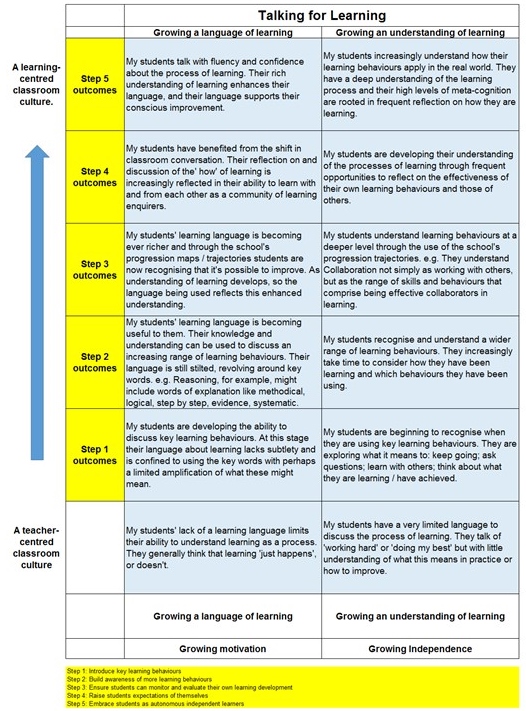
The chart alongside shows how the classroom culture for the three aspects of Talking for Learning:
- Creating a language for learning;
- Exploring learning as a process;
- Nudging learning forward;
may grow as the culture moves from being teacher centred towards being learning centred.
Download and print a copy.
Look over these trajectories. For each of the 3 columns, ask yourself the key question:
- Which cell in each column do you think best describes your current classroom culture?
It is worth taking your time over this. The outcomes from this self-reflection, coupled with the outcomes from Find Out 2, will help to identify the teaching strategies that will move your current classroom culture towards a learning centred classroom culture.
Growing Talking for Learning, from a teacher centred classroom culture towards a learning centred classroom culture.
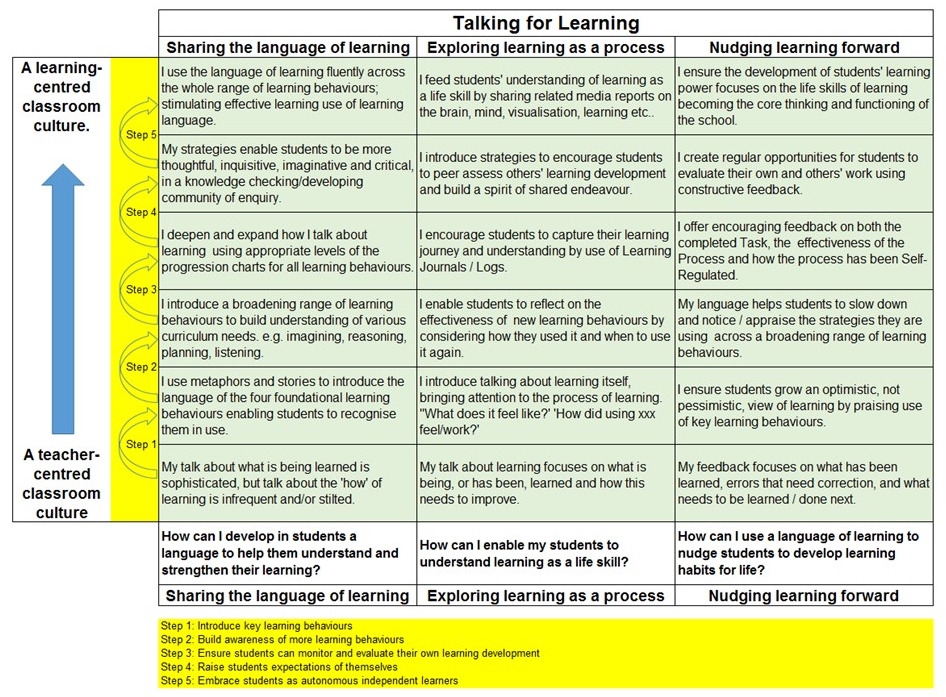
Which cells best describe your classroom culture now?
Download as a pdfFind out 2
How are your students responding to changes in classroom culture?
Culture is the minute by minute, hour by hour, day by day way that learners come to understand their role as a learner; it’s always all too evident to learners. Culture is sometimes seen as your enacted values in the classroom – what you do and what you do not do, what you say and do not say, what you believe and do not believe, what you value and do not value.
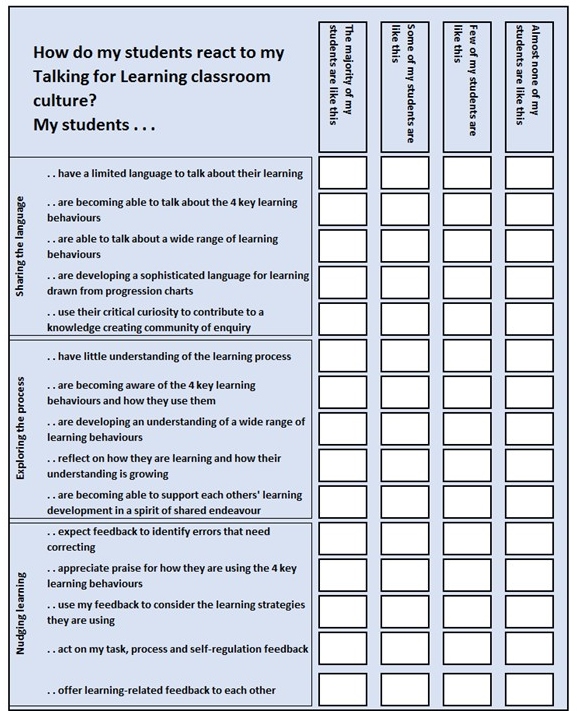
How are your students reacting to the learning climate of your classroom? How are they reacting to the changes you are making to create a language to explore and understand the learning process?
Download and print a copy.
Look over these three groups of statements.
The first 5 statements are about Sharing a language for learning, the second about Exploring learning as a process, and the third is about Nudging learning through feedback.
For each of the 3 groups, ask yourself the key question:
- Which statement in each set do you think best describes the majority of your learners at this time?
It is worth taking your time over this. The outcomes from this, coupled with the outcomes from Find Out 1, will help to identify the teaching strategies that will move your current classroom culture towards a learning centred classroom culture.
Try out 1
A range of little culture shifts
Teachers are in the habit forming business
As a teacher you are an influential character builder and so need to be mindful of how your classroom culture helps students to form, replace, re-form and strengthen their learning habits. Which aspects of your classroom culture are helpful in this respect, and which are perhaps less so? After all, if you are unable or unwilling to make changes to your classroom culture, learners are unlikely to change how they respond to it!
What to stop and start
Here are a few ideas you might want to try. Take it steady, this way of teaching can be a big but exciting shift so it’s worth doing it slowly and thoughtfully.
Begin with the ‘stop/avoid’ box – if any of these teaching behaviours are still in evidence in your classroom it would be worth thinking through how they can be eliminated, since failure to do so will undermine the changes you are hoping to achieve for your learners
Then cast your eye over the other 3 boxes. Which ideas appeal to you? Which do you think will have the greatest impact on your students?
Now seek out teaching ideas below in Try Outs 2/3/4 that you can use to move your classroom culture forward.
Try Out 2 focuses on ideas for creating a language for learning;
Try Out 3 focuses on exploring learning as a process;
Try Out 4 focuses on nudging learning forward.
Try out 2
Build Talking for Learning by creating and sharing a language for learning
Creating a language for learning – helping learners to understand and use a language of sufficient precision and subtlety that enables them to describe, discuss and understand the learning process. The learning language begins with naming learning behaviours and moves on to exploring what these are, when we use them, how we might get better at using them and how we can become a better learner.
Use what you have found out about your classroom culture in Find Out 1 (the green tables) and how your students are responding to it in Find Out 2 (the blue quiz) to identify the best place to start in creating a language for learning. There are five possible growth stages to consider.
Explore the teaching ideas for creating a language for learning here

Try out 3
Build Talking for Learning by exploring learning as a process
Exploring learning as a process – the ways in which you enable learners to explore and reflect on the process of learning. It’s a shift away from talking about the ‘what’ of learning and broadens classroom discourse to include conversations about the process of learning, the ‘how’ of learning.
Use what you have found out about your classroom culture in Find Out 1 ( the green tables) and how your students are responding to it in Find Out 2 (the blue quiz) to identify the best place to start in exploring learning as a process. There are five possible growth stages to consider.
Explore the teaching ideas for exploring learning as a process here

Try out 4
Build Talking for Learning by nudging learning forward
Nudging learning forward – offering feedback, both written and oral, to help learners to improve as learners. This is about how we catch learners actually learning, alert them to it, remind them about it, suggest how they might get better at it. Nudging the learning process broadens feedback to include the learning behaviours employed as well as content.
Use what you have found out about your classroom culture in Find Out 1 (the green tables) and how your students are responding to it in Find Out 2 (the blue quiz) to identify the best place to start in nudging learning forward. There are five possible growth stages to consider.
Explore the teaching ideas for nudging learning forward here

Find out 3
Developing a deeper understanding of how learner behaviours may respond to the changes you have made in your classroom culture.
We have thus far, with the exception of Find Out 2, focused on changes you can make to your classroom culture, focusing on the three ‘Means’ of Talking for Learning:
- Creating a language for learning;
- Exploring learning as a process;
- Nudging learning forward.
Here we turn our attention to the two ‘Ends’, the anticipated outcomes for learners, and how these are linked to the changes you are making / have made:
- Growing a language for learning;
- Growing an understanding of learning.
Ask yourself:
- Which cell in each column best describes my learners at present?
- Is there a good match with the Steps I have been working on in Try Outs 2/3/4?
- Are they responding in the ways anticipated?
- Are they ready to be challenged to become increasingly fluent in their learning language and ready to further understand the process of learning, or is there a need for a period of consolidation while the changes you have made take full effect?
And critically – what next? You should probably choose to turn your attention to one of the other units so as to maintain a degree of consistency of approach across the four aspects of classroom culture (Relating, Talking, Constructing, and Celebrating).
But, do not forget – you can always return to this unit in the future with the intention of further progressing your classroom culture and their responses.

Find out 4
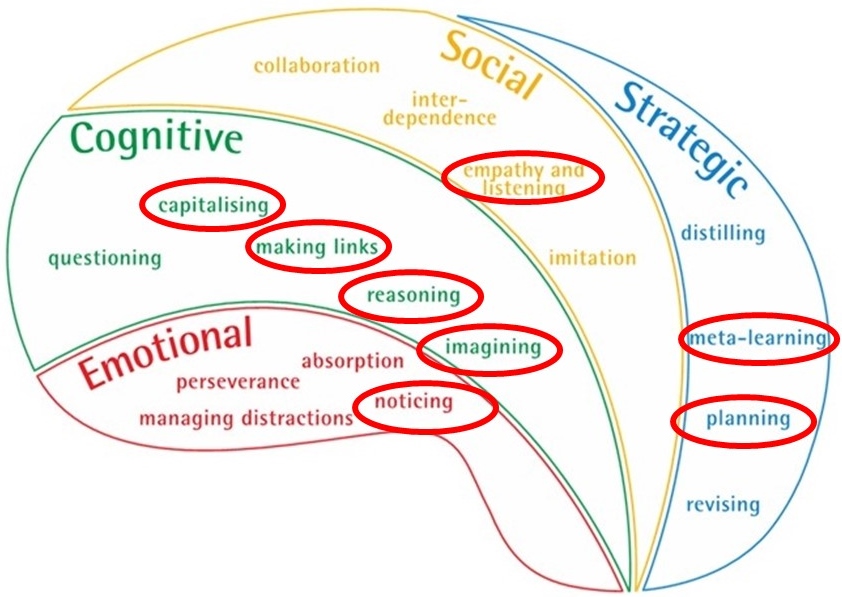
Finding out about 8 further learning behaviours to broaden the range of behaviours you are actively promoting in your classroom.
This Find Out, which appears in all units, is a reference tool to be accessed when / if you need it.
It gives a short introduction to 8 additional learning behaviours: Noticing; Reasoning; Imagining; Making Links; Capitalising; Listening; Planning; Meta Learning.
Each contains 5 short sections:
- What do we mean by this learning behaviour?
- How do teachers create a classroom culture for it.
- How does the behaviour grow?
- Some teaching ideas to encourage the behaviour.
- How to develop your learning language to support the behaviour.
You will find these introductions most useful as you begin to tackle Steps 2 and 3 in the Try Outs (above).
Review and Evaluate
Suggested termly review activity
Suppose that your main focus over the Spring term was on Talking for Learning:
- You were working mostly on Step 2, with a focus on introducing a wider range of learning behaviours;
- You used some familiar books to stimulate discussions about listening and noticing;
- You created a display of nursery rhyme characters and their learning behaviours;
- You may well also have had some associated actions in the other 3 aspects of classroom culture;
- You have noticed that many students are developing a broader understanding of what a successful learner does;
- And in the future you intend to work on introducing Reasoning and Imagining.
Your review and evaluation sheet might well look like the one opposite.
Download and complete your own review and evaluation sheet. Keep it as an ongoing record of what you have done, and pass a copy to senior leaders so that they can keep an eye on developments across the school.
Download a blank copy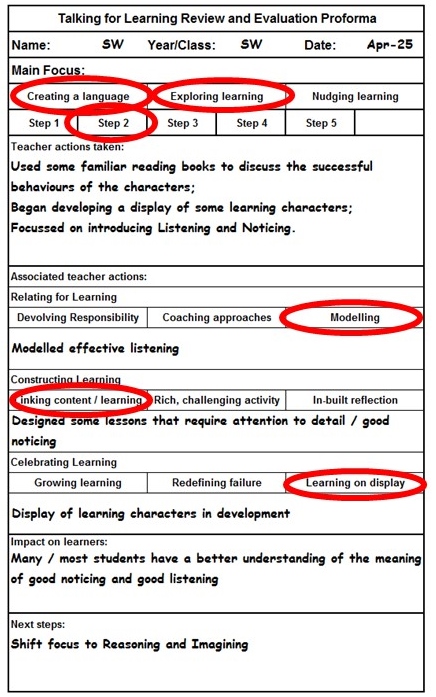
Comments are closed.