
Building the habit of Capitalising.
Welcome to Building Powerful Learners Phase 2. This eight unit online programme will enable you as a teacher to expand your students’ use of learning behaviours.
The programme combines three types of action that will help you to experiment with, analyse and understand how to become more skilled in developing your students’ use of learning power.
1 Understand by using Read abouts…of which there are two types
- Essential Read …essential must read text.
- Extended Read …interesting, good to know, absorb when you can.
2 Analyse by using Find outs…tools to help you discover and analyse essential information
3 Experiment with Try outs…practical activities for you to try, check and perfect in your classroom
This unit explores the “how” of building capitalising.
- What are the key aspects of capitalising? (Essential Read about 1)
- How confident are my students now as capitalisers? (Find out 1)
- How could I embed building capitalising into my teaching? (Find out 2)
- What sort of approaches may be useful in making a start on this? (Try out 1 to 5)
- Estimate my students’ development using a detailed capitalising chart (Find out 3)
Structuring and using the ideas below with your students over the next month or so will enable them to extend the range of learning behaviours that they use consciously.

Essential Read about 1
Unpacking Capitalising
A well formed Capitalising habit involves being ready, willing, and able to:
- Recognise that we learn from many different sources – other people, books, the internet, music, the environment, experience…
- Select appropriately from a range of learning strategies;
- Keep a purposeful look-out for useful learning aids;
- Adapt and adopt the successful habits and values of others into their own learning repertoire;
- Make intelligent use of all kinds of things to aid learning;
- Use resources in novel ways to solve problems.
Being a good capitaliser involves learning with the help of many different sources –other people, books, the internet, music, the environment, experience…and making intelligent use of all kinds of strategies and things to aid learning. In the early stages, it means selecting and making the best use of known strategies and classroom resources but this swiftly moves on to embracing a much wider and varied range of possibilities. This involves being able to seek novel ways of solving problems by exploiting the potential of known strategies and what is around them including things you may never have thought of as a resource. Importantly it includes being able to adapt and adopt the ways other people do things; taking their habits and values into your own repertoire (imitating). Gradually students can improve their physical skills, absorb ideas and thinking patterns by observing the approach and detail of how others do things. When looked at from these diverse angles, growing capitalising moves well beyond encouraging a student to ‘read pages 24 and 25’.

Good capitalisers are resourceful, enterprising learners who make the best of what is to hand, they are good at resourcing their own learning. For that reason, we tend to use the terms ‘Capitalising’ and ‘Resourcing Learning’ interchangeably.
Extended Read about 1. Understanding Capitalising ⬇️
The learning behaviour known as capitalising
Capitalising is about being on the lookout for strategies, resources and forms of support in the environment that can help you in your current learning or problem-solving. Traditional schooling assumes that intelligence is all in the head, but recent studies show that it is much fairer and more accurate to see good learners as people who are ready and able to make intelligent use of all kinds of strategies and things around them—floor space, filing cabinets, dictionaries, notebooks, personal organisers, telephones, libraries, e-mail, the internet and, of course, other people. Everyone needs to be good at capitalising on resources available in the world so it’s obviously a good idea to start developing this skill at school.
The form of assessment we use in schools have a powerful influence on the kinds of learning that students do, and the kinds of teaching their teachers use. If the good learner is essentially the person plus their resources (and their ability to draw on them), our methods of testing should encourage teachers and students to value and practise capitalising. In today’s world, it makes as much sense to sit 15-year-olds down at solitary desks and ask them to display their knowledge and skill as it would to take away David Beckham’s football away and tell him to perform.
From Building Learning Power by Guy Claxton 2002
Re-find out 1
Focus on the capitalisers in your class.
The capitalising progression chart should give you a fairly clear view of the capitalising behaviours and how your students do, and do not, currently exhibit them.
- The majority of students may well display a similar set of positive behaviours (ie the majority may be in the purple or blue phase)
- You will also be conscious of some students who still lack positive behaviours (ie they are still firmly rooted in the grey/lacks phase of the progression chart)
- But some students will appear to have made general progress even in learning behaviours not spotlighted earlier.
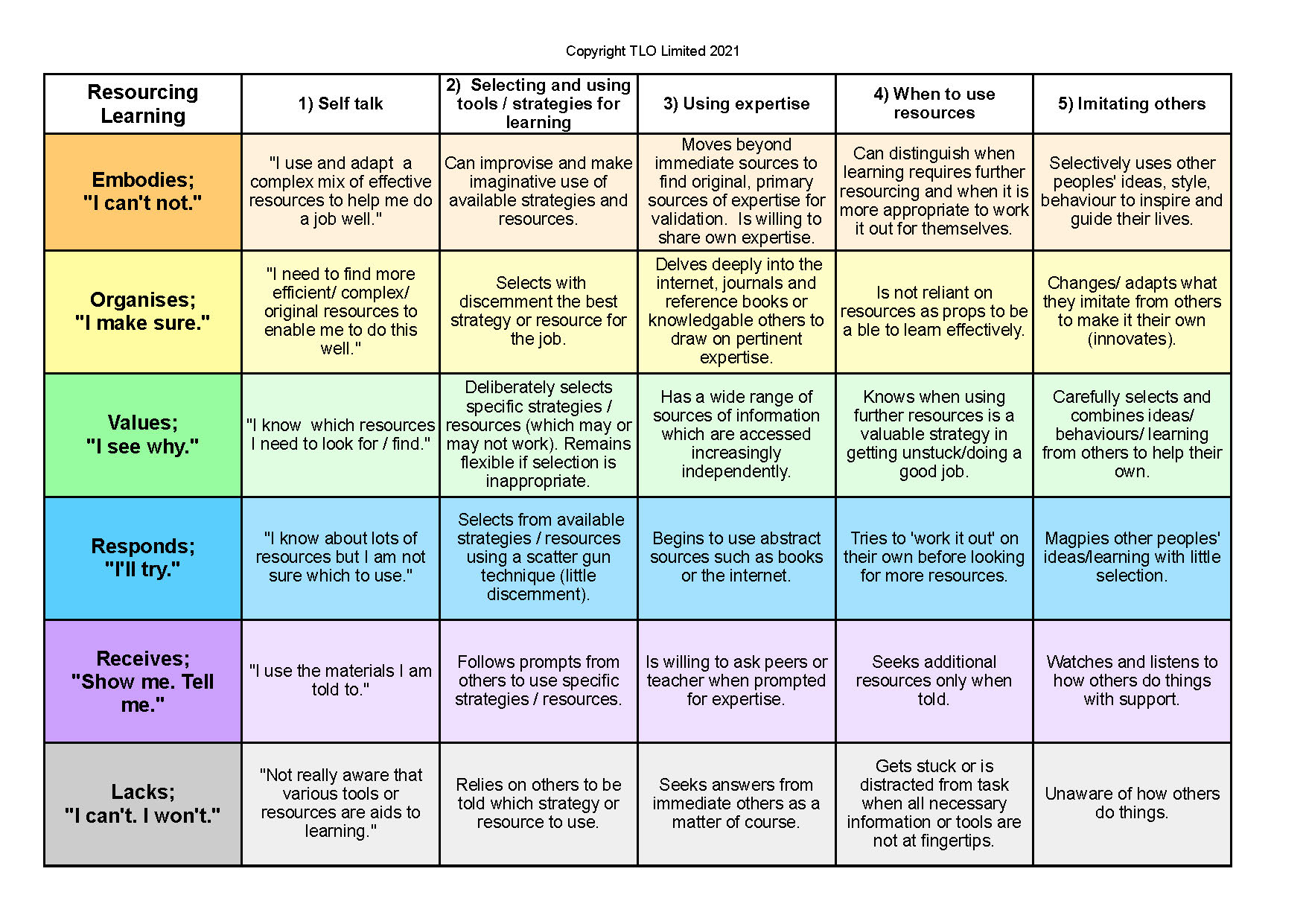
The chart alongside shows how capitalising grows. Column 1 identifies the 6 phases of development, column 2 describes how the skills and behaviours may grow over time, column 3 shows the self-talk; what students may quietly say/explain to themselves at each phase of development.
A word of warning.
While you may be tempted to focus your efforts on the majority for greatest impact, you’ll need to take care not to do so at the expense of your ‘grey’ students, as these are your potential underachievers in the future.
What to look for.
In Try Outs 1 to 5, look out for teaching ideas that you think will have the greatest impact on your particular group of learners. Don’t attempt to try all of the ideas – better to do a few thoroughly than to adopt a scattergun approach.
Growing capitalising; a trajectory of developing behaviours, skills, attitudes and self-talk
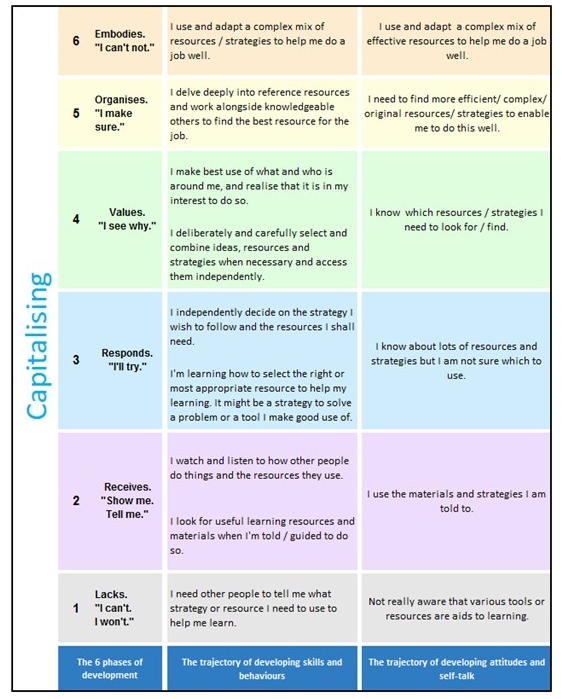
Which phase have most of your students reached now?
Download as a pdfFind out 2
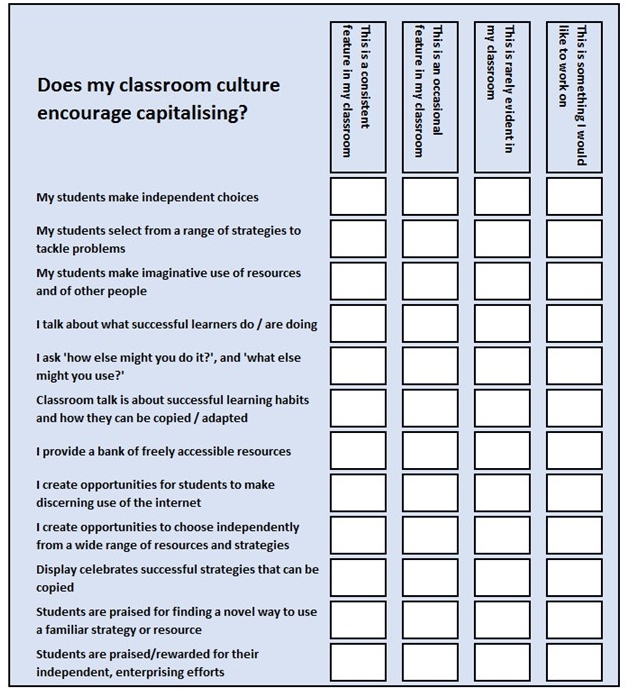
How much does my classroom culture encourage Capitalising?
Culture is the curriculum of the classroom, frequently hidden from the external observer, but always all evident to learners. It is the minute by minute, hour by hour, day by day way that learners come to understand their role as a learner. Culture is your enacted values in the classroom – what you do and what you do not do, what you say and do not say, what you believe and do not believe, what you value and do not value.
Here is a selection of features that might begin to shape the emotional climate of your classroom to encourage capitalising.
Download and print a copy.
Reflect on your current classroom culture.
It’s worth noting that the list is made up of the four action types you first met last year in the Teachers’ Palette (Unit 2);
- ways of giving students more responsibility for their learning
- the sort of language you might use to stimulate capitalising
- ideas for constructing lessons to build capitalising
- ways of celebrating capitalising
Ask yourself which of the features of the capitalising-friendly classroom are:
- already a consistent feature of your classroom?
- an occasional feature of your classroom?
- rarely evident in your classroom?
Which of these features are you interested in developing further?
At this point it might be worth having an informal chat with some of your colleagues. Is anyone already making progress with one of the features you would like to work on? Do you have any consistent features that others might learn from? Take your completed sheet to discuss at the meeting at the end of this unit.
Try out 1
A range of little culture shifts
Have a think about your current classroom culture in relation to Capitalising.
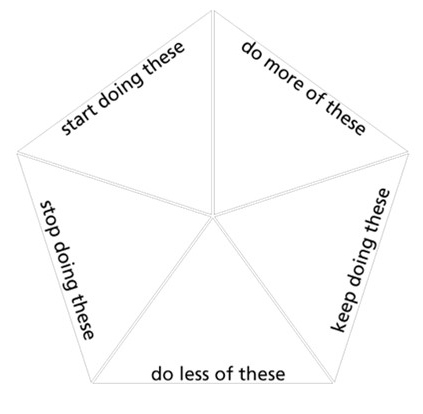
Begin with the ‘stop/avoid’ box – if any of these teaching behaviours are still in evidence in your classroom it would be worth thinking through how they can be eliminated, since failure to do so will undermine the changes you are hoping to achieve for your learners
Then cast your eye over the other 3 boxes. Which ideas appeal to you? Which do you think will have the greatest impact on your students?
Now seek out teaching ideas below in Try Outs 2/3/4/5 that you can use to move your classroom culture forward.
Try Out 2 focuses on ideas for moving responsibility for capitalising towards learners (Relating);
Try Out 3 focuses on developing a learning language for capitalising (Talking);
Try Out 4 focuses on how lessons/activities can be designed to activate and develop capitalising (Constructing);
Try Out 5 focuses on how capitalising can be recognised/ rewarded / praised / celebrated (Celebrating).
Try out 2
Extend students’ responsibilities in order to build capitalising
Classroom layouts
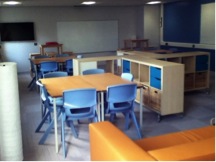
The obvious starting point in encouraging capitalising is to organise your classroom in such a way that students are able to select, get and return the resources they need.
The first decision is to position furniture to maximise flexibility within the space. Think about centralising the resources so as to give access to large whiteboards at student height on every wall. This enables students to think about, explore, plan and reflect upon their learning on Working Walls at their height. A range of work and break out spaces could be provided including tables and chairs, bar tables and stools, sofas, bean bags, and an architect’s desk. Display boards could be covered in neutral backing paper in order to maintain a calm space where the students’ work would provide the colour.
Teacher talk
- You might need a XX resource to do that.
- Have you got everything you need?
- Where might you find a XX
- You might be missing . . . .
- You can find that one yourself.
Two more ideas for extending students' responsibilities. ⬇️
Adopt a character to help to anchor capitalising
‘Adopt’ a character – real, imaginary, human or animal – who/that exhibits the best features of capitalising. Talk about the character until your students become familiar with its attributes. Leave the character (actual/picture) on tables when you have set a group to work on using a particular learning behaviour in – numeracy, reading, writing etc., as a reminder.
Teacher talk
- What is capitalising all about?
- Why do we need to use resources?
- How will we know what will help us?
- Which resource will work best?

Engage students in looking for capitalising behaviours.
What is it?
Help students to appreciate / recognise that:
- objects can be used in different ways
- sometimes we need to free up thinking — not seeing things as functionally fixed.
Set up the Activity by dividing students into groups of four. Each group selects an object in the room. The aim is to develop as many strange uses as possible for each object.
- Each person in the group uses the object in a different way (e.g. the chair becomes a wheelbarrow, horse, cart, etc.)
- Group members to guess what the objects have become.
- Debrief and Discuss
As in all cases, deeper learning relies on our capacity to see possibilities — what exactly do we do when we open our minds to possibilities? Explore what happens when we capitalise — we open things up and then focus things down. Indicate the importance of keeping things open for as long as possible and not closing things down too soon. What is the danger of closing down our thinking and reducing the range of capitalising?

Teacher talk
- Can you use this object in a different way?
- What has this become?
- Try not to think too hard about what we usually use this for.
- Why was …object…more difficult to think of in another way?
- That’s a great idea…
Try out 3
Build a learning language of capitalising.
Teacher talk – as a learning coach
(To ensure students do the thinking for themselves)
- What could we use to help us with this?
- What led you to choose to use that?
- Look very carefully at someone you think is doing …… really well and think about how you can do it like that
- Could you tackle this by imagining someone who does it really well?
- What sort of reference / resource do you need here?
- Look around. See what is available to help. How could you use it?
- Could you work this out for yourself first before looking for more information?
- Who could you turn to for help?
- Think through the strategies you might use.
- Which is the best learning strategy for this job?
What do you think?
- Which of these capitalising nudges might you start using?
- In which particular lessons would such nudging be most useful?
- How will most of your students respond to such nudges?
- Will this way of engaging be more popular with girls or boys?
- What other nudging ideas might you add to the list?

Two more teacher talk ideas ⬇️
Focus your capitalising talk….
Spend time with your class just noticing learning, talking about how it feels and when it’s best. Then ask the class to talk about what helped their learning, the ingredients of learning.
Capture what students say and make lists of:
- Doing words such as
- sharing
- focusing
- listening
- talking
- practising
- quiet thinking
- Feeling words such as
- energy
- support
- happy
- patient
- Words relating to things such as
- number lines
- computers
- TV
- books
- People words such as
- brothers
- sisters
- parents
- doctors
You will be pleasantly surprised by the number of words offered for processes, and the great range of items that students find helpful when learning. Make the lists into posters and display in the classroom, as a public support to continuing the dialogue about learning. It’s also worth reviewing and developing the lists at a later date.
Teacher talk
- What helps you to learn?
- Can we make a list of all the things that help us to learn?
- What sort of feelings help us to learn?
- What sort of things do we do when we are learning well?
- Who helps us to learn?
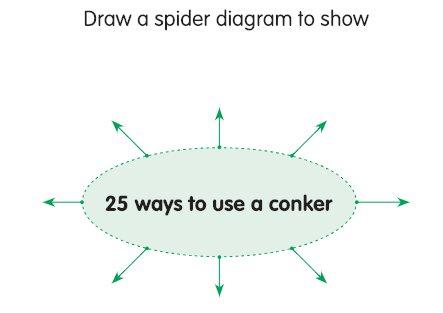
How many uses for…
To get students thinking about how resources can be used in many different ways.

Try out 4
Build capitalising into lesson design
It is through learning activities that learning behaviours get a workout. Their role is to enable your students to access and wrestle with information and ideas; to help them use and understand something; to ensure their effectiveness as a learner. The ‘right’ activity helps to make new concepts more concrete. The ‘right’ activity provides insights into new ideas and subject matter. The ‘right’ activities need to be carefully chosen and, critically, linked to the learning goal.
The missing wallet
A wallet was found at a crime scene on the 10th August. Detectives need to work out as much as they can about the person they are looking for in order to focus their enquiries . . . . .
Teacher talk
- What types of questions did you pose at different points?
- How did you seek to answer these questions?
- In what ways did you make links between different resources to try and put a full picture together?
- What did you imagine about the person and upon what was your imagination based?
- How did you work logically with the resources to make sense of people and events?
- Did you capitalise on all of the resources in the wallet and what other resources did you use (e.g. your own experience and knowledge of other things)?
- What other resources might a detective use to get more precise information?
You can download a full set of resources to help you run this activity from our extensive BLP’s Activity Bank.

Two more lesson design ideas ⬇️
Finding out about…
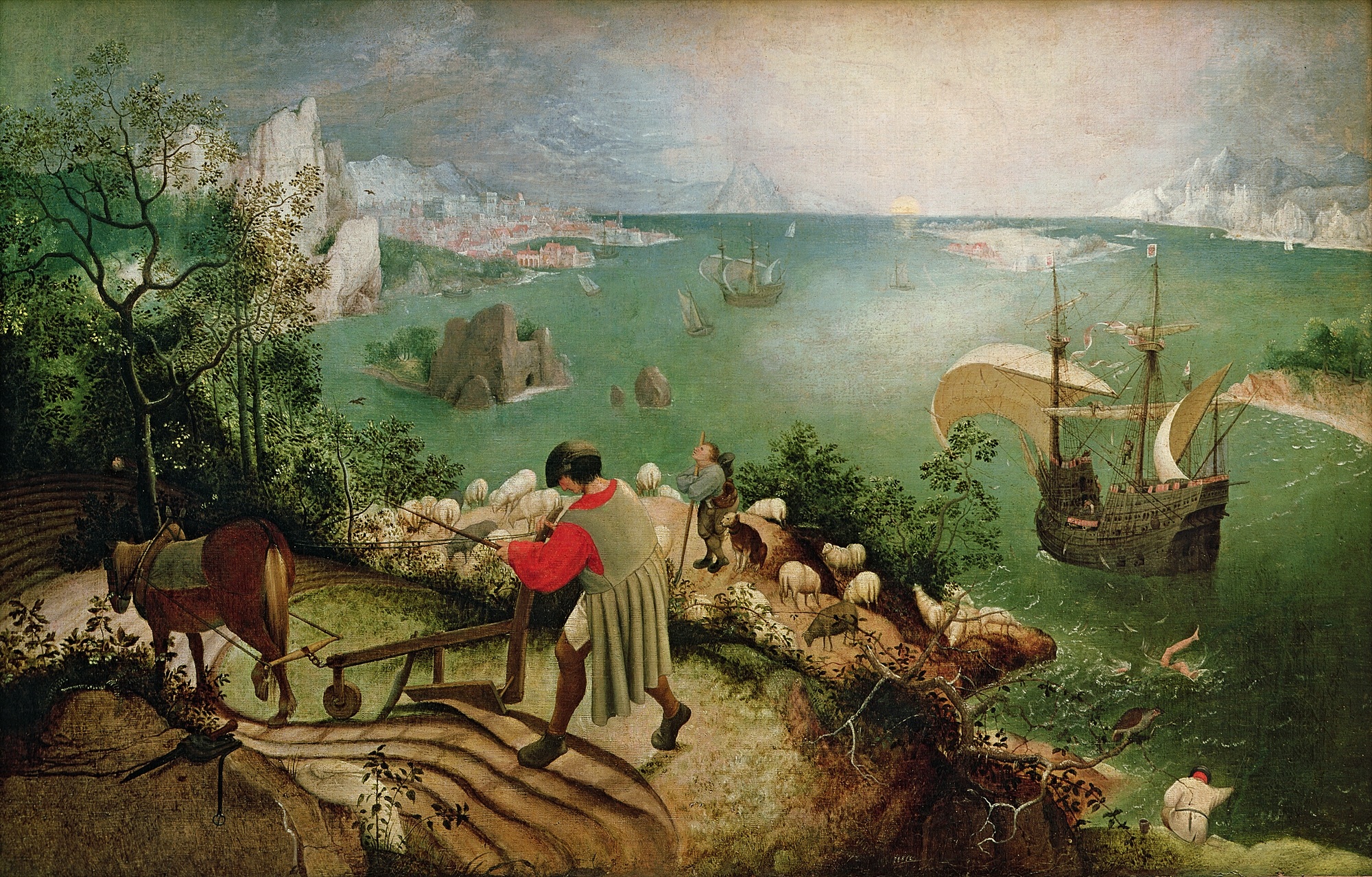
A painting
Purpose: Recognition of the range of resources that can be called upon when seeking to acquire new knowledge, understand the unfamiliar and respond to challenges. Acknowledge that internal resources – such as attitudes and prior experience – are often as valuable as external ones.
- Show the painting e.g. Landscape with the Fall of Icarus by Breughel. Do not give its title.
- Ask students to examine the picture, notice, and make observations.
- Accept observations from paired discussion – encourage curiosity – take all offers at face value.
- Ask class to consider “What could we find out about this picture?” and then “Where could we find out about it?”
- Capitalising on using resources available in the school (internet, library, the art department …)
- Offer the artist’s name and encourage further research possibilities.
- Offer, or allow the discovery of, the painting’s title.
- Consider: “What does the title mean? How can we find out …?”
- As suggestions and realisations occur prompt curiosity about Icarus – as the myth emerges, through existing knowledge or research, encourage enquiries into what the myth has to do with the picture … and what the artist may have had in mind.
- Distil all of the resources – from memory, to other people, to books and the internet, that have been used or could be used to fully explore what challenges are offered by the picture.
- Debriefing and rating the learning stretch Capitalising means making use of a wide range of internal; and external resources.
Teacher talk
- What internal capacities can you draw upon?
- What external resources did you turn to?
- How did you use external resources – by being selective – skimming for information – going deeper to find out more – linking ideas and information?
- What are the first things to do when set a challenge that requires you to capitalise on all possible sources?
Information hunt
Summary of an activity from The Teacher’s Toolkit: Raise Classroom Achievement with Strategies for Every Learner by Paul Ginnis
- Supply each student with a Fact Finder sheet and require them to find out information about the topic in hand.
- For younger children the sheet could be in the form of a treasure map giving locations in the classroom and beyond where materials (posters, photos, books, people…) enable students to solve riddles that entitle them to a crack at the “treasure chest key question”. It is important that there are a variety of different information sources to keep the exercise interesting and to stretch students’ abilities to utilise different resources. For older students the sheet could be a more regular matrix to fill in or a standard question-and-answer sheet.
- Students have to find accurate and complete information against the clock.
- Students can come to the teacher at any point to check how they are doing – this must still be done within the time limit, so students need to decide carefully whether they need the check.
- As soon as someone has a full set of answers/has opened the treasure chest, or when the time is up, the activity stops and the teacher and class go over the questions together.
In science, each station could include a mini experiment to carry out. For Modern Foreign Languages, the activity could be conducted in the target language.
Why?: The exercise practises a number of learning skills including working to a deadline, using a range of resources, identifying key points, and recording information quickly.
Variations: Students could work in pairs or teams rather than individually. The exercises could be numbered and tackled in order, with students starting at different numbers to avoid congestion – this reduces the independence of the exercise.
Teacher talk
- If you could find people/sources who have thought about this problem before, who would you turn to?
- How might you amend XX’s ideas to suit your style/purposes?
- That’s a brilliant adaptation of XX. What inspired you to try that?
- I can see this essay/drawing/experiment/ calculation/piece has been influenced by XX’s work/ideas. How have you made it work for you?
Try out 5
Build capitalising by celebrating its use.
Self-monitoring capitalising in action.
Introducing a new learning behaviour every month or so is trickier than it seems.
- You might concentrate on it in say three or four lessons.
- You will bring it to the fore in your talk.
- But how do you get students to pick up all the aspects of the behaviour?
- How might you ensure they see its usefulness in lessons in general?
- How do you ensure they absorb the use of the behaviour into how they learn?
A learning mat
Use a learning mat for capitalising to ensure students monitor their own use of the behaviour.
Learning mats are usually A4 laminated sheets that show various aspects of a learning habit. Keep them on desks/tables or as part of a wall display.
Students refer to them during lessons, using them as prompts about the finer aspects of a learning habit that is being stretched. This tool helps students to be able to join in meta-cognitive talk.

Two more celebrating ideas ⬇️
Top Tips
Set aside an area of display where students are asked to share any strategies or ‘top tips’ that they have found particularly helpful in their own learning. For those offering the ‘top tip’, it is a distilling activity, but the resulting gallery of ‘top tips’ invites students to adopt the successful strategies of others.
This will also support the skills of noticing, collaborating, and distilling.

Teacher talk
- Who has a top tip to add to the board today?
- What made you think of that way of doing it?
- Well done, you worked this out for yourself.
- Can you try to do this without that tool? Can you work it out in your head?
- What else might be helpful?
Becoming a skilled imitator
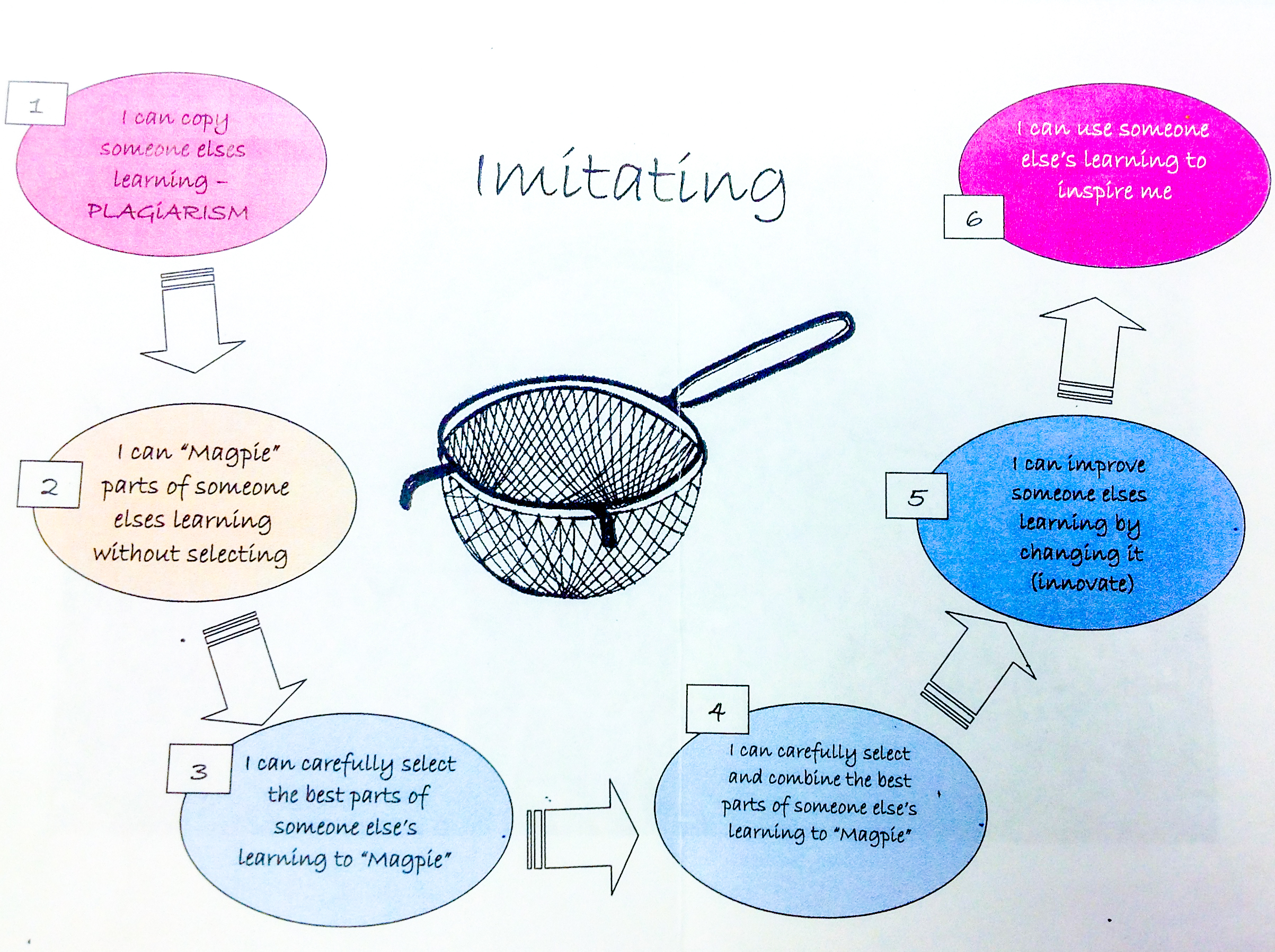
This learning mat was worked out and produced by Yr 6 students at a school in Gloucestershire. When you take a closer look you will see that it’s effectively a progression path for imitation. It starts with straight copying being likened to plagiarism. As you read around the ovals the emphasis moves from selecting to being inspired. . .
- carefully selecting the best parts
- carefully selecting and combining with their own thinking
- improving someone else’s idea (innovate)
- finally to be inspired by someone else.
The tool was used by students in a similar way to the learning mats we have featured throughout the units, and eight year olds were certainly able to reflect effectively on how they had used imitation during a lesson.
Use the ideas to stimulate and discuss more sophisticated levels of imitation.
Find out 3
Build capitalising by considering it in greater depth
The chart alongside offers a deeper view of how Capitalising may grow.
Column one deals with self-talk. We’ve shown a small flavour of self-talk thoughts that teachers can encourage students to imitate. Some relate to setting about learning, others to talking through which learning methods or resources might be useful, and others to monitoring and evaluating the learning being used. All such self-talk is important in building a Meta-Learning habit.
Column two is about building expertise for finding and selecting resources and strategies for learning. It shows how students move from relying on others to provide strategies and tools to being able to choose from a selection and on to being able to find their own strategies and tools and finally to use familiar strategies and resources imaginatively to broaden their effect.
Column three is about how we broaden our use of sources of expertise. This moves from people we know before broadening out to other sources of expertise i.e. books, the internet. This broadening range of expertise must be used with care and discernment and moves on into more specific and complex realms.
Column four is about when to use resources and is included as a caution. It’s about students being able to recognise when a resource is needed and when they could indeed work something out for themselves such that resources don’t become learning props. Eventually, a person’s own expertise enables them to learn well from themselves.
The last column is about our inclination and ability to learn from others. We are all hard-wired to learn by imitating others. This moves from being unaware of how other people do things to using people’s ideas and values to help guide our own lives. It moves from watching and listening; ‘magpieing’ but with little selection; selecting and combining; changing and adapting (innovating). So this is not straight copying, it’s about being stimulated by using others’ ideas but making them fully your own.
Take a look at the chart and see if you can plot where the majority of your students are now.
Which aspects do they find more tricky?
How has the chart helped you to understand the development of capitalising more fully?
Growing capitalising; a trajectory of developing behaviours, skills, attitudes and self-talk
Download as a pdf
Learning together meeting (for schools that have decided that all teachers study the same unit at the same time)
Suggested meeting agenda
- Decide what you want this meeting to achieve (5 mins)
- Discuss what you have found out about students’ use of capitalising (15 mins)
- Re-cap and reflect on the action you have each undertaken in your classrooms (20 mins)
- Consider issues that would be beneficial if implemented across the school (10 mins)
- Review how the meeting format went (5 mins)

Learning Team Year 2 Meeting Agenda ⬇️
Item 1. Meeting Objectives. (5 mins)
Meeting objectives might include:
- discuss levels of capitalising displayed across the school
- share and learn from what we have each tried in our classrooms;
- feel confident about taking forward ideas from online materials into our practice;
- identify actions that would be more useful if everyone applied them in their practice;
Outcome. To have decided what the meeting should aim to achieve.

Item 2. Discussion about learning culture (15 mins)
Explore together your discoveries about your students as capitalisers;
- what did you find out about your students as capitalisers (Find out 1)?
- are students improving capitalising with age? Moving from grey to purple to blue etc?
- where did we each estimate our classroom to be in terms of its culture (Find out 2)?
- what did we each learn from Find out 2.
- which 3 are the weakest features?
- which 3 actions are our strongest?
- what surprised or baffled you?
- are there significant differences between year groups?
Outcome. A clearer understanding of students as capitalisers and the extent to which our classroom cultures are set up to support and develop capitalising.
Item 3. Explore action using the initial Try outs (20 mins)
Share and discuss the action you each took in making a start on strengthening capitalising in classroom practice.
- Which of the suggestions did you each use?
- Any concerns about or difficulties in putting the Try outs into action.
- Which seemed the most valid or successful?
- How the Try Outs affected different age groups.
- Ways of implementing these that we can all learn from and adopt.
Outcome. A clear picture of our interest in and enthusiasm for amending classroom cultures to support learning to learn. A feel for which are proving to be most effective and why. Would any of these culture shifts call for action on current school wide policies?
Item 4. Learning from practice (10 mins)
In relation to all the shades of practice you have been trying out, sharing, mulling over and observing, think about them now in two ways;
1. personally and 2. school wide.
Which ideas/practice stand out as:
- things you want to start doing
- things you think you need to stop doing (that’s harder)
- things you want to keep doing
- things you want to do more often
- things you want to do less
Outcome.
- At this stage it’s essential to note ideas arising from this discussion using 2 pentagon diagrams;
- one for each team member personally and
- one for decisions/suggestions that are school wide.
- Ensure that your school/group wide pentagon is shared with senior leaders.
Item 5. Evaluate team session. (5 mins)
- Did we achieve our objectives?
- Are we comfortable with what we are trying to achieve so far?
- Any concerns at this point?
- Next meeting date and time.

Feedback proforma (for schools that have decided that teachers can study the units in any order)
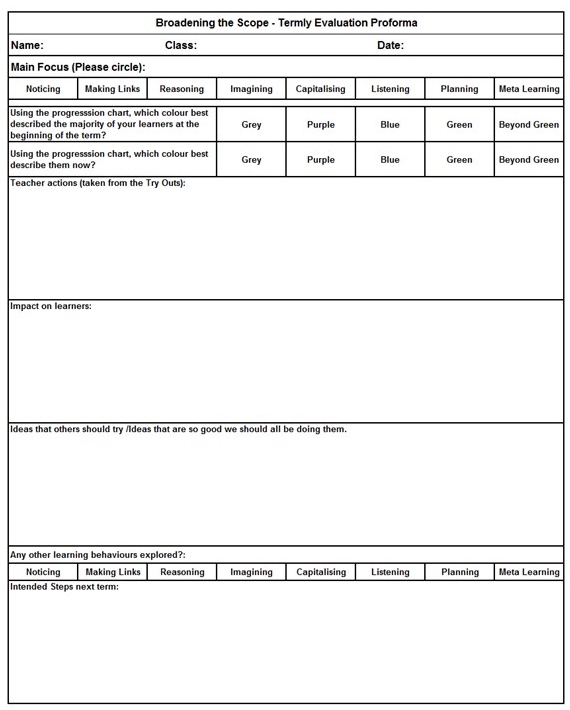
To share your experiments with others and to enable senior leaders to maintain an overview of developments, please complete this proforma termly and hand it to the Building Powerful Learners coordinator.
To give you a flavour, an example of a completed proforma is in the Noticing unit. Click below to download and print a blank version for yourself.
Download a blank proforma
Comments are closed.