
Building the habit of Planning.
Welcome to Building Powerful Learners Phase 2. This eight unit online programme will enable you as a teacher to expand your students’ use of learning behaviours.
The programme combines three types of action that will help you to experiment with, analyse and understand how to become more skilled in developing your students’ use of learning power.
1 Understand by using Read abouts…of which there are two types
- Essential Read …essential must read text.
- Extended Read …interesting, good to know, absorb when you can.
2 Analyse by using Find outs…tools to help you discover and analyse essential information
3 Experiment with Try outs…practical activities for you to try, check and perfect in your classroom
This unit explores the “how” of building planning.
- What are the key aspects of planning? (Essential Read about 1)
- How confident are my students now as planners? (Find out 1)
- How could I embed building planning into my teaching? (Find out 2)
- What sort of approaches may be useful in making a start on this? (Try out 1 to 5)
- Estimate my students’ development using a detailed planning chart (Find out 3)
Structuring and using the ideas below with your students over the next month or so will enable them to extend the range of learning behaviours that they use consciously.

Essential Read about 1
What do we mean by Planning?
A well formed Planning habit involves being ready, willing, and able to:
- Identify end goals or objectives before considering possible action;
- Consider timescales and possible obstacles in drawing up a realistic plan;
- Make use of a wide variety of skills and tools to gather ideas and information;
- Sequence activity in order to decide what needs to be done;
- Think laterally as well as logically so that the task benefits equally from creative and rational thought;
- Be open-minded and flexible about how things might happen so that opportunities can be seized and fresh directions taken.
Being able to think ahead isn’t the whole story of Planning. Becoming an effective Planner of your own learning needs you need to know something about yourself as a learner, your interests, your needs, your wishes. Training the process of thinking ahead often starts simply by asking students to find the resources they will need to carry out a task. But planning your own learning is a sophisticated task. It involves a personal, silent assessment of your learning skills (‘What can I feasibly achieve? What am I capable of doing? What resources would bolster my chances of success?’) The more timid, less confident or lower achieving students may find such planning a daunting prospect. Introducing and requiring students to work learning out for themselves will take time and careful planning on the part the teacher. When looked at from these diverse angles growing planning moves well beyond encouraging a student to ‘think ahead’
Extended Read about 1. Understanding Planning ⬇️
The learning behaviour known as planning
Planning is the ability to take a strategic overview of your learning, and make sensible decisions. It means:
- taking stock of the problem and the parameters within which you must work
- assessing the available resources, both inner and outer, and deciding which you think are going to be needed
- making an estimate of the time the learning will take, and the competing priorities that may have to be delayed or sacrificed
- imagining a route-map for the learning
- anticipating hurdles or problems that may arise along the way.
Good learners like taking responsibility for planning and organising their learning. They welcome opportunities to decide for themselves when, where, why and how they are going to learn—and to get better at doing so. Research shows, for example, that people who can make a reasonable estimate of how long a task will take are more likely to finish on time, and to do better work.
From Building Learning Power by Guy Claxton 2002
Re-find out 1
Focus on the planners in your class.
The planning progression chart should give you a fairly clear view of the planning behaviours and how your students do, and do not, currently exhibit them.
- The majority of students may well display a similar set of positive behaviours (ie the majority may be in the purple or blue phase)
- You will also be conscious of some students who still lack positive behaviours (ie they are still firmly rooted in the grey/lacks phase of the progression chart)
- But some students will appear to have made general progress even in learning behaviours not spotlighted earlier.
The chart alongside shows how planning grows. Column 1 identifies the 6 phases of development, column 2 describes how the skills and behaviours may grow over time, column 3 shows the self-talk; what students may quietly say/explain to themselves at each phase of development.
A word of warning.
While you may be tempted to focus your efforts on the majority for greatest impact, you’ll need to take care not to do so at the expense of your ‘grey’ students, as these are your potential underachievers in the future.
What to look for.
In Try Outs 1 to 5, look out for teaching ideas that you think will have the greatest impact on your particular group of learners. Don’t attempt to try all of the ideas – better to do a few thoroughly than to adopt a scattergun approach.
Growing planning; a trajectory of developing behaviours, skills, attitudes and self-talk
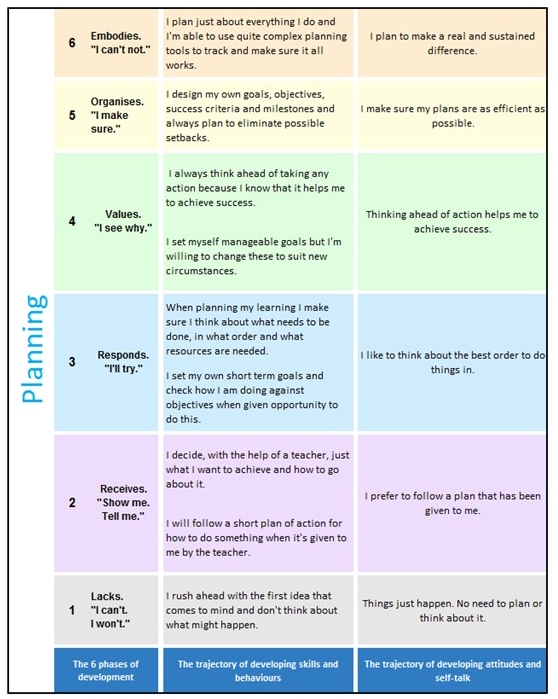
Which phase have most of your students reached now?
Download as a pdfFind out 2
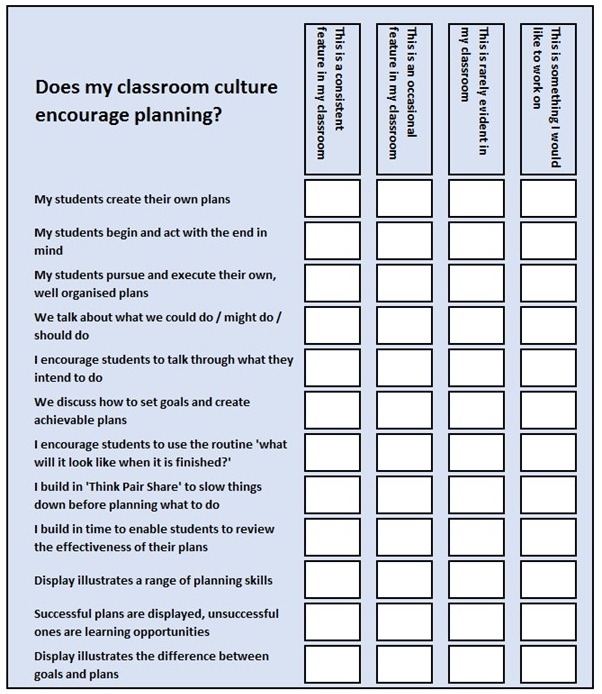
How much does my classroom culture encourage Planning?
Culture is the curriculum of the classroom, frequently hidden from the external observer, but always all evident to learners. It is the minute by minute, hour by hour, day by day way that learners come to understand their role as a learner. Culture is your enacted values in the classroom – what you do and what you do not do, what you say and do not say, what you believe and do not believe, what you value and do not value.
Here is a selection of features that might begin to shape the emotional climate of your classroom to encourage planning.
Download and print a copy.
Reflect on your current classroom culture.
It’s worth noting that the list is made up of the four action types you first met last year in the Teachers’ Palette (Unit 2);
- ways of giving students more responsibility for their learning
- the sort of language you might use to stimulate planning
- ideas for constructing lessons to build planning
- ways of celebrating planning
Ask yourself which of the features of the planning-friendly classroom are:
- already a consistent feature of your classroom?
- an occasional feature of your classroom?
- rarely evident in your classroom?
Which of these features are you interested in developing further?
At this point it might be worth having an informal chat with some of your colleagues. Is anyone already making progress with one of the features you would like to work on? Do you have any consistent features that others might learn from? Take your completed sheet to discuss at the meeting at the end of this unit.
Try out 1
A range of little culture shifts
Have a think about your current classroom culture in relation to Planning.
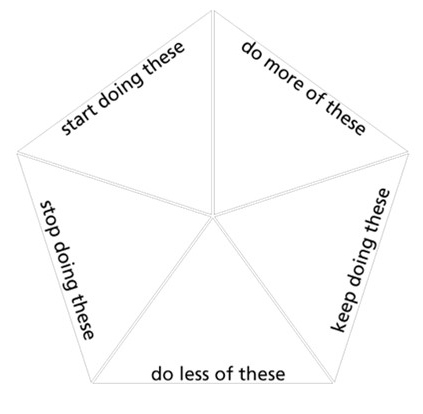
Begin with the ‘stop/avoid’ box – if any of these teaching behaviours are still in evidence in your classroom it would be worth thinking through how they can be eliminated, since failure to do so will undermine the changes you are hoping to achieve for your learners
Then cast your eye over the other 3 boxes. Which ideas appeal to you? Which do you think will have the greatest impact on your students?
Now seek out teaching ideas below in Try Outs 2/3/4/5 that you can use to move your classroom culture forward.
Try Out 2 focuses on ideas for moving responsibility for planning towards learners (Relating);
Try Out 3 focuses on developing a learning language for planning (Talking);
Try Out 4 focuses on how lessons/activities can be designed to activate and develop planning (Constructing);
Try Out 5 focuses on how planning can be recognised/ rewarded / praised / celebrated (Celebrating).
Try out 2
Extend students’ responsibilities in order to build planning
Assist students to recognise what planning consists of and that it has a number of stages, from exploring possibilities to defining exactly what has to be done.
- Group sits in a circle.
- Group or teacher identifies a problem or issue — school-based or wider world.
- Person nearest the door states their ‘could be’ solution.
- Each subsequent group member (to left) adds their own view, using as many ideas from the previous speaker as possible.
- Continue process until a plan generally acceptable to all group members is arrived at.
- When a member can’t add anything new they pass.
- When ideas run out, break into groups of four:
- distil what we have
- summarise group plan of action
- share all plans and see if one plan emerges.

Teacher talk
- What happened in our discussion?
- What are the stages in coming up with a plan?
- How did you feel …when your idea was taken on, or rejected?
- Did we build on the good ideas?
- Did we have any wild ideas?
- What happened to them?
- How can we present the plan effectively (flow diagrams etc.)
Two more ideas for extending students' responsibilities. ⬇️
Adopt a character to help to anchor planning
‘Adopt’ a character – real, imaginary, human or animal – who/that exhibits the best features of planning. Talk about the character until your students become familiar with its attributes. Leave the character (actual/picture) on tables when you have set a group to work on using a particular learning behaviour in – numeracy, reading, writing etc., as a reminder.
Teacher talk
- What is planning all about?
- Why do we need to plan things?
- What will help us to plan?
- It’s all about planning carefully.

Engage students in looking for planning behaviours.
What will a good one look like?
What Will It Look Like When I’ve Finished – WWILLWIF ?
Too often students start a task without giving thought to what it will look like when it has been completed, what a good one will look like. Some find it easier to plan ‘in reverse’ – working backwards from the finished article to where they are now to establish a sensible plan of action.
Make WWILLWIF the regular precursor to any action. Ask students to determine WWILLWIF for themselves in conjunction with others. Help them to visualise this in an appropriate form.
Try out 3
Build a learning language of planning.
Teacher talk – as a learning coach
Here are 10 ideas to ensure your students do the thinking for themselves
- What will your end product look like?
- How will you judge the success of what you have done?
- Look at what you have done so far – do you need to make any changes?
- Are you on track to meet your deadline?
- What needs doing? In what order will you tackle it?
- Do you have a contingency plan if that does not work?
- Keep a weather eye on how it is going.
- Are any particular planning tools appropriate here?
- Is the goal manageable?
- How can you make this plan more efficient?

Two more teacher talk ideas ⬇️
Introduce the language of planning
Design a planning sheet to use with the students when you are planning an activity with them. You might include these and other headings:
- What are we trying to achieve? (agreed goal, outcome)
- How will we know we have been successful? (success criteria)
- What do we need to do? (actions, jobs)
- What will help us? (resources)
- What might be a problem? (traps, obstacles)
- What will we do about it? (What- if or contingency plans)
- Who will do what? (roles) [Simplify according to age range.]

How might we tackle this?
A lack of confidence often stems from simply not knowing what to do or how to do it. The task appears overwhelming and otherwise confident individuals become paralysed by the prospect of the task ahead.
At the beginning of a session talk with students about the strategies and things they might use to help them with their learning. Steer talking about how they might tackle this, thinking about strategies that have worked in the past, or speculating on new approaches that might work. It is time spent thinking about tackling the task rather than actually starting to tackle it. It reminds students that they have a range of strategies available and gives confidence that they have the tools for the job in hand.

Teacher talk
- How might we tackle this?
- Which learning behaviours may be needed?
- Have we done something like this before?
- Which strategy is most likely to be successful?
Try out 4
Build planning into lesson design
It is through learning activities that learning behaviours get a workout. Their role is to enable your students to access and wrestle with information and ideas; to help them use and understand something; to ensure their effectiveness as a learner. The ‘right’ activity helps to make new concepts more concrete. The ‘right’ activity provides insights into new ideas and subject matter. The ‘right’ activities need to be carefully chosen and, critically, linked to the learning goal.
Advance organiser
A graphic organiser that is much used in primary schools to help students to plan their approach to an investigation or problem. The TASC wheel, derived from Thinking Actively in a Social Context, is a framework that helps develop thinking and problem-solving skills. With TASC, learners can think through a problem to the best outcome – and understand why it’s the best outcome.
TASC will guide students through the stages of thinking and problem-solving in an organised way, starting at one o’clock working clockwise. If you have a complex or wide-ranging problem you want to tackle, it offers a means of organising and synthesising a range of ideas.
Much like PEE (Point / Evidence / Explain) that helps students to structure a paragraph, the TASC wheel gives a simple way of helping students to sequence what they need to do to undertake an investigation.

 Teacher talk
- This wheel has all the steps you need to take.
- It will enable you to do this task all by yourselves
- What do you know about this already?
- Think carefully about what the task is asking you to do.
- How did the wheel questions help you…and so on
Two more lesson design ideas ⬇️
FAME planning
It’s important that plans provide a starting point. A clear beginning or focus shows a student where and how to start and what to do, and what steps or actions to take. The aim of the plan is to liberate the student from direct teacher assistance. Plans are not only a teaching device but aim to provide a means for independent learning.
A good plan contains;
- a thinking component
- an action component
- a monitoring component, which means providing metacognitive steps to help make judgements about what they are doing
- an evaluation component
Without the monitoring and evaluation components the plan remains just a set of directions for a given task. A good plan is strategic and includes skills that can be applied in a number of contexts. FAME –
- Focus, what is your focus, what do you want to achieve?
- Act, what action steps do you need to take to get there?
- Monitor, what will you need to keep checking along the way?
- Evaluate, what will make you pleased with yourself when you have finished?
Include more steps e.g. 2 for focusing or 3 for acting but having too many steps becomes confusing. Keep the magic number 7 in mind.
A good way to introduce this type of planning is for you to do a very detailed one and then ask students to simplify the steps in their own words
Once students understand the planning process and have used them for a number of purposes they will become more proficient and confident, developing skills in:
- knowledge of what plans are;
- formulating plans for different purposes;
- understanding when planning would or would not be useful/appropriate;
- being mindful (strategic) in undertaking tasks and solving problems.

Teacher talk
- Take time to decide what you are going to do
- With a good plan of action, you can do this
- Your last plan was really successful. So you could use that way of doing it again.
Visible Thinking Routine
How long will it take ?
This routine helps students to anticipate what needs doing and how long it might take. It also encourages them to consider the sequencing of the activity. There are three questions:
- What needs to be done ?
- What order will you do it in ?
- How long do you think it might take ?
The natural place to use this routine is prior to embarking on a piece of extended work in order to slow the impulse to ‘get on with it’ and to encourage a more strategic approach.

Try out 5
Build planning by celebrating its use.
Self-monitoring planning in action.
Introducing a new learning behaviour every month or so is trickier than it seems.
- You might concentrate on it in say three or four lessons.
- You will bring it to the fore in your talk.
- But how do you get students to pick up all the aspects of the behaviour?
- How might you ensure they see its usefulness in lessons in general?
- How do you ensure they absorb the use of the behaviour into how they learn?
A learning mat
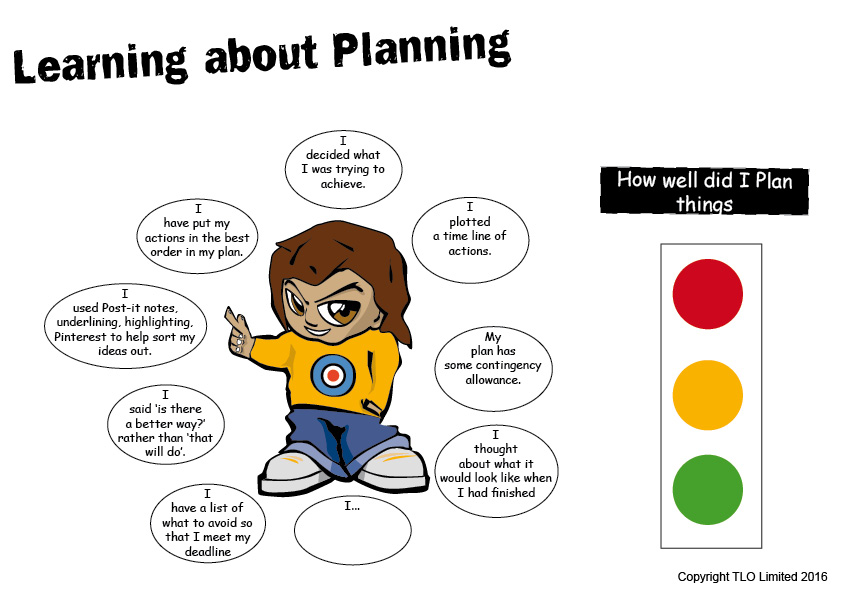
Use a learning mat for planning to ensure students monitor their own use of the behaviour.
Learning mats are usually A4 laminated sheets that show various aspects of a learning habit. Keep them on desks/tables or as part of a wall display.
Students refer to them during lessons, using them as prompts about the finer aspects of a learning habit that is being stretched. This tool helps students to be able to join in meta-cognitive talk.
Two more celebrating ideas ⬇️
Prioritising action
The familiar Skill / Will matrix (Tao of Coaching, Max Landsberg) is a useful tool to help students develop ways of reflecting on their own performance and identify where they need to practice. Using the matrix (see below), students judge their levels of accomplishment and motivation in any area of the curriculum or indeed life beyond school.
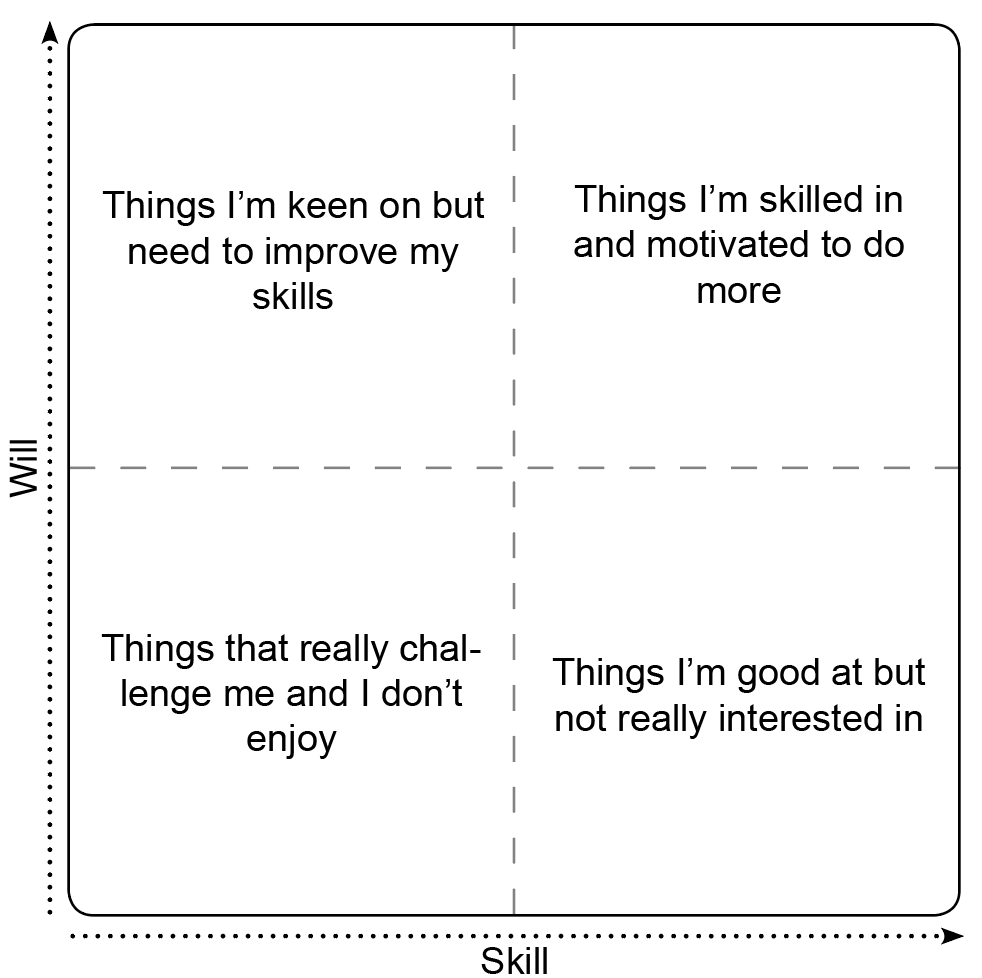
This ‘identifying the problem’ planning tool is a valid way to approach revision.
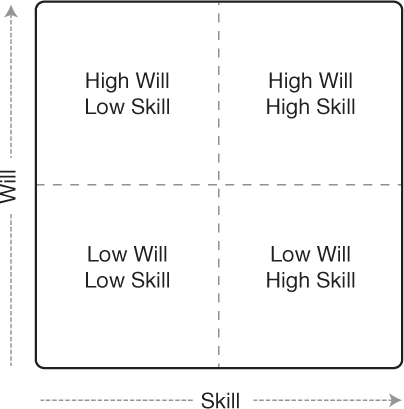
Teacher talk
- Put the topics you want in the skill:will diagram
- You will need to make two judgements about the topic
- First, how good at it are you? …your level of skill?
- Second, how keen on it are you?…your level of will?
- Is it time to tackle the low skill/low will box?
Tips for poor planners
Read, digest and convert the essence of this article into a useful wall display.
Just as we tend to recognise that skills like creativity, analysis or writing can come much easier to some than to others, ease with planning, it appears, is something that we’re either born with or we’re not. However, we can develop those skills by actively building neuro-connections in our brain through persistent practice.
Here are some key steps for using knowledge of your natural brain strength to build your planning skills.
Recognise your strengths and weaknesses… work out which aspects of planning are strengths or weaknesses.
Accept the difficulty… If we think something should be easy when it’s hard, we tend to get upset and are more likely to give up. But if we set expectations that a task will be difficult, we may still flounder, but we’re more willing to work through any issues, since we understand that challenge is part of the process.
Let go of all-or-nothing thinking… Some people think that they must follow their plans perfectly, or their efforts have been wasted. Instead, try to view learning as a process where improvement counts and every day matters. This will build your resilience because you won’t beat yourself up as much when you deviate from your plan, and in turn, you will find it easier to get back on track.
Borrow other people’s brains… If you know people who excel in planning or have good organisational skills, ask for their advice and insight. They may be able to offer solutions to problems that overwhelm you.
Keep trying… When you find yourself getting frustrated in the process of planning, have self-compassion when you make mistakes, refocus when you get distracted and adjust your plan when new issues crop up.
Understanding what’s going on in your brain as you acquire time management skills can make a dramatic difference in your ability to plan. When you convince yourself that you can change and accept that you’ll need to work harder than most, you’ll have a much higher chance of improving your planning. Adapted from Harvard Business Review.


Find out 3
Build planning by considering it in greater depth
The chart alongside offers a deeper view of how Planning may grow.
Column one deals with the growth of planning tools. Planning may simply start in our heads but we need tools to help when it gets more complex. us work Progress of planning tools runs from simple lists to spider diagrams to Post its to flow diagrams, to spreadsheets and so on. The point here is about moving from simple to complex tools.
Column two is about the student’s attitude to planning. Attitudes are central to whether we do something willingly or not. Here we capture the journey from following a given plan, to planning being a key part of how a person runs their life. It’s in the Values phase that the process of planning is beginning to make sense and shown to be worthwhile. These attitudes are tied up with how a student views themselves as a learner; whether they think they have the skills to carry through with a plan or brave enough to set challenging targets. Helping students to get good at planning is a hearts as well as a minds job.
Column three is about Self-talk, what we say to ourselves as we learn. The statements capture what someone in each phase of the grid would be thinking. We’ve shown a small flavour of self-talk thoughts that teachers can encourage students to imitate. Helping to develop such talk is a critical part of a teacher’s role.
Column four is about goal setting. It may start with simple statements about what we want something to look like. As we come to know ourselves and our intentions we become more skilled in estimating what is possible, what’s realistic within time constraints and how such a view of the end result could be measured/assessed.
Column five captures the sort of things commonly associated with a plan; the actions, the order of things, the timing, the resourcing, the contingencies. These elements of a plan grow to become more sophisticated and accurate over time.
The last column concerns the how we monitor and change our plans; how we keep an eye on a plan as it moves along. Such checking may simply be ‘have I met or will I meet that target/milestone’. i.e. is the plan going to plan? Later it’s about how plans have to be amended as circumstances change. This level of understanding and flexibility begins in the values phase and grows to become meta-evaluation; ‘is this method of planning itself effective? Do I need to tweak the process of planning?’
Take a look at the chart and see if you can plot where the majority of your students are now.
Which aspects do they find more tricky?
How has the chart helped you to understand the development of planning more fully?
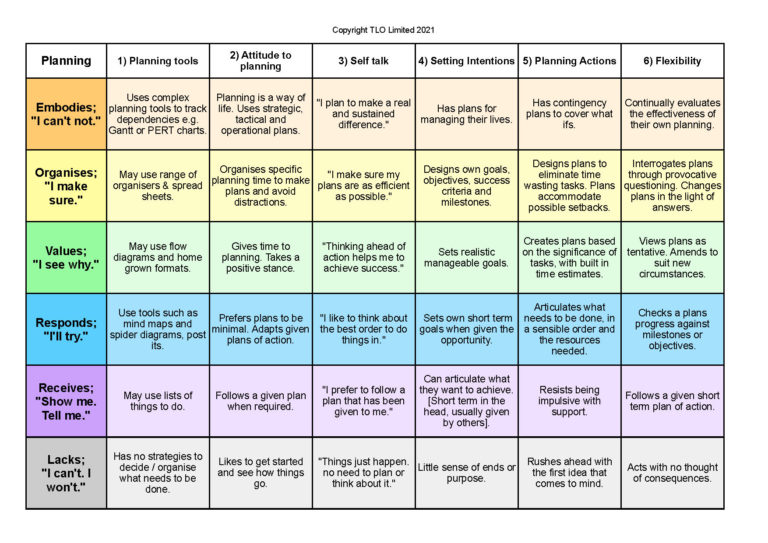
Growing planning; a trajectory of developing behaviours, skills, attitudes and self-talk
Download as a pdf
Learning together meeting (for schools that have decided that all teachers study the same unit at the same time)
Suggested meeting agenda
- Decide what you want this meeting to achieve (5 mins)
- Discuss what you have found out about students’ use of planning (15 mins)
- Re-cap and reflect on the action you have each undertaken in your classrooms (20 mins)
- Consider issues that would be beneficial if implemented across the school (10 mins)
- Review how the meeting format went (5 mins)

Learning Team Year 2 Meeting Agenda ⬇️
Item 1. Meeting Objectives. (5 mins)
Meeting objectives might include:
- discuss levels of planning displayed across the school
- share and learn from what we have each tried in our classrooms;
- feel confident about taking forward ideas from online materials into our practice;
- identify actions that would be more useful if everyone applied them in their practice;
Outcome. To have decided what the meeting should aim to achieve.

Item 2. Discussion about learning culture (15 mins)
Explore together your discoveries about your students as planners;
- what did you find out about your students as planners (Find out 1)?
- are students improving planning with age? Moving from grey to purple to blue etc?
- where did we each estimate our classroom to be in terms of its culture (Find out 2)?
- what did we each learn from Find out 2.
- which 3 are the weakest features?
- which 3 actions are our strongest?
- what surprised or baffled you?
- are there significant differences between year groups?
Outcome. A clearer understanding of students as planners and the extent to which our classroom cultures are set up to support and develop planning.
Item 3. Explore action using the initial Try outs (20 mins)
Share and discuss the action you each took in making a start on strengthening planning in classroom practice.
- Which of the suggestions did you each use?
- Any concerns about or difficulties in putting the Try outs into action.
- Which seemed the most valid or successful?
- How the Try Outs affected different age groups.
- Ways of implementing these that we can all learn from and adopt.
Outcome. A clear picture of our interest in and enthusiasm for amending classroom cultures to support learning to learn. A feel for which are proving to be most effective and why. Would any of these culture shifts call for action on current school wide policies?
Item 4. Learning from practice (10 mins)
In relation to all the shades of practice you have been trying out, sharing, mulling over and observing, think about them now in two ways;
1. personally and 2. school wide.
Which ideas/practice stand out as:
- things you want to start doing
- things you think you need to stop doing (that’s harder)
- things you want to keep doing
- things you want to do more often
- things you want to do less
Outcome.
- At this stage it’s essential to note ideas arising from this discussion using 2 pentagon diagrams;
- one for each team member personally and
- one for decisions/suggestions that are school wide.
- Ensure that your school/group wide pentagon is shared with senior leaders.
Item 5. Evaluate team session. (5 mins)
- Did we achieve our objectives?
- Are we comfortable with what we are trying to achieve so far?
- Any concerns at this point?
- Next meeting date and time.

Feedback proforma (for schools that have decided that teachers can study the units in any order)
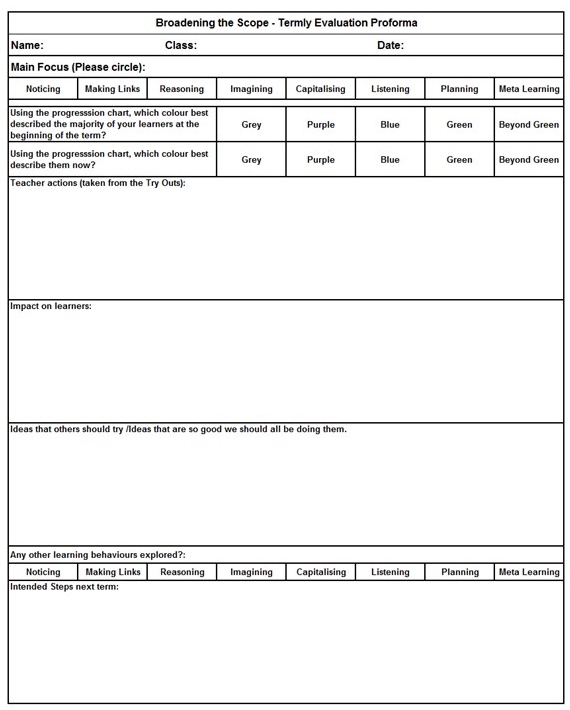
To share your experiments with others and to enable senior leaders to maintain an overview of developments, please complete this proforma termly and hand it to the Building Powerful Learners coordinator.
To give you a flavour, an example of a completed proforma is in the Noticing unit. Click below to download and print a blank version for yourself.
Download a blank proforma
Comments are closed.