

Building the habit of Reasoning.
Welcome to Building Powerful Learners Phase 2. This eight unit online programme will enable you as a teacher to expand your students’ use of learning behaviours.
The programme combines three types of action that will help you to experiment with, analyse and understand how to become more skilled in developing your students’ use of learning power.
1 Understand by using Read abouts…of which there are two types
- Essential Read …essential must read text.
- Extended Read …interesting, good to know, absorb when you can.
2 Analyse by using Find outs…tools to help you discover and analyse essential information
3 Experiment with Try outs…practical activities for you to try, check and perfect in your classroom
This unit explores the “how” of building reasoning.
- What are the key aspects of reasoning? (Essential Read about 1)
- How confident are my students now as reasoners? (Find out 1)
- How could I embed building reasoning into my teaching? (Find out 2)
- What sort of approaches may be useful in making a start on this? (Try out 1 to 5)
- Estimate my students’ development using a detailed reasoning chart (Find out 3)
Structuring and using the ideas below with your students over the next month or so will enable them to extend the range of learning behaviours that they use consciously.
Essential Read about 1
Unpacking Reasoning
A well formed Reasoning habit involves being ready, willing, and able to:
- Resist jumping to conclusions;
- Seek justifiable evidence to shape sound, well-honed arguments;
- Scrutinise your assumptions;
- Seek evidence and counter evidence, look for false steps and carefully draw conclusions;
- Remain suspicious, doubting and self-doubting in order to avoid unwarranted certainty;
- Convey your logical thinking clearly, through dialogue, symbols, analogies, prose and pictures.
So, at a less abstract level, students need to learn the inclination to resist impulsive responses; to respond logically and thoughtfully; to apply logic by explaining, justifying and, ultimately, proving what they think; to utilise a range of reasoning tools; and to develop strategies for presenting their reasoning to others persuasively. When looked at from these diverse angles growing reasoning moves well beyond encouraging a student to ‘think it through’.

Extended Read about 1. Understanding Reasoning ⬇️
The learning behaviour known as reasoning
Reasoning—the kind of logical, analytical, explicit disciplined thinking that schools often focus on. There is a lot of interest at the moment in ways of teaching thinking, and in building students’ Learning Power, such ‘Show your working’ kinds of thinking are a very important part of the good learner’s toolkit, although not the be-all and end-all of learning. In fact, research suggests that secondary schools have not been very successful at developing students’ ability to think logically in real life.
It turns out to be quite difficult to free any kind of thinking or learning skill from its ties to the particular setting and subject matter in which it was originally practised.
Nevertheless, being able to construct logical arguments or make practical use of Venn diagrams, for example, is very useful, and good learners need practice at using such tools in the context of their real-life concerns.
From Building Learning Power by Guy Claxton 2002
Re-find out 1
Focus on the reasoners in your class.
The Reasoning progression chart should give you a fairly clear view of the reasoning behaviours and how your students do, and do not, currently exhibit them.
- The majority of students may well display a similar set of positive behaviours (ie the majority may be in the purple or blue phase)
- You will also be conscious of some students who still lack positive behaviours (ie they are still firmly rooted in the grey/lacks phase of the progression chart)
- But some students will appear to have made general progress even in learning behaviours not spotlighted earlier.
The chart alongside shows how reasoning grows. Column 1 identifies the 6 phases of development, column 2 describes how the skills and behaviours may grow over time, column 3 shows the self-talk; what students may quietly say/explain to themselves at each phase of development.
A word of warning.
While you may be tempted to focus your efforts on the majority for greatest impact, you’ll need to take care not to do so at the expense of your ‘grey’ students, as these are your potential underachievers in the future.
What to look for.
In Try Outs 1 to 5, look out for teaching ideas that you think will have the greatest impact on your particular group of learners. Don’t attempt to try all of the ideas – better to do a few thoroughly than to adopt a scattergun approach.
Growing reasoning; a trajectory of developing behaviours, skills, attitudes and self-talk
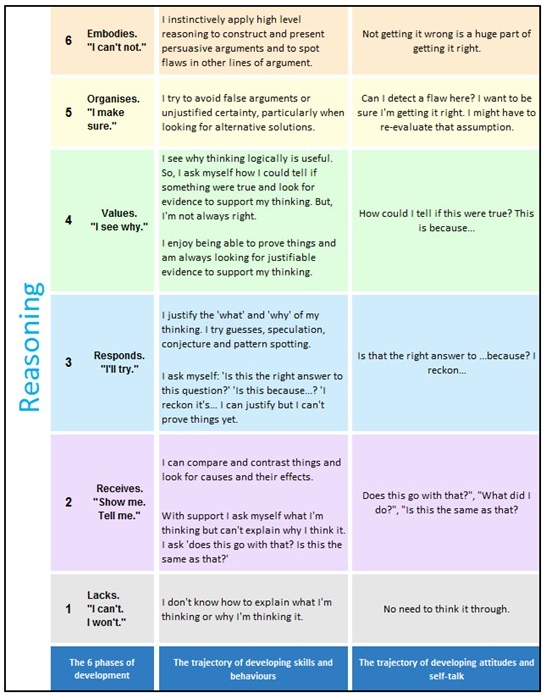
Which phase have most of your students reached now?
Download as a pdfFind out 2
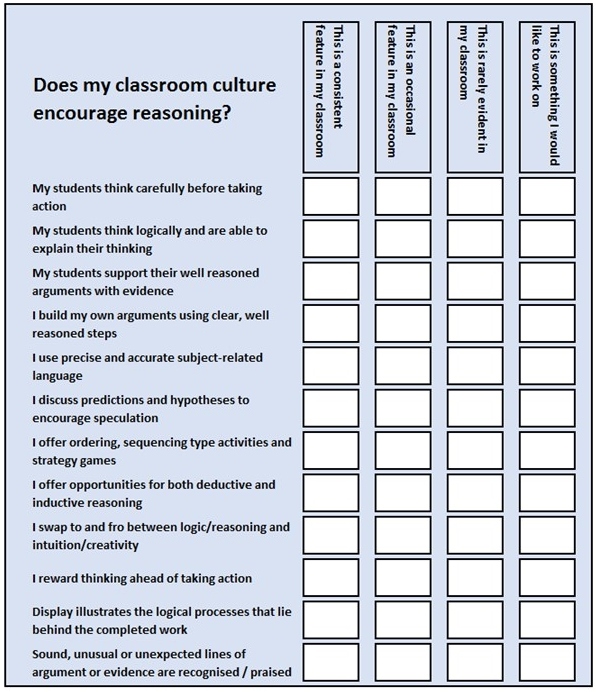
How much does my classroom culture encourage Reasoning?
Culture is the curriculum of the classroom, frequently hidden from the external observer, but always all evident to learners. It is the minute by minute, hour by hour, day by day way that learners come to understand their role as a learner. Culture is your enacted values in the classroom – what you do and what you do not do, what you say and do not say, what you believe and do not believe, what you value and do not value.
Here is a selection of features that might begin to shape the emotional climate of your classroom to encourage reasoning.
Download and print a copy.
Reflect on your current classroom culture.
It’s worth noting that the list is made up of the four action types you first met last year in the Teachers’ Palette (Unit 2);
- ways of giving students more responsibility for their learning
- the sort of language you might use to stimulate reasoning
- ideas for constructing lessons to build reasoning
- ways of celebrating reasoning
Ask yourself which of the features of the reasoning-friendly classroom are:
- already a consistent feature of your classroom?
- an occasional feature of your classroom?
- rarely evident in your classroom?
Which of these features are you interested in developing further?
At this point it might be worth having an informal chat with some of your colleagues. Is anyone already making progress with one of the features you would like to work on? Do you have any consistent features that others might learn from? Take your completed sheet to discuss at the meeting at the end of this unit.
Try out 1
A range of little culture shifts
Have a think about your current classroom culture in relation to Reasoning.
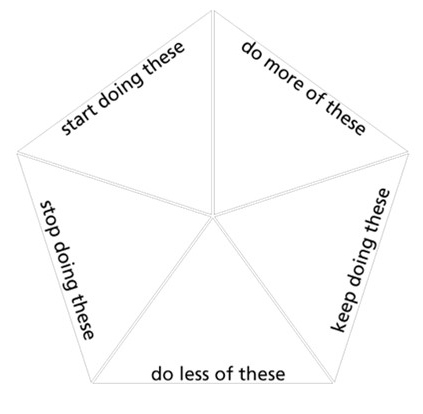
Begin with the ‘stop/avoid’ box – if any of these teaching behaviours are still in evidence in your classroom it would be worth thinking through how they can be eliminated, since failure to do so will undermine the changes you are hoping to achieve for your learners
Then cast your eye over the other 3 boxes. Which ideas appeal to you? Which do you think will have the greatest impact on your students?
Now seek out teaching ideas below in Try Outs 2/3/4/5 that you can use to move your classroom culture forward.
Try Out 2 focuses on ideas for moving responsibility for reasoning towards learners (Relating);
Try Out 3 focuses on developing a learning language for reasoning (Talking);
Try Out 4 focuses on how lessons/activities can be designed to activate and develop reasoning (Constructing);
Try Out 5 focuses on how reasoning can be recognised/ rewarded / praised / celebrated (Celebrating).
Try out 2
Extend students’ responsibilities in order to build reasoning
Sequencing
Cut up;
- a cartoon,
- series of pictures of a production process,
- a flow diagram,
- a mathematical proof,
- a story line,
- a musical score,
- a poem,
- a sequence of events, and so on.
Invite students to reassemble the pieces in what they think is a viable order and explain their reasons for this. Model and listen for the language of reasoning to strengthen the process.
[Lift the level of challenge by omitting one or two of the pieces, or by including a red herring or two, or by interleaving two sequences that need to be separated before the sequencing can be completed.]

Teacher talk
- Why do you think that?
- What comes next?
- If that has happened, what now?
- Can you explain that?
Two more ideas for extending students' responsibilities. ⬇️
Making an intelligent guess
Get in the habit of requiring students to make estimates and to predict what should happen. This is quite different from asking them to say what might or could happen – that’s closer to speculation and Imagining. Here you are asking students to use what they already know to make a prediction. Often referred to as hypothesising in Science, this is about using logic to make an intelligent ‘guess’.
Once they have made their prediction, encourage them to explain why they think that – it helps to move their thinking from describing what they think will happen to explaining why they think it will happen. It is the ‘giving reasons’ bit of Reasoning, that will in time mature into justification and proof.

Teacher talk
- What’s going to happen here?
- From what you know about this what’s the next stage?
- What makes you say that?
- Why do you think that…?
Trial and Error, or better still…
Trial and improvement
Get into the habit of inviting students to ‘have a go’ at something to see what happens. It will provide you with the opportunity to probe what students are noticing and thinking, helping them to tease out why things turned out how they did. Or you could:
- Include a trial and improvement success criterion when asking students to create a piece of work. For example: I would like to see evidence that you have tried and improved at least a couple of different attempts at xxx before settling on…

Teacher talk
- If it doesn’t work, try something else
- Have a go! See if it works
- Don’t rush at it
- Tell me about it
- Try it and see
Try out 3
Build a learning language of reasoning.
Teacher talk – as a learning coach
Here is a range of things you could say to nudge reasoning. When you use this kind of language you are talking as a learning coach, encouraging students to think for themselves.
Here are 10 ideas to ensure your students do the thinking for themselves
- What assumptions are you making? Are they sound?
- Can you think it through in clear steps from start to finish?
- How many reasons can we find for that?
- Can you spot the false step there? Is the argument water tight?
- What evidence can you find to support your case/argument? What’s the counter evidence?
- How have you reached that conclusion? What are the implications?
- Which thinking tool would help us solve this?
- Are you convinced?
- One the one hand . . . , but on the other . . .
- Why do you think that?

Two more teacher talk ideas ⬇️
Focus your reasoning talk….
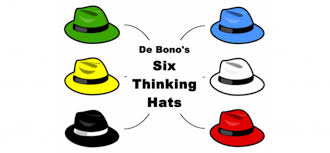
De Bono’s Six Thinking Hats
Students reflect on an issue from different perspectives in a structured and disciplined way. They wear six different coloured hats in turn, each of which indicates the sort of thinking required at the time.
- White Hat — Facts and information: What do I know…what’s happening?
- Yellow Hat — Positive judgment: What are the positive features and why?
- Black Hat — Critical judgment: What are the negative features and why?
- Green Hat — Alternatives and learning: What is possible?
- Red Hat — Feelings and emotions: How do I feel about this?
- Blue Hat — The big picture: What hat should we use now?
- Make sure that students take enough time wearing one hat before moving on to another.
The discipline which this imposes is very helpful for clarifying issues, it makes students separate out different types of reaction and thinking, and helps them to focus on one aspect of a complex problem at a time.
‘Six Hats’ in Wikipedia gives an excellent introduction to using the hats; or buy the book!
Teacher talk
- What’s happening here?
- Are there any positive things here?
- Why do you say that?
- What are the negative things about this?
- How would you criticise this?
- What are the possibilities?
- How are we feeling about this?
- Now what?
Draw out the language of reasoning through jigsaws
Sit at the jigsaw table with groups of children and work on the jigsaws together. Model your reasoning out loud to the children explaining what you did first second, third, etc. so that they begin to understand a methodical, step by step approach.
Explain why you put a piece in a certain place and why it couldn’t go elsewhere.
Develop conversations around…
- What can we see?
- Why does this fit here?
- What tells you it is right?
- Does this make sense? and so on.

Try out 4
Build reasoning into lesson design
It is through learning activities that learning behaviours get a workout. Their role is to enable your students to access and wrestle with information and ideas; to help them use and understand something; to ensure their effectiveness as a learner. The ‘right’ activity helps to make new concepts more concrete. The ‘right’ activity provides insights into new ideas and subject matter. The ‘right’ activities need to be carefully chosen and, critically, linked to the learning goal.
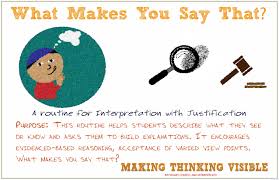
A Visible Thinking Routine
What’s happening here?
What makes you say that?
The first question in this routine is flexible: it is useful when looking at objects such as works of art or historical artefacts, but it can also be used to explore a poem, make scientific observations and hypotheses, or investigate more conceptual ideas (i.e. democracy).
The first question invites students to describe what they notice, see or know, but it is the supplementary question (What makes you say that?) that requires them to build explanations. It promotes evidence-based reasoning and when the students share their interpretations it encourages them to understand alternatives and multiple perspectives.
This is one of many visible thinking routines to be found on the visible thinking website.
Go to the Visible Thinking Websitefor more examples and information about visible thinking routines.
To download ‘What makes you say that’ from the Visible Thinking Website as a pdf:
Download as a pdf
Teacher talk
- Why is that?
- What evidence can you give to support that?
- Do you have good reasons for…?
- How do you mean?
Two more lesson design ideas ⬇️
Odd one out
Identifying similarity and difference is one of the most powerful learning skills since it requires students to notice detail, distil information, make links, and use their reasoning skills in order to spot the odd one out.
- Give students sets of words or pictures and ask them to identify the odd one out and give reasons for their choice.
- E.g. in the group Square, Circle, Triangle, Cube the cube is the odd one out because the other shapes are all two-dimensional. [Of course, circle could be the odd one out, for different reasons].
- Extend the activity by asking them to create sets with an odd one out as challenges for other students to solve.

Teacher talk
- Can you find anything that should not be here?
- How do those fit together?
- Does that make sense?
- Because???
Using QFT Question Formulation Technique in maths
This technique was unpacked in Phase 1 Questioning unit 5 where it was used to stimulate story writing. Here, it is used in maths.
[In QFT students practise question formation and additionally three fundamentally important thinking abilities: divergent thinking, convergent thinking and meta-cognition.The following is a brief summary of a case study described in;
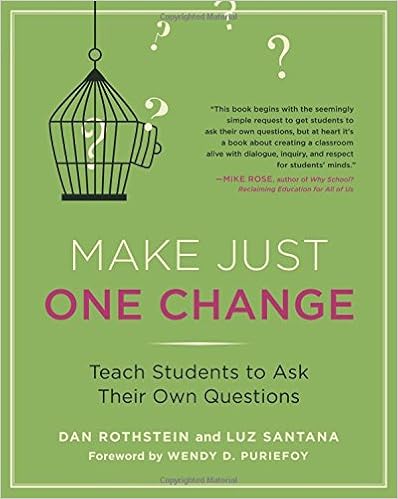
The book Make Just One Change: Teach students to ask their own questions, is a very readable comprehensive discussion and analysis of how to use the QFT.
To read more about the Question Formulation Technique:
https://www.amazon.co.uk/Make-Just-One-Change-Questions/dp/1612500994 ]
Making mathematicians
Students...had not experienced much success in maths and were conditioned to think they had to finish a problem set, give in the answers and wait to be given the next problem.
Teacher...wanted to shift them from turning in answers to turning answers into questions and begin ‘thinking like mathematicians’.
- Start with.. a problem the group could solve or at least understand the solution.
- Ask for a volunteer…to present a solution and explain why it was correct.
- Challenge them …to take the solution and generate new questions from it. The previous solution becomes the Question Focus.
- Students generate questions, chose one to work on further, present their solution and repeated the process.
- Students got used to this flow; answering a question and generating new questions, answering those, sharing their work with the whole class, and then selecting an answer as a new QFocus for generating even more questions.
- The process helped them take apart and drill down deep inside a maths problem from different perspectives.
Here’s a classical word problem they tackled after a week or so using QFocus.
The broken egg problem.
A farmer is taking her eggs to the market when her cart hits a pothole. The cart tips over and every egg is broken. For insurance purposes she needs to know how many eggs she had. Unfortunately she doesn’t know, but remembers something from various ways she tried packing the eggs. When she put the eggs in groups of two, three, four, five and six, there was always one egg left over, but when she put them in groups of seven they ended up in complete groups with no eggs left over.
What can the farmer figure out from this information about the number of eggs she had? Is there more than one answer?
- What questions are we now asking ourselves?
- How can we investigate this further?
Try out 5
Build reasoning by celebrating its use.
Self-monitoring reasoning in action.
Introducing a new learning behaviour every month or so is trickier than it seems.
- You might concentrate on it in say three or four lessons.
- You will bring it to the fore in your talk.
- But how do you get students to pick up all the aspects of the behaviour?
- How might you ensure they see its usefulness in lessons in general?
- How do you ensure they absorb the use of the behaviour into how they learn?
A learning mat
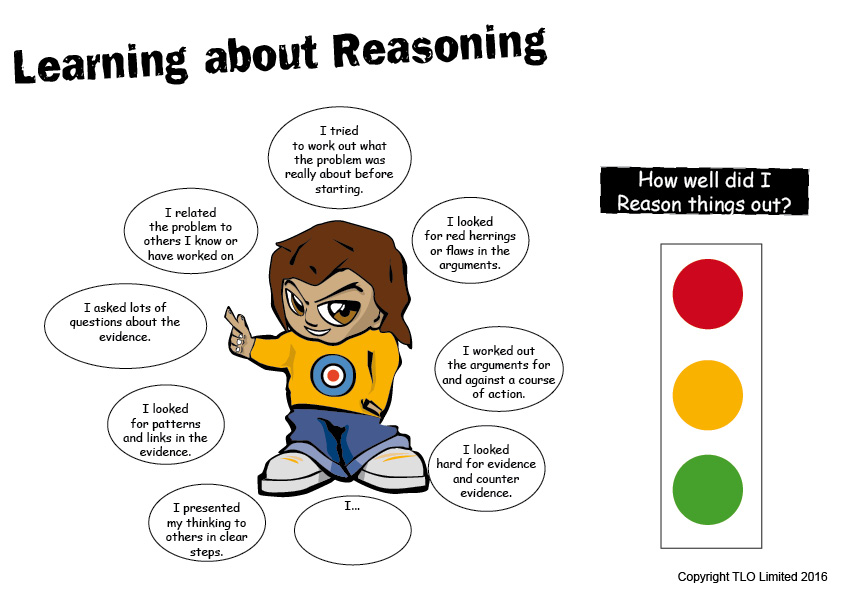
Use a learning mat for reasoning to ensure students monitor their own use of the behaviour.
Learning mats are usually A4 laminated sheets that show various aspects of a learning habit. Keep them on desks/tables or as part of a wall display.
Students refer to them during lessons, using them as prompts about the finer aspects of a learning habit that is being stretched. This tool helps students to be able to join in meta-cognitive talk.
Two more celebrating ideas ⬇️
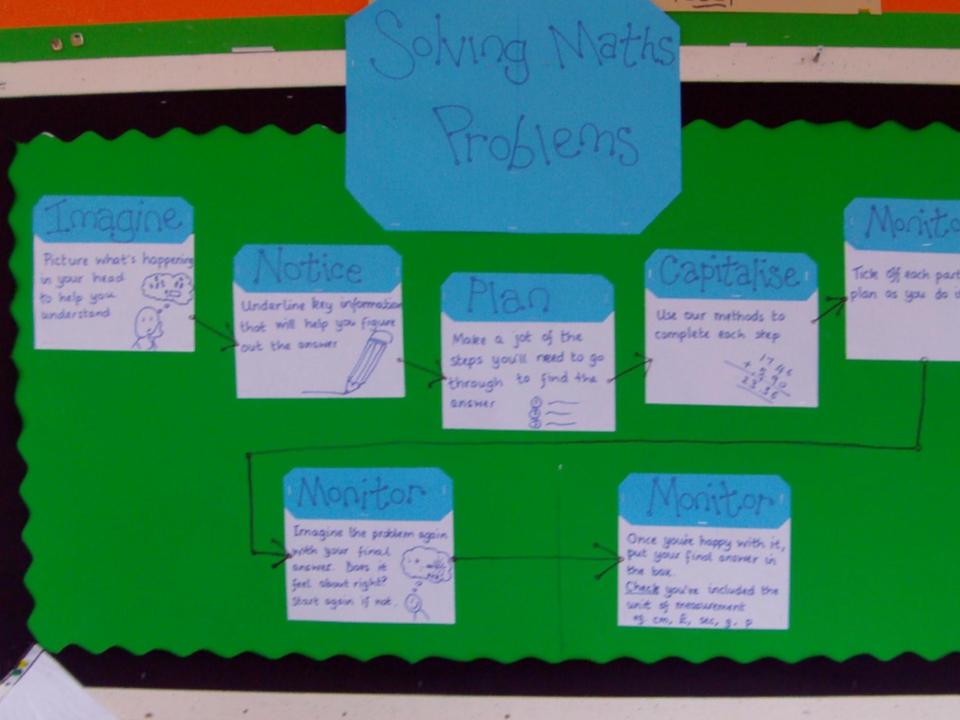
Wall display showing how learning behaviours are used to solve a Maths problem.
This wall display hails from the early days of Building Learning Power. Here the teacher has identified and labelled the learning behaviours being used at each step of solving a particular maths problem. In this case the behaviours being used are Imagining, Noticing, Planning, Capitalising and Monitoring, in addition of course to Reasoning which is an almost ever present feature of successful problem solving.
It illustrates that successful learning is rarely a case of employing one learning behaviour – rather it is bringing to bear a wide range of learning behaviours, moving seamlessly between them as necessary.
Sometimes referred to as ‘sensitivity to occasion’, it is not only important to have a wide range of learning skills, but it also equally important to understand when to exercise them.
Draw out reasoning in Strategy Games
Use games that require strategy and logical thinking. From noughts and crosses to chess, from hangman to backgammon, such games help to develop and refine reasoning skills.
Many appear in the form of maths investigations and problems: Frogs; Tower of Hanoi; Nim; Connect 4; etc.

Find out 3
Build reasoning by considering it in greater depth
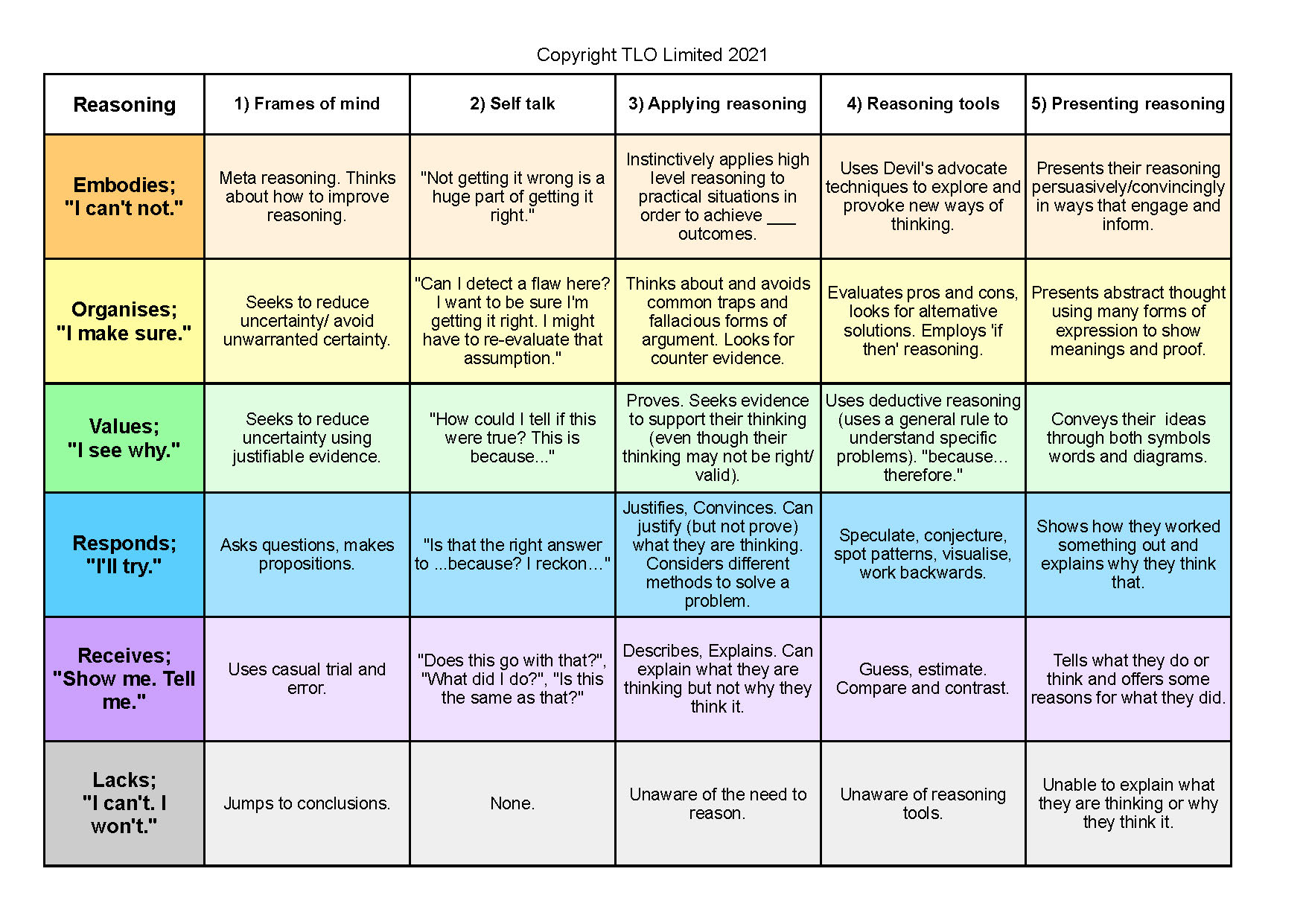
The chart alongside offers a deeper, more sophisticated view of how Reasoning may grow.
Column one deals with how students tend to think about things; their frame of mind as they build or add to/increase their reasoning skills.
Column two is about self-talk; what students may be saying to themselves in growing their self-awareness about reasoning.
Column three is about the ‘how’ of reasoning; what they actually do that shows they are applying reasoning ‘know – how’.
Column four is about the reasoning tools they actually use at each growth stage; from guessing and comparing/contrasting to employing ‘if-then reasoning and using techniques to provoke new ways of thinking.
The last column concerns how the person tends to describe or show or explain their reasoning.
Take a look at the chart and see if you can plot where the majority of your students are now.
Which aspects do they find more tricky?
How has the chart helped you to understand the development of reasoning more fully?
Growing reasoning; a trajectory of developing behaviours, skills, attitudes and self-talk
Download as a pdfLearning together meeting (for schools that have decided that all teachers study the same unit at the same time)
Suggested meeting agenda
- Decide what you want this meeting to achieve (5 mins)
- Discuss what you have found out about students use of reasoning (15 mins)
- Re-cap and reflect on the action you have each undertaken in your classrooms (20 mins)
- Consider issues that would be beneficial if implemented across the school (10 mins)
- Review how the meeting format went (5 mins)

Learning Team Year 2 Meeting Agenda ⬇️
Item 1. Meeting Objectives. (5 mins)
Meeting objectives might include:
- discuss levels of reasoning displayed across the school
- share and learn from what we have each tried in our classrooms;
- feel confident about taking forward ideas from online materials into our practice;
- identify actions that would be more useful if everyone applied them in their practice;
Outcome. To have decided what the meeting should aim to achieve.

Item 2. Discussion about learning culture (15 mins)
Explore together your discoveries about your students as reasoners;
- what did you find out about your students as reasoners (Find out 1)?
- are students improving reasoning with age? Moving from grey to purple to blue etc?
- where did we each estimate our classroom to be in terms of its culture (Find out 2)?
- what did we each learn from Find out 2.
- which 3 are the weakest features?
- which 3 actions are our strongest?
- what surprised or baffled you?
- are there significant differences between year groups?
Outcome. A clearer understanding of students as reasoners and the extent to which our classroom cultures are set up to support and develop reasoning.
Item 3. Explore action using the initial Try outs (20 mins)
Share and discuss the action you each took in making a start on strengthening reasoning in classroom practice.
- Which of the suggestions did you each use?
- Any concerns about or difficulties in putting the Try outs into action.
- Which seemed the most valid or successful?
- How the Try Outs affected different age groups.
- Ways of implementing these that we can all learn from and adopt.
Outcome. A clear picture of our interest in and enthusiasm for amending classroom cultures to support learning to learn. A feel for which are proving to be most effective and why. Would any of these culture shifts call for action on current school wide policies?
Item 4. Learning from practice (10 mins)
In relation to all the shades of practice you have been trying out, sharing, mulling over and observing, think about them now in two ways;
1. personally and 2. school wide.
Which ideas/practice stand out as:
- things you want to start doing
- things you think you need to stop doing (that’s harder)
- things you want to keep doing
- things you want to do more often
- things you want to do less
Outcome.
- At this stage it’s essential to note ideas arising from this discussion using 2 pentagon diagrams;
- one for each team member personally and
- one for decisions/suggestions that are school wide.
- Ensure that your school/group wide pentagon is shared with senior leaders.
Item 5. Evaluate team session. (5 mins)
- Did we achieve our objectives?
- Are we comfortable with what we are trying to achieve so far?
- Any concerns at this point?
- Next meeting date and time.

Feedback proforma (for schools that have decided that teachers can study the units in any order)
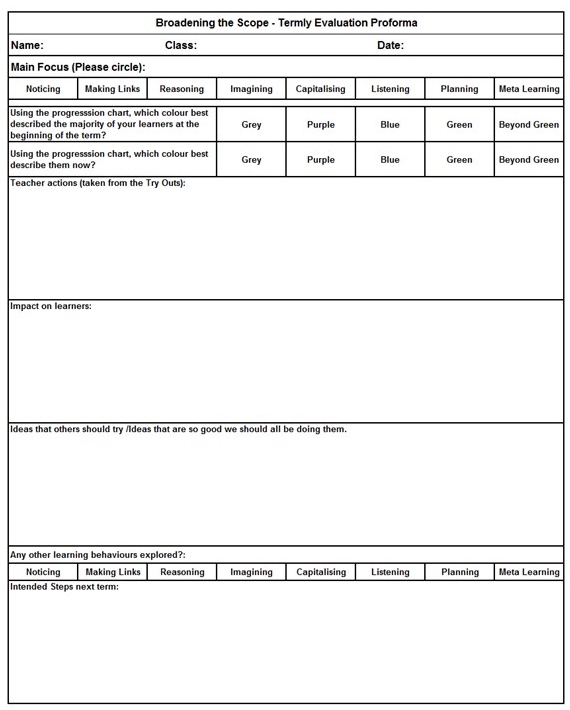
To share your experiments with others and to enable senior leaders to maintain an overview of developments, please complete this proforma termly and hand it to the Building Powerful Learners coordinator.
To give you a flavour, an example of a completed proforma is in the Noticing unit. Click below to download and print a blank version for yourself.
Download a blank proforma
Comments are closed.